-
-
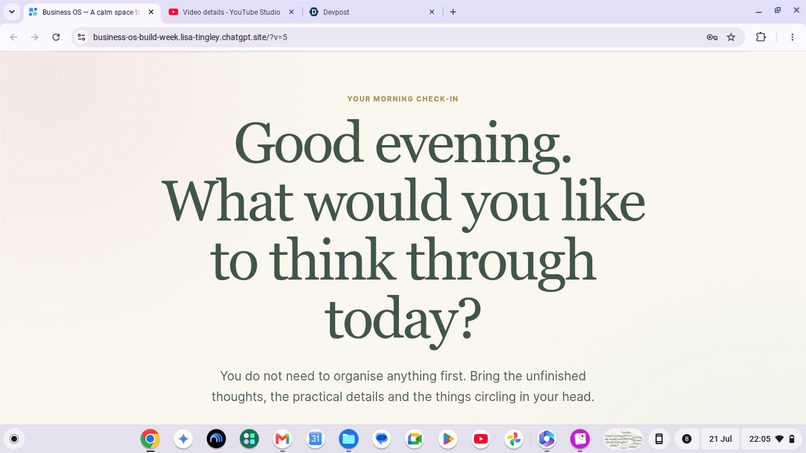
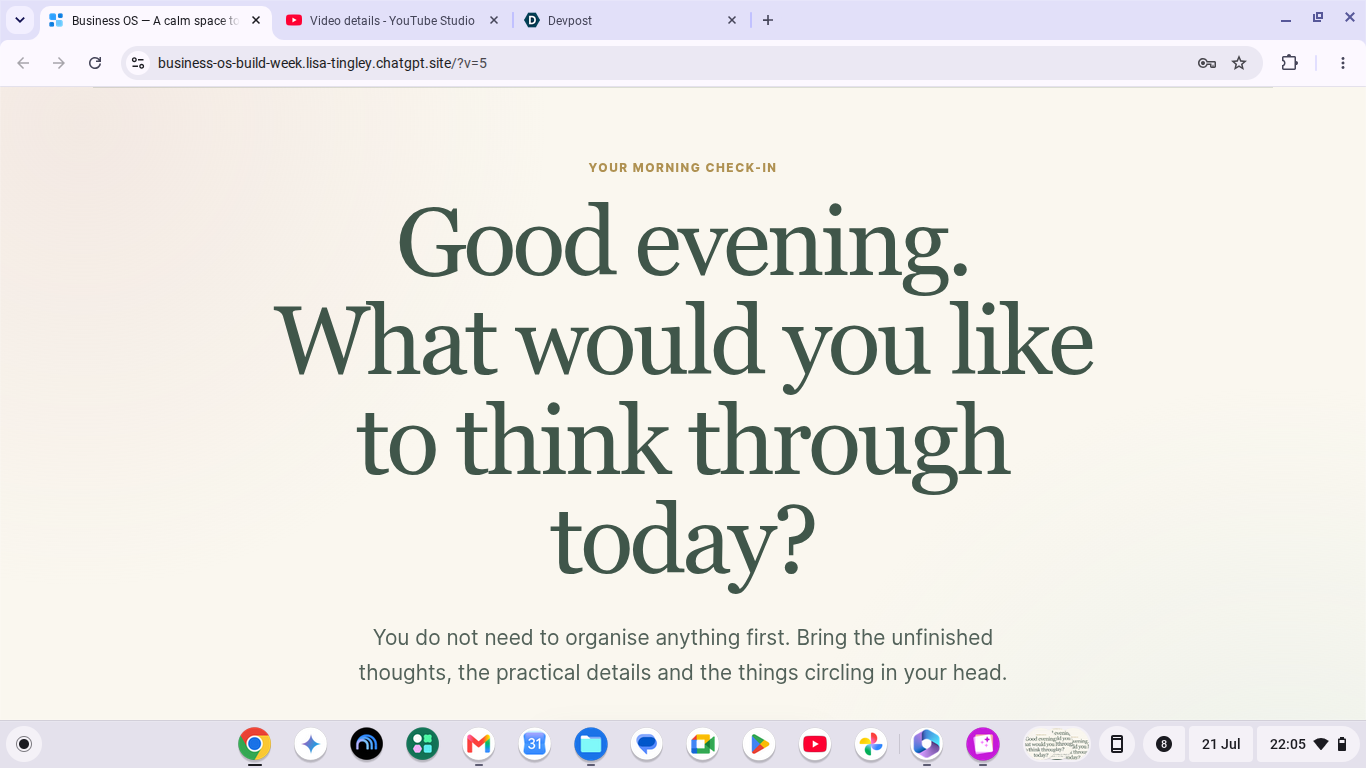
entry page
-
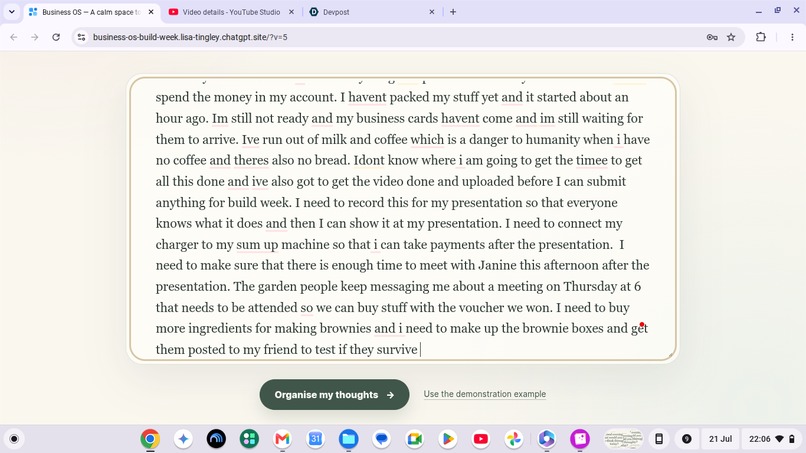
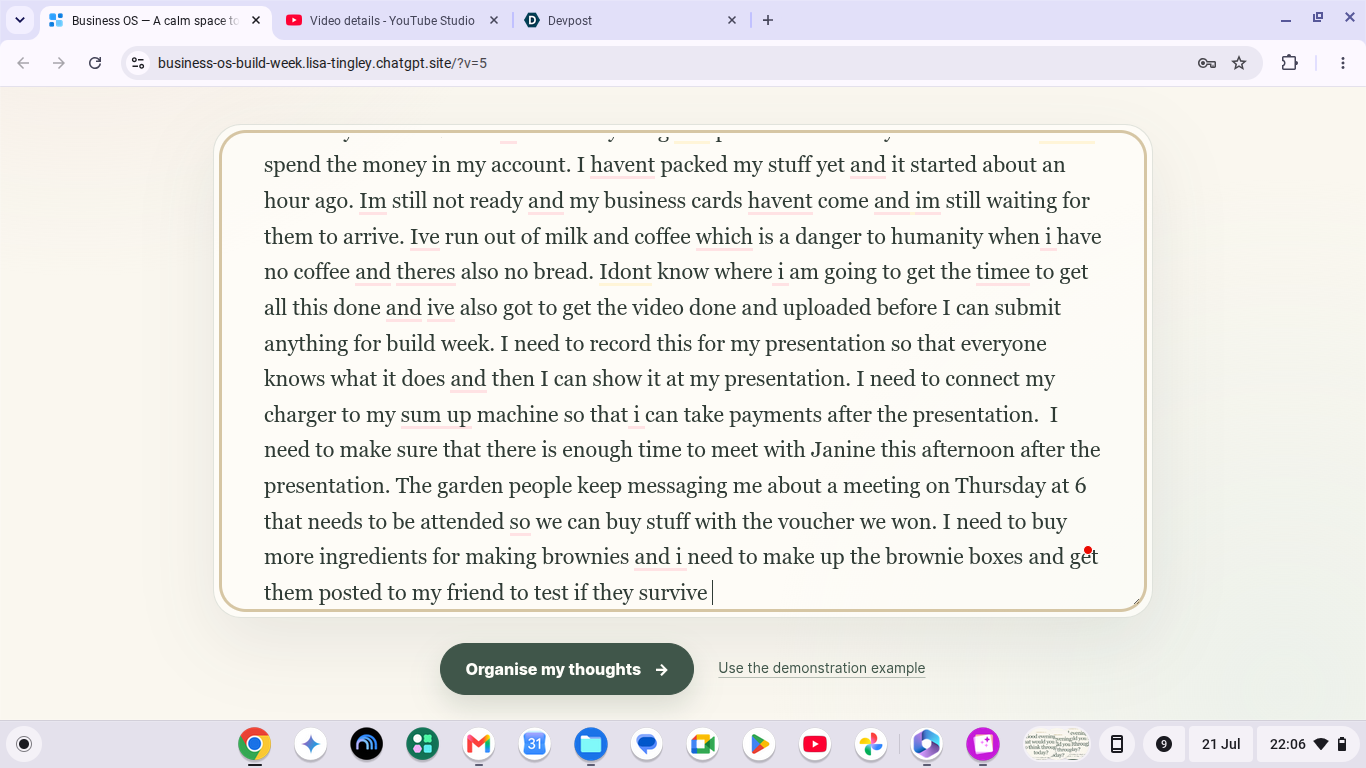
thought dump
Inspiration I was on a course with other small business owners. One of the things that I noticed was that quite a few of us had lots of ideas but had difficulty putting them into action and this led to many of us feeling overwhelmed and not really doing our best in our businesses. I decided to put an email reminder in place and then a calendar to help me organise things. I didnt want AI to take over my business or leave me out of the loop. Instead I wanted it to help me remove the friction of running a business. I wanted some business cards printed and i didnt want to become an expert in Canva or Photoshop so I asked Sol to design me some cards and get them ready for the printers. I didnt want to become a print specialist I just wanted Sol to remove the friction of getting them printed by designing them to my specifications using my branding and my colour scheme but ultimately the decision and what went on the cards came back down to me and what i wanted. I understood that at the end of the day the cards were my responsibility and a reflection of me. I wanted AI to help me in collaboration and not take over the whole process. I asked GPT to build me a daily bulletin to help me with my business and help me prioritise what i needed to do for the day to help reduce overwhelm. I designed it around a counselling model and the mantra "Keep what helps and leave what doesnt." Its just quite gentle but lets me keep my agency and choice in what I do next or if I just shut the door and go down the beach instead.
What is does. At the moment it takes my rambling brain dump, which i just free write, and then i press the button for it to organise my thoughts. It then says "this is what I hear" so that you can look through and check that it has understood things in context. No being told this is what you have to do. It then sorts what its heard into 4 sections. Todays priorities, things needing attention, upcoming commitments, possible risks using bullet points to highlight the tasks it has distilled from my rambling free writing.
At the bottom of the screen it gives you a suggested focus for the day. At this point you can ask the AI to think it through for you or you can edit things if you dont think the suggested starting point is quite right. If you ask it to give you a starting point the AI then produces a pathway for your day with what is most important all the way down in priority to can safely be ignored. It is at this stage you decide whether to accept this or to edit it if you dont feel its quite right. A pathway for the day is then produced so you can keep it open and look at it but it is not a call to action or a todo list and it was not designed to be a check list it suggests a pathway through the day with the most important actions the place you start. If you decide not to follow it, it doesnt matter it is not there to make people feel guilty, its to aid productivity so you can see what needs done and what would be a priority. The pathway at the end is just a suggested pathway not a todo list or a
How we built it I had the lived experience of a small business owner and was carrying too many thoughts and ideas by myself at any one time. I decided to define how I wanted the owner to feel before I touched the technology. I wanted them to feel calm, organised but listened to and still in control of their own lives/ business. I created a Product Vision, Cultural Framework and Behaviour Contract to guide every decision. These established important principles, including allowing the owner to write naturally without completing forms or organising their thoughts first, using gentle language, and ensuring that the AI supports rather than takes over. It was meant to collaborate with the user.
For Build Week, I deliberately reduced the idea to one clear journey: a welcome screen, an open Listening Space where the user can free write, AI-supported executive thinking, owner review, and a concise Today’s Pathway. I worked iteratively with OpenAI Codex as my technical build partner. I provided the lived experience, product direction, wording, behavioural rules and testing feedback, while Codex translated those decisions into the working React prototype and connected it to OpenAI through the Responses API. I tested the prototype using genuine, unstructured brain dumps(several times ! ) rather than carefully prepared examples. Early versions sometimes repeated or reorganised the owner’s words without adding enough value. I refined the instructions so Business OS would identify the primary objective, the task that unlocks progress, important supporting tasks and what needs to be done and what can safely wait. At this stage I had to check the wording was still being supported by the cultural framework. The result is a working web-based MVP that demonstrates one complete transformation: busy, unfinished thoughts become a calm and practical pathway—without removing the owner’s authorship.
Challenges we ran into. Without connecting it to a live AI the sections seemed to repeat themselves and it was very clunky. I didnt realise that it was not reflecting what it was actually capable of doing regarding the distilling of information and then the clean and concise pathway. So I kept trying to change the architecture and thought it was a problem but it was just because without the AI part connected it looked like it wasnt working.
It was very easy for terminology or jargon to sneak in and it suddenly felt corporate and too pushy or judgy. I wanted an invitation to a conversation not another to do list and I had to nit pick some of the words or phrases so that it sounded how I wanted. Not like every other do this or feel guilty you have failed at life approach. I wanted it to feel calm and using phrasing that made everyone feel relaxed and welcome. Trying to get the right balance of user - confirmation of what was said - AI task prioritisation - pathway without either the AI taking over and telling the user what to do or being left with a useless repetition of what the user had said. When we first started the screen said "How are you feeling?" and this gave the impression that it was a mental health service rather than a productivity product. We had to change it so that it was still welcoming and inviting a conversation but not in a counselling type manner. It is a practical business-thinking tool designed to help solo business owners manage cognitive load, identify priorities and decide what can safely wait. I refined the wording to make that distinction clearer while preserving the calm, supportive experience.
Accomplishments that we're proud of. We managed to keep to the initial cultural framework incredibly well and the finished product followed it to a tee with the colour scheme and the wording. To actually see a working basic MVP version is the biggest accomplishment and seeing my philosophy come to life in a product, that works (!!! ) and is beneficial to me in my life and is something I can use. I began Build Week without a technical background, but with a real problem, a clear vision and a strong understanding of how I wanted the owner to feel. I turned that into a working AI product that takes genuinely messy thoughts and creates calm, practical clarity through the pathway. I am truly proud of how beautiful it is. Its beauty is not merely visual, it is in the gentleness of the experience and the fact that the owner remains in control and maintains their autonomy. Seeing something that previously existed only in my imagination become tangible has been an extraordinary accomplishment. I cant believe it is now a real live product.
What we learned I learned that I do not need a technical background to create a technology product. My role was to understand the problem, define the experience, make decisions and keep testing until the product behaved as intended. I learned that I could actually have an idea and that that idea could become real. I did not need to know how to code.
I also learned the importance of reducing a large vision to one meaningful journey. This was tricky as I had so many ideas and getting down to just one path was difficult. Business OS could eventually do many things, but concentrating on the transformation from an unstructured brain dump to a calm Today’s Pathway made it possible to build a clear, working MVP. I learned that there needed to be a story arc and that finished Pathway was the closing chapter. Testing with genuine thoughts taught me that simply reorganising someone’s words is not enough. I found this frustrating and unhelpful. The AI needs to add useful thinking while preserving the owner’s voice, choices and control. Several rounds of testing and refinement were needed to achieve that balance. I learned that gentleness and beauty are not decorative extras. An overwhelmed brain does not need flashing lights and fancy jargon. The gentleness is part of how the product works. When technology feels calm, human and non-judgemental, it can help an overwhelmed owner think more clearly rather than adding another demand.
What's next for Business OS I would like to be able to connect things like calendars and gmail so that I can have reminders and this can be put in without me having to enter everything. So if I have a client meeting at 9.30 I can tell my calendar and it will automatically factor that in to the priorities / pathway as something i should be aware of. I dont want to be duplicating things or writing things in notebooks/diaries.
I would also like to attach some kind of email check service so that they could also be included if they are important according to user set criteria such as customer enquiries. Possible banking / accounting so that i can tell it how much i have spent and it can then work out a separate budget / expenses / tracker or link it to other apps that i might be using such as accounting software that can tell me that my accounts are due or that i should be aware of tax deadline, etc. But the autonomy and choice should always be left for me to decide what I want to connect or not connect. The feature I most want to build next is voice. I want to be able to empty everything in my head into a microphone, have it converted into text, and then hear a calm, reassuring voice tell me that it is going to be okay, suggest my priorities and finish with a gentle, “You’ve got this.” In my ideal world, it would have the reassuring soothing tone of Liam Neeson—although probably not actually Liam Neeson unless he volunteers.( I can hope !)
Built With
- codex
- css
- gpt5.6sol
- html
- openai
- react
- responses
- typescript
- vite


Log in or sign up for Devpost to join the conversation.