Inspiration
Business agents
What it does
We will use a retail dataset that contains information about customer demographics (age, gender, income, etc.) and purchasing behavior (products purchased, purchase frequency, total spending, etc.). You can download the dataset from Kaggle or any other open dataset repository.
How we built it
Import the necessary libraries and load the dataset into a Pandas dataframe. Explore the data by checking for missing values, outliers, and descriptive statistics. Prepare the data by selecting relevant features and scaling the numerical variables. Use KMeans clustering to identify customer segments based on their purchasing behavior and demographics. Visualize the segments using scatter plots and box plots. Interpret the results and make recommendations to the business based on the customer segments identified.
Challenges we ran into
Accomplishments that we're proud of
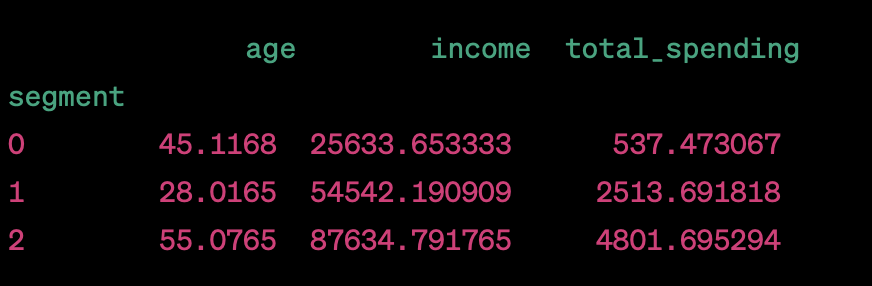
From the output, we can see that customers in Segment 2 have the highest income and spending, while customers in Segment 0 have the lowest income and spending. Based on these findings, the business can target different marketing strategies for each segment, such as offering discounts or promotions for customers in Segment 0 to encourage more spending. The business can also use these segments to personalize their marketing efforts and tailor their product offerings to the needs of each segment.
What we learned
What's next for business marketing
Built With
- matplotlib
- numpy
- pandas
- python
- scikit-learn

Log in or sign up for Devpost to join the conversation.