-
-
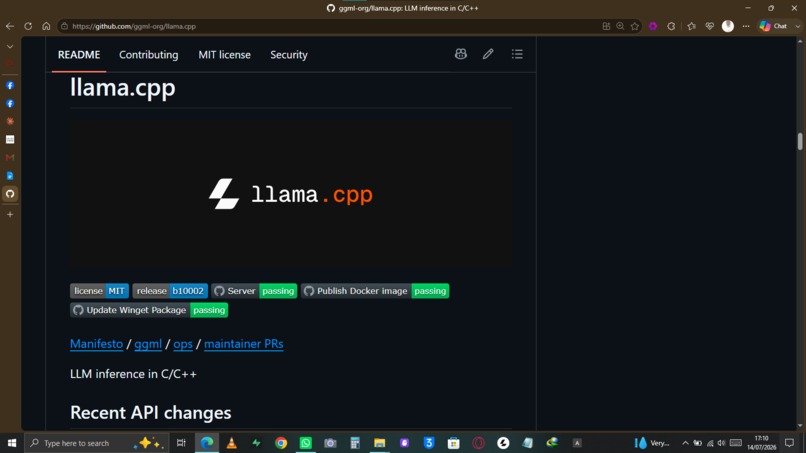
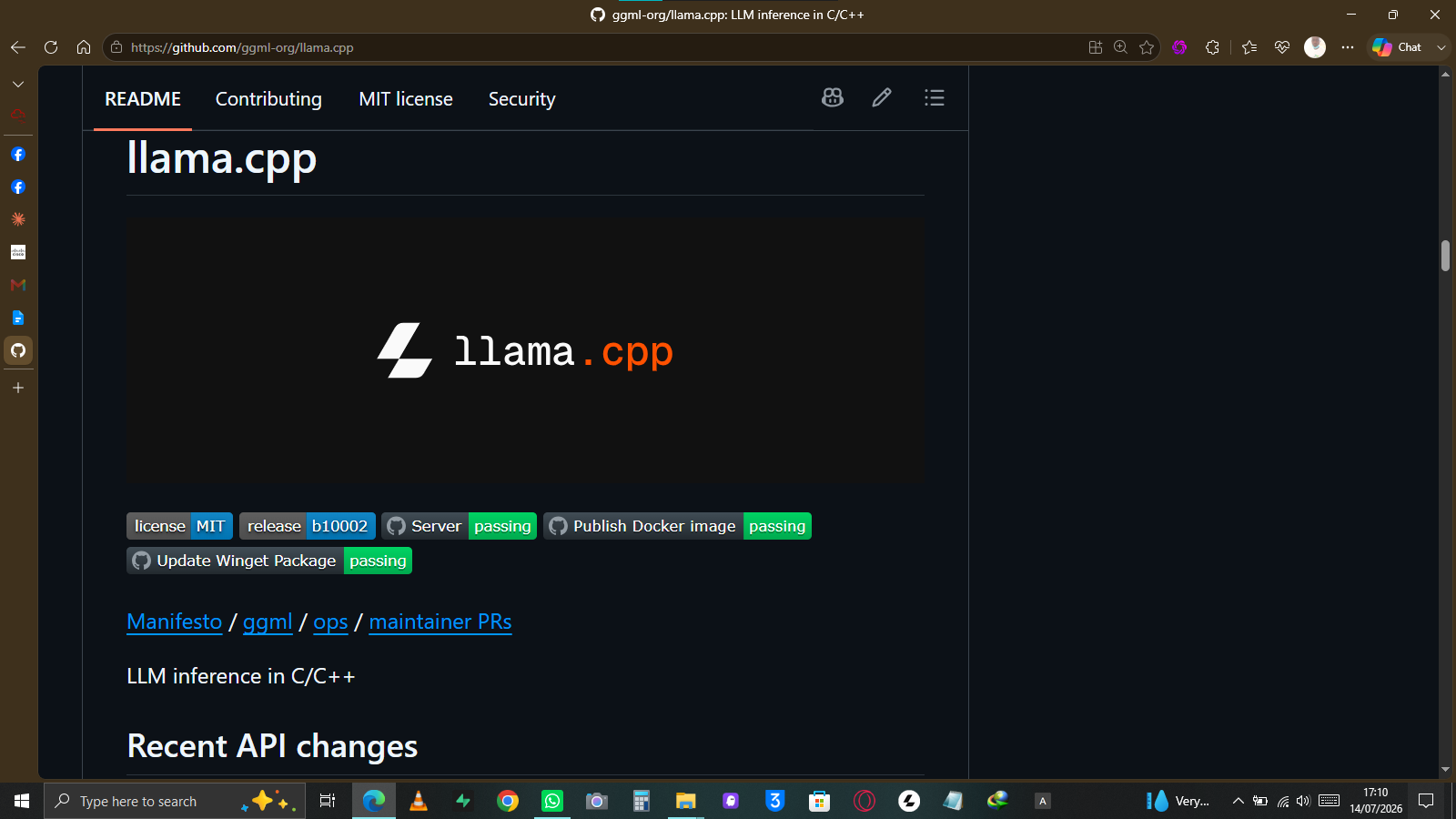
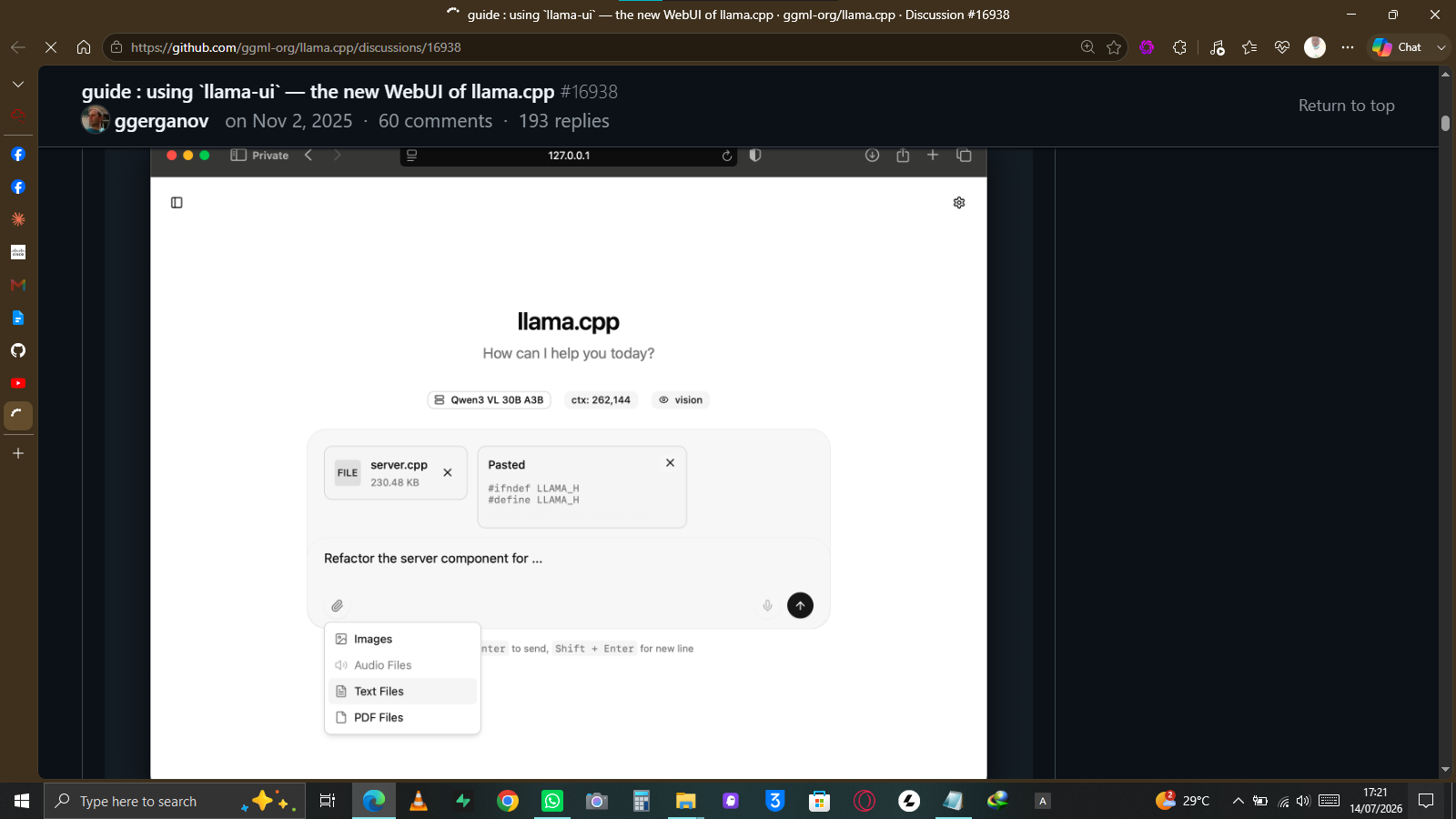
1. the github interface of llama.cpp, it works in lots of tech resources like webUI, CLI etc. https://github.com/ggml-org/llama.cpp
-
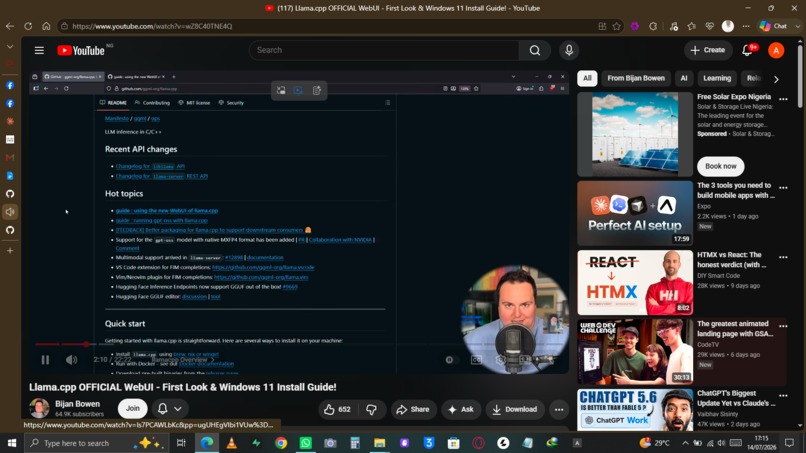
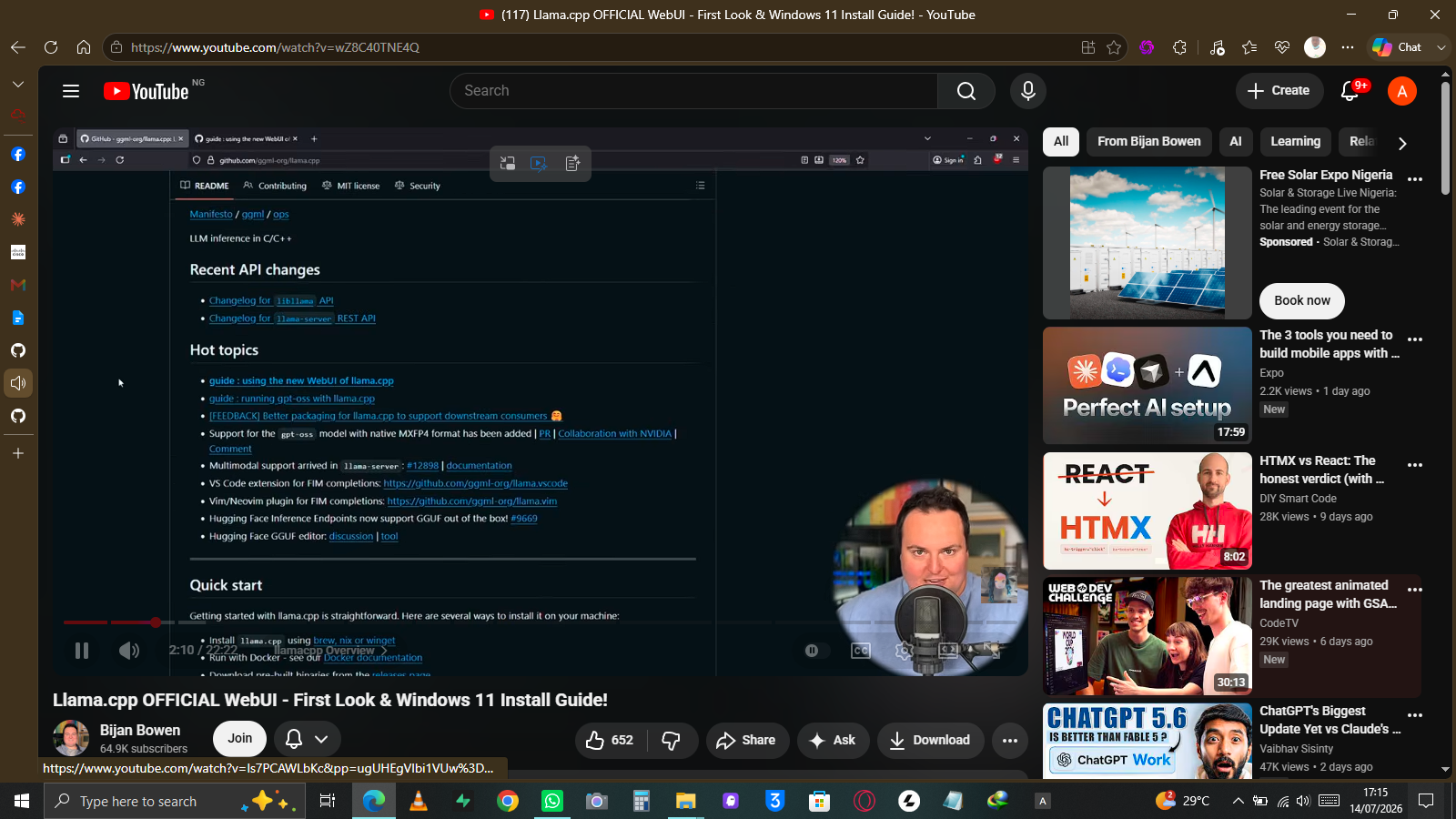
2. How to install llama.cpp WebUI and which one to select to your specified PC requirements - https://www.youtube.com/watch?v=wZ8C40TNE4Q
-
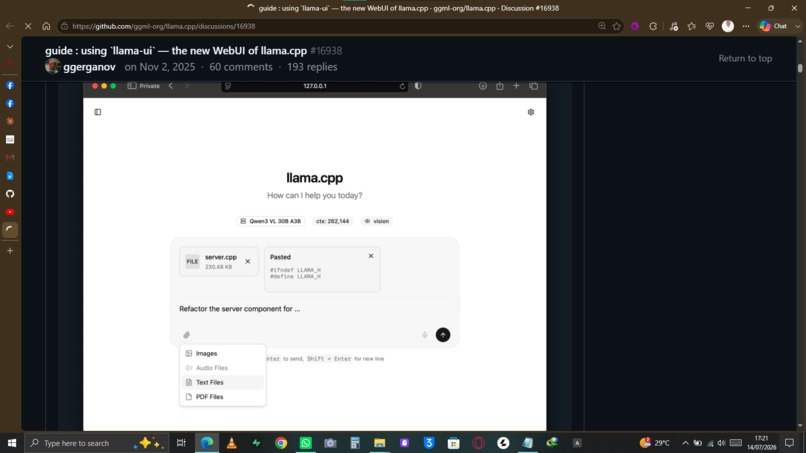
3. Download the WebUI version of llama.cpp (current working URL on 14th July 2026 - https://github.com/ggml-org/llama.cpp/releases(versions)
-
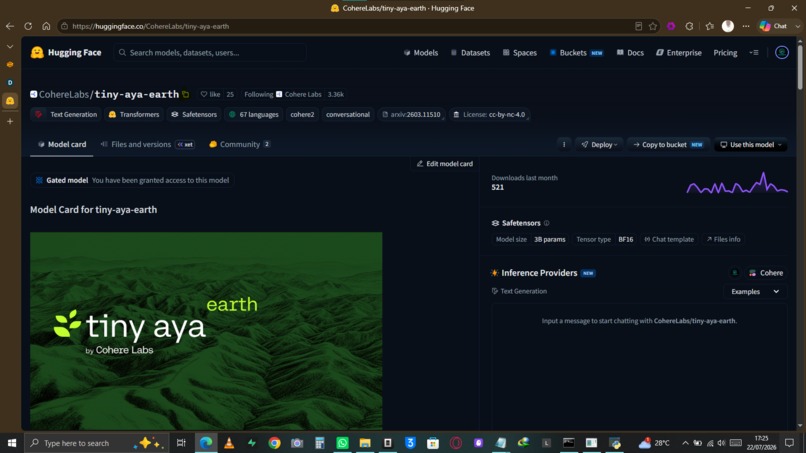
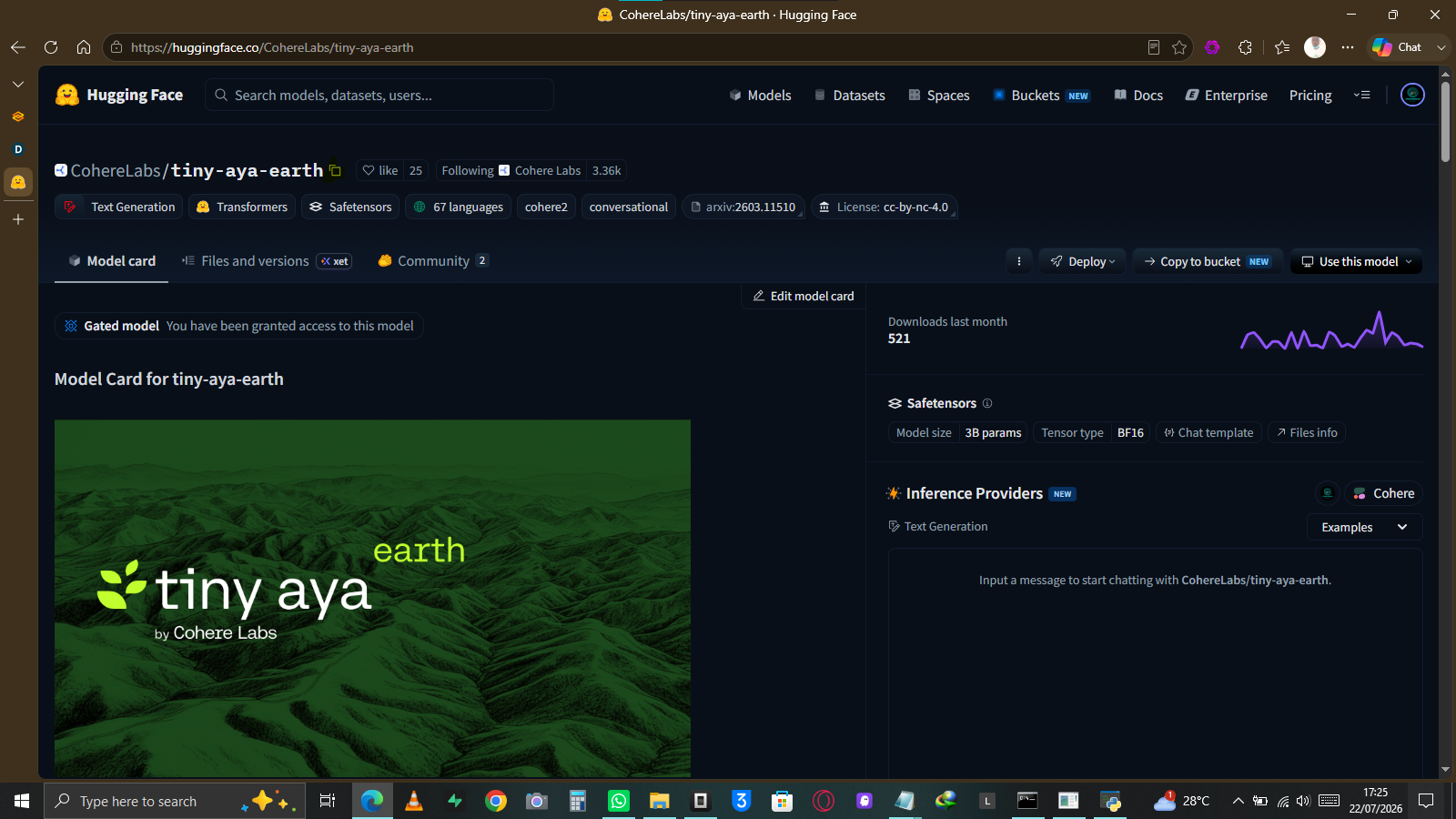
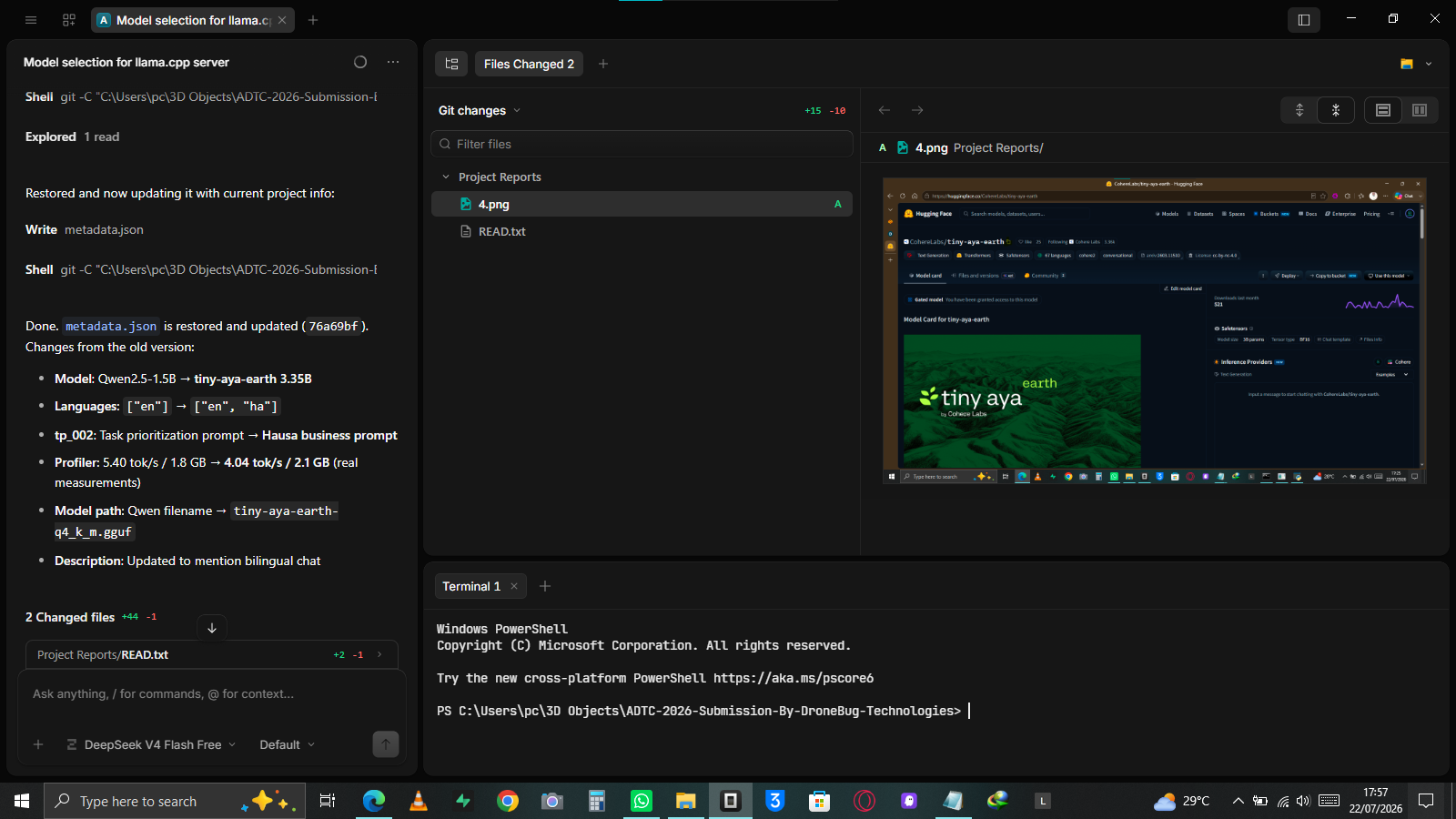
4. Download model as specified from tutorial via huggingface on .cmd terminal https://huggingface.co/CohereLabs/tiny-aya-earth
-
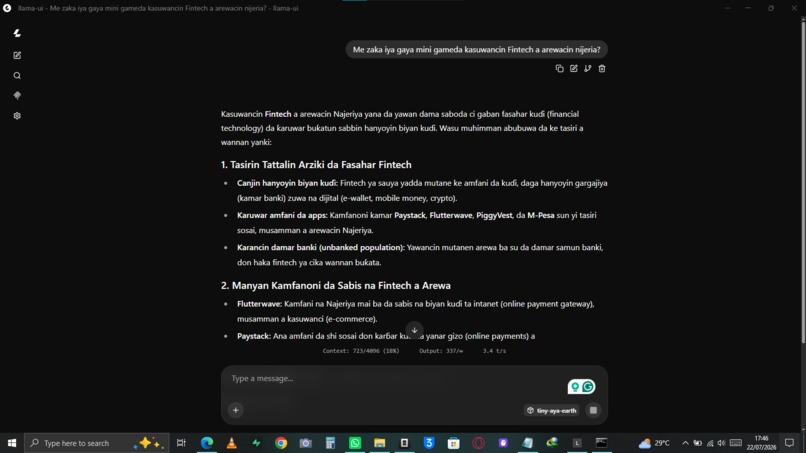
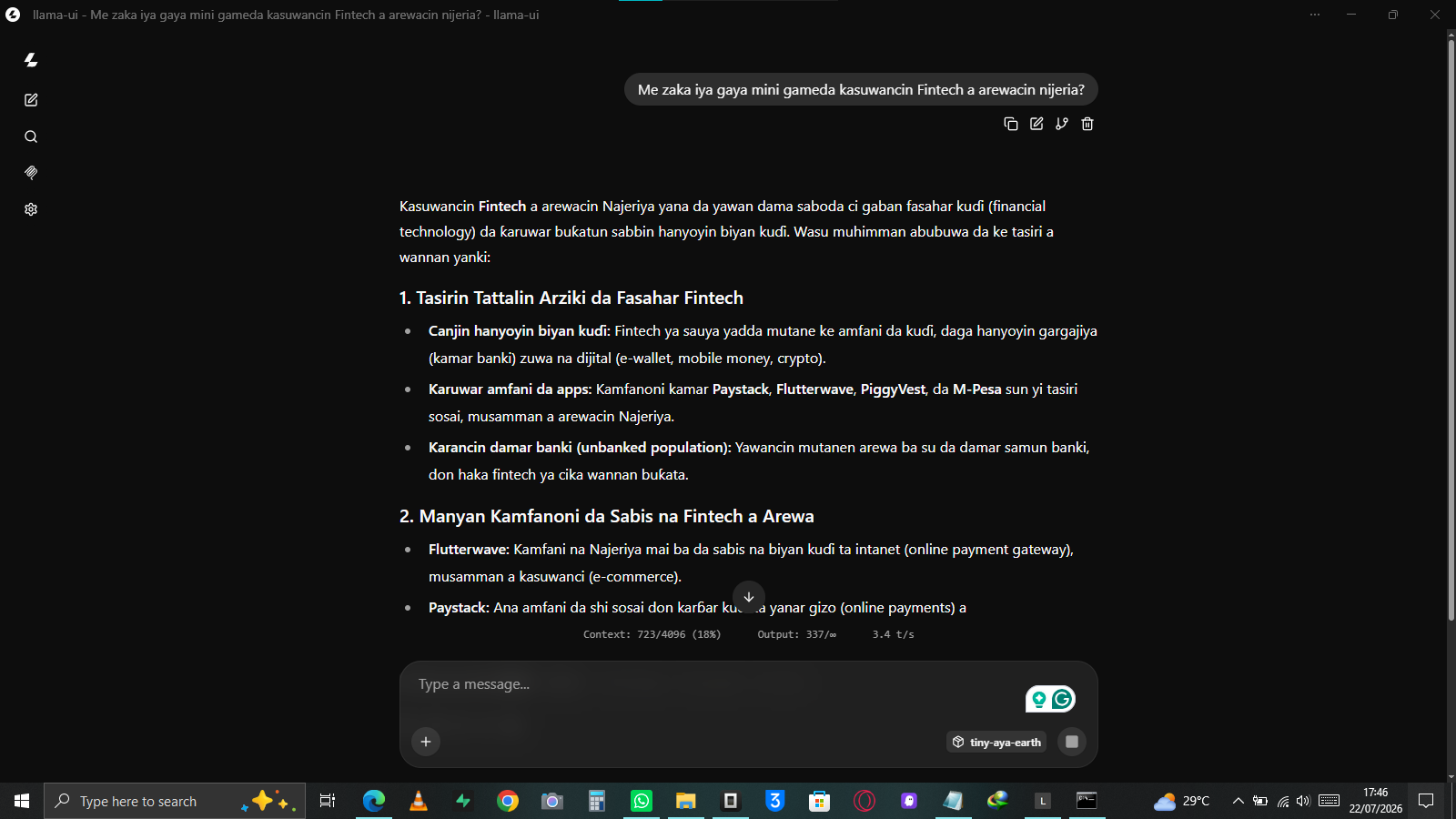
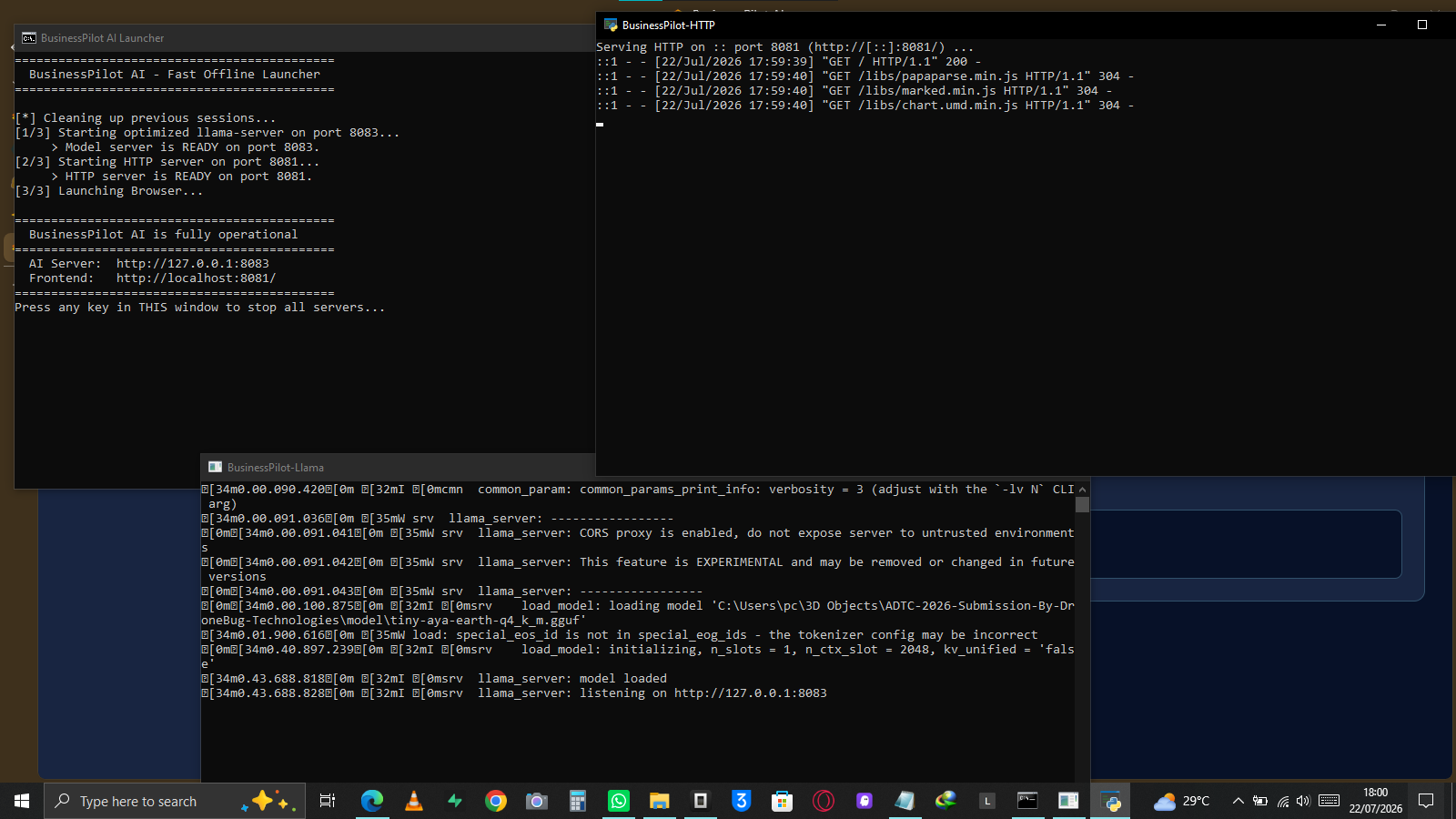
5. Test the model on llama.cpp WEB UI interface first to ascertain its actual capabilities. On: 127.0.0.1:8083
-
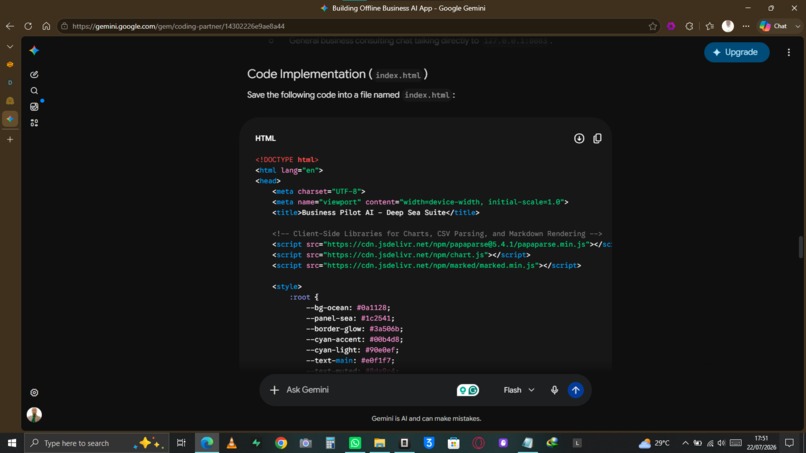
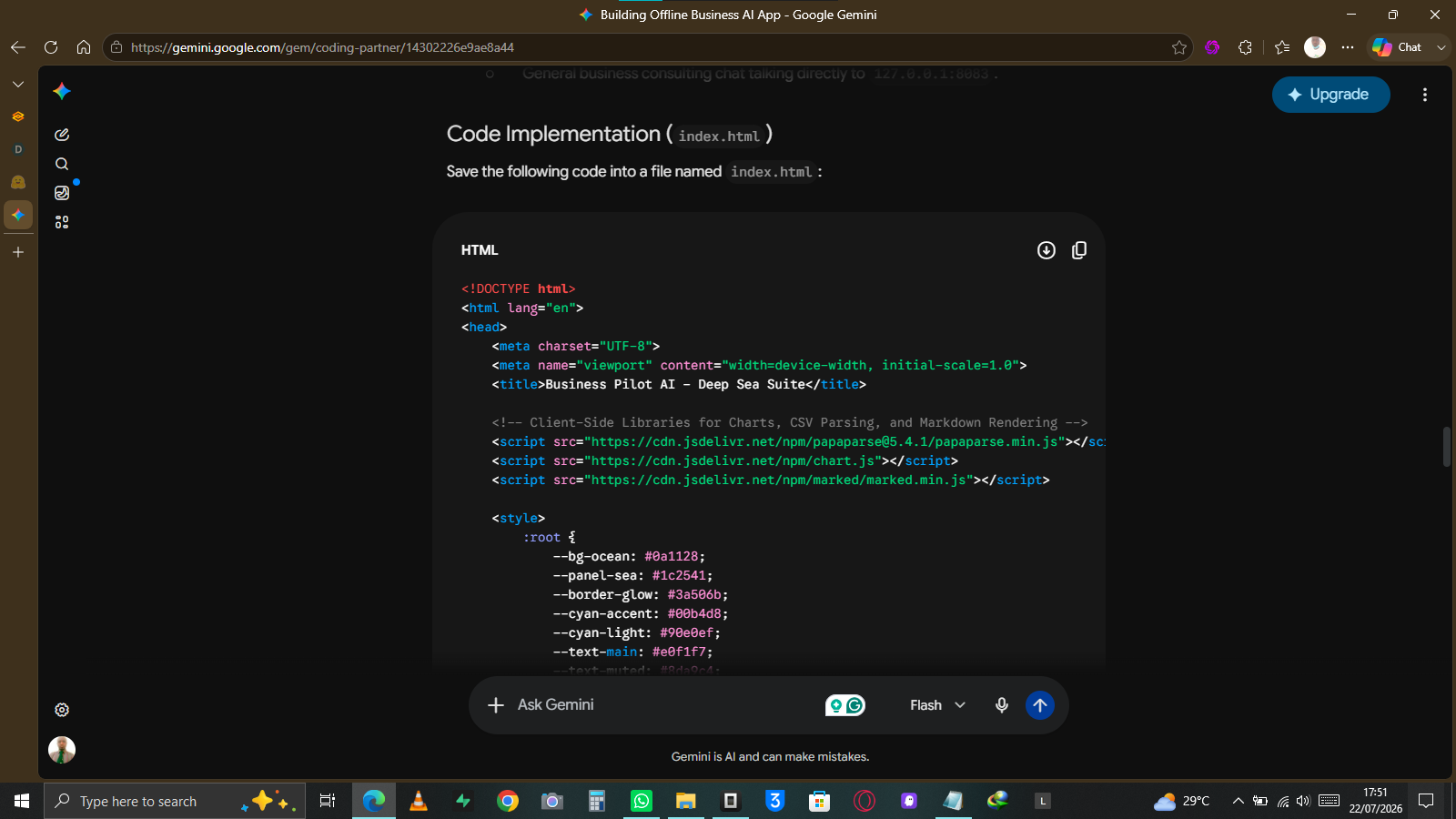
6. Made a simple RAM saving plan with AI to build single HTML file that runs llama.cpp+model with API, CPU-friendly though.
-
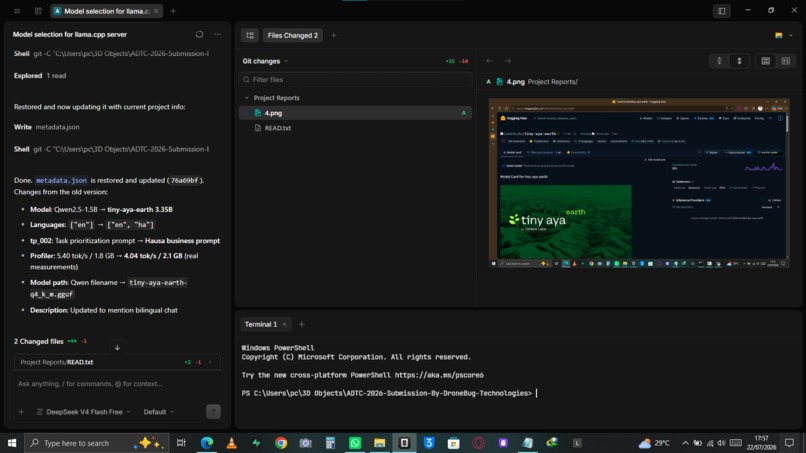
7. For Building process, OpenCode was leveraged; a Cursor-Like Agentic AI powered code generator which builds a production-ready project.
-
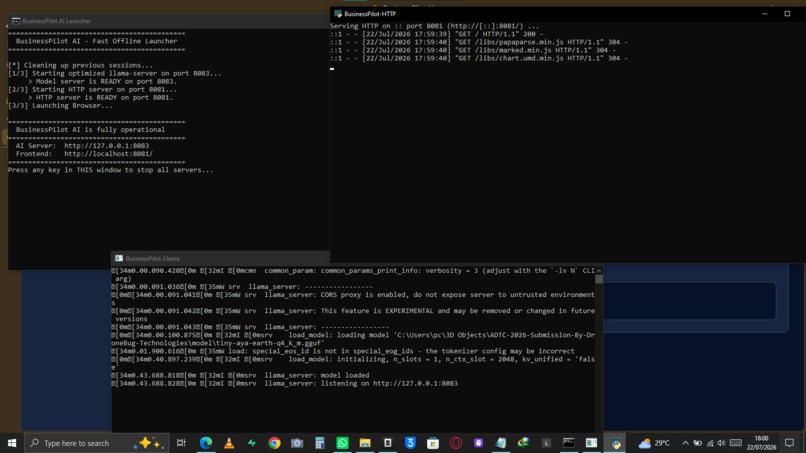
8. Application build-test-iterations. Business Pilot AI.
-
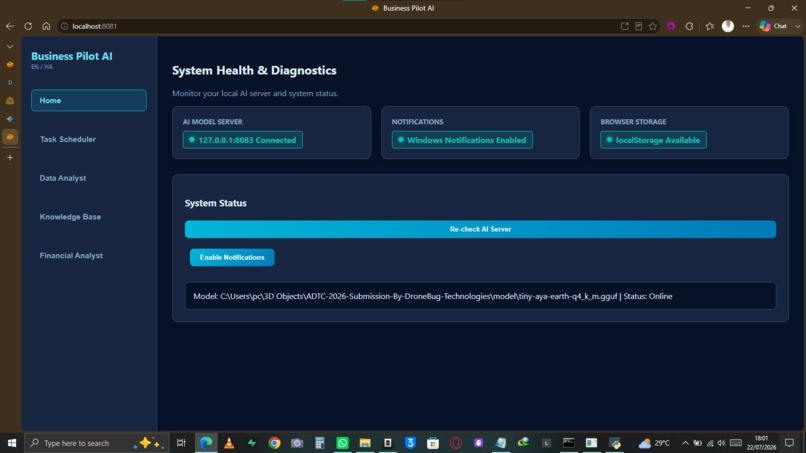
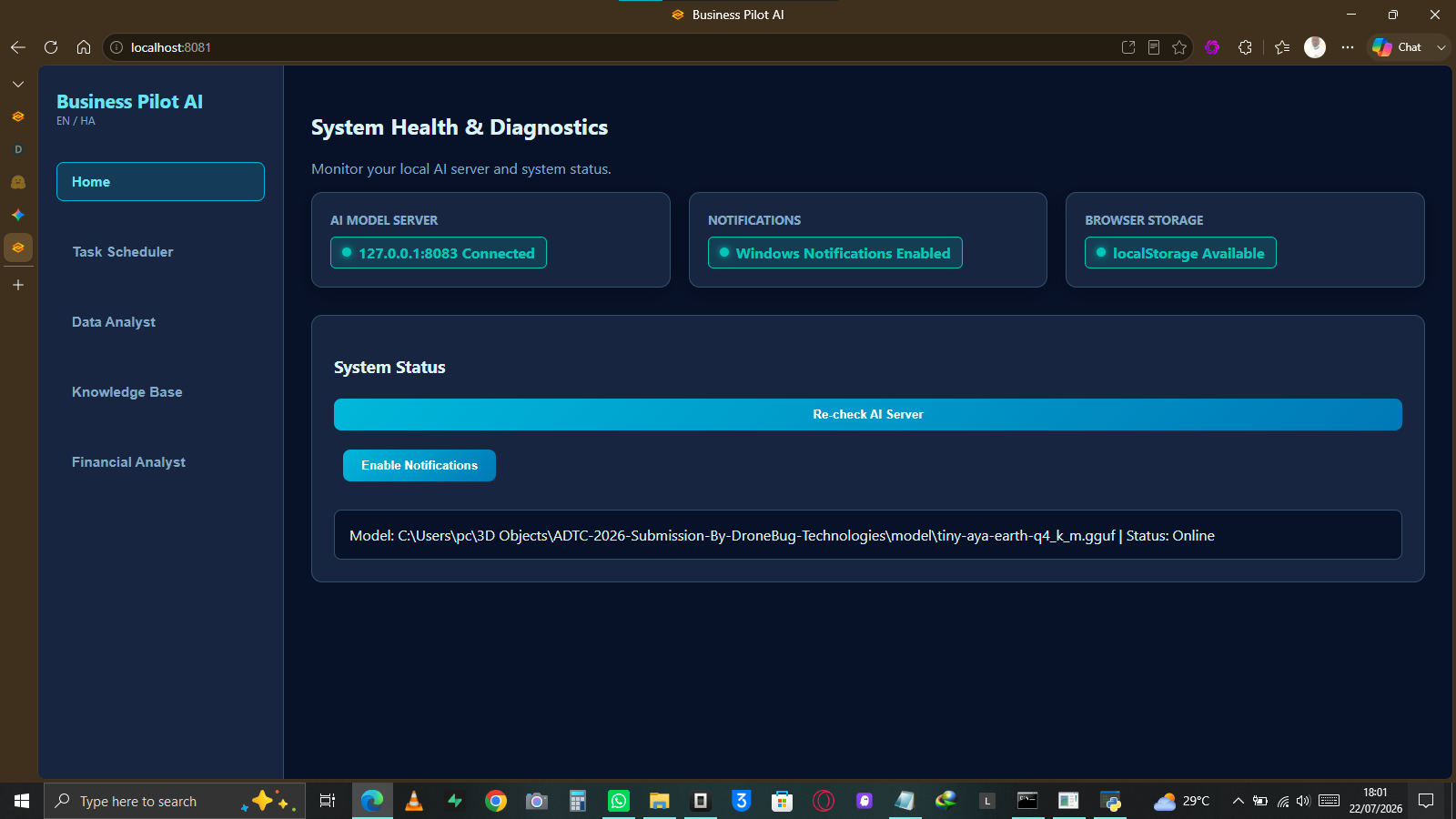
9. Home: UI Ensures everything works optimally.
-
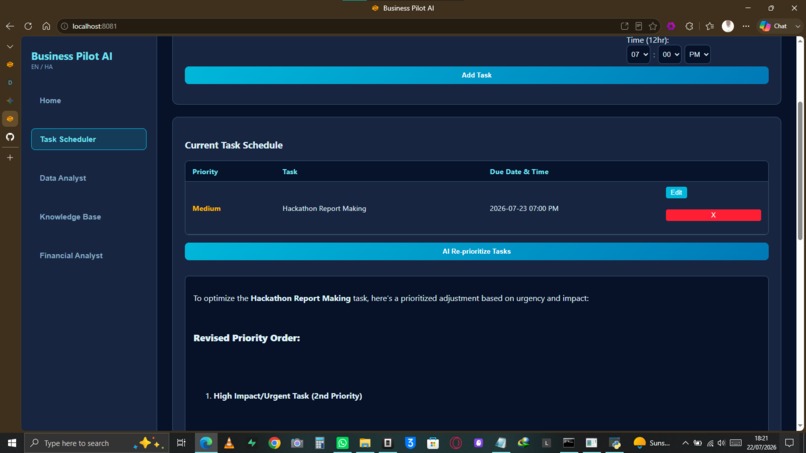
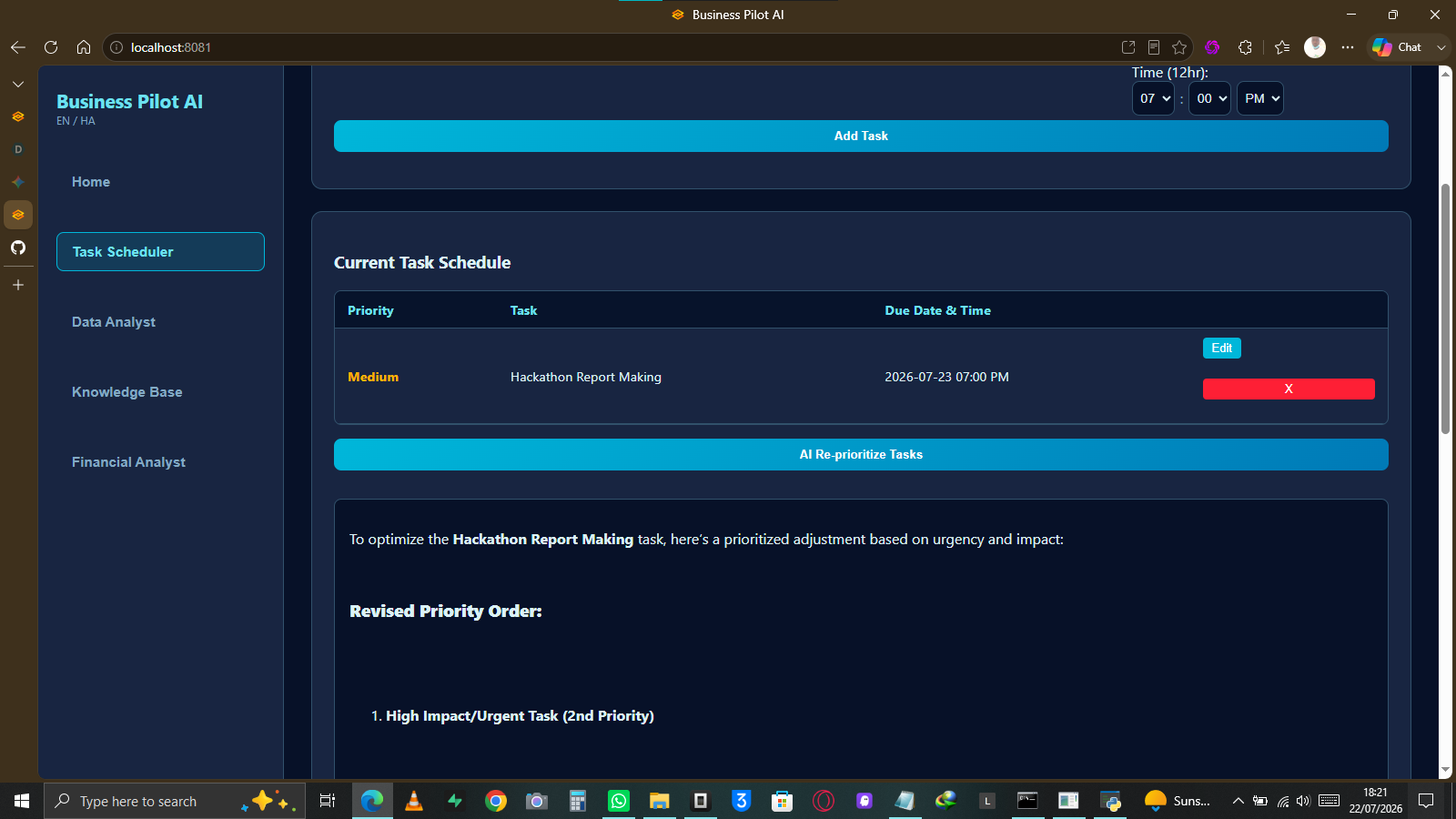
10. Smart task scheduler UI allows user to create task like meeting etc and uses AI to suggest prioritization.
-
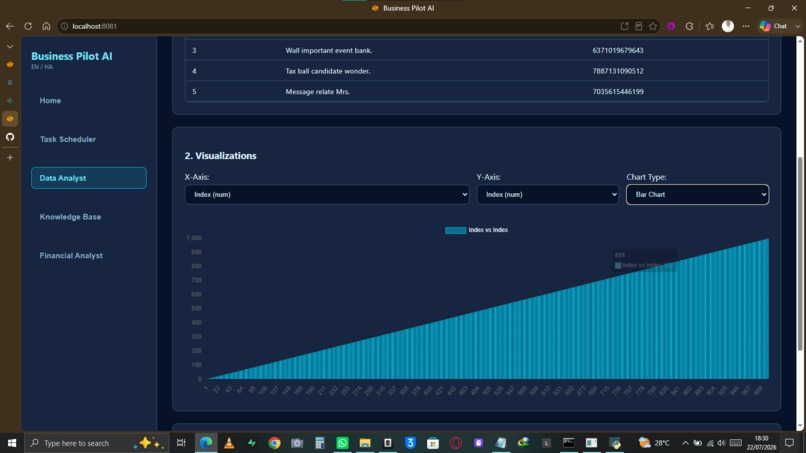
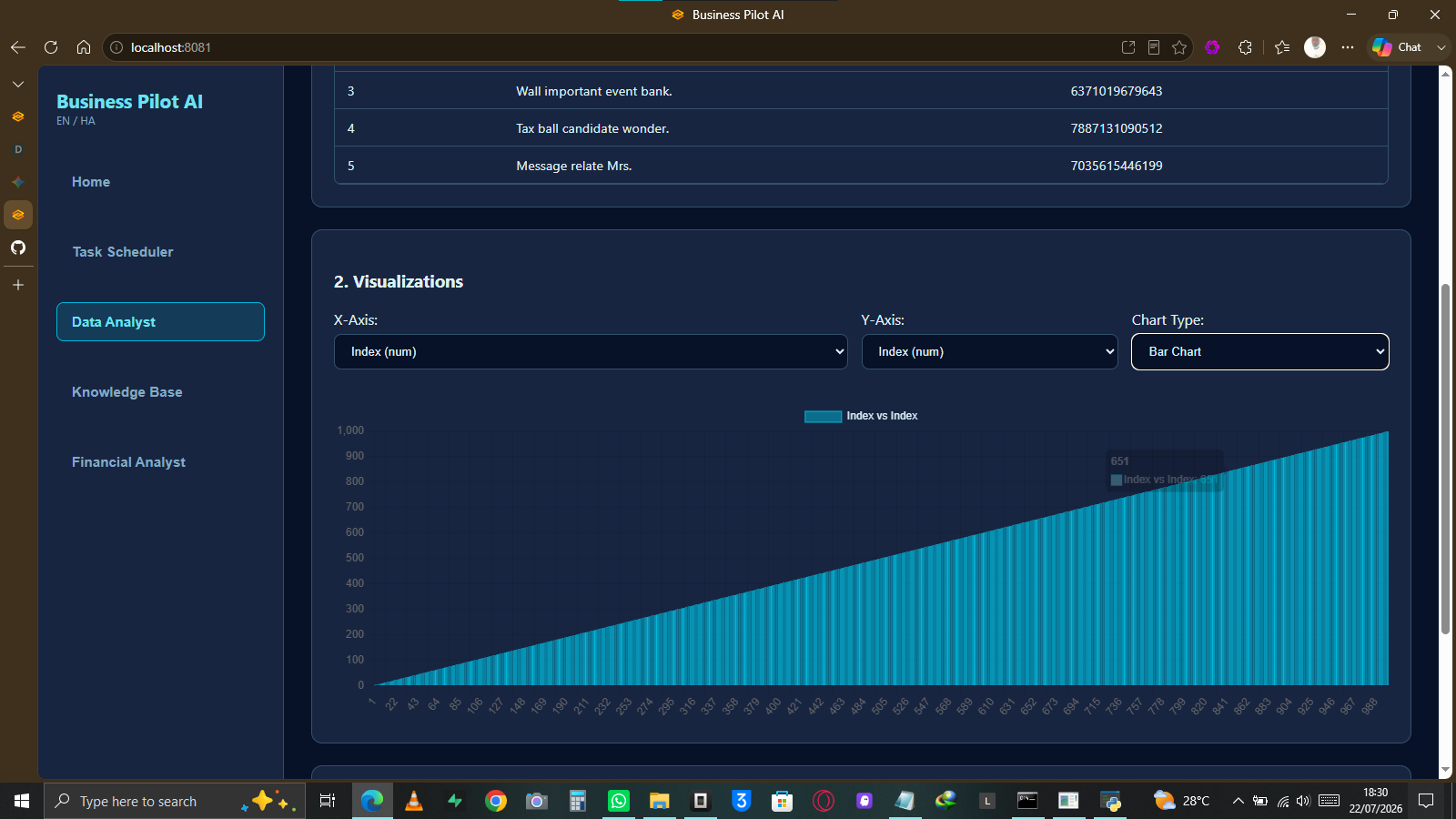
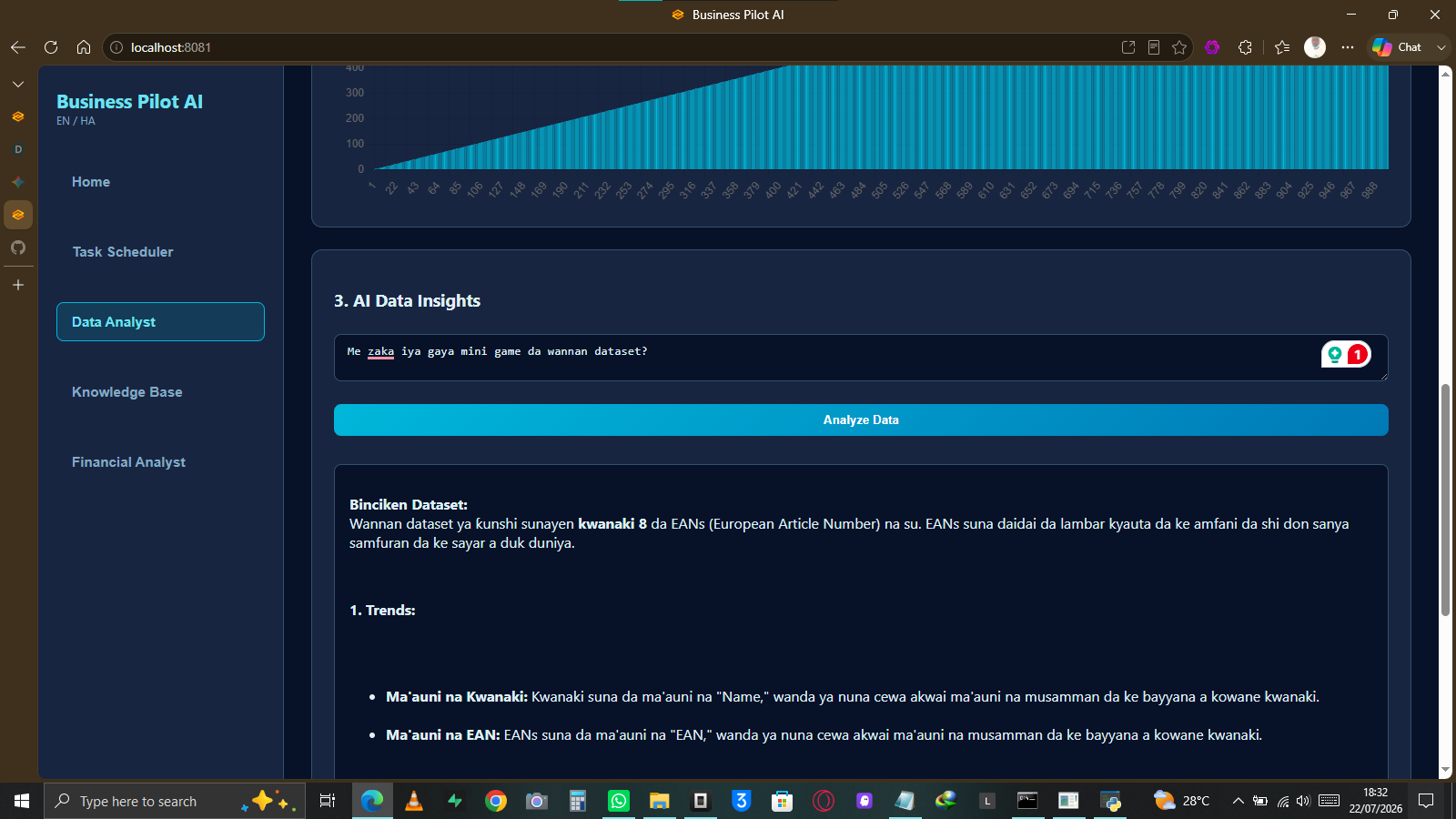
11. 1 Data Analyst: Import and Preview .csv file, plot graphs like bar charts, line graphs, pie chart, scatter graph. I
-
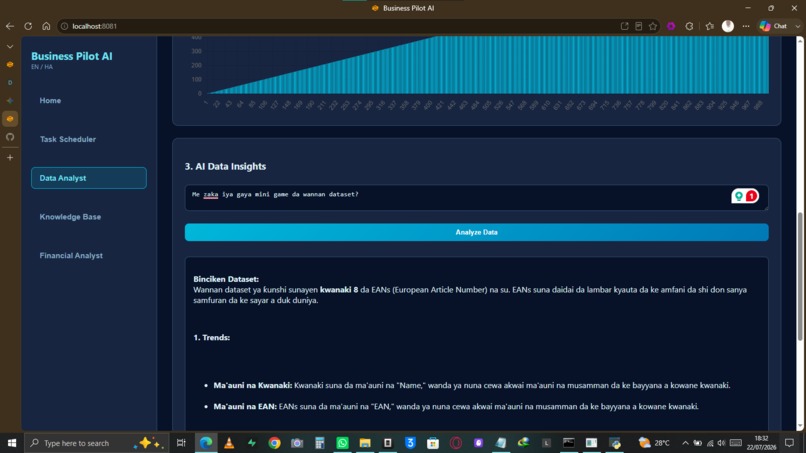
11.2. It also uses AI for instant insight in English or Hausa language.
-
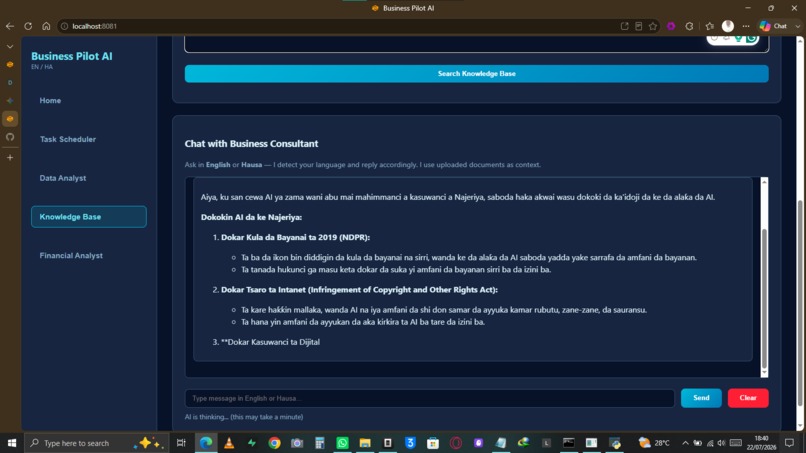
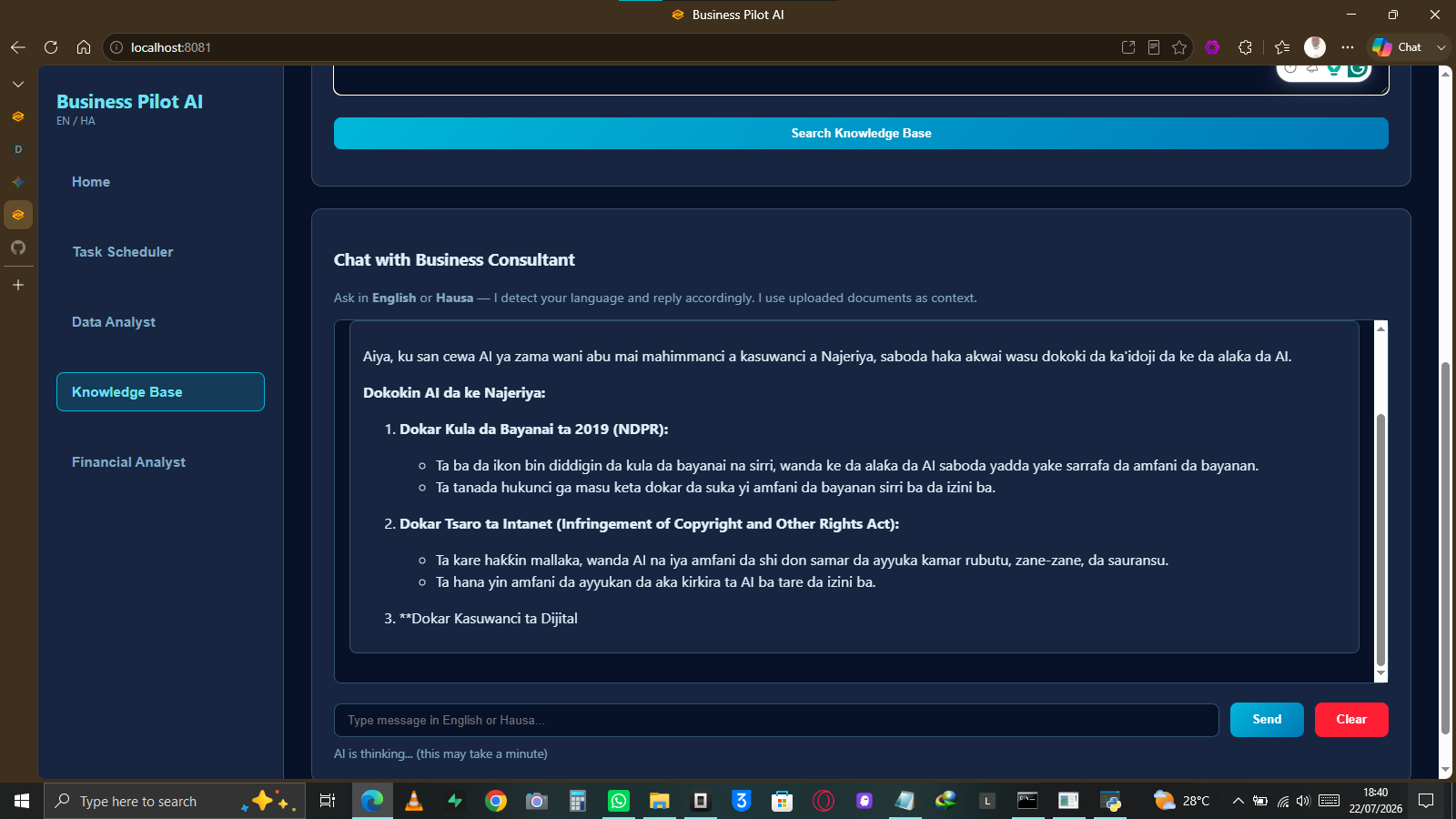
12. Knowledge Base UI: Business consultancy and general knowledge base AI that can read text and assist in English or Hausa.
-
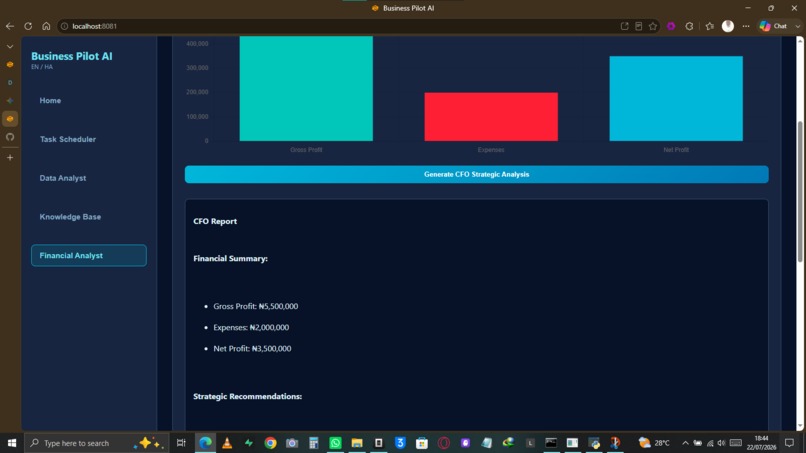
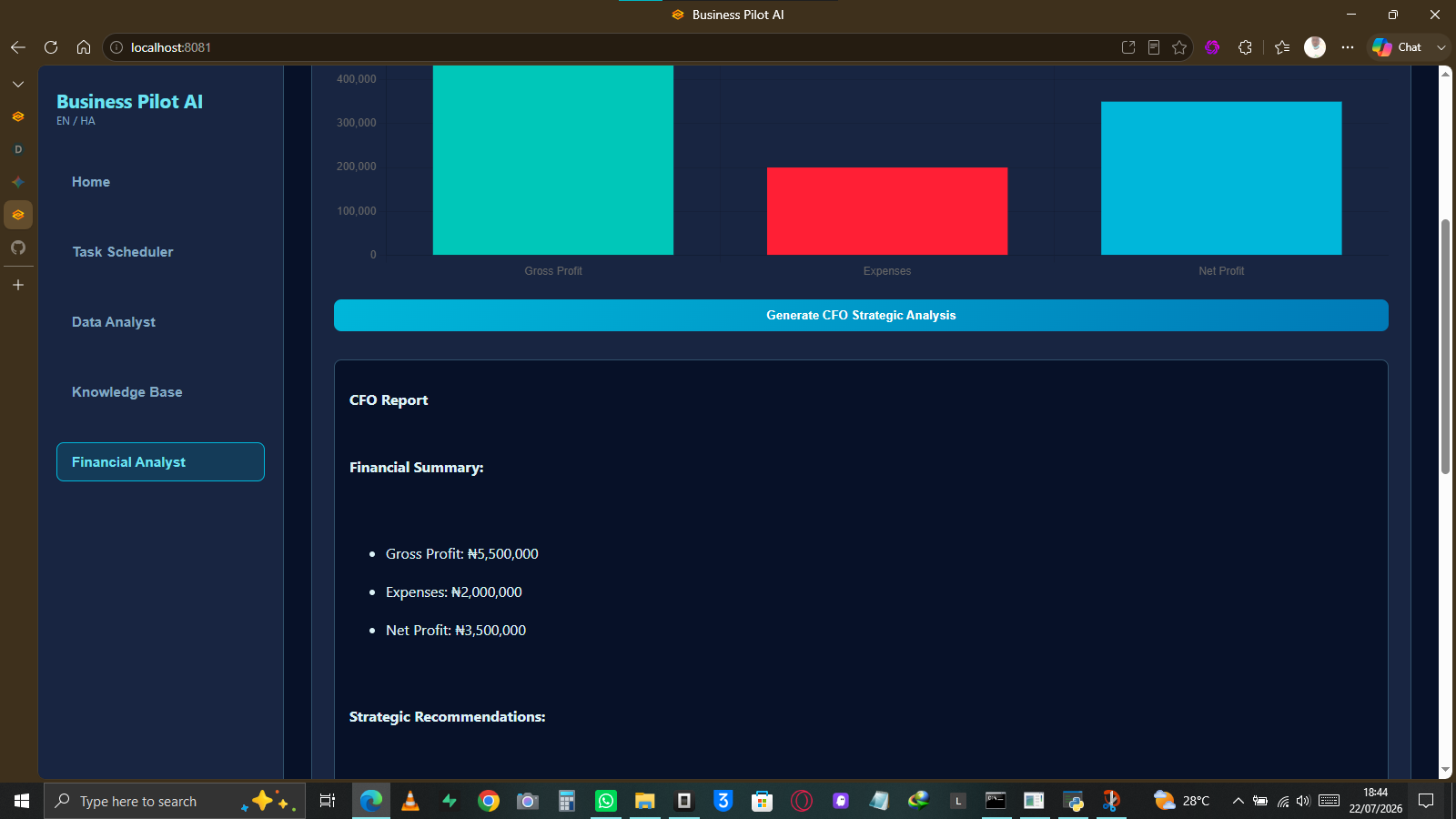
13. Financial Analyst UI: Analyze gross profit, expense and net profit in African currencies then use AI to generate CFO strategic Analysis.
Here is your rewritten text. All structural formatting and headers have been preserved, while "we", "our", and their corresponding verb conjugations have been converted to first-person singular ("I", "my", "was", etc.).
Inspiration
Across Africa, millions of SME owners and entrepreneurs operate in environments with unreliable internet, unstable electricity, and no access to expensive cloud-based AI tools. I was inspired by the Africa Deep Tech Challenge 2026's mission to build infrastructure-grade intelligence for African realities. As a developer from Nigeria, I saw firsthand how language barriers — especially for Hausa-speaking business owners — further exclude people from digital tools. I wanted to create something that runs on the hardware Africa already has: a basic 8 GB RAM laptop, with zero internet dependency, and speaks the user's language.
What it does
BusinessPilot AI is an offline, bilingual business copilot designed specifically for African SMEs. It provides 5 integrated workspaces in a single local application:
- Home — System health monitoring and notifications
- Task Scheduler — AI-assisted project management with priority sorting and Windows toast notifications
- Data Analyst — Upload CSV files, generate interactive charts (bar, line, pie, scatter), and get AI-powered data insights
- Knowledge Base — Upload business documents (.md/.txt), store them locally with semantic chunking, search by meaning, and chat with your documents in English or Hausa
- Financial Analyst — Profit/loss calculations in African currencies (NGN, KES, ZAR, GHS, EGP, USD), visual bar charts, and AI-generated CFO strategic reports
Everything runs entirely on-device with no GPU, no cloud calls, and no internet required.
How I built it
My journey started with a Python Streamlit prototype using the Qwen 2.5 model, which gave me a functional proof-of-concept quickly. However, after the first ADTC session, the requirement shifted to Cohere's tiny-aya-earth model, and I pivoted to a Gradio UI. I soon discovered Gradio was too resource-heavy for my 8 GB RAM target — it consumed excessive memory and felt sluggish on low-end hardware. This forced me to rethink my entire approach.
I rebuilt BusinessPilot AI from the ground up as a zero-dependency, single-page HTML application that leveraged vanilla CSS, JavaScript, and native browser APIs. I used Chart.js for visualization, PapaParse for CSV parsing, marked.js for rendering AI output, and the Browser Notification API for native Windows toasts. The AI backend runs on llama-server.exe with a quantized tiny-aya-earth Q4_K_M (3.35B) model, chosen for its multilingual English/Hausa capabilities. All persistence is handled through localStorage, and bilingual support is achieved through a system prompt that auto-detects the user's language. The entire stack launches with a single run_business_pilot.bat file.
The entire application was built and tested on a 5th generation Lenovo laptop — the same class of hardware my target users actually own.
Challenges I ran into
My biggest challenge was the pivot from Python frameworks to pure HTML/JS. Streamlit was easy to prototype but impossible to optimize for offline edge deployment. Gradio looked promising but proved to be a RAM hog — it consumed so much memory that my 8 GB target was impossible to hit. Moving to a pure HTML/JS stack meant I had to reimplement everything: charting, CSV parsing, markdown rendering, and notifications — but it was the right call.
I also struggled with CORS limitations between the frontend and local AI backend, solved by configuring llama-server with --ui-mcp-proxy. Building semantic search and RAG entirely client-side without a vector database required implementing document chunking and local storage-based retrieval manually. Ensuring accurate Hausa business terminology in a 3.35B model demanded extensive prompt engineering. Making the UI feel responsive on integrated graphics while streaming AI responses and rendering charts required careful performance tuning. Most importantly, I had to prove the system could run smoothly on real, aging hardware — not just spec sheets.
Accomplishments that I'm proud of
I'm proud of my willingness to rebuild from scratch when the first two approaches failed. Many developers would have stuck with a bloated stack — I tore it down and built lean. I'm proud to have created a fully functional, multi-workspace business intelligence platform with zero internet dependency that runs in a browser tab.
Achieving bilingual English/Hausa support for business consulting while staying under 8 GB RAM was a significant technical victory. But what I'm most proud of is the real-world validation: the entire application runs comfortably on approximately 2.1 GB of RAM, and it was built and tested on a 5th generation Lenovo laptop — the exact kind of hardware millions of African entrepreneurs already own. The fact that a non-technical user can launch the entire system with a double-click on a N200,000 or less, (current refurbished price), 8-year-old laptop is something I deeply value. Passing the ADTC's offline and resource constraints on actual aging hardware validated my philosophy: when the tool doesn't fit the reality, change the tool.
What I learned
This project taught me that framework convenience often comes at a hidden cost. Streamlit and Gradio accelerated prototyping but became liabilities under real-world constraints. I learned that vanilla JavaScript and browser APIs are far more powerful than I initially assumed — I built charts, CSV parsing, notifications, and persistent storage without a single npm install. I deepened my expertise in GGUF quantization, CPU-only inference, and memory-constrained system design.
The ADTC constraints forced me to embrace zero-dependency architecture, which turned out to be a strength, not a limitation. Building on a 5th gen Lenovo laptop taught me that testing on real, aging hardware reveals problems spec sheets never will — thermal throttling, disk I/O bottlenecks, and browser memory limits all became visible only when I stopped developing on modern machines. I also gained valuable experience in multilingual prompt engineering for low-resource languages and client-side semantic search implementation.
What's next for BusinessPilot AI
I plan to bundle BusinessPilot AI into a proper desktop application using Tauri, replacing the browser-based launcher with a native desktop experience. This will give me better system integration, offline voice input/output capabilities, and a more polished UI. I'm expanding language support beyond English and Hausa to include Yoruba, Igbo, Swahili, French, and Arabic — making it a truly pan-African business tool. Offline voice features are a priority: I want entrepreneurs to be able to speak to their business advisor in their native language and receive spoken responses, removing literacy barriers entirely.
I'm also exploring integration with DroneBug's agricultural assistant (Abokin Manomi) to create cross-sector advisory for agri-business entrepreneurs. The ultimate vision is a suite of offline, voice-enabled AI advisors that empower African entrepreneurs to build, scale, and sustain their businesses — no cloud, no subscription, no barriers, no excuses. And it will all run on the 5th-gen laptop they already have.

Log in or sign up for Devpost to join the conversation.