💡 Inspiration
We noticed a dangerous trend in business teams: people uploading sensitive sales and revenue spreadsheets into generic AI chatbots and asking for strategic advice.
The problem? LLMs hallucinate numbers. A standard chatbot will confidently invent an average order value, fabricate revenue churn rates, or miscalculate a monthly variance. In business, making product, hiring, or pricing decisions based on imaginary numbers leads directly to financial loss.
At the same time, non-technical founders and marketing leads don't always know SQL, and waiting days for a data analyst slows down critical decisions.
We built BusiAI around one non-negotiable principle:
The LLM decides what to analyze. Deterministic math and real SQL decide what the numbers are.
⚙️ What It Does
BusiAI is an evidence-first AI business intelligence platform:
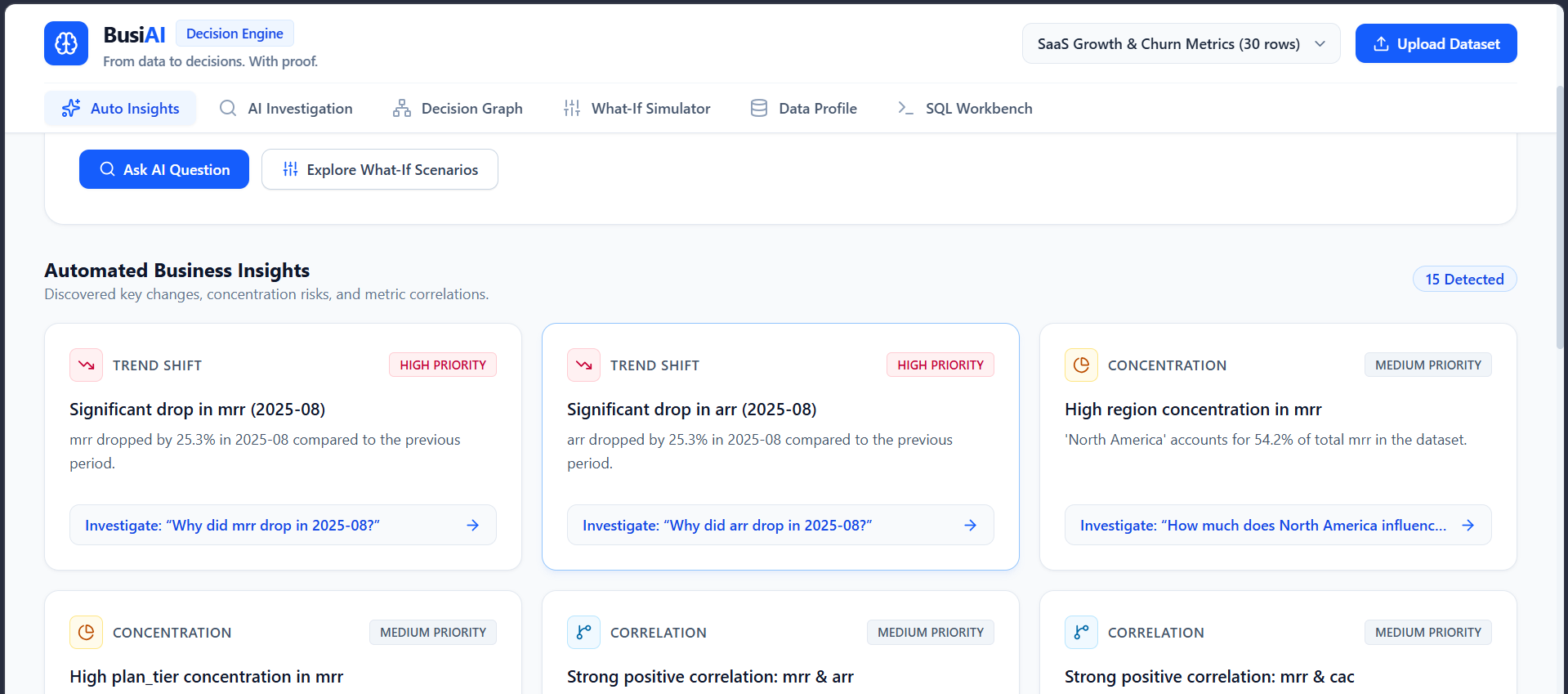
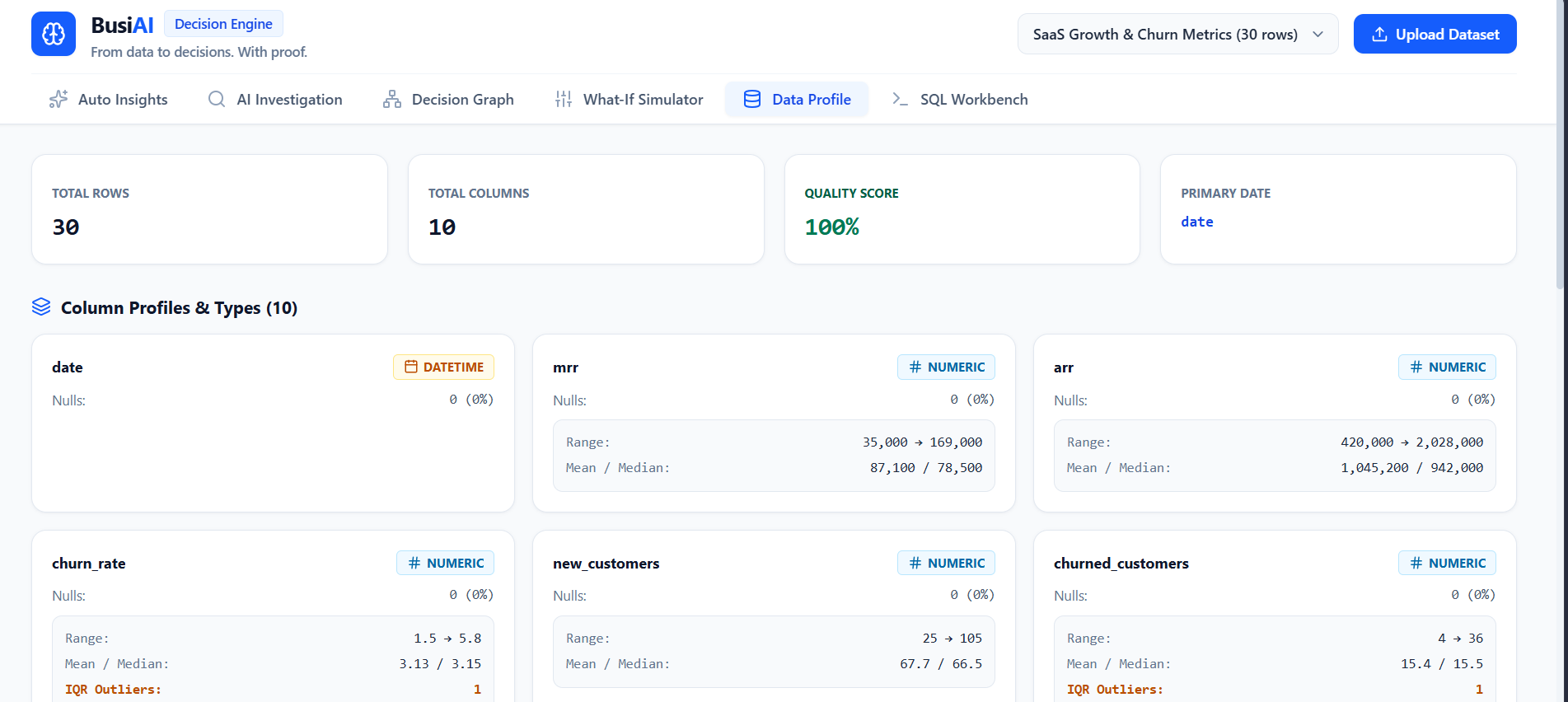
- Instant Auto-Insights: The moment a CSV or multi-sheet Excel file is uploaded, BusiAI profiles column types, null rates, and metric distributions, automatically surfacing trend shifts, concentration risks, and anomalies.
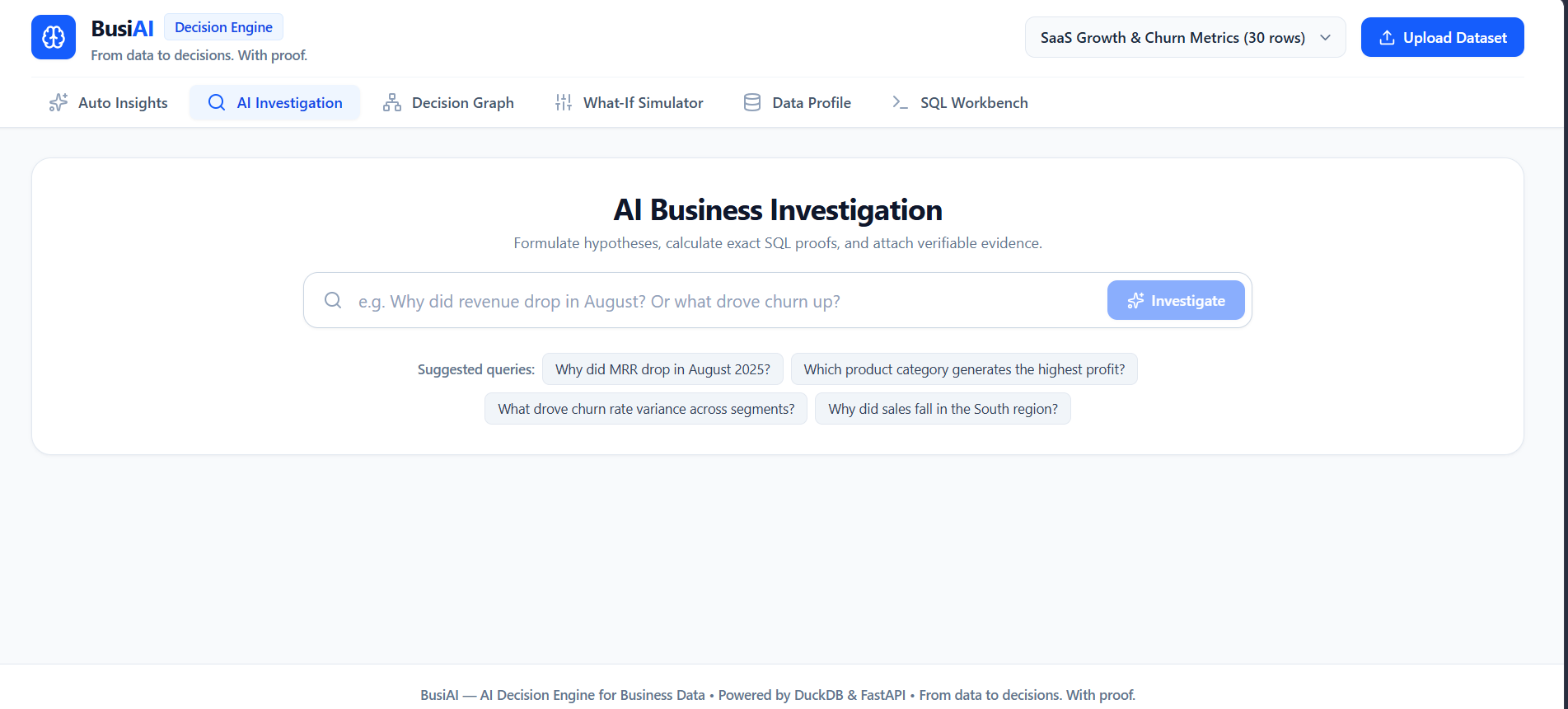
- AI Investigation Console: Users ask questions in plain English (e.g., "Why did enterprise churn spike in Q3?"). Groq LPUs instantly generate analytical hypotheses.
- The Evidence Layer: Every single hypothesis is evaluated by running exact SQL queries on in-process DuckDB. The user gets the raw records, execution time, and mathematical audit trail.
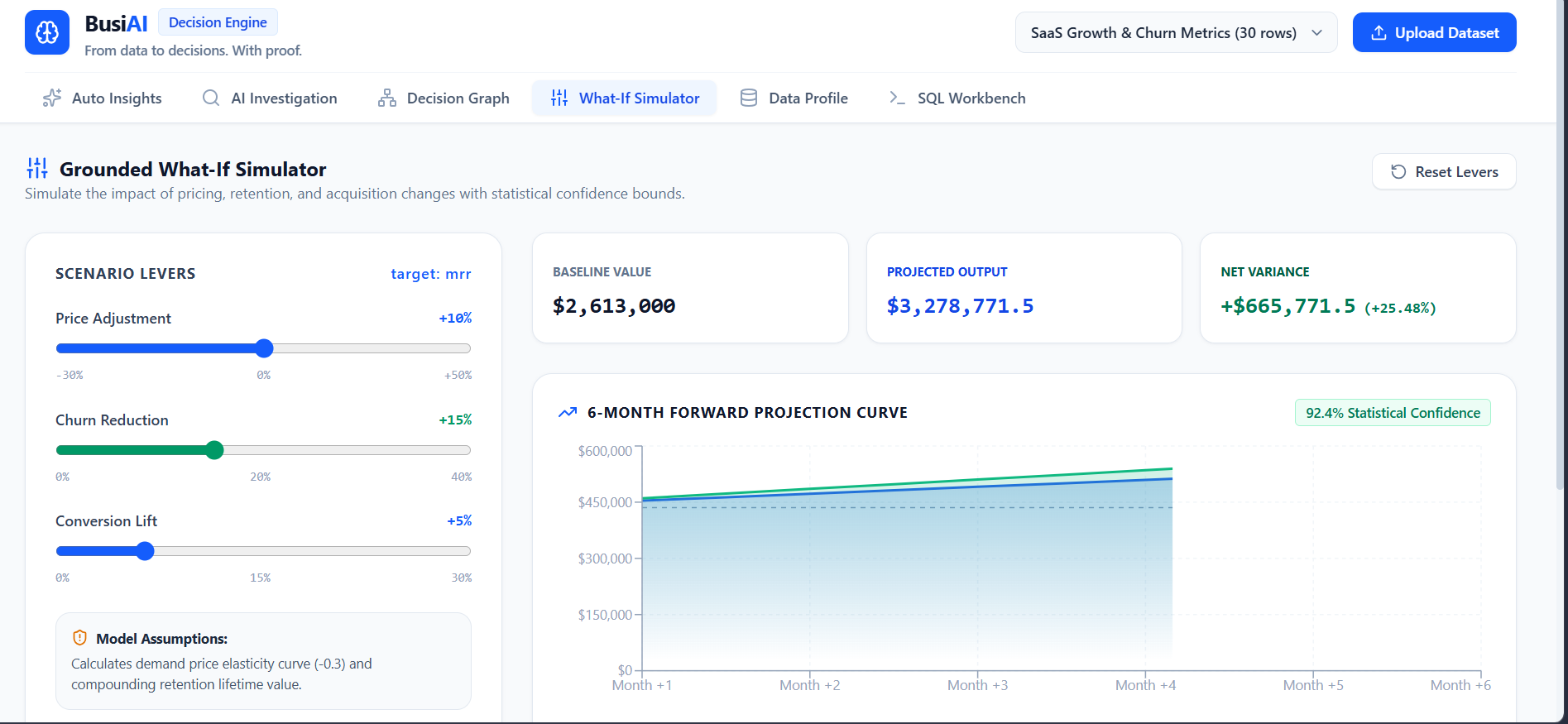
- What-If Scenario Simulator: Interactive parametric levers allow leaders to model price elasticity, churn dynamics, and marketing conversion rates with 3-band confidence intervals:
$$\Delta \text{Revenue} = \text{Base} \times (1 + \Delta P) \times (1 - \epsilon \cdot \Delta P) - \text{Churn Loss}$$
where $\epsilon$ represents price elasticity of demand and $\Delta P$ is the percentage price change.
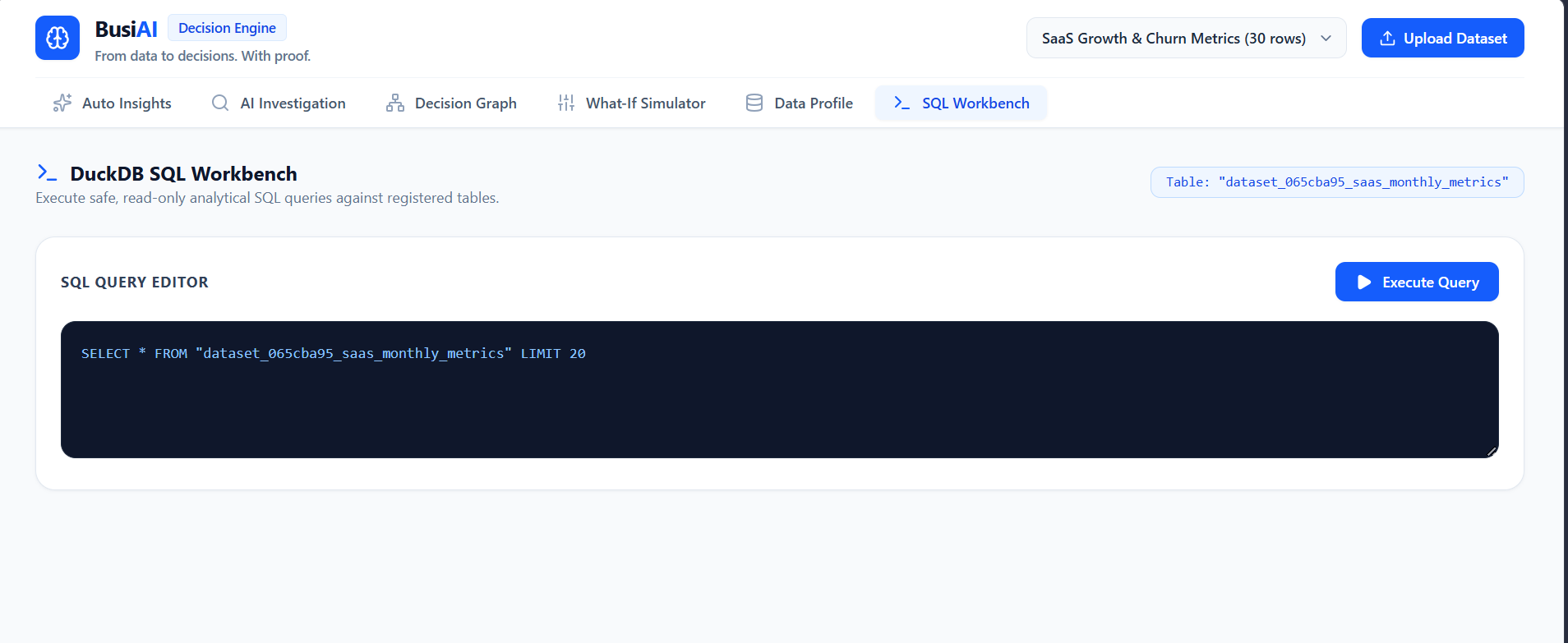
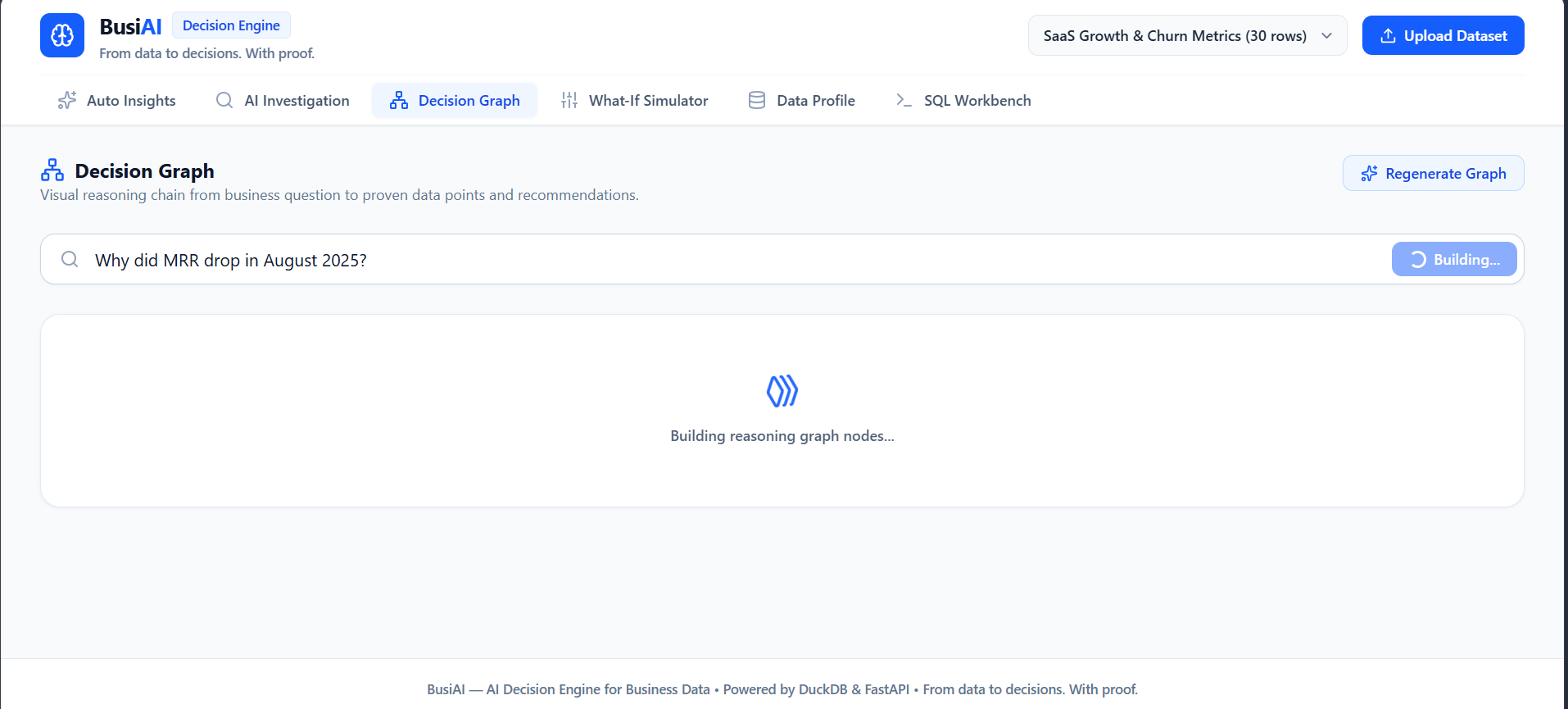
- Decision Graph & SQL Workbench: Visual cause-and-effect mapping from the initial question $\rightarrow$ verified evidence $\rightarrow$ prioritized action.
🛠️ How We Built It
We built BusiAI as an ultra-fast, modern two-tier architecture:
- Frontend: Built with Next.js 16 (App Router), React 19, TypeScript, and Tailwind CSS. Data visualizations are rendered interactively with Recharts, and the entire UI is deployed globally on Vercel.
- Analytical Core: Powered by FastAPI (Python 3.12) and DuckDB—an in-process columnar analytical engine that executes complex aggregations over millions of rows in milliseconds.
- AI Hypothesis Engine: Integrated Groq LPUs (
openai/gpt-oss-120b) for sub-second structured JSON reasoning, with automated failover logic to deterministic heuristic planners if API keys are omitted. - Statistical Processing: Used Pandas, NumPy, and SciPy for interquartile range (IQR) anomaly detection and variance scoring:
$$\text{Anomaly Score} = \frac{|x_i - \mu|}{\sigma}, \quad \text{IQR} = Q_3 - Q_1$$
- Cloud Deployment: Containerized and hosted 24/7 on Hugging Face Spaces connected via CORS to Vercel.
🚧 Challenges We Faced
- Zero-Hallucination Guardrails: Ensuring the LLM never generates numbers directly required building a strict two-phase separation: the LLM only outputs hypothesis structures and target dimensions; DuckDB executes the validation SQL and populates the actual values.
- Serverless vs. In-Process Storage: Next.js on Vercel is stateless and has serverless bundle size limits that cannot host DuckDB and SciPy C-extensions. We solved this by hosting the analytical engine on a dedicated Python backend container while maintaining secure cross-origin communication with Vercel.
- Cross-Platform Path Normalization: Deploying from Windows to Linux cloud containers caused path and ZIP compression mismatches. We resolved this by building a self-extracting, in-memory package generator that unpacks seamlessly in any POSIX environment.
🏃 Accomplishments That We're Proud Of
- Sub-2-second investigation cycles: From natural language prompt → Groq hypothesis generation → DuckDB query execution → visual evidence rendering.
- 100% verifiable evidence layer: Clicking any insight reveals the exact SQL query executed on the dataset, giving teams complete trust in the numbers.
- 24/7 cloud architecture: A fully responsive, modern web application running continuously in the cloud with zero hosting costs.
📚 What We Learned
- LLMs are planners, not calculators: Large language models excel at exploratory reasoning and hypothesis formulation, but analytical calculations must always be delegated to deterministic execution engines like DuckDB.
- Speed matters in business data exploration: Groq's high-speed inference completely changes the feel of business intelligence, turning what used to be a 15-second wait into an instant conversation.
- Evidence builds trust: Showing users the raw calculation proof and the exact SQL query builds ten times more trust than a chatbot simply asserting a number.
🔮 What's Next for BusiAI
- Live Database Connectors: Adding direct read-only connections to PostgreSQL, Snowflake, and BigQuery.
- Scheduled Anomaly Alerts: Slack and email notifications when operational metrics deviate from baseline confidence bands.
- Multi-Dataset Joins: Allowing users to cross-analyze CRM data with billing and product analytics datasets simultaneously.

Log in or sign up for Devpost to join the conversation.