-
-
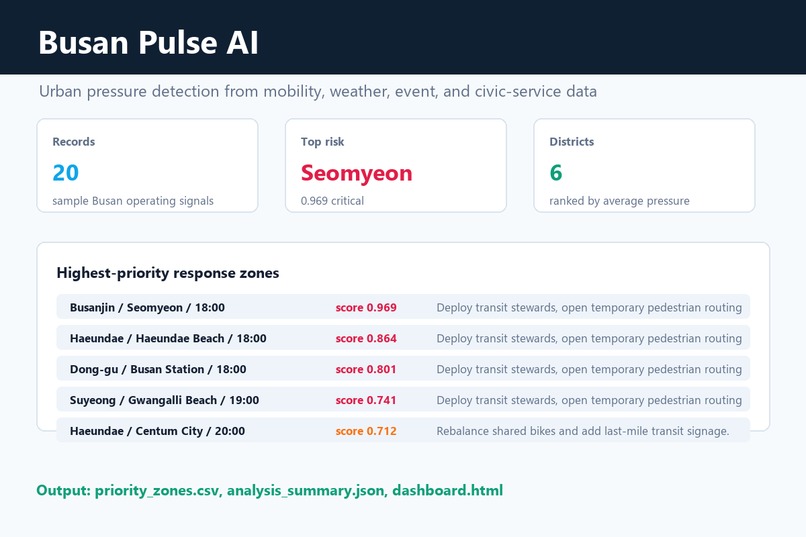
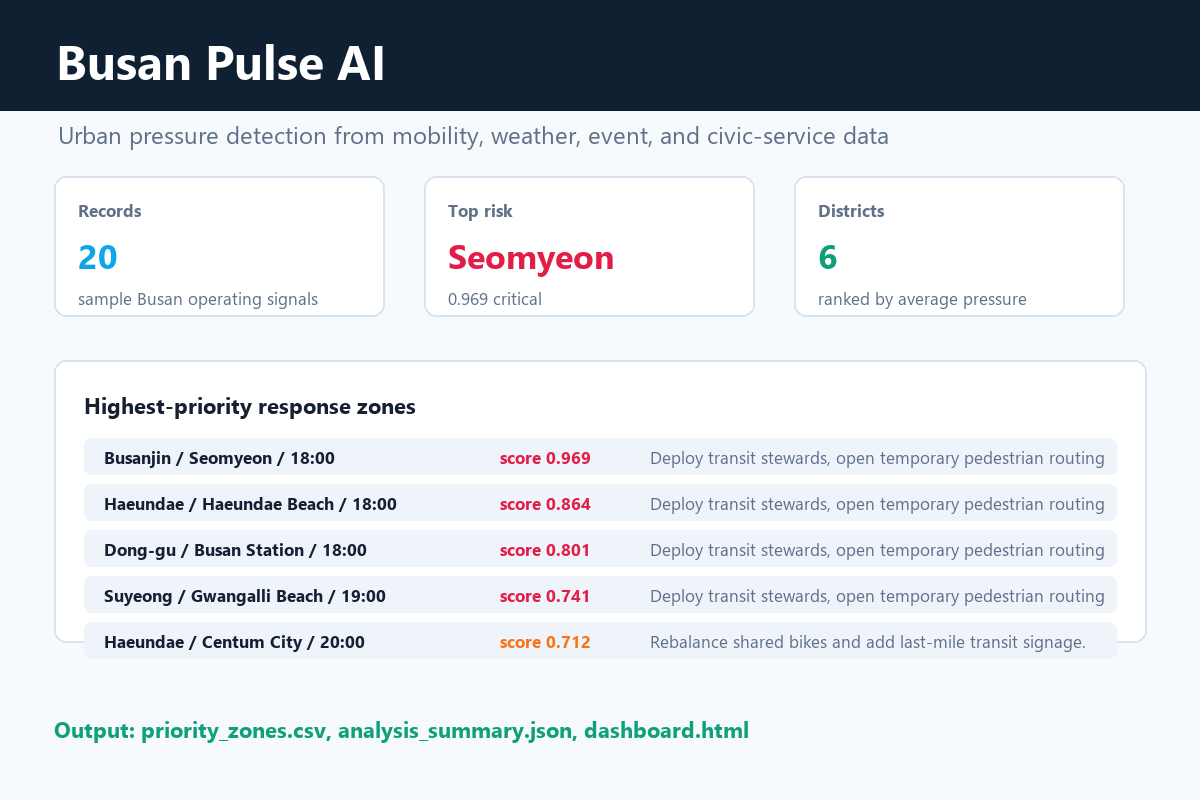
Busan Pulse AI summary showing records analyzed, top risk zone, district coverage, and highest-priority response zones.
-
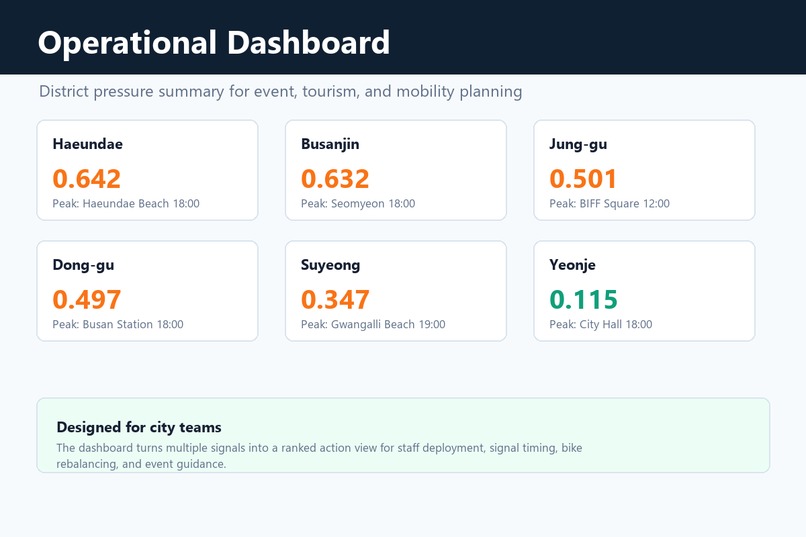
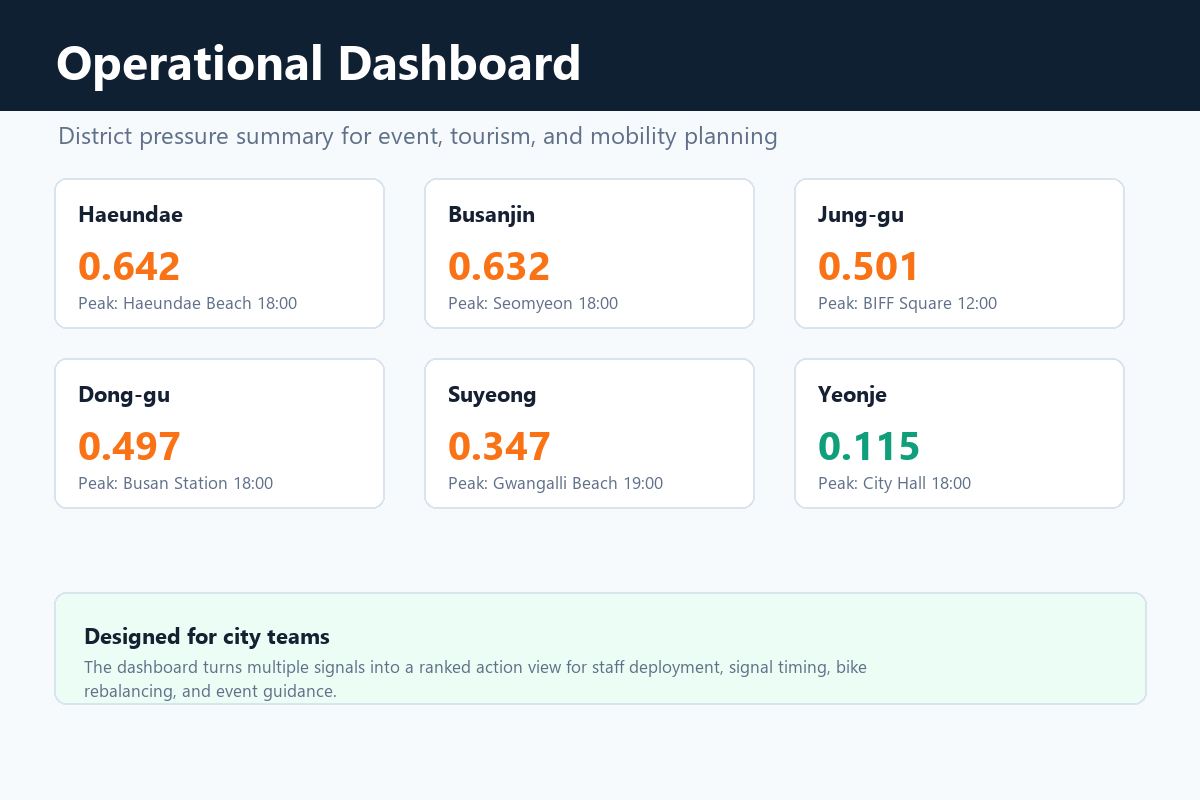
Operational dashboard preview with district pressure scores and peak locations for city planning.
-
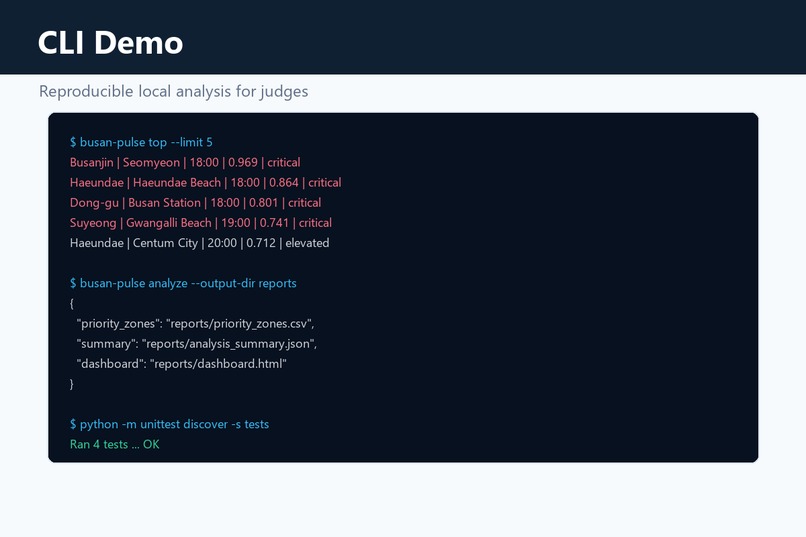
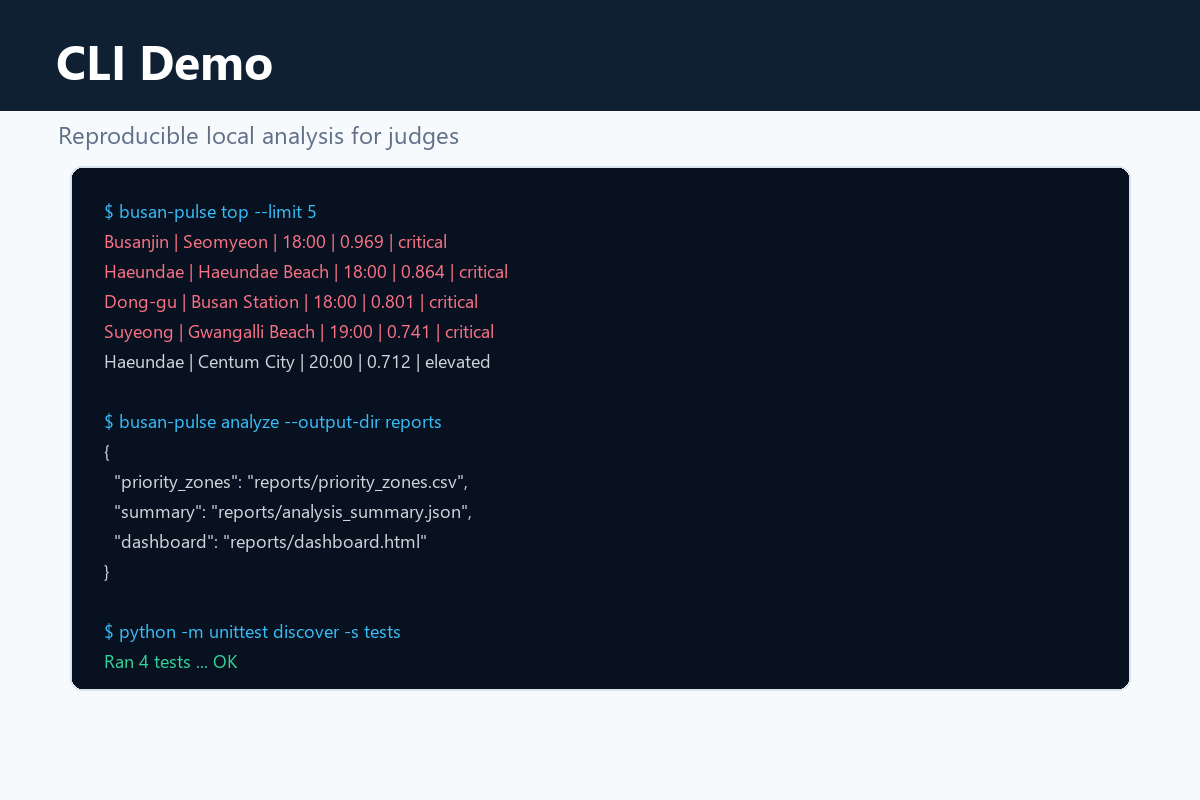
CLI demo showing priority-zone ranking, generated report files, and passing tests.
Inspiration
DIVE 2026 is about turning real-world data into useful public and private-sector services. Busan is a city where tourism, transit, waterfront events, markets, and civic operations all overlap. A crowding issue is not just a visitor-count problem; it can also affect traffic speed, waste response, emergency calls, shared mobility, and local businesses. Busan Pulse AI was inspired by the idea that city teams need a simple way to combine these signals before problems become visible on the ground.
What it does
Busan Pulse AI analyzes city-style data for Busan districts and locations. It combines visitor volume, transit exits, event flags, weather, traffic speed, emergency calls, waste reports, and shared-bike availability into a single urban pressure score.
The project produces ranked priority zones, district summaries, recommended response actions, a JSON analysis artifact, a CSV operations list, and a browser-friendly dashboard. It helps planners see where to deploy staff, adjust transit guidance, rebalance bikes, prepare waste crews, or monitor areas during events.
How we built it
We built the project as a standalone Python application with no required external services. The sample dataset is a synthetic public-style dataset modeled around common Busan operating areas such as Haeundae Beach, BEXCO, Gwangalli Beach, Busan Station, Seomyeon, and Jagalchi Market.
The scoring engine normalizes each signal, weights the signals by operational importance, detects risk levels, and maps risk patterns to recommended actions. The CLI can print the highest-risk locations or generate full report artifacts into the reports folder.
Challenges we ran into
The biggest challenge was designing a realistic contest project without depending on private government or company datasets. We solved that by including a clear synthetic sample dataset and documenting which real data sources could replace it later.
Another challenge was turning many signals into an output that is easy for non-technical city teams to act on. Instead of only creating charts, we included recommended actions and priority lists that could be used during an event operations meeting.
Accomplishments that we're proud of
We are proud that Busan Pulse AI turns multiple city signals into a practical operational view. It does not stop at analysis; it produces a prioritized response list and clear recommendations.
We are also proud that the project is simple to run, easy to inspect, and ready for extension with real public or private data feeds.
What we learned
We learned that data utilization is strongest when the output supports a decision. A dashboard alone is useful, but a ranked action list is much closer to what city operations teams need.
We also learned that combining small signals can reveal pressure earlier than waiting for one extreme metric. Visitor volume, traffic slowdown, civic reports, weather, and low bike availability each tell part of the story.
What's next for Busan Pulse AI
Next, we would connect Busan Pulse AI to real public data APIs for transit, weather, event schedules, tourism density, emergency response, and civic complaints. We would also add forecasting, map visualization, Korean-language reporting, and mobile alerts for district operations teams.
Built With
- busan
- civic-tech
- dashboard
- data-analysis
- databases
- machine-learning-ai
- mobility
- public-data
- python
- urban-planning

Log in or sign up for Devpost to join the conversation.