Inspiration
AI coding agents can rapidly consume tokens through long-running tasks, repeated tool calls, and unattended execution flows. As agent workflows become more autonomous, it becomes increasingly difficult to understand how quickly usage and cost can grow in real time.
We wanted to build a lightweight monitoring layer that gives teams immediate visibility into AI agent token burn before costs become difficult to control.
What it does
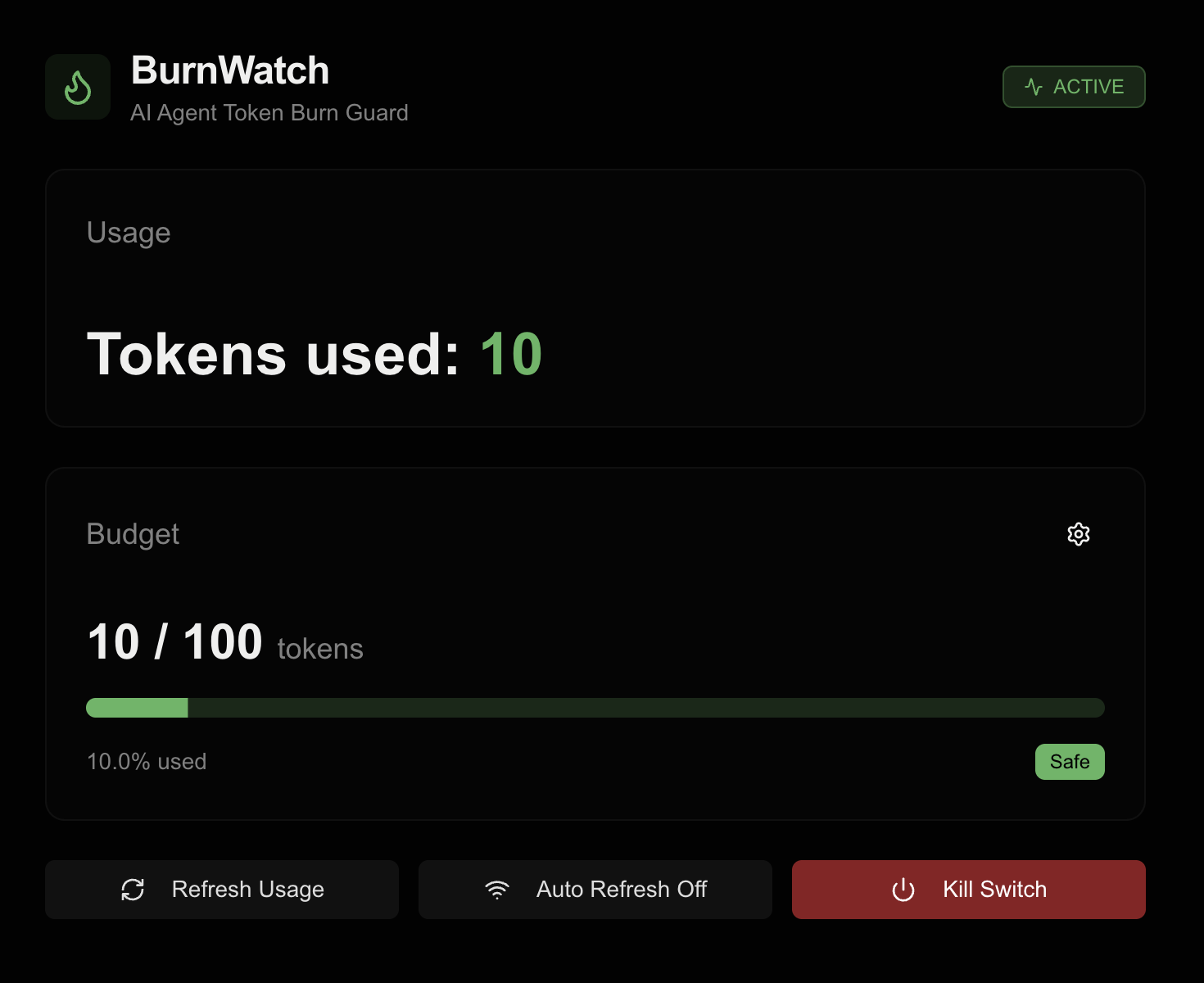
BurnWatch is a lightweight monitoring dashboard for AI coding agents.
It tracks token usage in real time, compares usage against a configurable token budget, and visualizes risk levels through Safe, Warning, and Critical states.
The dashboard supports:
- Live usage monitoring
- Manual and automatic refresh modes
- Budget threshold tracking
- Kill Switch interaction
- External API-based usage integration
BurnWatch is designed to work with CLōD-compatible AI execution pipelines and lightweight agent workflows.
How we built it
We built BurnWatch as a lightweight frontend-first monitoring dashboard using:
- Next.js
- React
- TypeScript
- Tailwind CSS
- shadcn/ui
The frontend continuously fetches token usage data from an external usage endpoint and calculates budget thresholds locally in the dashboard.
We also integrated:
- Auto-refresh polling
- Kill Switch behavior
- API response validation
- Lightweight usage monitoring logic for CLōD-compatible workflows
The architecture was intentionally kept simple and modular to support fast iteration during development.
Challenges we ran into
One of the biggest challenges was defining a clean integration flow between the frontend dashboard and external AI execution systems.
Because token usage data can come from different providers and execution pipelines, we had to design the dashboard around a flexible API contract instead of tightly coupling it to a single backend implementation.
We also had to balance real-time updates with UI stability, avoiding excessive polling and layout shifts while keeping the dashboard responsive.
Accomplishments that we're proud of
We're proud that we were able to turn a complex AI infrastructure problem into a lightweight and understandable monitoring experience.
Some highlights include:
- Real-time usage tracking
- Configurable budget monitoring
- Auto-refresh polling
- Kill Switch interaction
- CLōD-compatible usage integration flow
- Clean and responsive dashboard UX
We also designed the system to remain simple enough for rapid iteration while still supporting future backend expansion.
What we learned
We learned that even simple AI monitoring workflows quickly become complex once real-time execution, usage tracking, and external integrations are involved.
We also learned the importance of keeping system contracts lightweight and flexible, especially when multiple teammates are working on different parts of the stack simultaneously.
Building BurnWatch reinforced how important observability and cost visibility are becoming in AI agent workflows.
What's next for BurnWatch
Future improvements for BurnWatch include:
- Persistent usage history and analytics
- Multi-agent monitoring support
- Cost estimation and spend forecasting
- Real backend execution control
- Advanced alerting and automatic circuit breakers
- Richer CLōD and agent orchestration integrations
- More detailed execution insights and monitoring dashboards
Built With
- clod
- next.js
- react
- typescript


Log in or sign up for Devpost to join the conversation.