-
-

Burmalda — AI payroll agent powered by PayPal
-
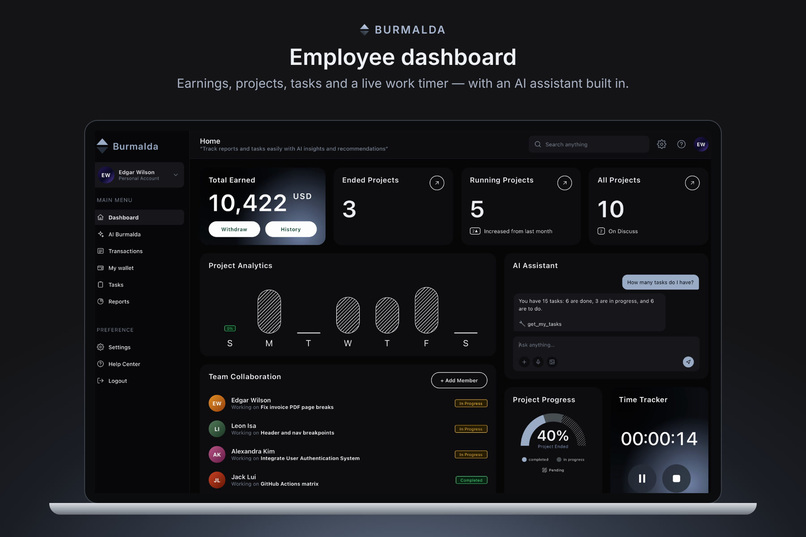
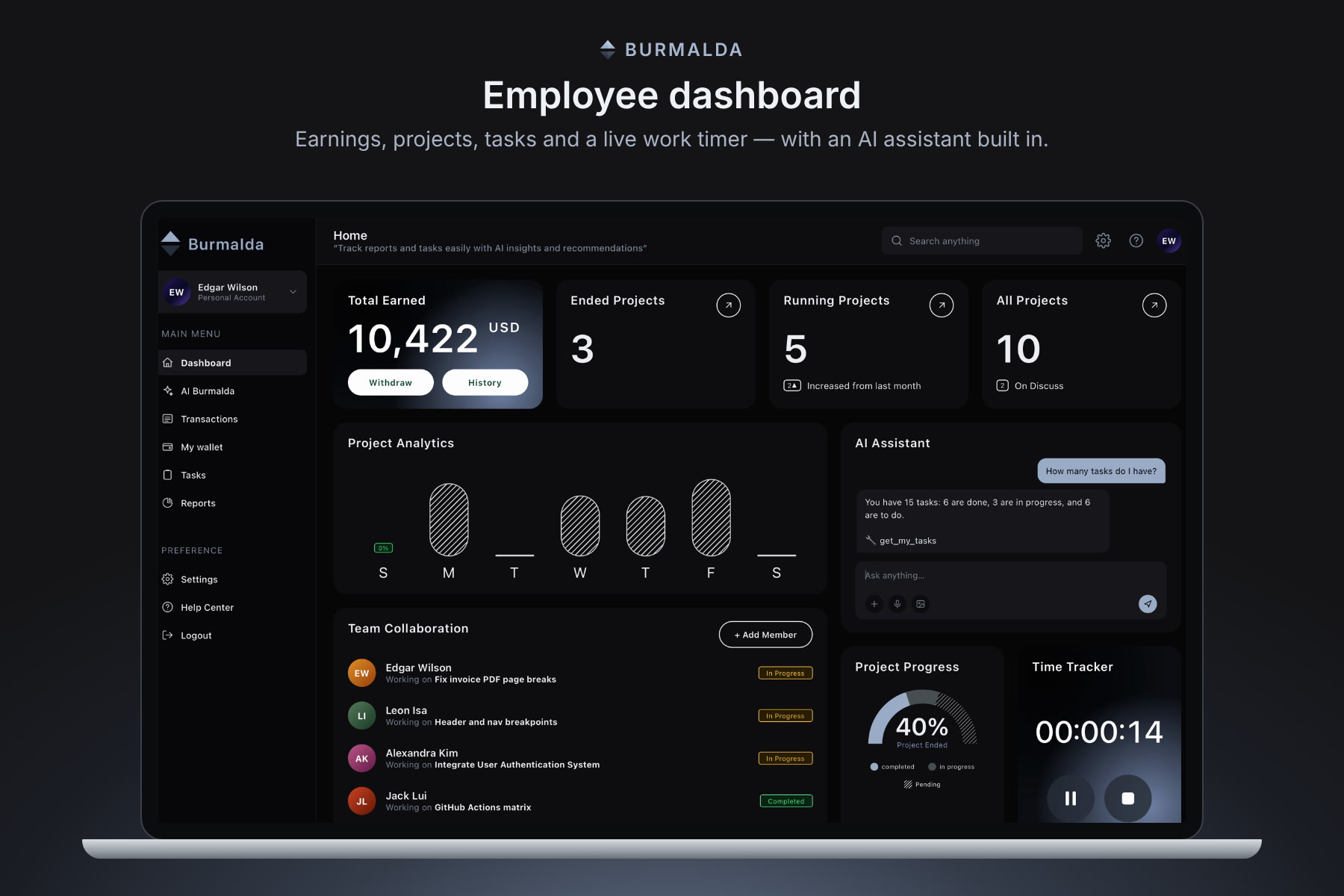
Employee dashboard: earnings, projects, tasks and a live timer, with an AI assistant built in.
-
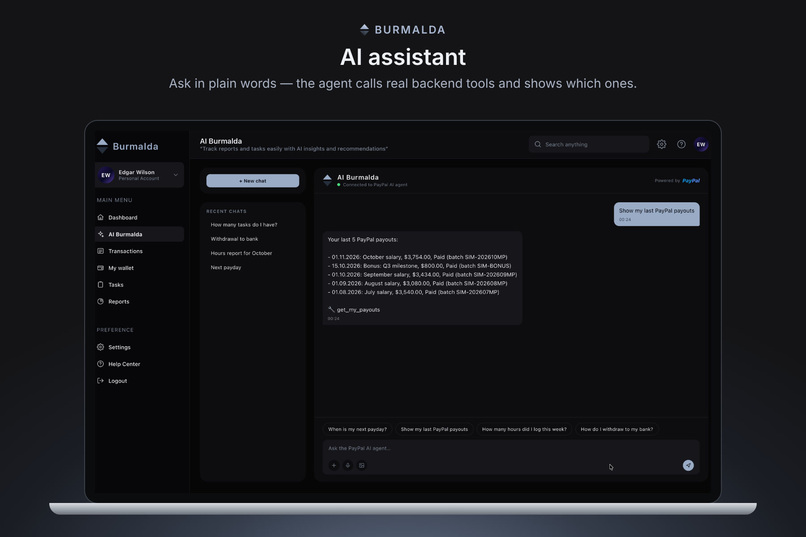
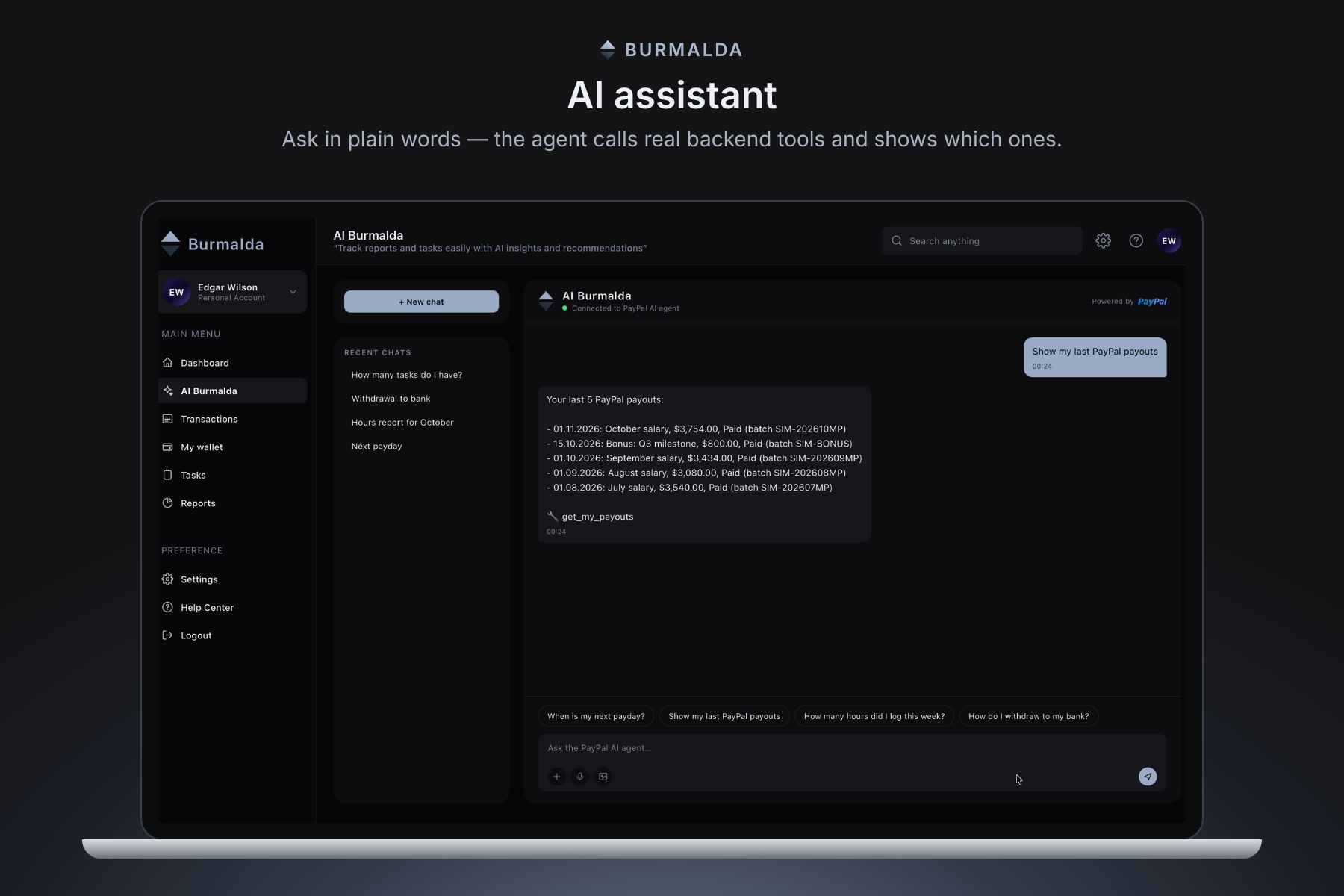
The AI agent answers from real data and shows which backend tools it called.
-
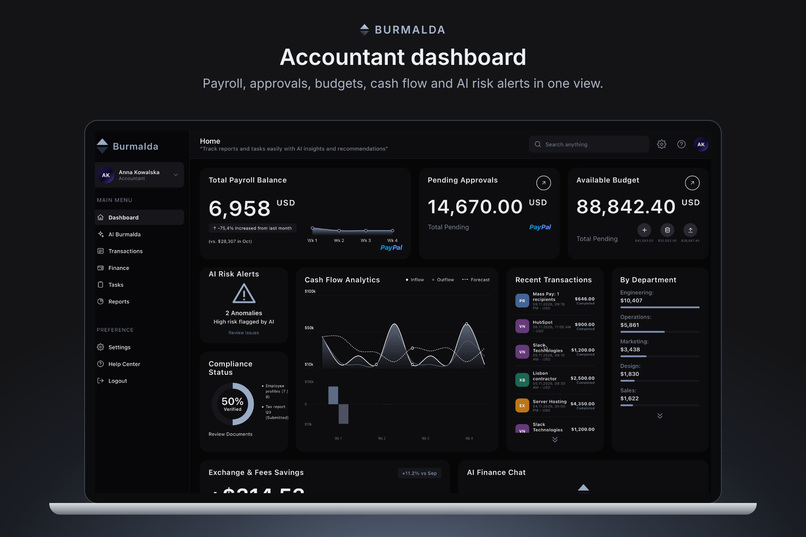
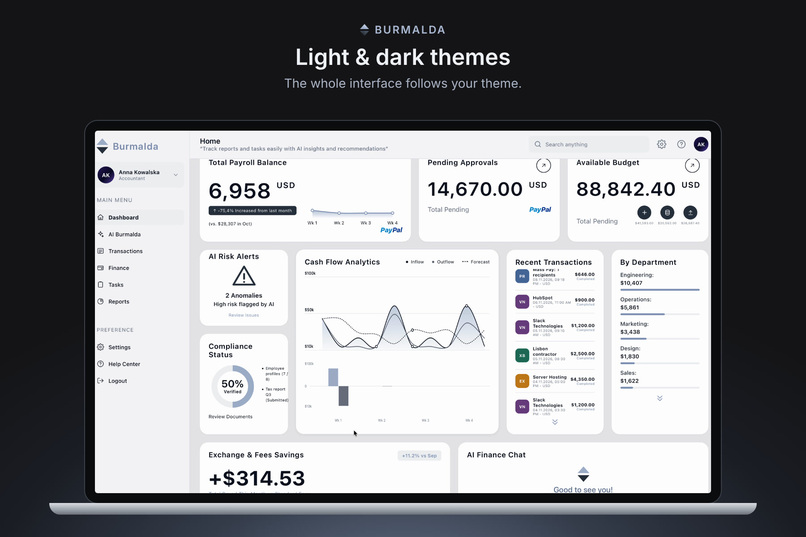
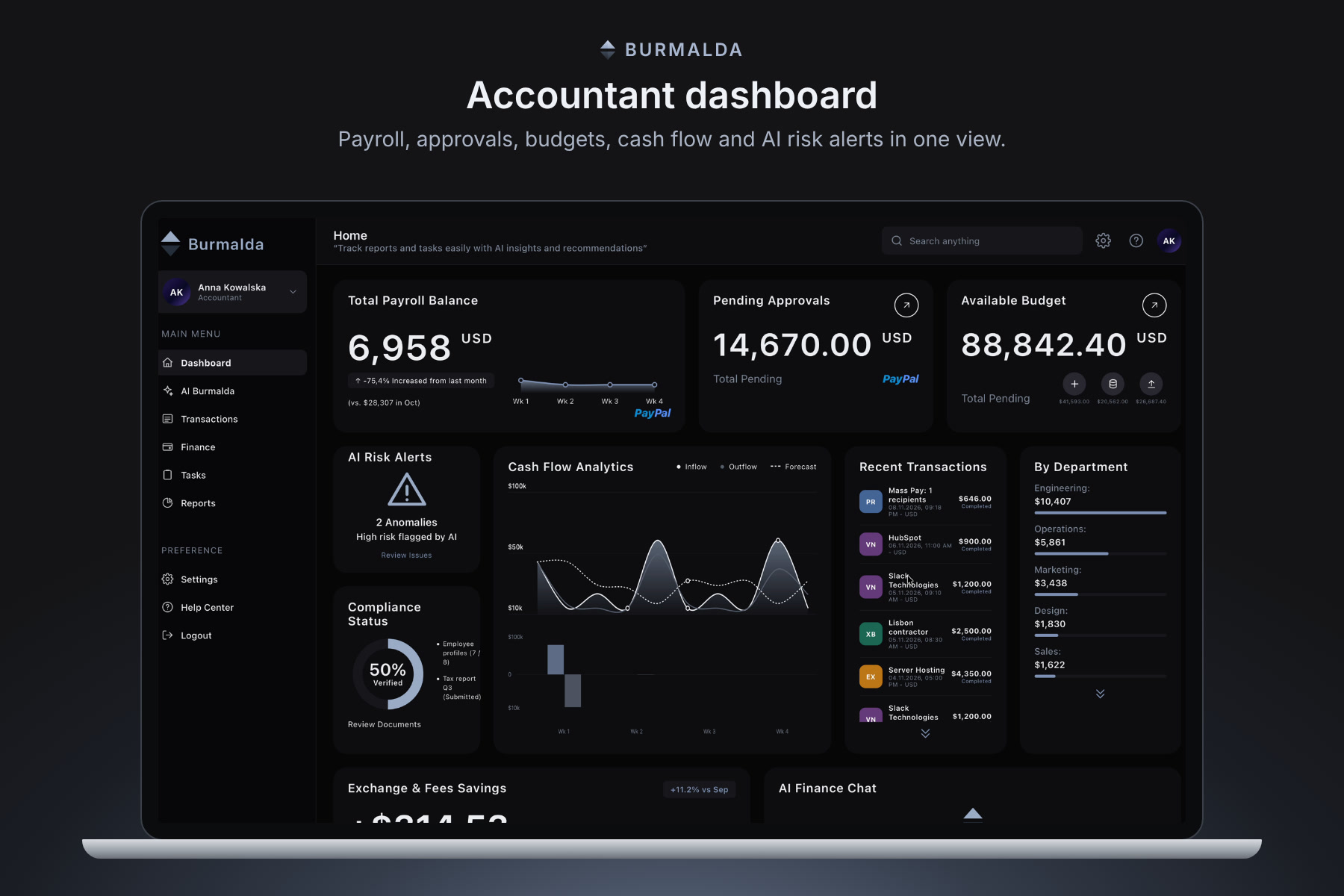
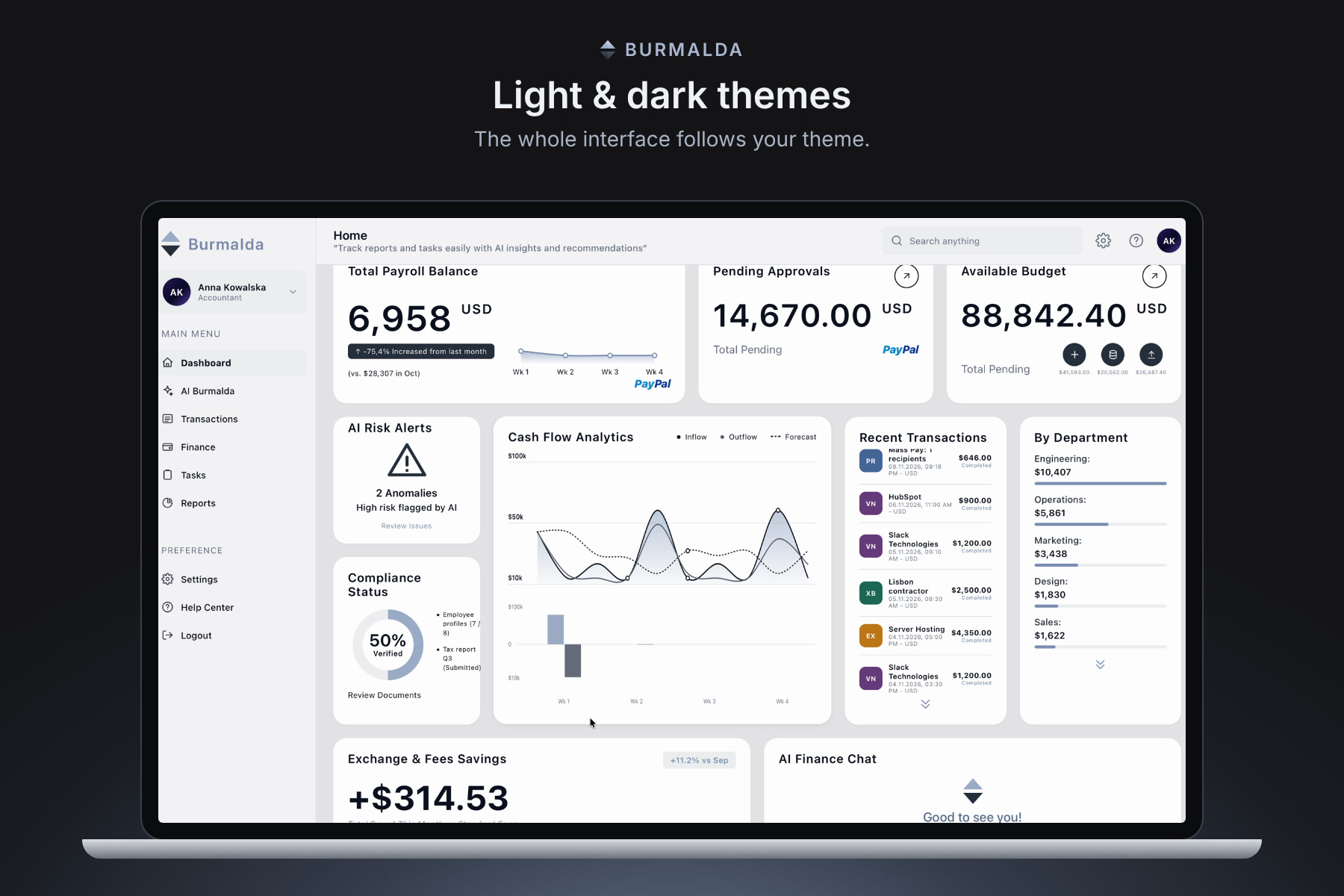
Accountant view: payroll, pending approvals, budgets, cash flow and AI risk alerts.
-
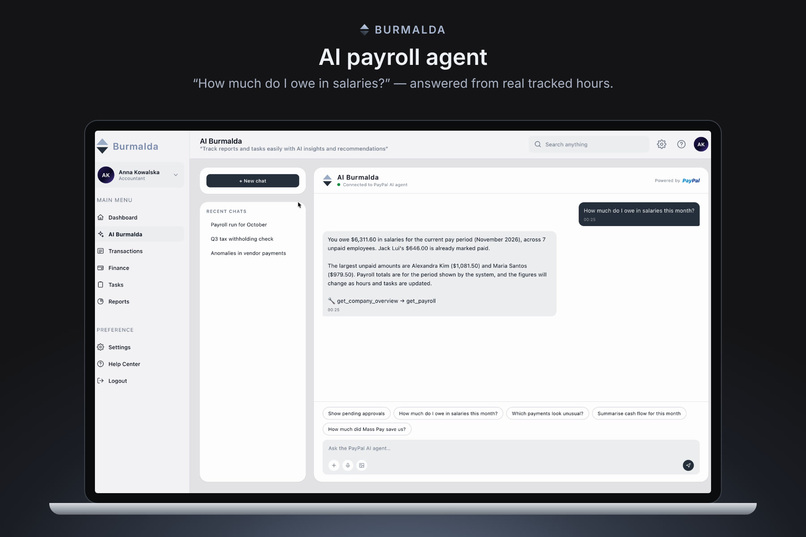
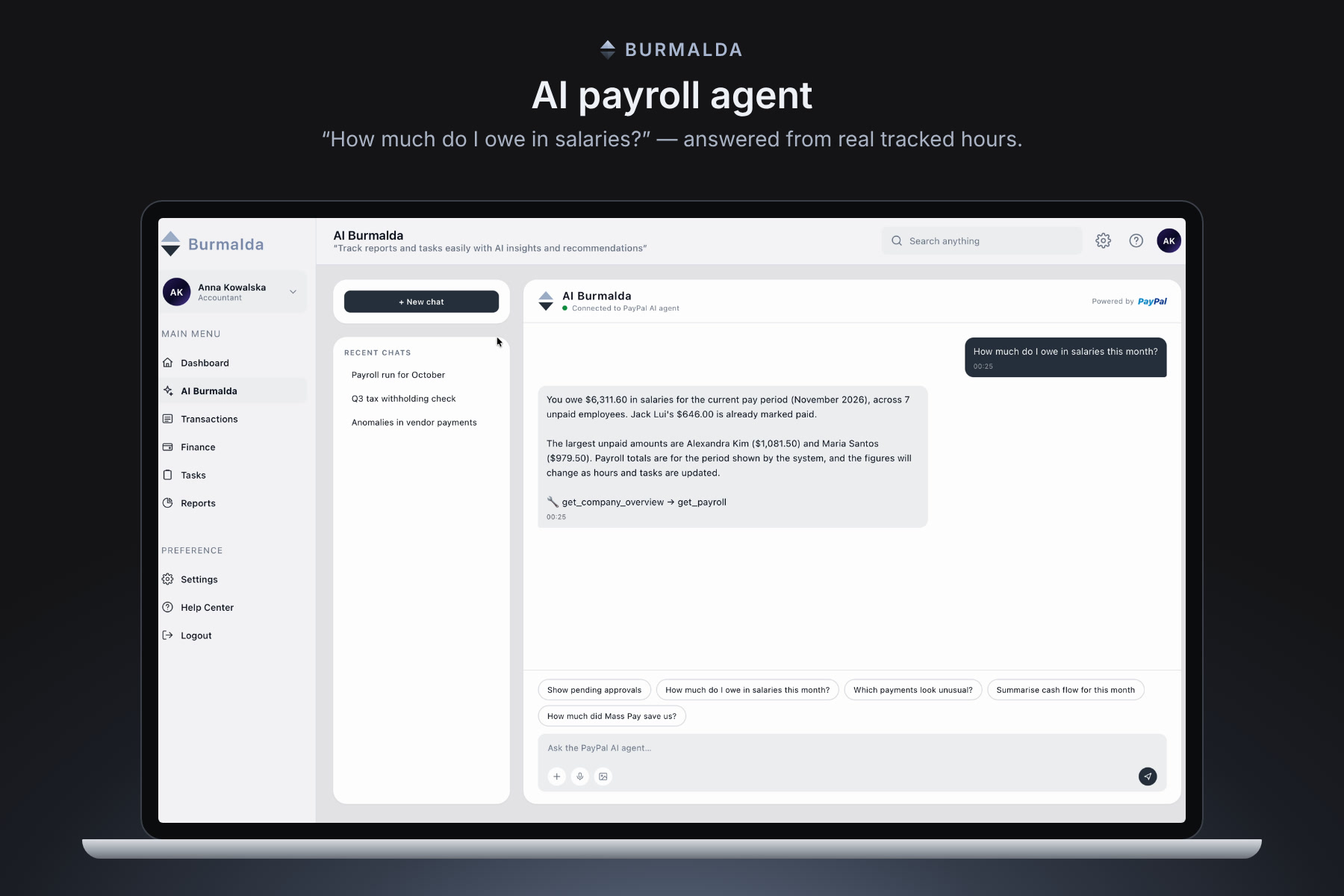
Ask "How much do I owe in salaries?" and the agent calculates it from tracked hours.
-
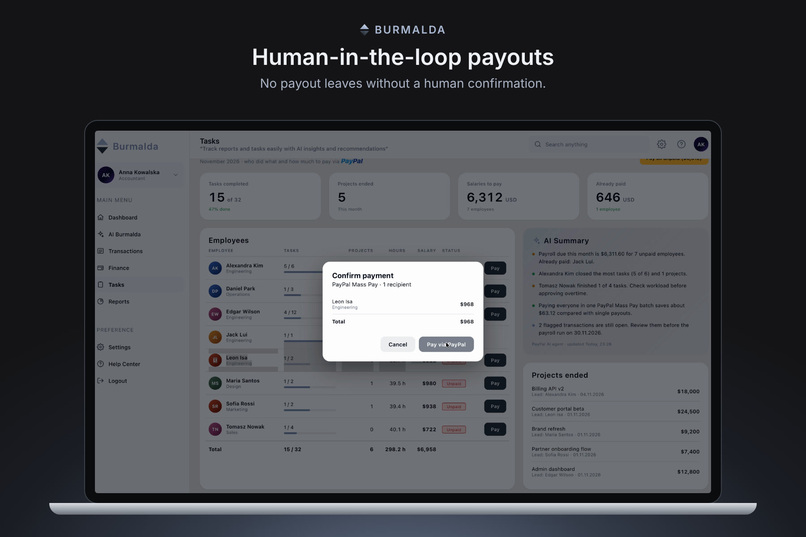
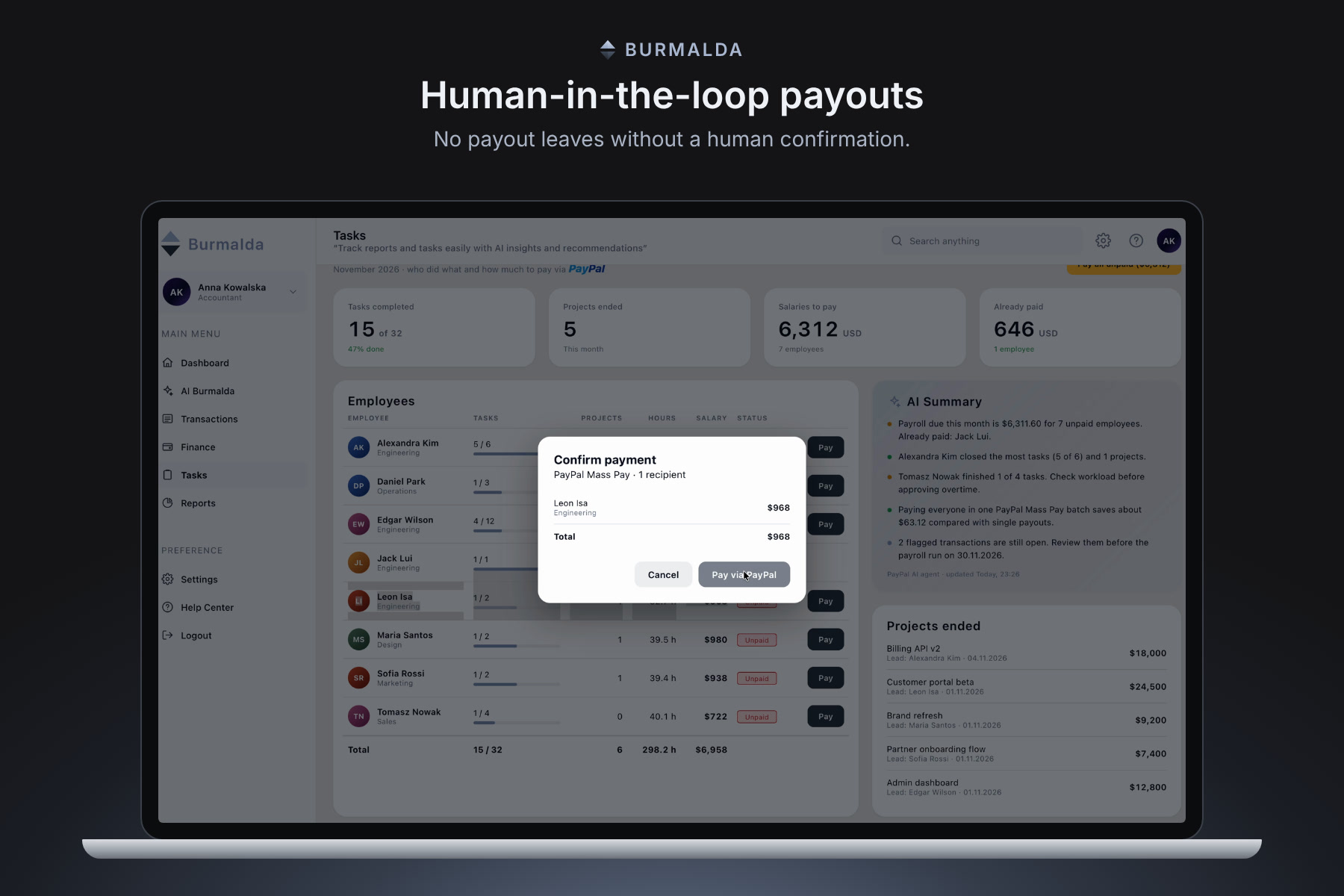
Every payout needs a human confirmation before it is sent via PayPal.
-
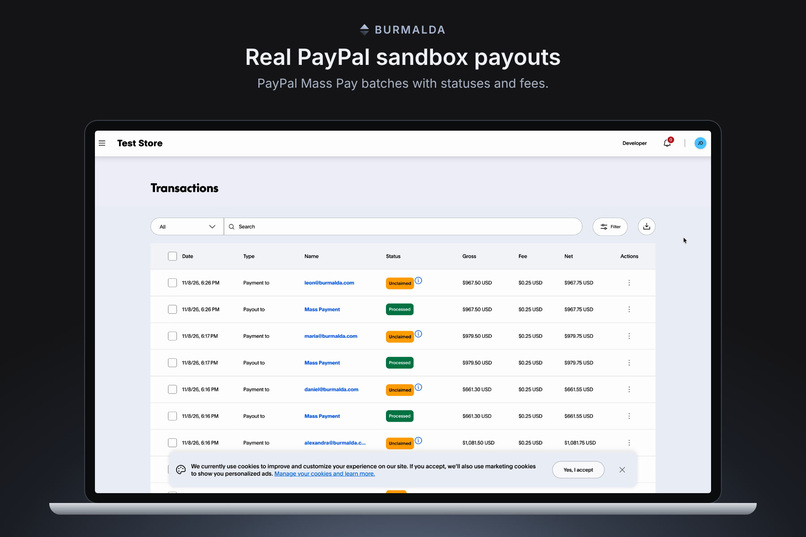
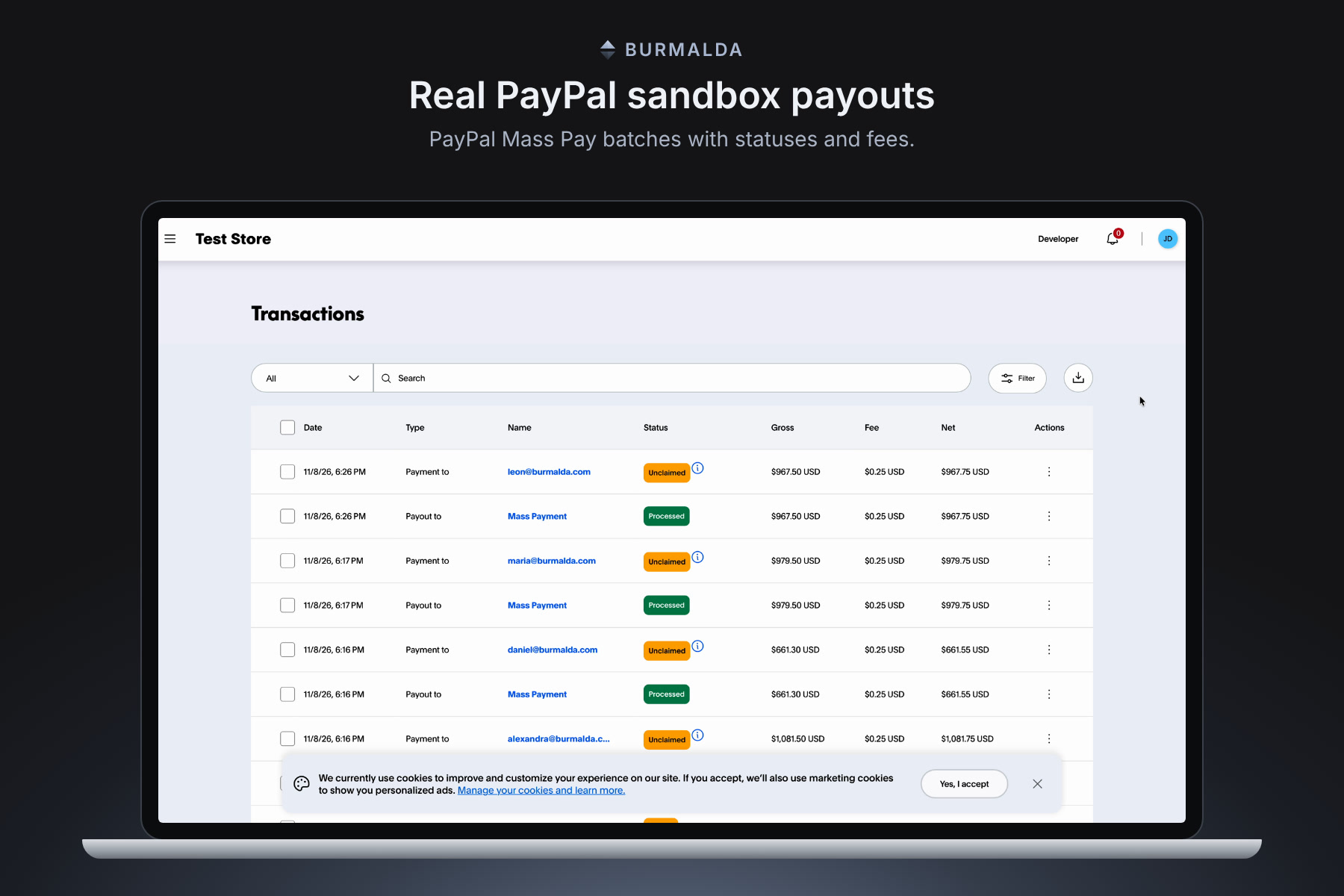
Real PayPal Payouts (Mass Pay) in the sandbox, with statuses and fees.
-
Light and dark themes across the whole app.
-
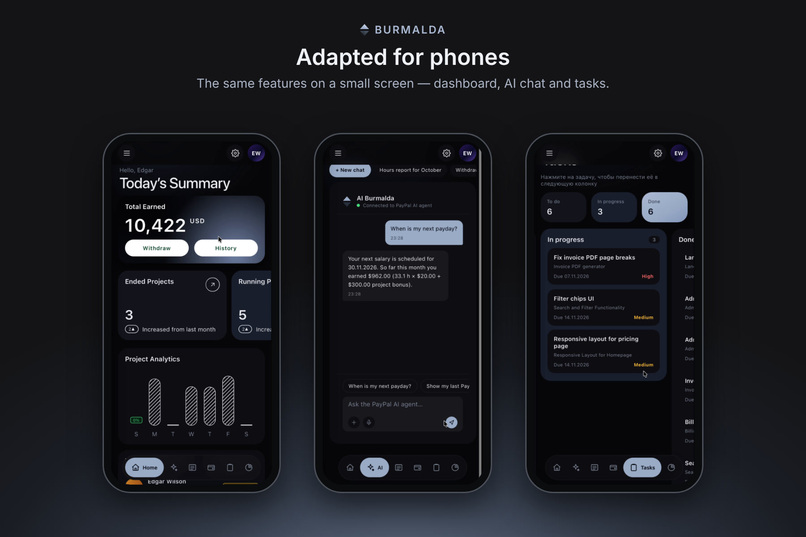
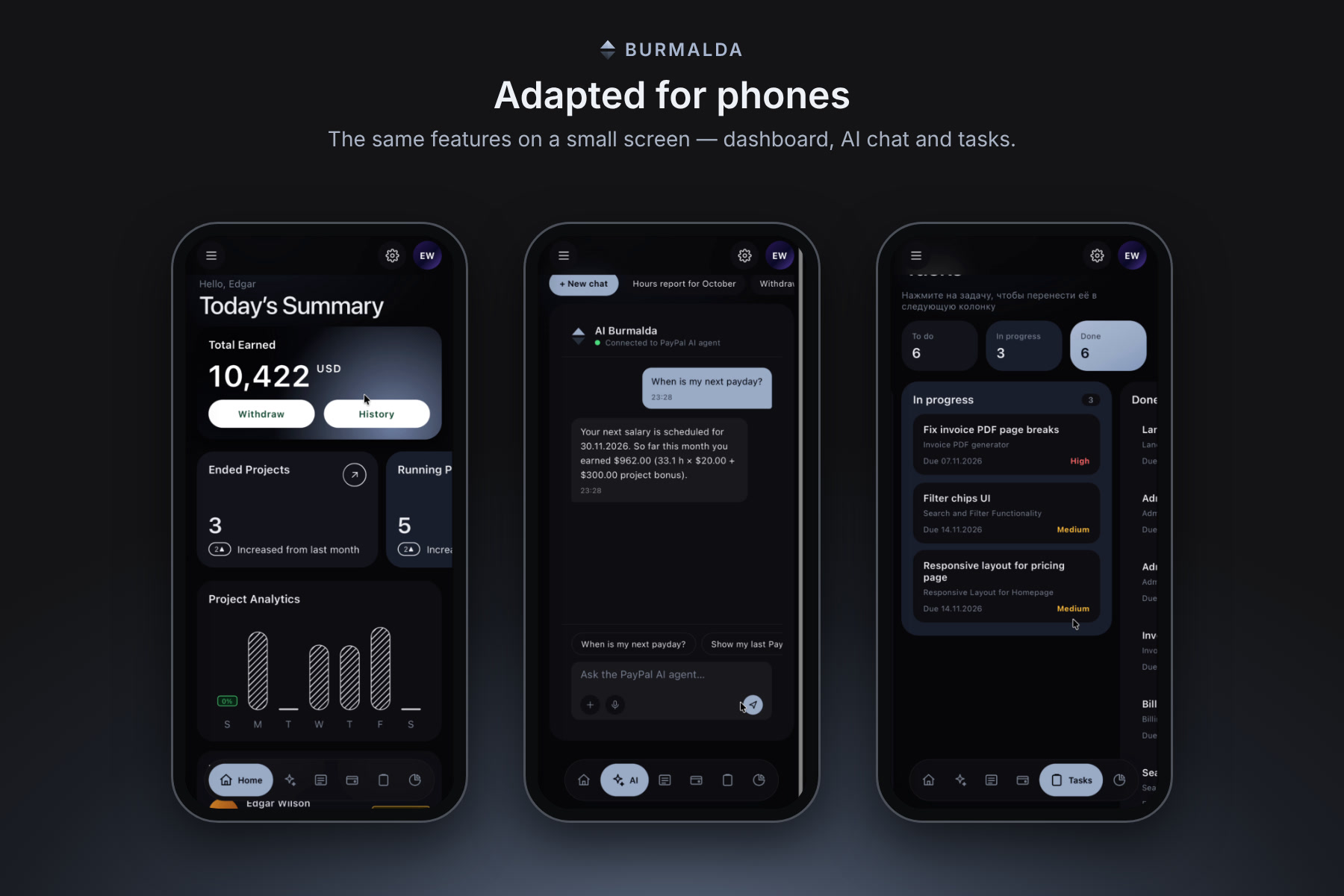
Adapted for phones: dashboard, AI chat and tasks on a small screen.

Inspiration
In small companies payroll is still a mess: hours live in one tool, projects in another, and on payday the accountant copies numbers into PayPal by hand, one transfer at a time. We wanted one place where the work is tracked, salaries are calculated automatically, and an AI agent can answer "who still needs to be paid and how much?" and then actually pay everyone, with a human approving every payout.
What it does
Burmalda has two roles:
- Employee: projects, tasks, a work timer, earnings and payout history. The AI assistant answers questions like "how much will I get this month?" or "what are my tasks?".
- Accountant: payroll, pending approvals, department budgets, cash flow with a forecast, compliance and AI risk alerts (anomalies in transactions).
The core is an AI agent with tool calling. You ask in plain language (by text, voice, or with a photo or file attached), and the agent calls real backend tools: get_payroll, find_anomalies, get_cash_flow, get_projects and more. When you ask it to pay salaries, it proposes a payout batch and waits for an explicit CONFIRM in the next message. Only then does it execute a PayPal Payouts (Mass Pay) batch and track its status.
Salary = hours × hourly rate + a bonus for every project finished that month.
Try it yourself
Open the demo link and sign in with a demo account (the login page also lets you click to fill them in):
- Accountant:
[email protected]/demo1234 - Employee:
[email protected]/demo1234
PayPal runs in sandbox mode, so no real money moves. Try asking the AI: "Who still needs to be paid?", then "Pay everyone" and reply CONFIRM.
Screen sizes: the UI is optimized for desktop at 1920×1080 with 100% browser zoom and for phones (portrait). Other resolutions, tablets or different zoom levels may show layout issues. For the best experience use a desktop browser at 100% zoom (Ctrl+0).
Note: the free Render instance sleeps when idle, so the first load can take ~1 minute.
How we built it
- Backend: Java 21 and Spring Boot 3.5 with Spring Security (stateless JWT, role-based access for employees and accountants), Spring Data JPA on H2 (PostgreSQL-ready), Maven.
- PayPal: the Payouts API (Mass Pay) in sandbox: OAuth client-credentials, one batch for the whole team, then polling the batch status and saving it to the payout history.
- AI agent: Claude (Anthropic Messages API) with tool use. The agent has role-specific tools: the accountant gets payroll, approvals, anomalies, cash flow, budgets and projects; the employee gets their pay, hours, tasks and payouts. It also reads attached photos, PDFs and CSV files. Gemini is a backup model, and a rule-based fallback keeps the chat alive if both APIs are down.
- Safety: paying people is split into two tools.
propose_payroll_paymentonly builds a preview.execute_payroll_paymentruns only after the user typesCONFIRMin a separate message. - Frontend: plain HTML, CSS and JavaScript with no framework. It has a dark and a light theme, a mobile layout, and voice input via the Web Speech API.
- Deploy: a multi-stage Docker build plus a Render blueprint. The backend serves the frontend from the same origin, so there is no CORS pain.
Challenges we ran into
- Letting an AI touch money safely. We had to make sure the model can never pay anyone by itself, not even if a prompt or an uploaded file tells it to. The fix was the proposal → confirmation → execute flow, enforced in code, not just in the prompt.
- Unstable LLM APIs. We ran into "model overloaded" errors, timeouts and models retired mid-hackathon. We added retries, fallback models and automatic model discovery, and in the end made Claude the main agent.
- PayPal sandbox details. Our first sandbox business account had no USD balance (
INSUFFICIENT_FUNDS), so we created a US business account and a new app. - Payroll logic. At the start of a month "this month" has nothing to pay yet, so the backend picks the pay period itself: last month if someone is still unpaid, otherwise the current one.
- Two people, one repo. Frontend and backend changes landed at the same time and sometimes overwrote each other. We learned to pull before every change.
Accomplishments that we're proud of
- A working end-to-end flow: ask the AI in plain words → it calculates payroll from real tracked hours → you confirm → real PayPal sandbox payouts go out → their status shows up in the app.
- The AI doesn't just chat. It calls 15+ real backend tools and shows which ones it used under every answer.
- The human-in-the-loop design: the agent is useful, but the money decision always stays with a person.
- Two full role-based dashboards, voice input, file and photo understanding, and mobile support, all built in a short hackathon window.
What we learned
- How to design tools for an LLM agent: small, well-described tools beat one big "do everything" tool.
- Prompts are not security. Anything important (payments, permissions) has to be enforced in backend code.
- How the PayPal Payouts API works end to end: OAuth, batches, item statuses, sandbox accounts.
- JWT-based security in Spring, Docker multi-stage builds and deploying on Render.
What's next for Burmalda
- Connecting real employee PayPal accounts and running scheduled automatic payroll.
- Multi-currency payouts for international teams.
- Invoice processing: upload a vendor invoice and the agent drafts a payment for approval.
- Integrations with Jira, GitHub and calendars, so tracked hours come in automatically.
- Smarter anomaly detection and cash-flow forecasting.
Built With
- anthropic
- claude
- css3
- docker
- gemini
- h2
- html5
- java
- javascript
- jpa
- jwt
- maven
- paypal
- paypal-payouts-api
- postgresql
- render
- spring-boot
- spring-security
- web-speech-api

