-
-
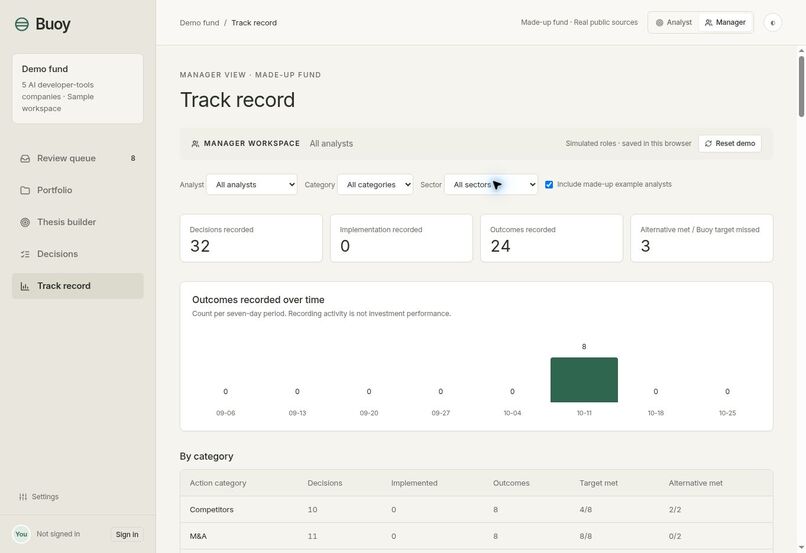
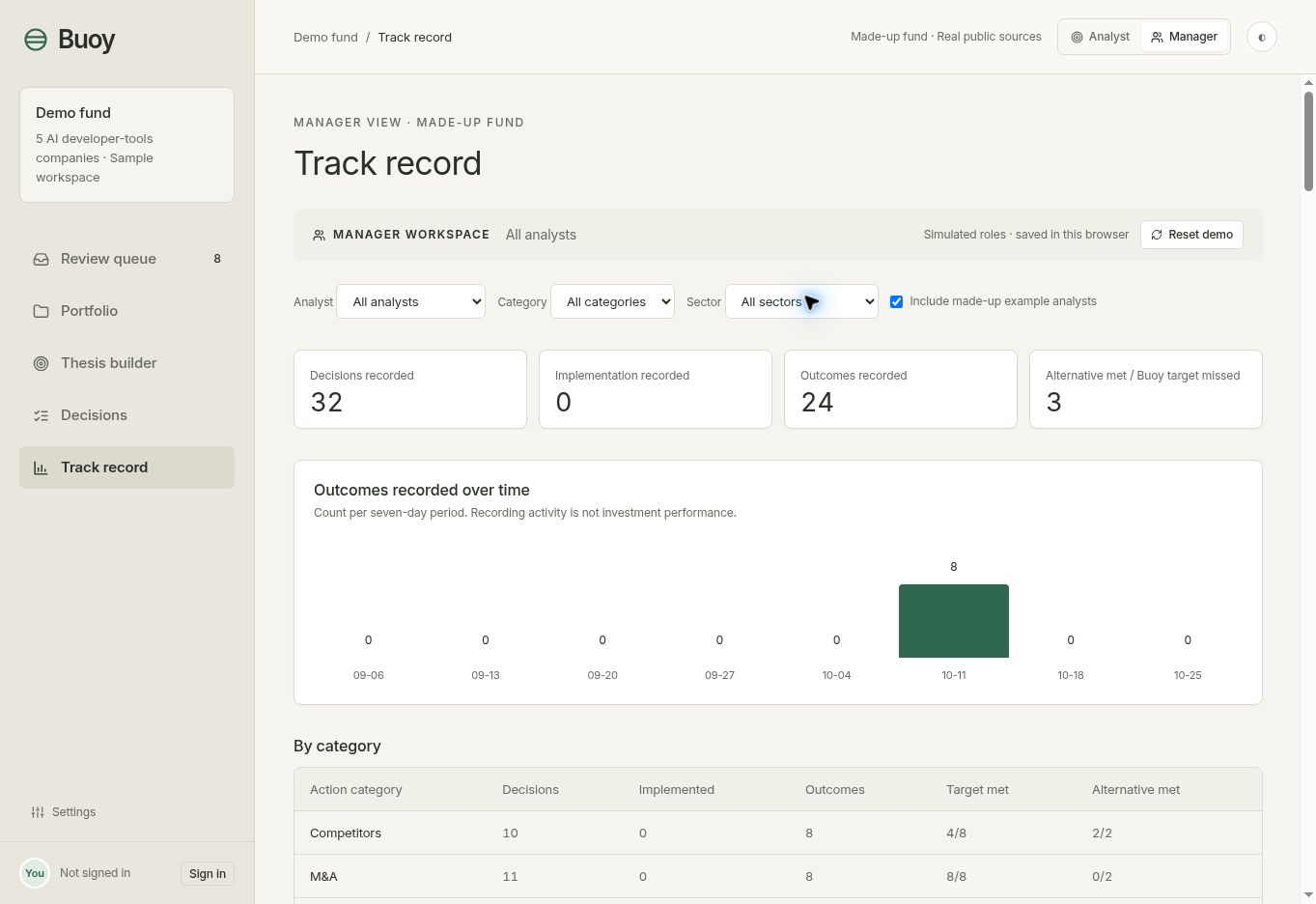
Track record: Explore recorded decisions and outcomes over time, filtered by analyst, category and sector. Shown with example data.
-
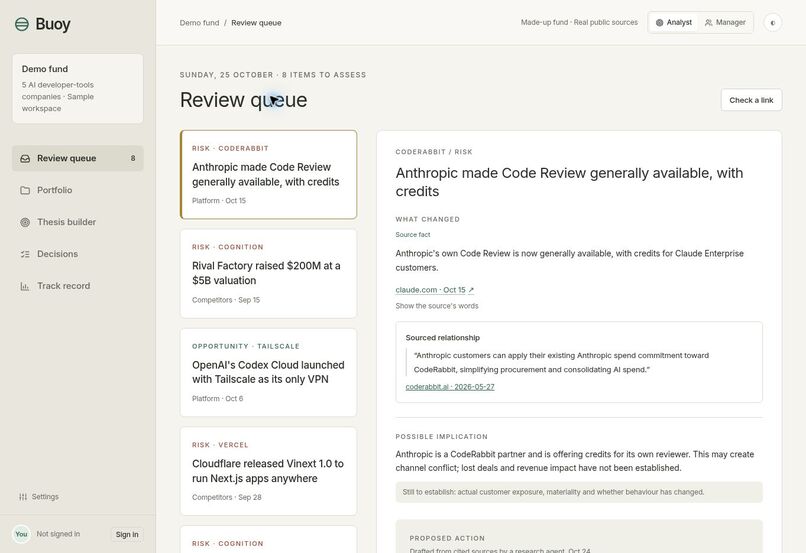
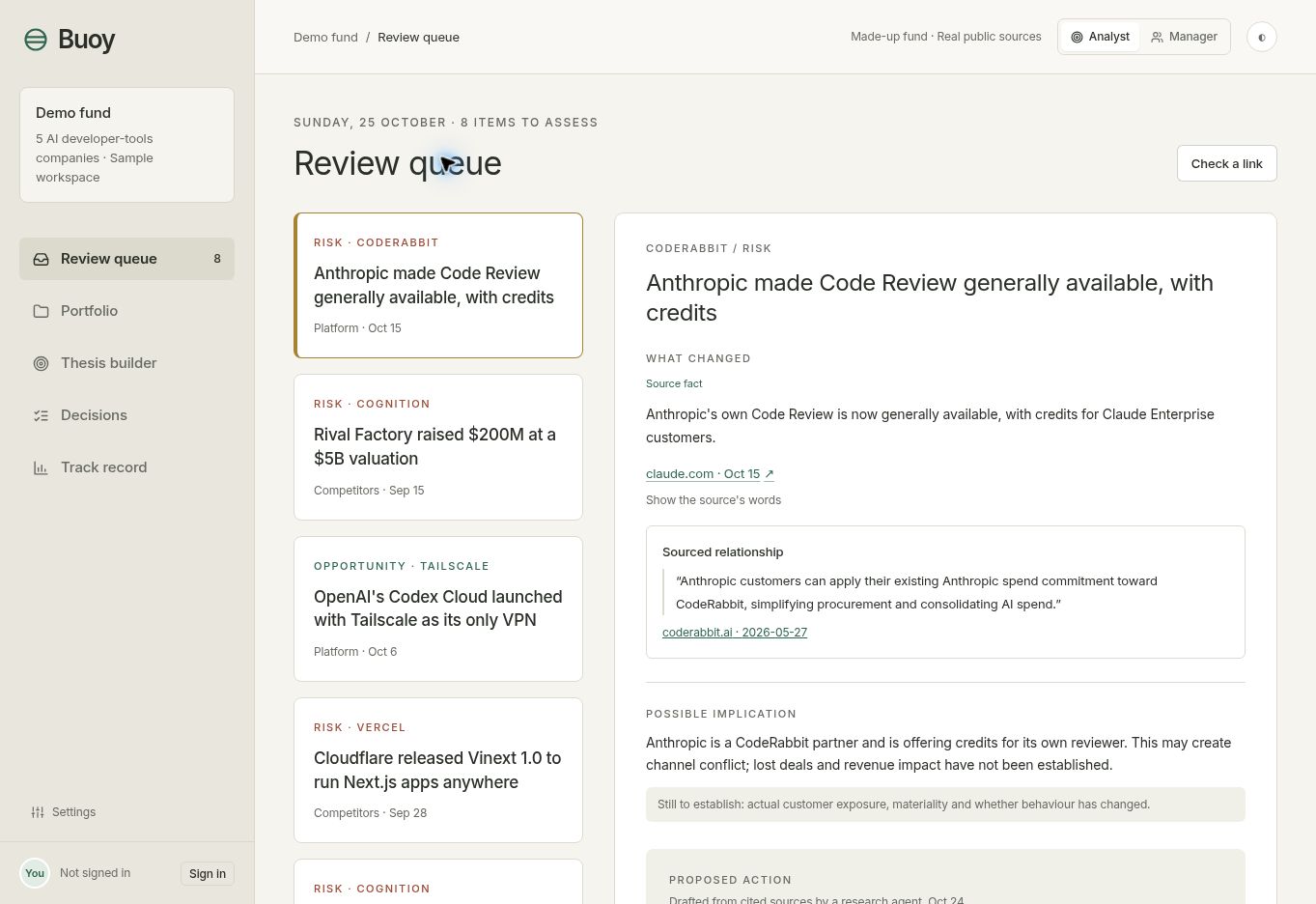
Review queue: Review portfolio risks and opportunities with source evidence, possible implications and suggested actions.
-
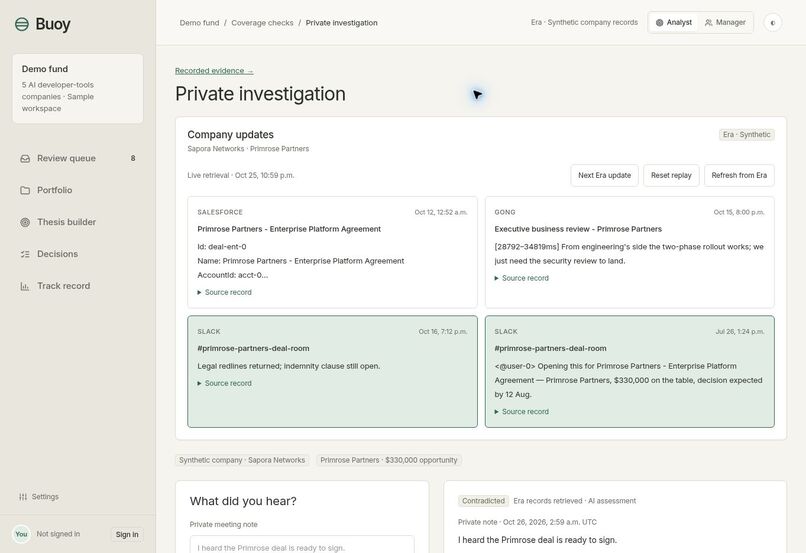
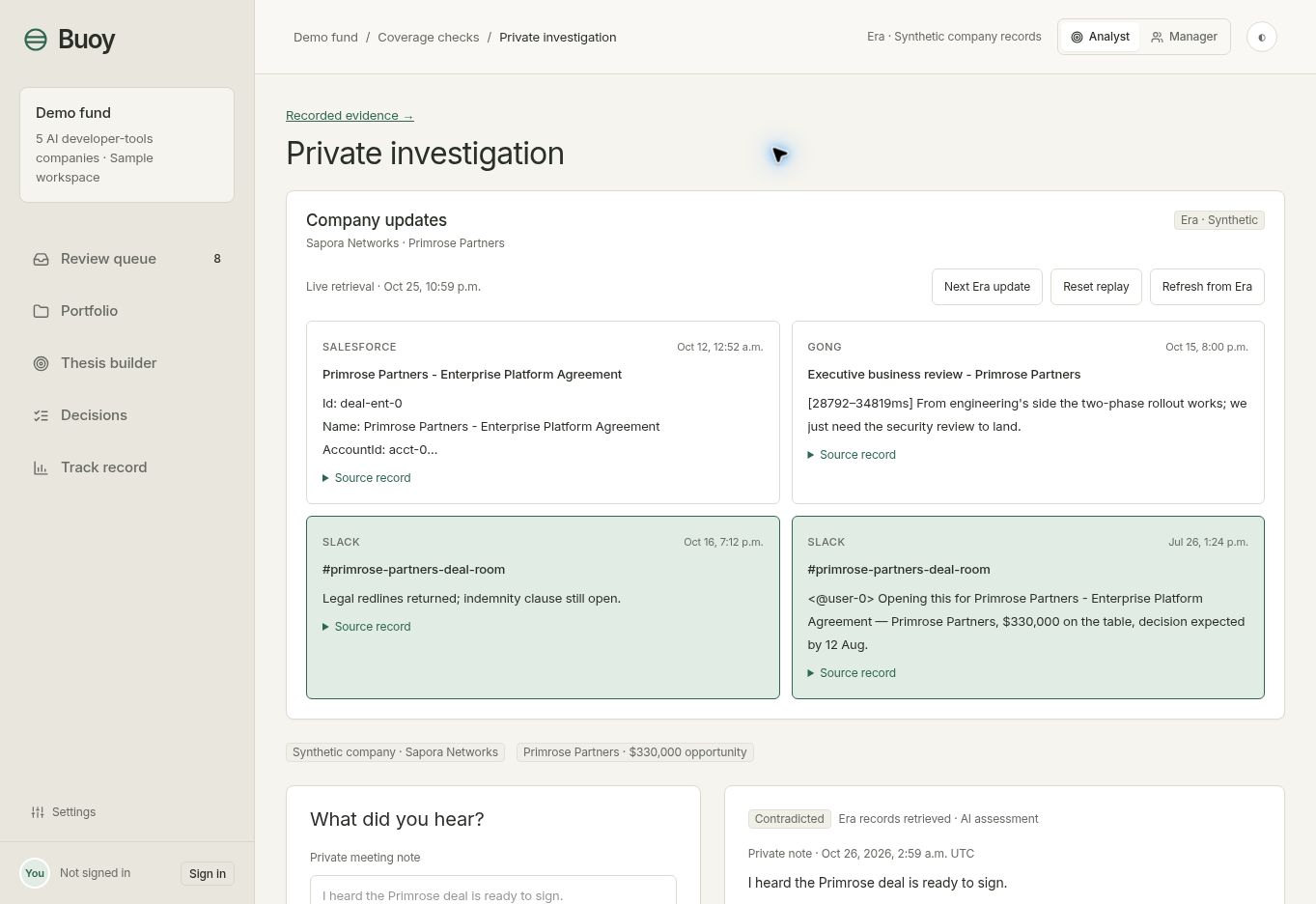
Era evidence: Check a meeting claim against synthetic Salesforce, Gong and Slack records.
-
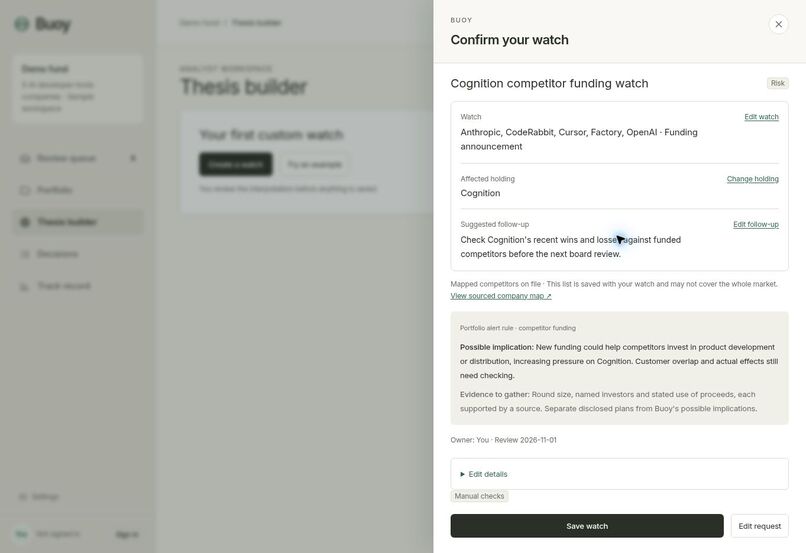
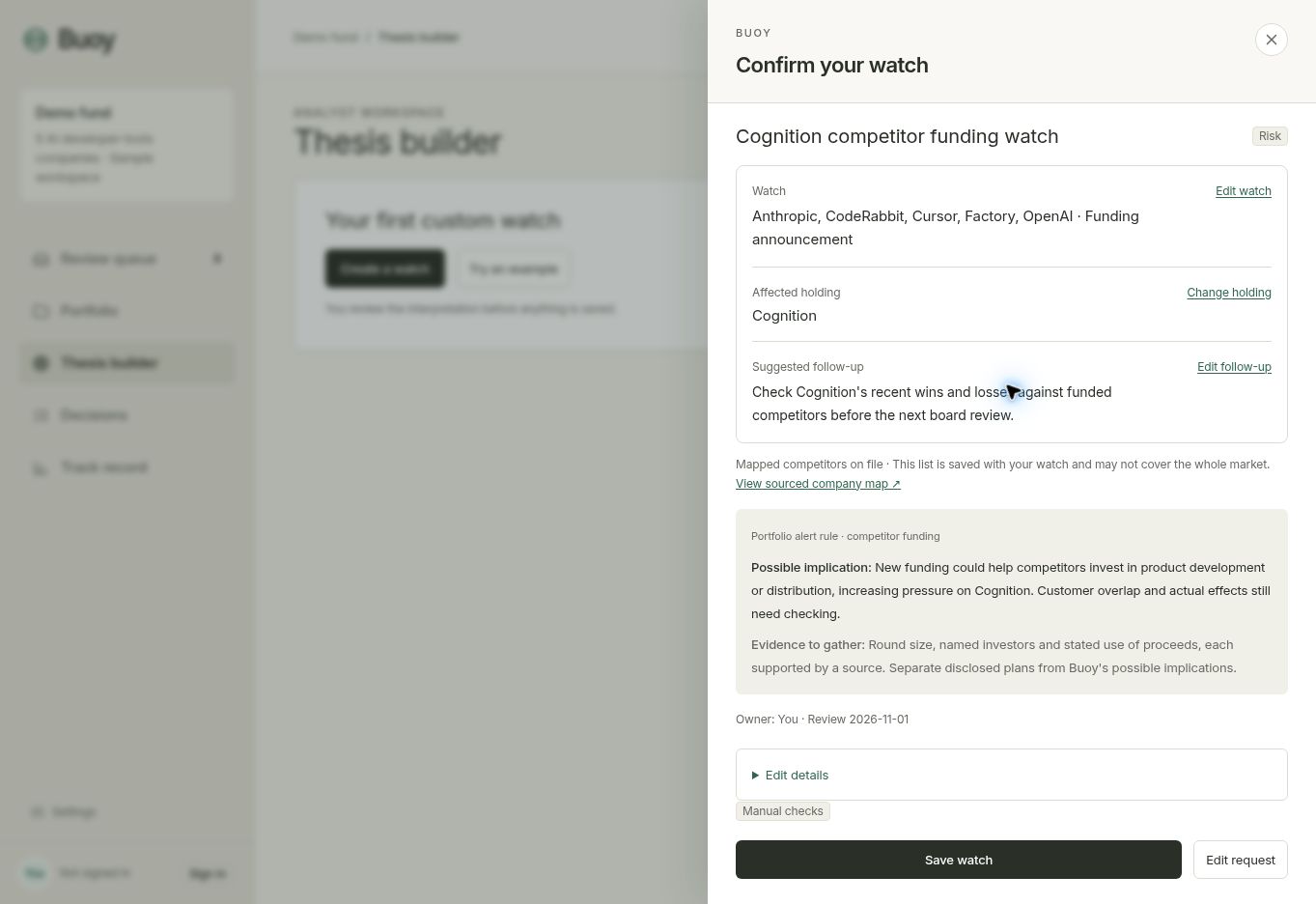
Custom watch: Turn an analyst’s question into an editable watch with evidence requirements and a proposed follow-up.
-
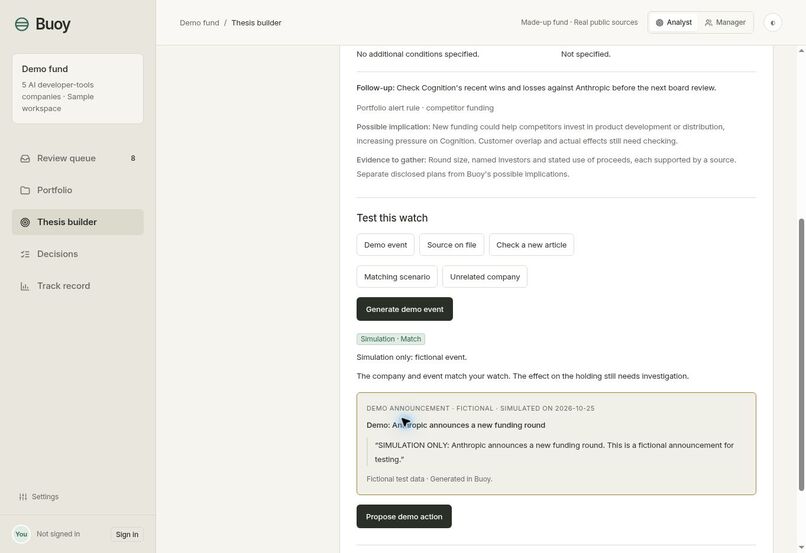
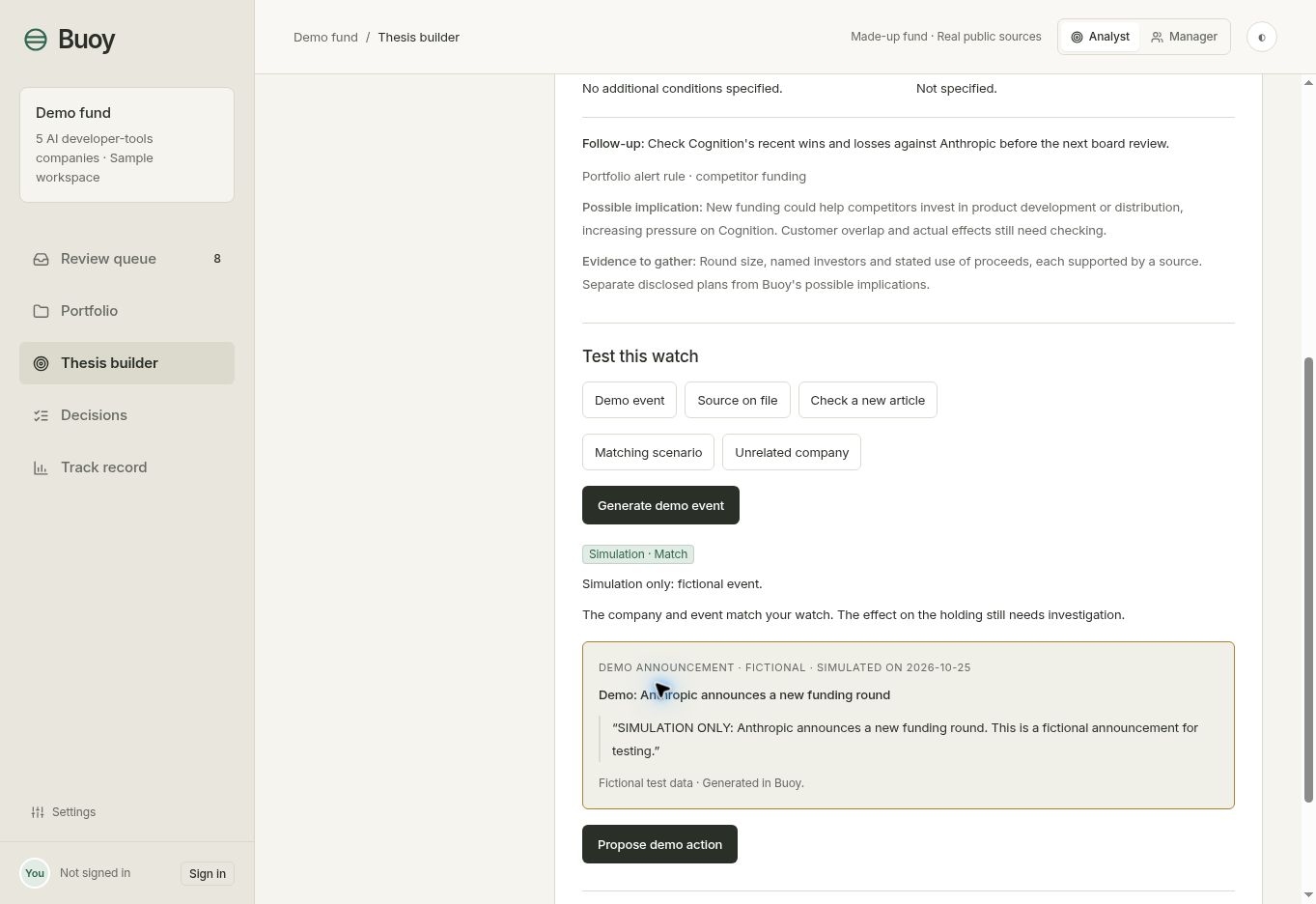
Simulated event: Test how a custom watch responds to a clearly labelled fictional funding announcement.
-
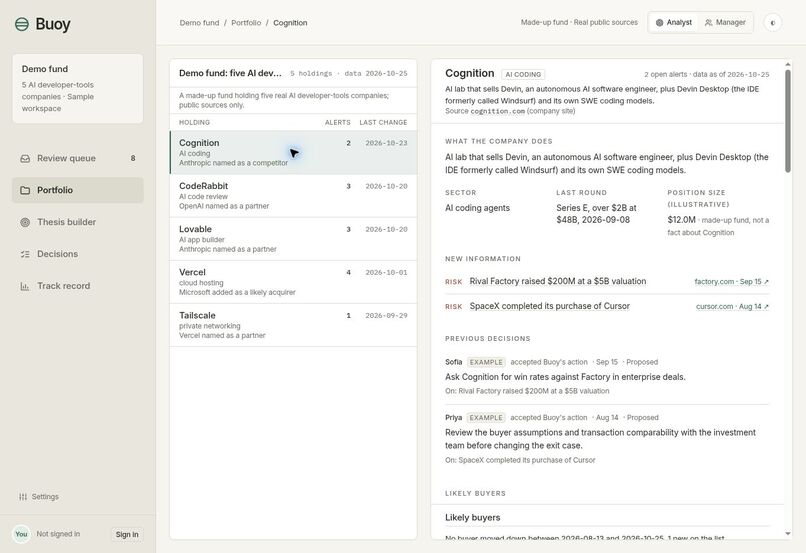
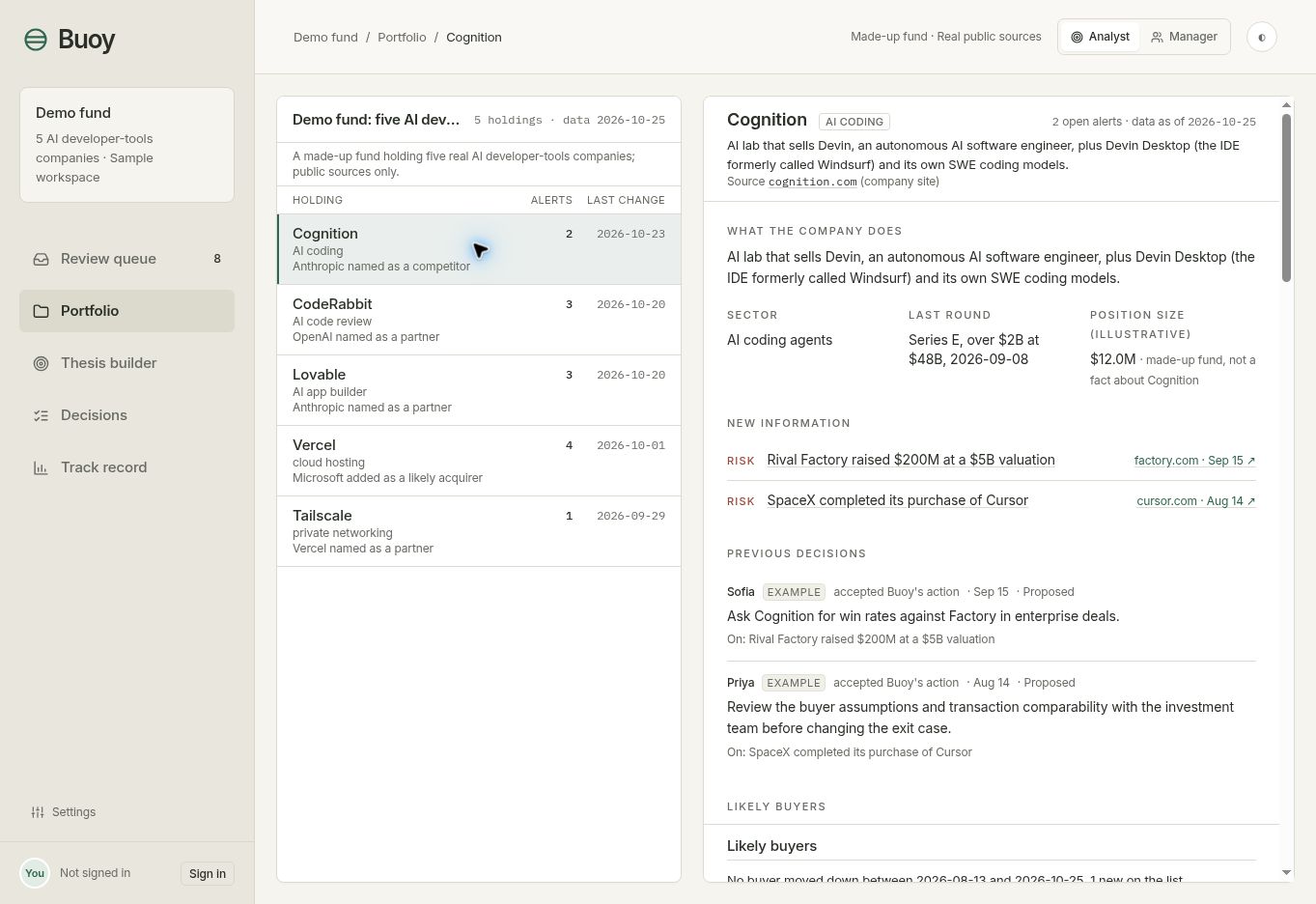
Portfolio: Explore holdings, company information, related events and previous analyst decisions.
-
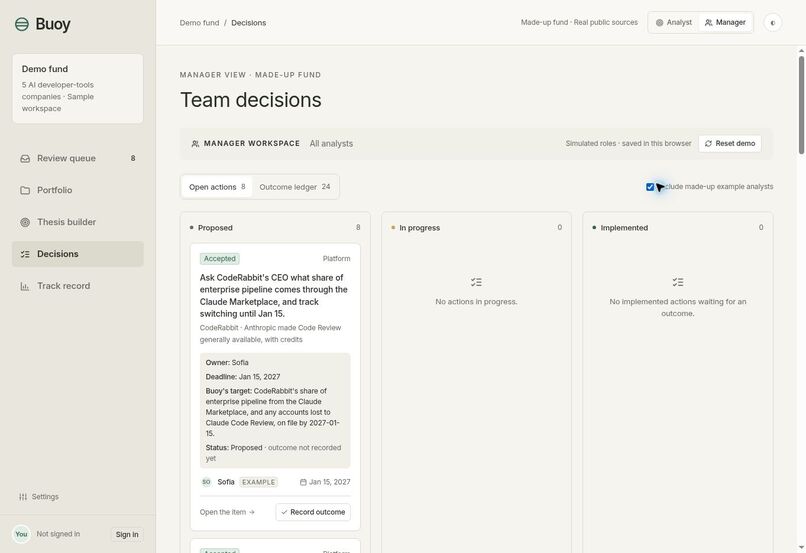
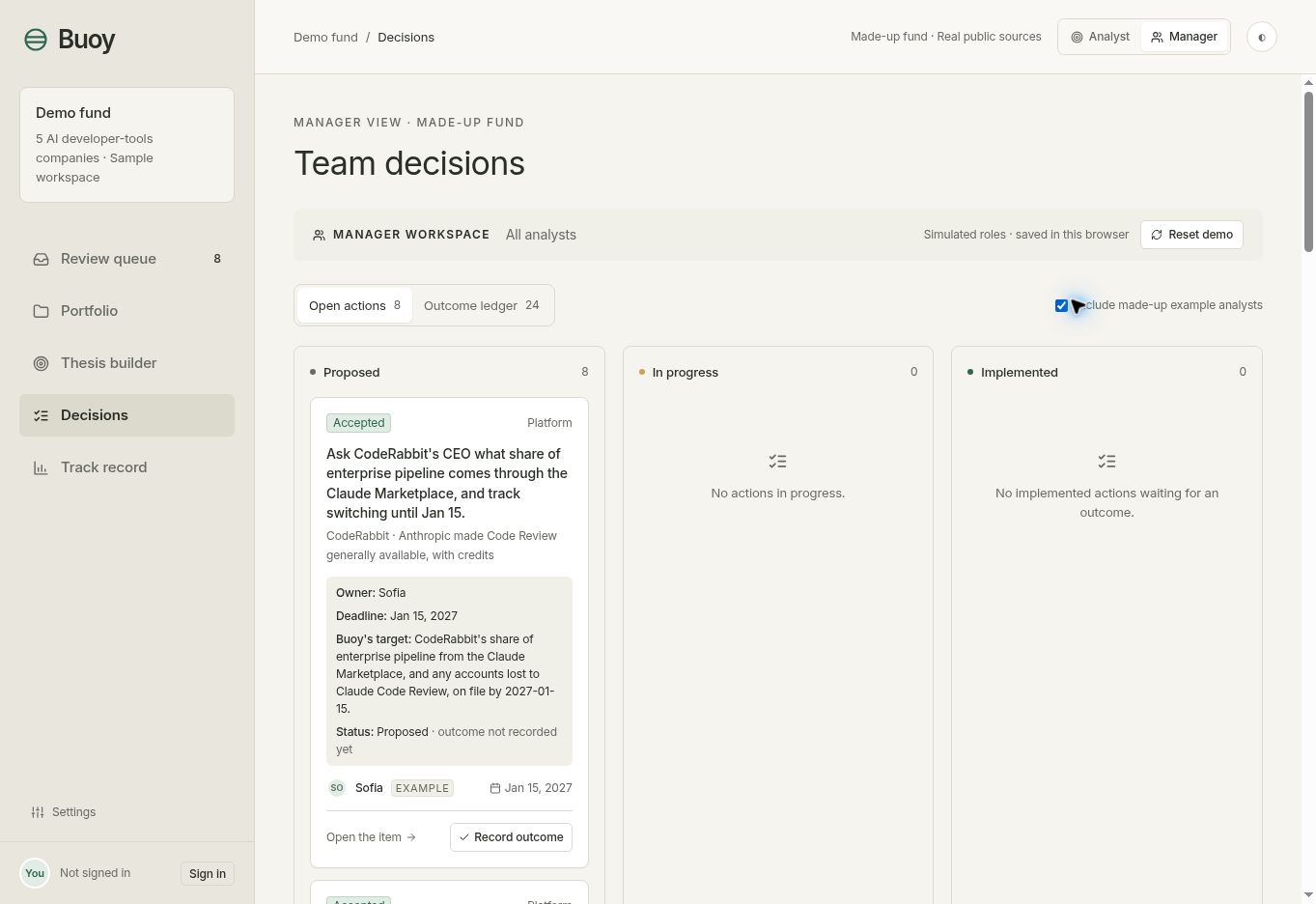
Manager decisions: Review team recommendations, assigned owners and deadlines. Shown with example analysts.
Inspiration
A portfolio company does not have to appear in a headline for that headline to matter.
A partner might launch a competing product. A rival might raise enough capital to change how it competes. A distribution agreement might create an opportunity worth discussing with the founder.
Buoy grew from experience in venture research and portfolio work. Finding information is only part of the job. Connecting it to a holding, understanding what remains uncertain and deciding what to investigate next requires judgment.
Investment teams do not run portfolio companies day to day. Their contribution often depends on noticing a consequential change, bringing a useful question to the founder and following through on the answer. Buoy was built to support that work.
What it does
Buoy gives analysts three starting points: a public event, a question they want to investigate, or something heard in a meeting.
- Public events: Buoy connects announcements to portfolio holdings through sourced customer, competitor, partner and potential buyer relationships. Each review item includes the evidence, possible implication and suggested follow-up.
- Custom watches: Analysts describe a question in plain language, such as which competitors of Cognition have raised funding and what that could mean for its competitive position. Buoy drafts an editable watch with evidence requirements and a follow-up. Analysts can manually check sources or test the watch with a clearly labelled fictional event.
- Meeting investigations: An analyst enters a claim and checks it against company records. The demonstration uses synthetic Salesforce, Gong and Slack records from Era by Eon to show how conflicting evidence changes an assessment.
Analysts review the evidence and can accept a suggested action or recommend an alternative. Recommendations carry an owner and review date into the manager's decision view. A track record lets the team revisit its core portfolio decisions and recorded outcomes.
When an analyst disagrees, the alternative and reasoning remain on record. The team can return to what it believed at the time, with the original context available.
How it was built
Buoy uses Next.js, React, TypeScript and Tailwind CSS, deployed on Vercel.
An explicit rules engine matches events to holdings through dated company relationships. Claude, accessed through the Anthropic API, handles structured extraction, watch interpretation, drafting and evidence reconciliation. Structured schemas and excerpt checks constrain the output, while analysts can inspect the underlying sources.
Exa supports public company and news research. Clerk handles authentication, and Supabase Postgres stores account-backed records. The public demo works without signing in and saves interactions in the browser.
Era by Eon supplies synthetic business records for the investigation workflow. Analysts can step through captured evidence or retrieve current records from the synthetic environment.
Challenges
The difficult part was preserving the distinction between evidence and interpretation throughout the workflow.
A source might establish that a competitor raised money while leaving the effect on a holding unknown. That uncertainty needs to survive extraction, the suggested action, the analyst's revision and the manager's review.
The investigation workflow presents the same problem across systems: a CRM opportunity marked "Commit" can coexist with unresolved security findings or legal terms. Buoy needs to expose those contradictions before suggesting a follow-up.
Another challenge was keeping recommendations intact through the analyst-to-manager handoff, including ownership, review dates and decision history.
What was learned
Early versions emphasized competitive analyst scoring. Building the workflow exposed a problem: completing a task, making a correct prediction and improving a company's outcome are different things.
An analyst can gather win/loss data on time while the original hypothesis turns out to be wrong. Recording task completion as investment judgment would confuse the two. Buoy now preserves decisions, reasoning and observed outcomes without collapsing them into a single score.
Customization also became simpler during development. Starting with the analyst's question made more sense than asking them to complete a long form before seeing whether the system understood their idea.
The most useful recommendation gives the analyst a specific uncertainty to investigate and a record they can revisit when more evidence arrives.
What's next
The next steps are dynamic portfolio onboarding, permissioned background monitoring, a unified action ledger and production fund isolation.
A focused fund pilot would then test whether the questions are relevant, whether recommendations lead to follow-through and what the team learns from the resulting evidence.
Buoy aims to help investment teams support portfolio founders through better questions, documented judgment and consistent follow-through.
Built With
- anthropic-api
- claude
- clerk
- era-by-eon
- exa
- next.js
- node.js
- postgresql
- react
- supabase
- tailwind-css
- typescript
- vercel
- zod


Log in or sign up for Devpost to join the conversation.