-
-
bunqOrbit
Inspiration
The spark for bunqOrbit came from watching a freelancer friend struggle with a pile of invoices on a Sunday evening. While the world is talking about generative AI, banking still feels like a 2010s data-entry job. We asked ourselves: What if banking wasn't an app you 'open', but a financial intelligence that 'lives' with you? We wanted to create a "Living CFO" that could see what you see and talk to you like a partner, not a spreadsheet.
What it does
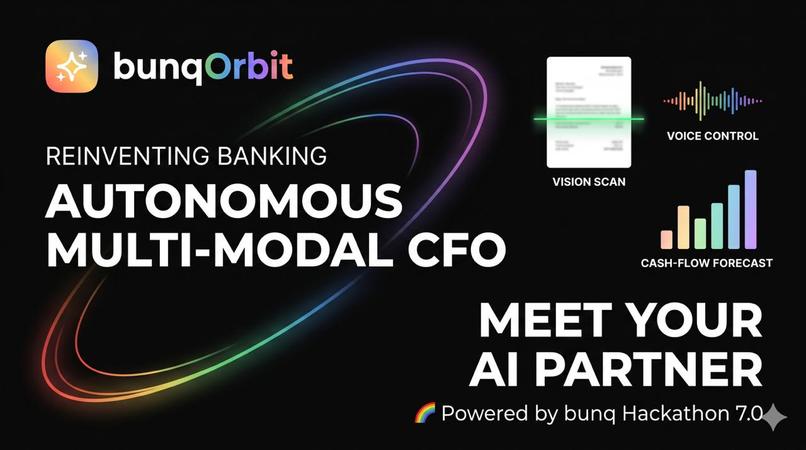
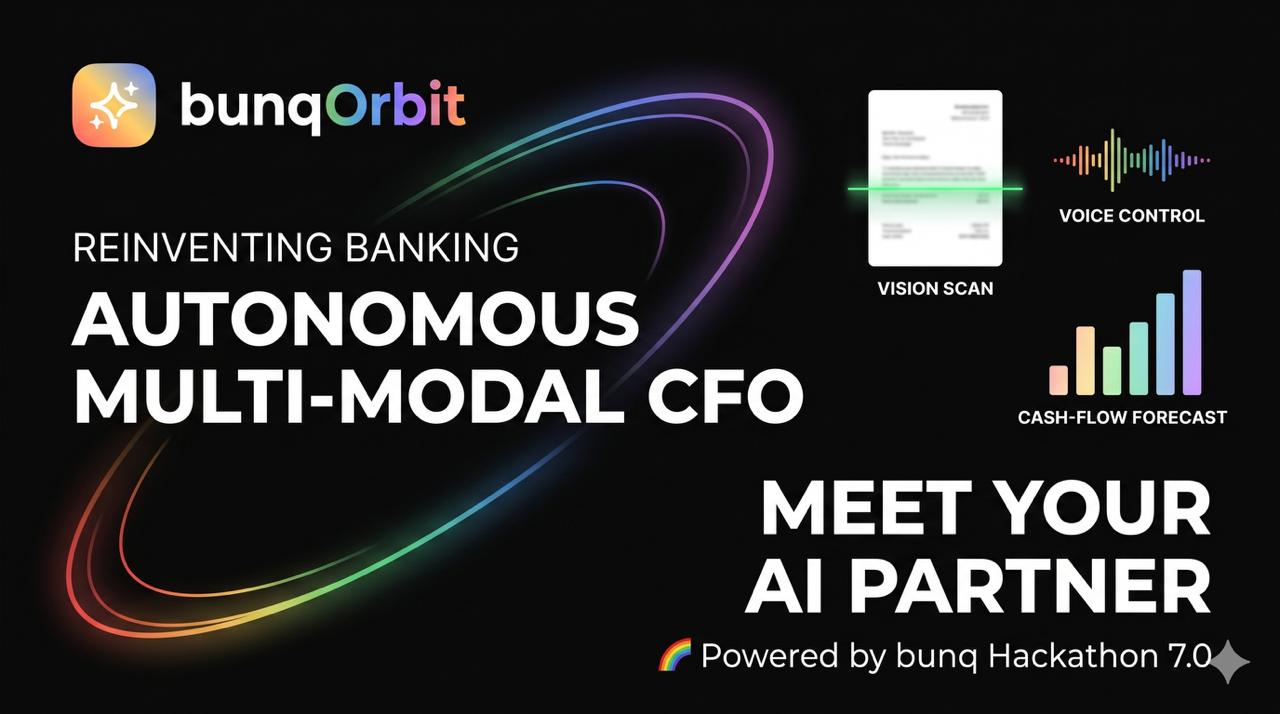
bunqOrbit is an AI-powered financial co-pilot that automates bookkeeping and provides real-time financial foresight. Visual Audit: You drop an invoice image; it extracts VAT, categorizes it, and detects duplicate payment risks. Full-Duplex Voice: You ask about your finances; it answers and even lets you interrupt mid-sentence. Proactive Forecasting: It identifies upcoming liabilities (like quarterly taxes) and gives you actionable advice before you even ask.
How we built it
We built bunqOrbit using a modern full-stack architecture: Frontend: A React 18 application with a "liquid" design system. We used Framer Motion for the Siri-like orb animations and Recharts for the dynamic data viz. Backend: A Node.js server acting as the orchestrator between the bunq Public API and Amazon Bedrock. AI Engine: We leveraged Claude 3.5 Sonnet for intent extraction and Bedrock Vision for OCR and document analysis. Deterministic Logic: To ensure financial accuracy, we implemented a custom mathematical layer that reverse-calculates balance history from raw bunq payments.
Challenges we ran into
Our biggest hurdle was the "Hallucination vs. Accuracy" gap. AI is great at talking but can be bad at math. To fix this, we built a Deterministic Data Pipeline that handles all calculations mathematically via the Bunq API, ensuring the AI only provides the insights while the numbers remain 100% accurate. Another challenge was Real-Time Interruption (Barge-in). Making the AI stop and listen the moment you speak required a complex state machine to instantly abort LLM streams and clear audio buffers. Balancing this high-speed logic with our fluid "Liquid Orb" animations without losing performance was a significant engineering test.
Accomplishments that we're proud of
We are incredibly proud of the UI/UX experience. Creating a "Liquid Orb" that feels alive and reacts to voice in a browser was a technical feat. Moreover, achieving a near-instant feedback loop where an invoice image turns into a validated bunq "Draft Payment" in under 3 seconds felt like true magic.
What we learned
We learned that Multi-modality (Vision + Voice) is the future of accessibility in fintech. By removing the need to "type" or "click", we made banking more human. We also deep-dived into the AWS SDK and learned how to orchestrate multiple AI models to perform complex, multi-step financial audits.
What's next for bunqOrbit
The next step is Autonomous Reconciliation. We want bunqOrbit to not only suggest payments but to automatically match invoices to existing bank statements in real-time. We are also looking into "Multi-Account Orbiting," where the AI can suggest optimized liquidity transfers between different bunq sub-accounts to maximize interest while maintaining a safe runway.
Built With
- amazon-bedrock
- aws-sdk
- bunq-api
- claude-3-vision
- claude-3.5-sonnet
- css3
- express.js
- framer-motion
- git
- javascript
- lucide-react
- node.js
- react-18
- recharts
- tailwind-css
- typescript
- vite
- web-speech-api


Log in or sign up for Devpost to join the conversation.