Inspiration
Shared expenses are rarely as simple as splitting a bill equally. Roommates, friends, couples, and travel groups often argue because real life is messy: someone was away for half the month, someone paid upfront, someone already reimbursed part of the bill, and the agreement is buried in a chat.
We wanted to solve a banking problem that happens outside the bank but ends inside it: money disputes. People already use screenshots, receipts, payment confirmations, PDFs, and voice notes to prove what is fair. bunq FairSplit brings all of that context into one place and turns it into an evidence-based settlement recommendation.
Our goal was to make shared expenses feel less awkward, less emotional, and more transparent.
What it does
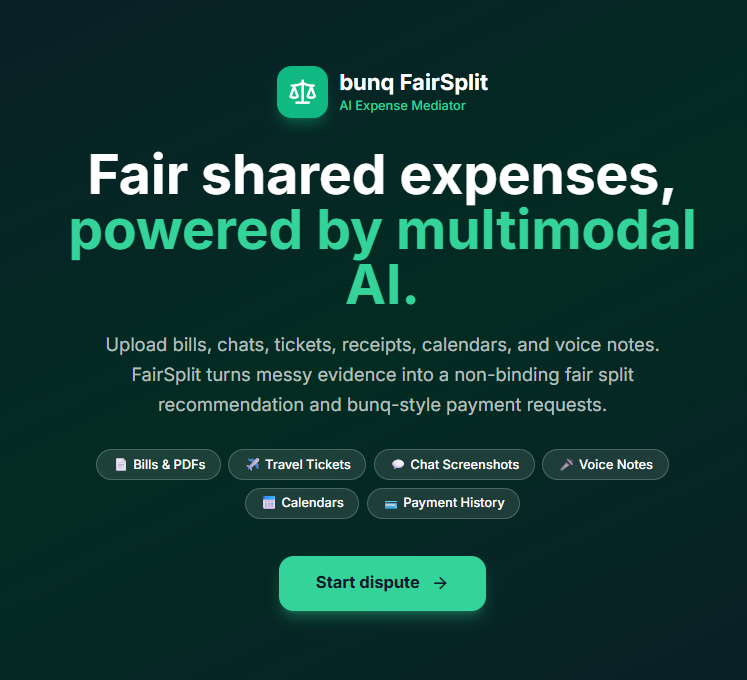
bunq FairSplit is a multimodal AI mediator for shared expense disputes.
Instead of blindly splitting a bill equally, FairSplit analyzes evidence from different sources, such as:
- utility bills
- receipts
- chat screenshots
- travel tickets
- calendar evidence
- payment history
- voice explanations
It then creates a clear financial timeline, separates the bill into fixed, baseline, and variable costs, and recommends a fair split based on the submitted evidence.
In our demo, three roommates receive a €180 utilities bill. An equal split would be €60 each, but one roommate proves she was abroad for 15 days. FairSplit does not simply remove her from the bill. It explains that fixed household costs still apply, while variable usage can be adjusted based on presence evidence.
The final recommendation is:
- Mel: €42
- Sarah: €69
- Noor: €69
Since Sarah paid the full bill upfront and Noor already paid €60, FairSplit generates bunq-style settlement actions:
- Mel owes Sarah €42
- Noor owes Sarah €9
The recommendation is non-binding, transparent, and challengeable. Users can upload more evidence, argue their case, and receive an updated explanation.
How we built it
We built bunq FairSplit as a working web prototype designed around a realistic dispute flow.
The app includes:
- a dispute setup screen
- participant profiles
- multimodal evidence cards
- an AI-generated timeline
- a cost decomposition model
- a fair split recommendation screen
- an argument/challenge interface
- bunq-style payment request generation
- a final bank-value pitch screen
We used a mock AI reasoning engine to simulate how multimodal AI would extract facts from uploaded evidence. The system identifies key facts such as travel dates, payment history, bill amount, prior agreements, and participant claims.
The core logic separates the bill into three parts:
- fixed costs, split equally
- baseline household usage, mostly shared
- variable usage, adjusted based on evidence
This lets the app move beyond simple arithmetic and explain why the final split is fair.
Challenges we ran into
The biggest challenge was avoiding the trap of building “just another bill-splitting app.” A normal split app can already divide €180 by three. We needed to show why multimodal AI actually matters.
Another challenge was fairness. It would be unrealistic to say that someone who is away uses zero electricity, because fixed costs, fridge usage, router usage, and other baseline household costs still continue. We had to design a model that feels reasonable, not overly simplistic.
We also had to be careful with the wording. FairSplit is not a legal judge and should not pretend to be one. It gives a non-binding recommendation based on submitted evidence. That makes the product more trustworthy, safer, and more realistic for a banking context.
Finally, we wanted to make sure the idea creates value for bunq, not only for the user. So we connected the recommendation directly to payment requests, group settlement, reusable house rules, and future shared banking flows.
Accomplishments that we're proud of
We are proud that FairSplit solves a real financial problem in a way that feels both practical and new.
The product does not use AI as a gimmick. Multimodal AI is central to the experience because the evidence behind money disputes lives in many formats: chats, bills, tickets, payments, screenshots, and voice explanations.
We are also proud of the fairness model. Instead of saying “equal split” or “one person wins,” FairSplit explains the reasoning clearly and lets users challenge the result. This makes the product feel like a mediator rather than a black-box decision system.
Most importantly, we created a concept that has value for both users and bunq. Users get less awkward disputes and clearer settlements. bunq gets more payment requests, more group engagement, stronger payment context, and a potential premium feature for shared households, students, freelancers, and groups.
What we learned
We learned that the best AI banking ideas are not always the flashiest ones. The strongest ideas are the ones where AI connects messy real-world context to actual banking actions.
We also learned that fairness is not the same as equality. Splitting a bill equally can be mathematically correct but socially unfair. A useful AI system needs to explain assumptions, handle uncertainty, and let people provide more context.
Another important lesson was that language matters. Calling the system an “AI judge” makes it sound too legal and risky. Calling it an “AI mediator” makes the role clearer: it helps people reach a fair resolution, but it does not make a legally binding decision.
What's next for bunq FairSplit
The next step would be integrating FairSplit with real bunq payment flows.
Future improvements could include:
- real document and receipt parsing
- voice-to-text evidence submission
- automatic matching of payments to disputes
- reusable house rules for recurring bills
- group expense history
- privacy-safe settlement links for non-bunq users
- support for travel groups, shared subscriptions, groceries, rent, and freelancer disputes
- confidence scoring based on evidence quality
- optional human-readable proof packs for resolved disputes
Long term, FairSplit could become a shared-finance layer inside bunq. Instead of only helping users move money, bunq could help users understand what is fair, resolve conflicts faster, and settle directly through the app.

Log in or sign up for Devpost to join the conversation.