-
-

-
Dashboard

Buno
Inspiration
The whole idea for Buno started when we were reading a research paper, The Budgeting App Trap: When Spending Information Backfires. After reading it, we came to a critical understanding of an enormous flaw in current finance monitoring apps. Even though personal finance is such a saturated space, almost none offer a way to guide user behavior, they just dump exact data on you and hope for the best.
Most apps assume that the more precise your data is, the better choices you'll make. But the research showed something totally counterintuitive: when people see an exact, real-time remaining balance near the end of the month, they view it as "permission" to spend every last dollar. That exactness strips away any psychological safety cushion.
We built Buno to fix that. Instead of triggering balance obsession, Buno uses qualitative spending guidance, context from recent purchases, and behavioral nudges to help people make calmer, smarter financial decisions.
What it does
Buno is a research-backed budgeting app that changes how spending info is shown to prevent overspending.
Here is what you can actually do in the app:
- Set and track a monthly budget
- Log your daily expenses manually
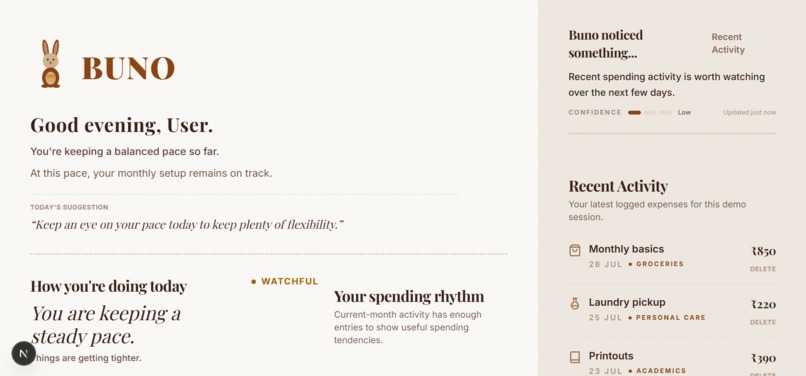
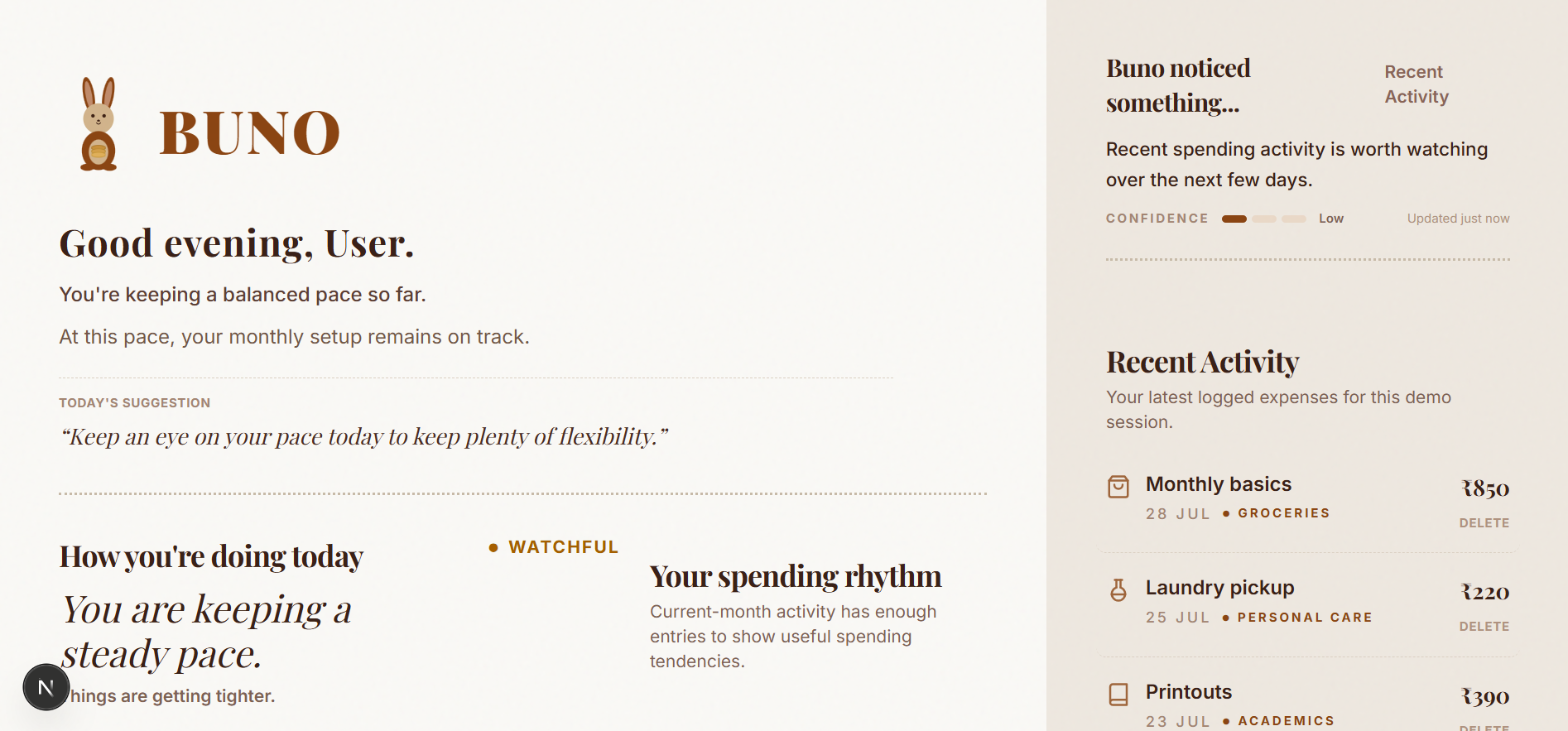
- Check a qualitative spending window instead of staring at a precise dollar balance
- Review your recent transactions in a clean feed
- Get smart pattern insights based on your recent habits
At its core, Buno isn't just another tracker. It’s built to actively shape better spending habits by replacing numeric anxiety with calm, intentional signals.
How it works
Under the hood, Buno relies on deterministic, rule-based logic to handle the actual math. But instead of showing a stark "$142.50 left" prompt, it translates that financial state into intuitive, qualitative guidance, like letting you know you're in a "safer" or more "watchful" spending window.
On top of that source-of-truth logic, we added a pattern interpretation layer. It takes your recent expenses, summarizes them deterministically in code, and generates a quick qualitative insight. Because the core math is kept separate from the insights, the official budget status remains completely reliable, explainable, and aligned with our original research goals.
How we built it
We built Buno as a Next.js/React web app using TypeScript, CSS, and a demo-first architecture.
Our build process was super iterative. We bounced ideas back and forth with ChatGPT to refine the behavioral finance concepts, scope down our feature list, and write solid prompts. Then, we used Codex to dive into the codebase, implement scoped edits, and wire up features cleanly without breaking existing structure.
A few principles kept us on track:
- Keep the core budget calculations strictly rule-based and deterministic.
- Never show exact remaining balances in the main decision area.
- Make sure every feature has a safe fallback.
- Keep things clean and demo-friendly rather than over-engineering the backend.
The UI features a quick setup flow, a simple expense logger, the main Today’s Spending Window card, a Pattern Insight card, and a recent transaction feed.
Challenges we faced
Our biggest hurdle was actually restraint. When building a finance app, the knee-jerk reaction is to stack up features—more analytics, more charts, and hyper-precise numbers. Overcoming that instinct to stay true to our research was tough, because we had to prove that less precision actually leads to better results.
It was also a delicate balancing act. Strip away too much detail, and the app feels broken or useless. Add too much precision back in, and you ruin the core premise. Finding that sweet spot took a lot of tweaking.
Technically, we had to make sure:
- The rule-based budget engine remained the ultimate source of truth.
- Pattern insights failed gracefully if data was missing or weird.
- Bad expense inputs wouldn't crash the frontend.
- We could pull all of this off under tight hackathon time constraints.
What we learned
The biggest takeaway from Buno? Better decisions don't come from giving people more data; they come from designing how that data is presented.
We got hands-on experience combining behavioral research, hard-coded logic, and thoughtful UX framing to solve a real human problem. On the development side, it gave us a much deeper appreciation for structuring full-stack apps, separating hard logic from AI/interpretation layers, and building resilient fallback systems.
Accomplishments we're proud of
- Turned a real behavioral research paper into a working, usable product.
- Successfully designed a budgeting flow that eliminates balance-driven spending anxiety.
- Maintained a 100% deterministic, explainable core budget engine.
- Got the full MVP loop working smoothly: users can log expenses, view their qualitative status, and get behavioral context all in one clean flow.
What's next for Buno
We want to take Buno further by validating our core hypothesis with real users and polishing the experience.
Next on our roadmap:
- Polishing the dashboard design and UI feel.
- Improving mobile responsiveness for on-the-go logging.
- Adding persistent storage for historical expense data.
- Running user tests to see how different wording choices and visual ranges impact real-world spending decisions.
Ultimately, we want to build Buno into a fully realized, research-backed finance product that changes how people interact with their money.
Built With
- Next.js
- React
- TypeScript
- JavaScript
- CSS
- Rule-based budget logic
- Prompt-constrained pattern interpretation
- Behavioral finance research
Built With
- chatgpt
- codex
- css
- github
- javascript
- next.js
- openai
- react
- typescript


Log in or sign up for Devpost to join the conversation.