-
-

logo
-
interface
-
process
-
bill
-
workflow

💡 Inspiration
BulkCart was inspired by a simple but important problem: why should households pay retail prices individually when an entire neighborhood could buy together at wholesale rates?
In Indian residential societies, families regularly purchase essentials such as rice, atta, and cooking oil. Buying in small quantities often means higher prices, while organizing a group purchase through WhatsApp messages and spreadsheets creates confusion, makes price comparisons difficult, and complicates quantity planning.
We wanted to turn neighborhood buying into a smarter, more transparent, and more organized experience—one where collective demand creates collective savings.
🛒 What BulkCart Does
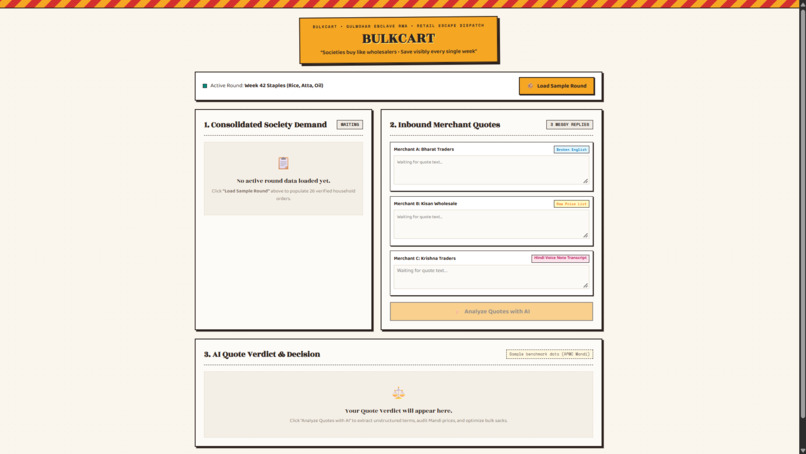
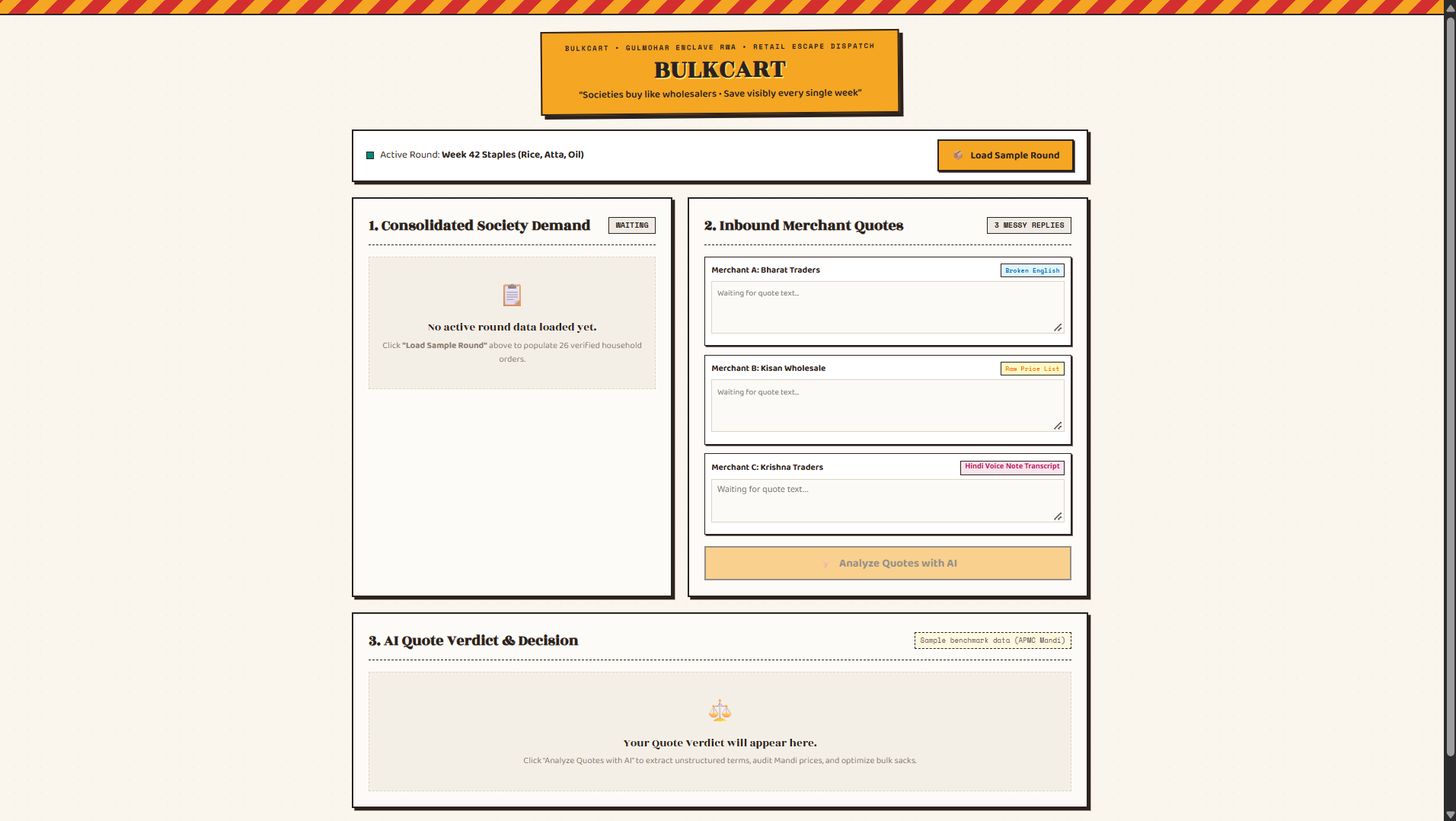
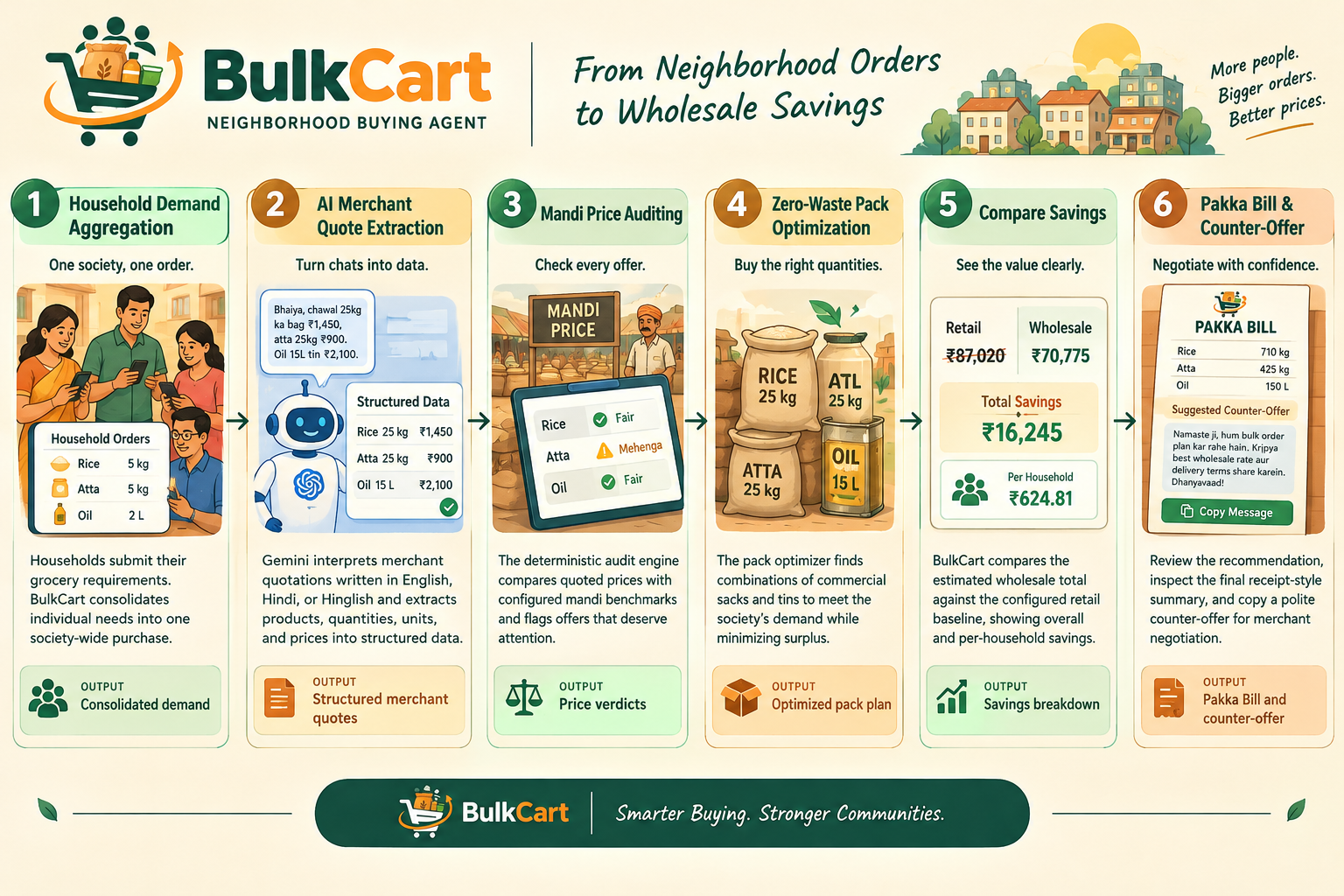
BulkCart is an AI-powered neighborhood buying agent that helps residential societies combine household demand, compare wholesale merchant quotes, and coordinate bulk purchases.
Instead of treating every household as an individual buyer, BulkCart brings their requirements together so societies can negotiate like wholesalers.
Key capabilities include:
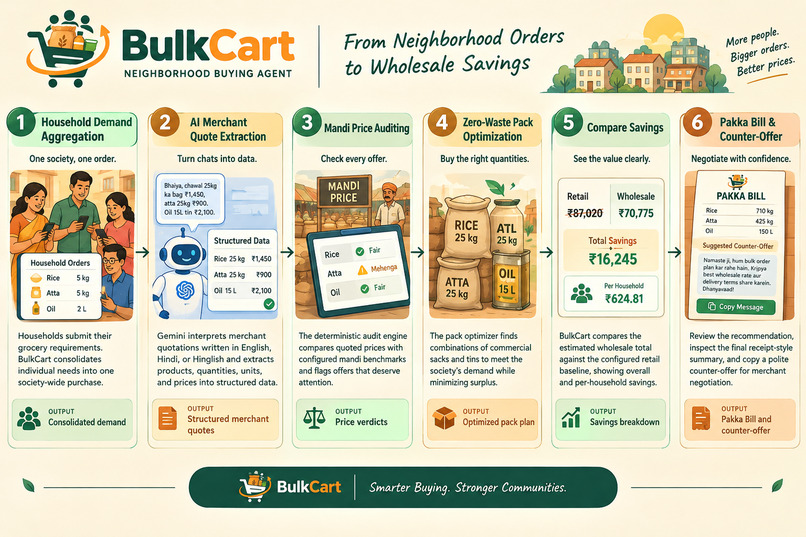
- Collective Demand Aggregation: Combines orders from multiple households into a consolidated purchasing requirement.
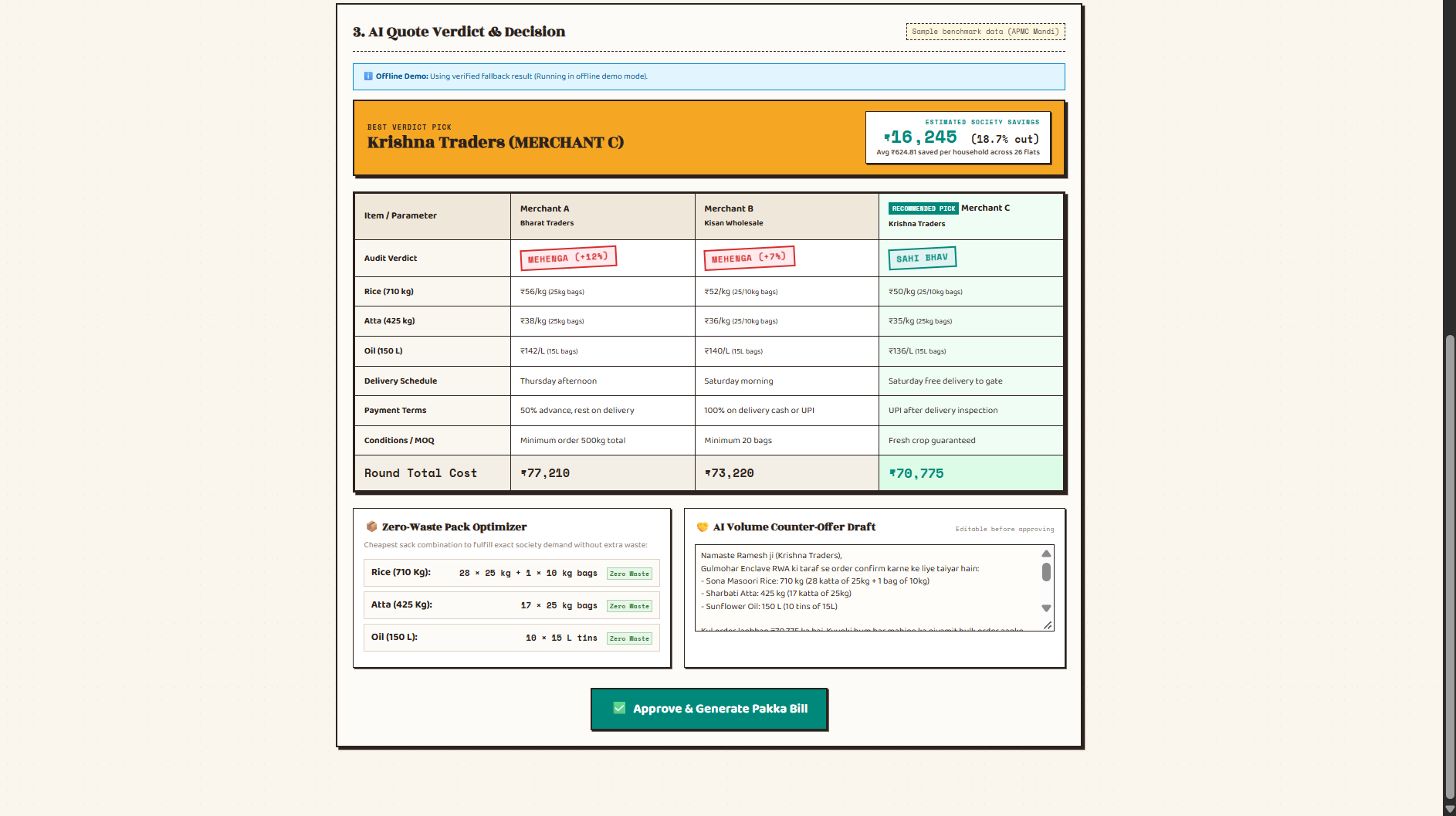
- AI-Powered Quote Extraction: Uses Google Gemini to interpret unstructured merchant quotations in English, Hindi, and Hinglish and convert them into structured data.
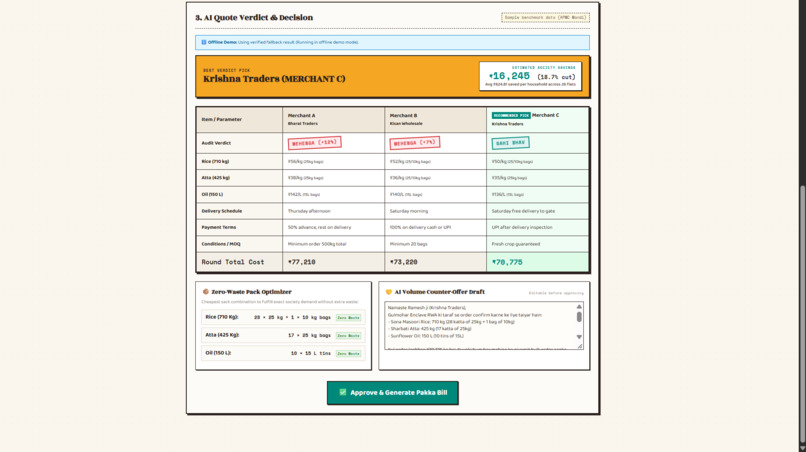
- Mandi Price Auditing: Compares merchant quotations against configured wholesale mandi benchmarks and retail baselines to help identify fair and expensive offers.
- Zero-Waste Pack Optimization: Calculates suitable combinations of commercial sacks and tins to meet the required quantities while minimizing excess.
- Transparent Savings Analysis: Estimates total savings and the benefit per household compared with retail purchasing.
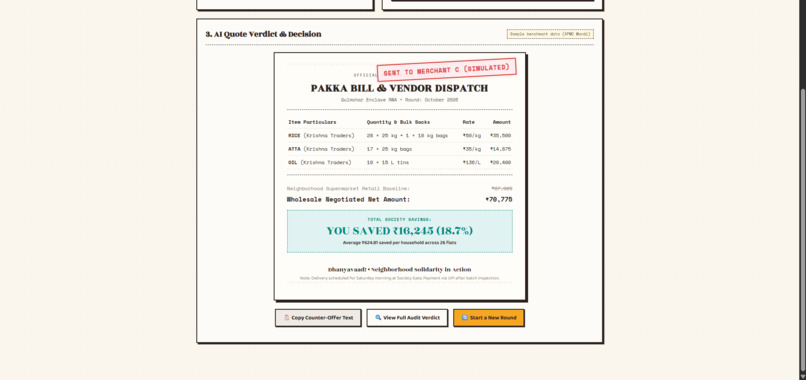
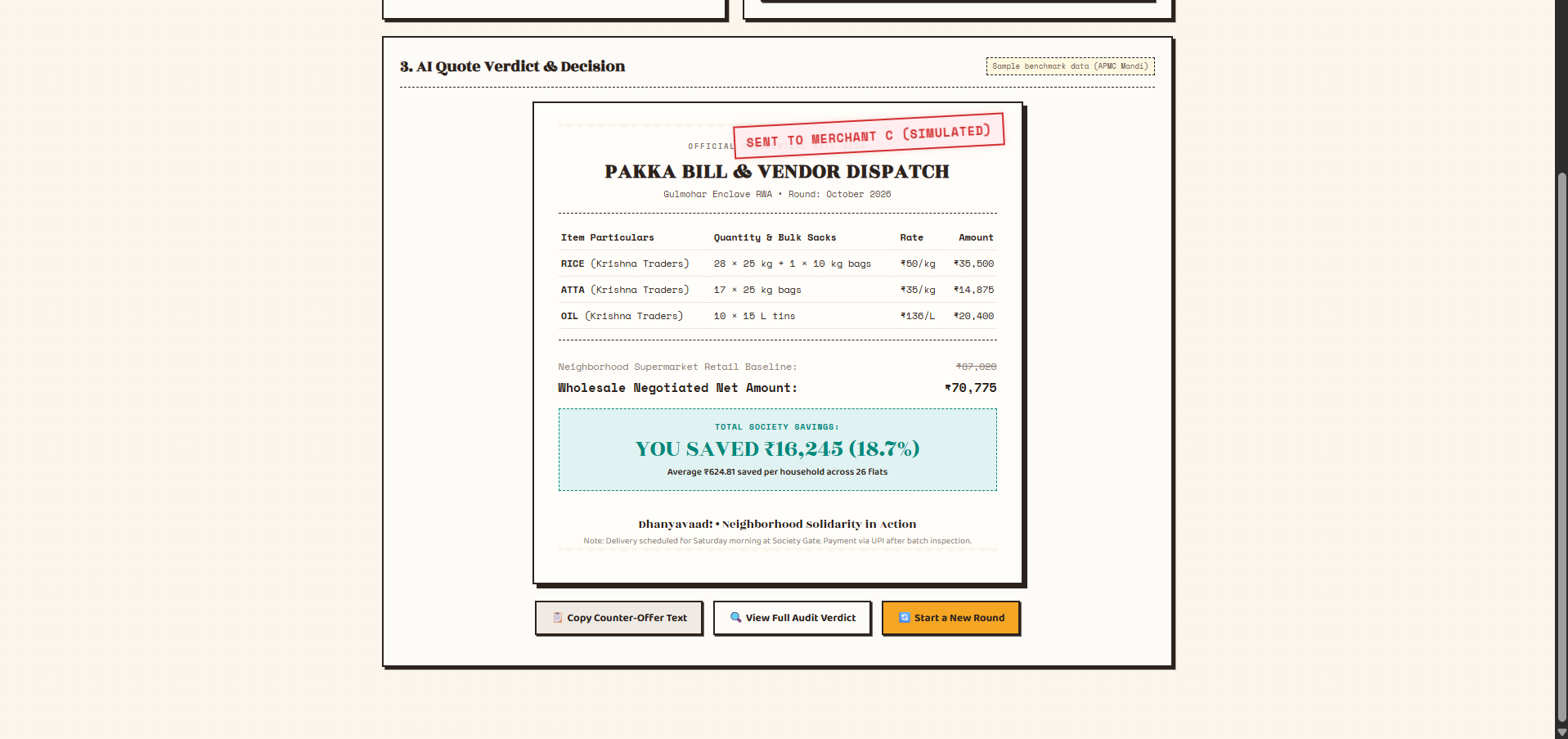
- Pakka Bill: Presents the purchase analysis as a clear, receipt-style resolution with suggested counter-offers that can be copied for merchant negotiations.
⚙️ How We Built It
We built BulkCart with a lightweight architecture designed to keep AI-powered interpretation separate from critical calculations.
- Python and FastAPI power the backend and REST API endpoints.
- Google Gemini 2.5 Flash extracts structured information from unstructured merchant quotes.
- Pydantic validates extracted information against defined data schemas.
- A deterministic Python math engine audits prices against configured benchmarks and calculates savings.
- A pack optimization engine determines combinations of commercial package sizes that satisfy consolidated demand.
- HTML, CSS, and JavaScript power the interactive Retro Kirana dashboard, quote comparison experience, and animated Pakka Bill receipt.
- Pytest and automated test scripts help verify the core calculation and extraction workflows.
We also designed a fallback mechanism that uses cached sample extraction data when the AI service is unavailable or times out. This allows the sample experience to remain testable without requiring a live Gemini API key.
🚧 Challenges We Faced
1. Understanding unstructured merchant quotations
Wholesale quotations are not always presented in a consistent format. Prices, units, product names, and quantities can appear in informal messages, Hindi, Hinglish, or mixed-language text. We addressed this by using AI-based extraction with structured schemas and validation.
2. Keeping financial calculations reliable
AI can interpret language, but important price comparisons and savings calculations need predictable results. We separated AI extraction from deterministic arithmetic so that the financial calculations follow explicit rules.
3. Matching demand with commercial package sizes
A society's total requirement may not align neatly with standard sack or tin sizes. We built a dedicated optimization engine to calculate practical combinations and minimize surplus.
4. Making savings understandable
Raw numbers are not enough to build trust. We designed the interface around understandable price verdicts, consolidated savings, per-household benefits, and a receipt-style summary.
5. Building a resilient demonstration
External AI services can fail or take too long to respond. A cached fallback and automated tests help keep the core demonstration usable and make important logic easier to verify.
📚 What We Learned
Building BulkCart helped us explore how AI can solve a practical coordination problem rather than simply generate text. We learned the importance of structured outputs, schema validation, deterministic business logic, resilient API integrations, and automated testing.
Most importantly, we learned that useful AI products need more than a language model. They need reliable calculations, clear workflows, meaningful data, and an interface that helps people make decisions with confidence.
🌱 What's Next?
BulkCart is a working proof of concept that demonstrates how neighborhood demand aggregation, AI-assisted merchant quote analysis, and deterministic purchasing logic can work together.
Future improvements could include live mandi price integrations, verified merchant listings, real household order collection, WhatsApp integration, and secure payment and delivery workflows.
Our vision is to make collective buying accessible to residential societies and help communities make more informed purchasing decisions.
BulkCart — Societies buy like wholesalers. Save visibly, every week.
Built With
- artificial-intelligence
- community
- css
- e-commerce
- fastapi
- gemini-2.5-flash
- generative-ai
- google-gemini
- html
- javascript
- optimization-algorithms
- pydantic
- pytest
- python
- rest-api

Log in or sign up for Devpost to join the conversation.