BuktiESG
Inspiration
Small organisations are increasingly asked to complete sustainability questionnaires, but most do not have an ESG team or specialised software. Their information is scattered across utility bills, spreadsheets, HR records, policies and emails.
The real challenge is not calculating another ESG score. It is determining:
- Which questions can be answered confidently?
- What evidence supports each answer?
- What information is missing, outdated or inconsistent?
- Which gaps should be addressed first?
- Who is responsible for the next step?
We created BuktiESG to solve this operational gap. “Bukti” means evidence in Malay, reflecting our belief that every sustainability claim should be traceable to reliable evidence.
What it does
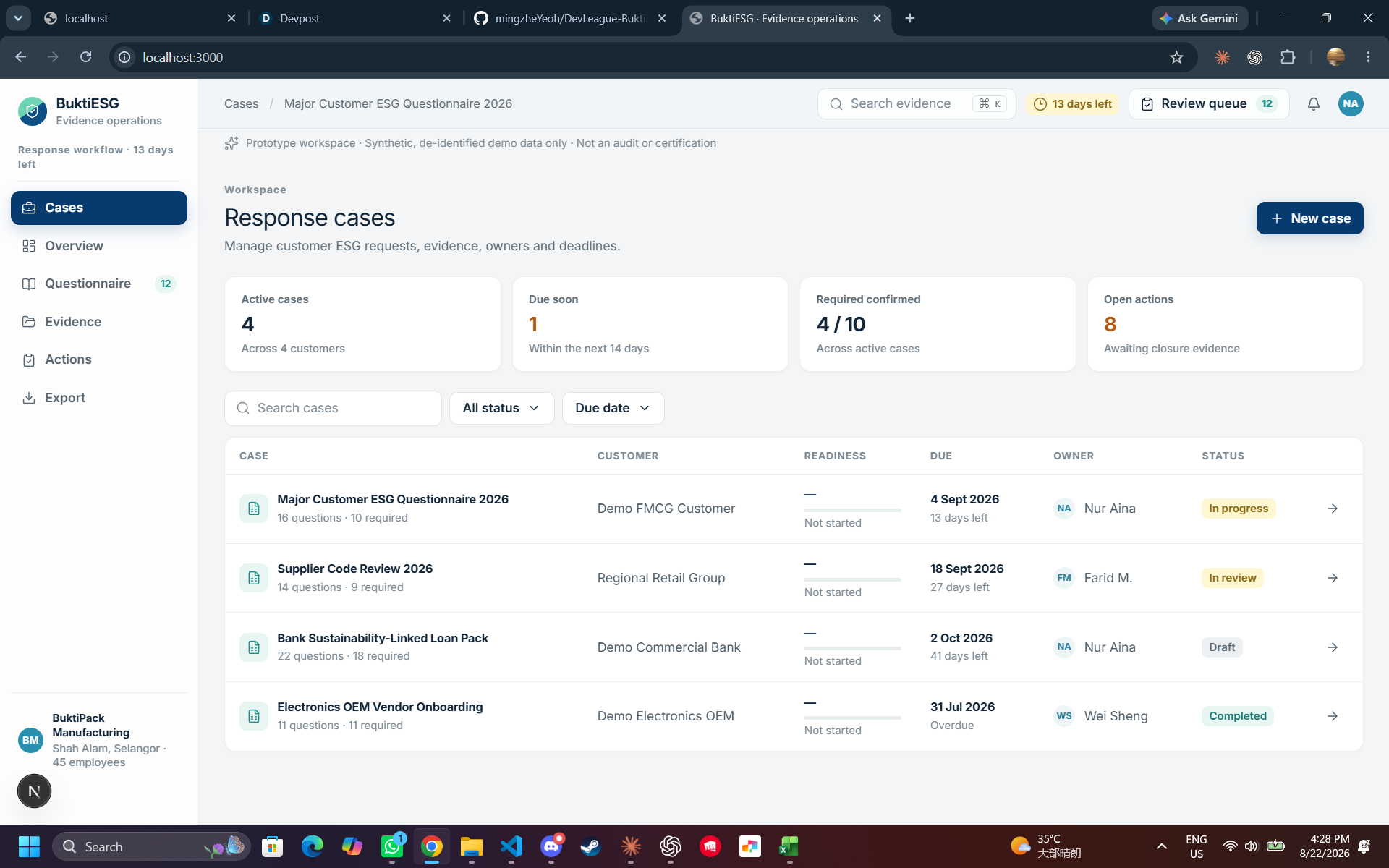
BuktiESG helps a resource-constrained organisation manage a customer ESG request from questionnaire to action.
Users can:
- Create a response case with a customer, deadline and reporting boundary.
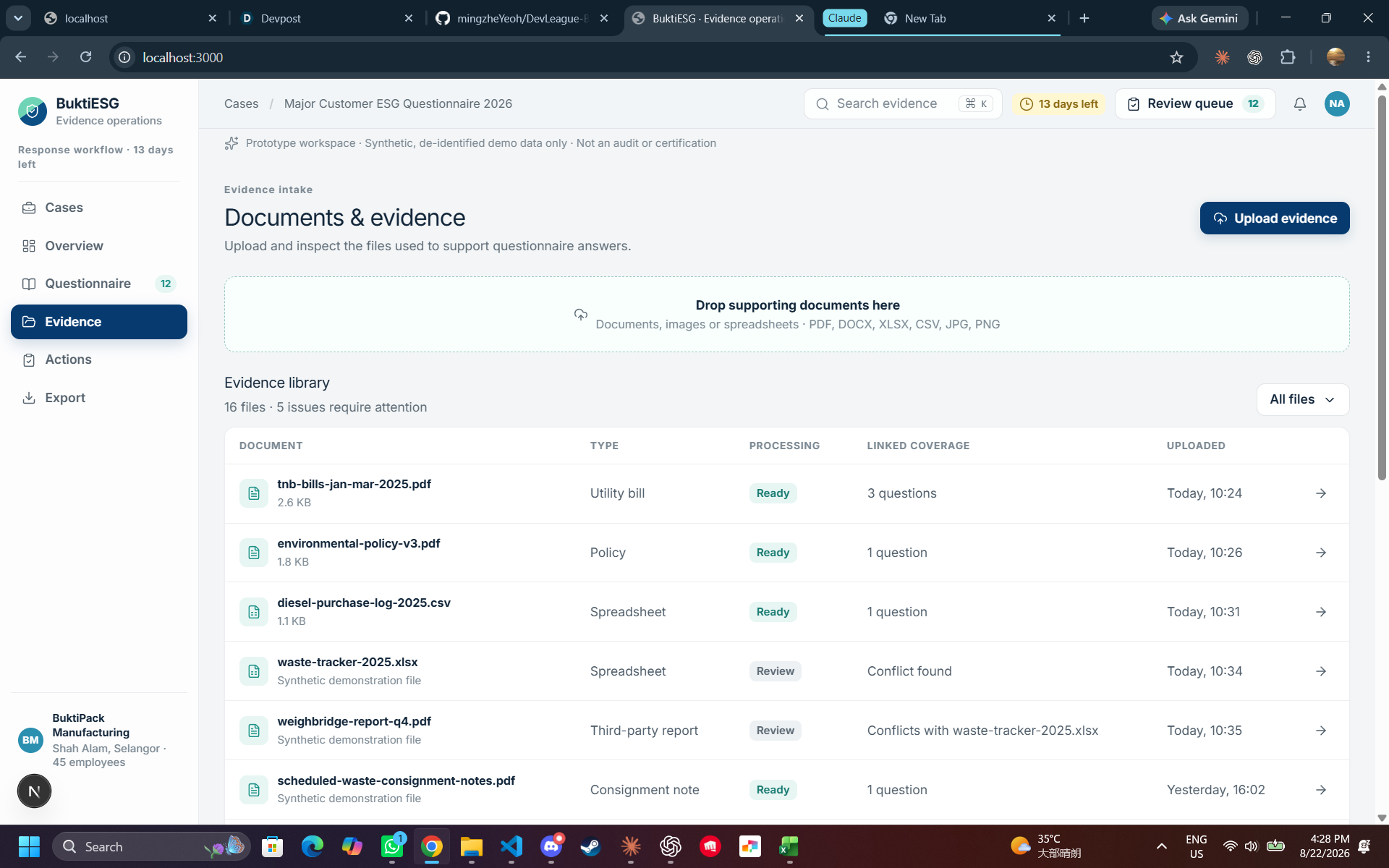
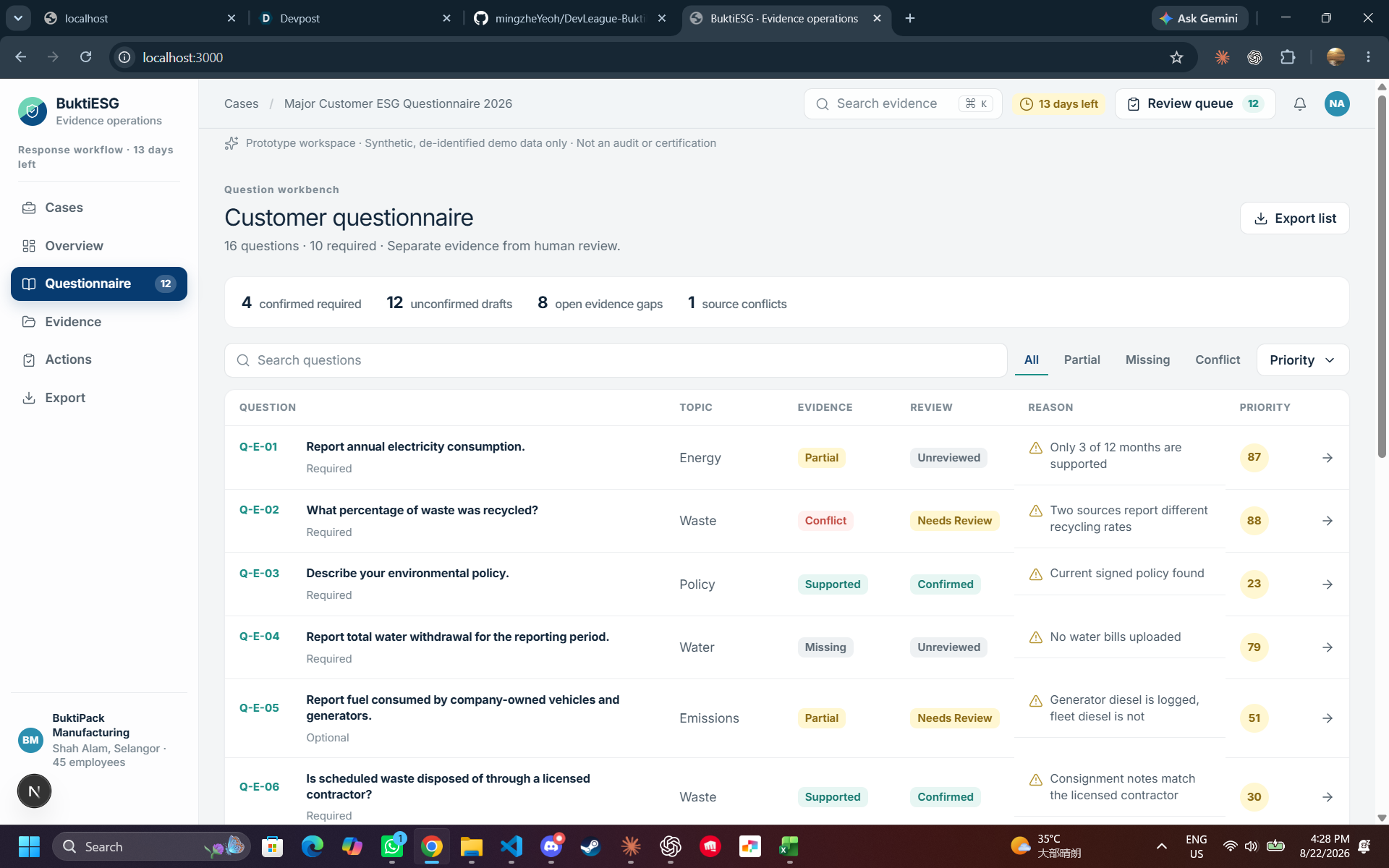
- Upload a questionnaire in PDF, DOCX, XLSX or CSV format.
- Organise detected questions into environmental, social and governance areas.
- Connect answers to supporting documents.
- distinguish between verified, partial, inconsistent, outdated, unsupported and missing information.
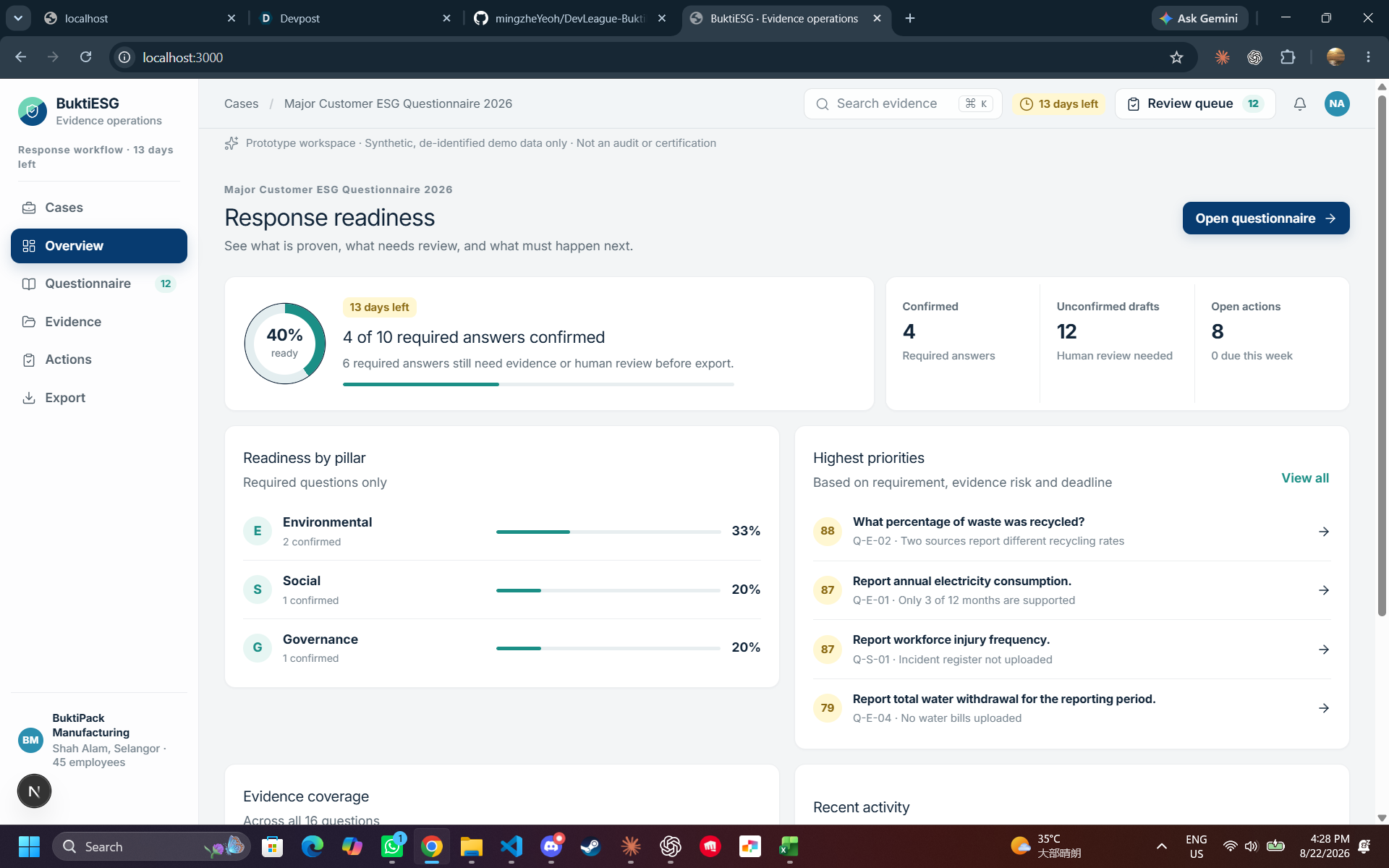
- Prioritise gaps using explainable factors such as urgency, customer requirements, operational impact and evidence quality.
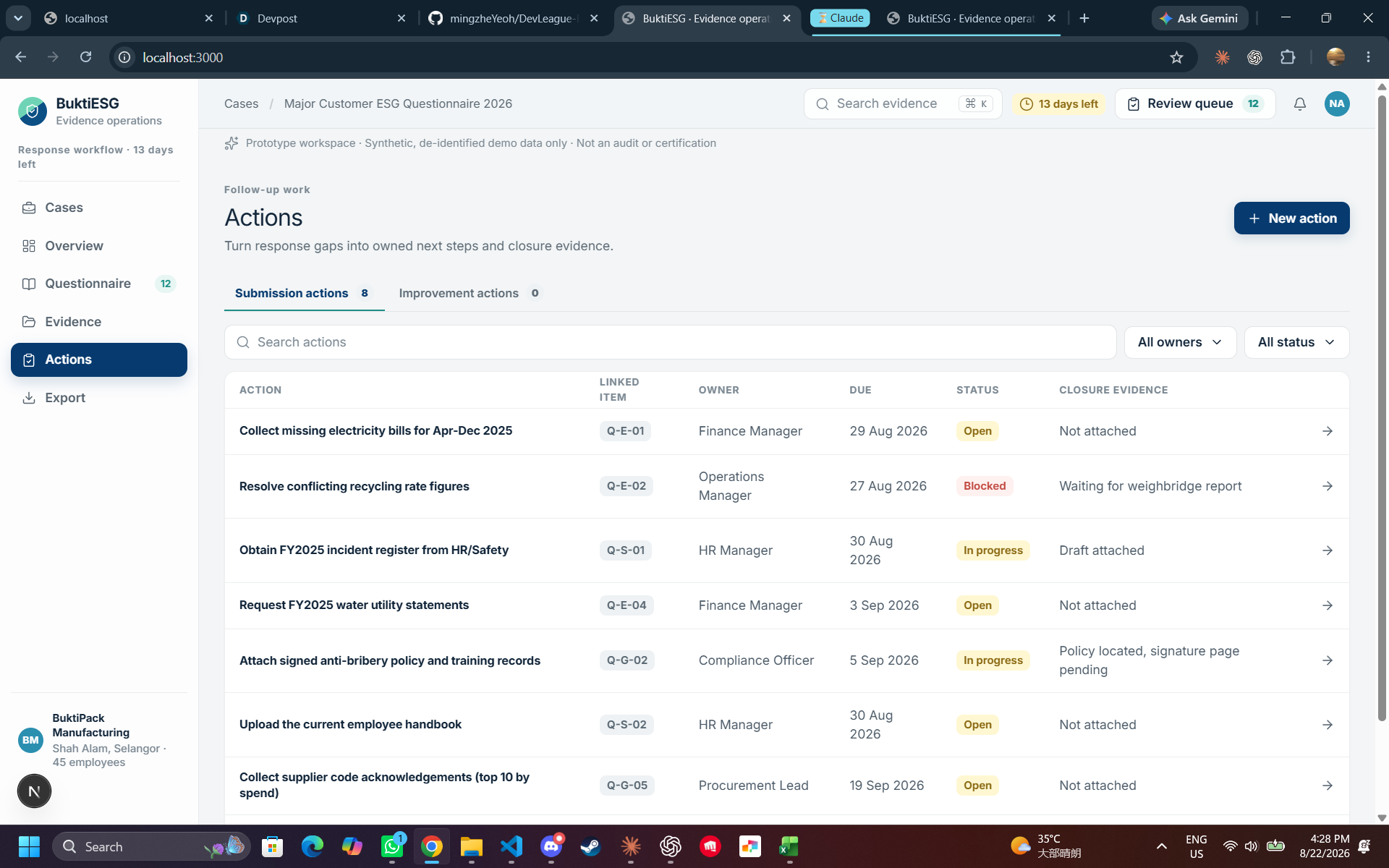
- Convert a priority issue into an action with an owner, next step, deadline and progress status.
- Produce a clear summary for management or the requesting customer.
BuktiESG keeps user-provided information, extracted evidence and system-generated suggestions visibly separate. The system can recommend an action, but it does not present that recommendation as a verified fact.
How we built it
We designed BuktiESG around an evidence-first workflow rather than a traditional ESG scorecard.
Each questionnaire item becomes a structured record connected to its reporting period, evidence requirements and current evidence status. Uploaded information is analysed and matched to relevant questions, while deterministic rules identify conditions such as missing documents, conflicting figures and expired certificates.
The prioritisation model combines customer urgency, issue significance, evidence gaps and operational risk. Each priority remains explainable so that users understand why it appears at the top of the action list.
The interface was designed as a guided case workflow so that a non-expert can move from setup to questionnaire review, evidence collection and action tracking without needing to understand ESG terminology first.
Challenges we faced
The biggest challenge was maintaining honesty when working with incomplete information. A document may mention a value without proving it, while two valid-looking documents may contain conflicting numbers.
We therefore had to design clear evidence states and ensure that the system never silently overwrites a user’s answer or converts an AI suggestion into a fact.
Another challenge was balancing depth with usability. ESG covers many topics, but small organisations need a short and practical list of actions—not another complex dashboard containing hundreds of indicators.
What we learned
We learned that sustainability becomes useful when it is connected to ordinary operational responsibilities.
An incomplete answer is not simply a reporting problem. It may reveal that nobody owns the data, records are not collected consistently, or a company policy has not been reviewed.
We also learned that clearly identifying uncertainty can be more valuable than generating a confident-looking ESG score. Knowing exactly what is missing gives the organisation a practical place to start.
What’s next
Next, we plan to improve document extraction and OCR, add reusable evidence libraries, support additional Malaysian and international ESG frameworks, and provide stronger collaboration and audit-history features.
Our goal is to make BuktiESG a lightweight operational workspace where small organisations can move from scattered documents to evidence-backed answers and measurable action.
Built With
- artificial-intelligence
- csv
- data
- data-extraction
- document-processing
- docx
- esg
- evidence-management
- fastapi
- next.js
- openai-api
- postgresql
- python
- react
- sustainability
- tailwind-css
- typescript
- workflow-automation
- xlsx


Log in or sign up for Devpost to join the conversation.