-
-
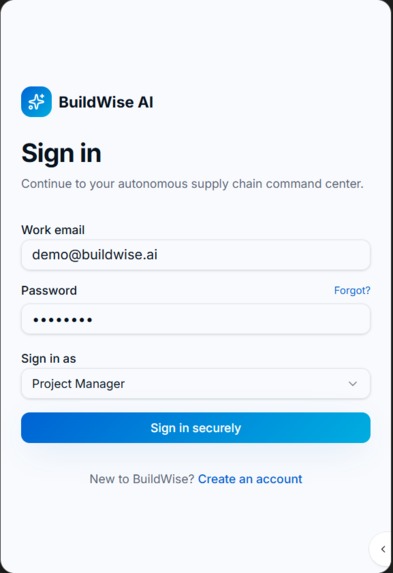
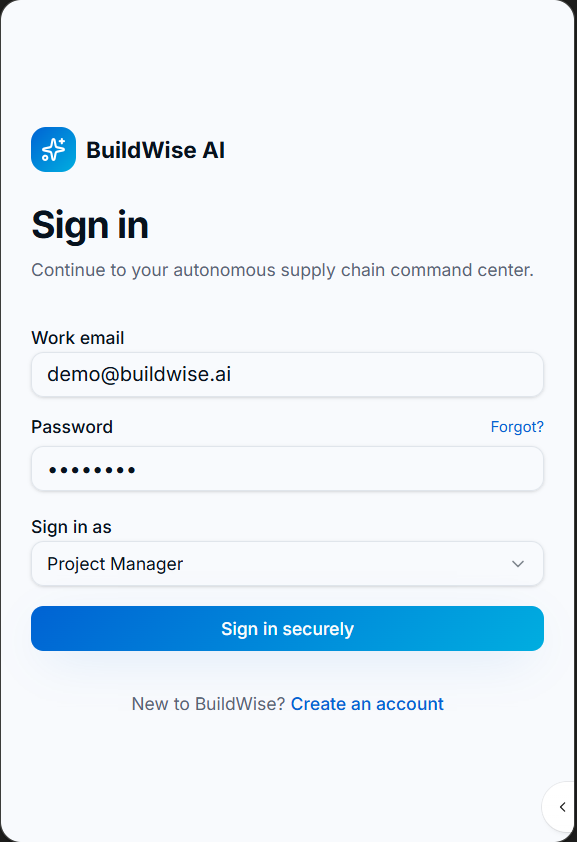
Login Page - Contains Different roles, includes Admin, Project Manager, Procurement Manager, and Site Engineer Roles.
-
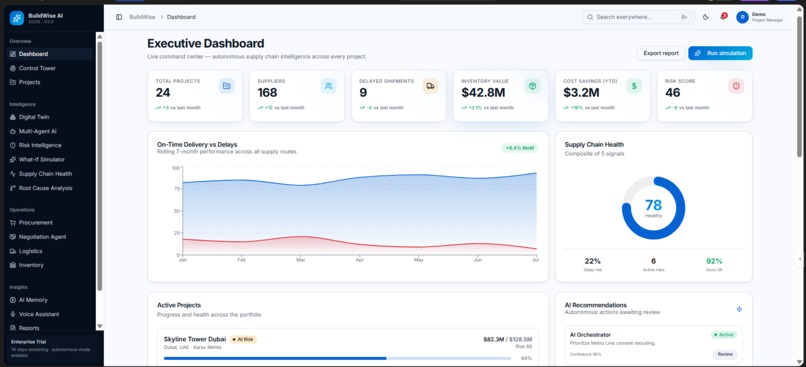
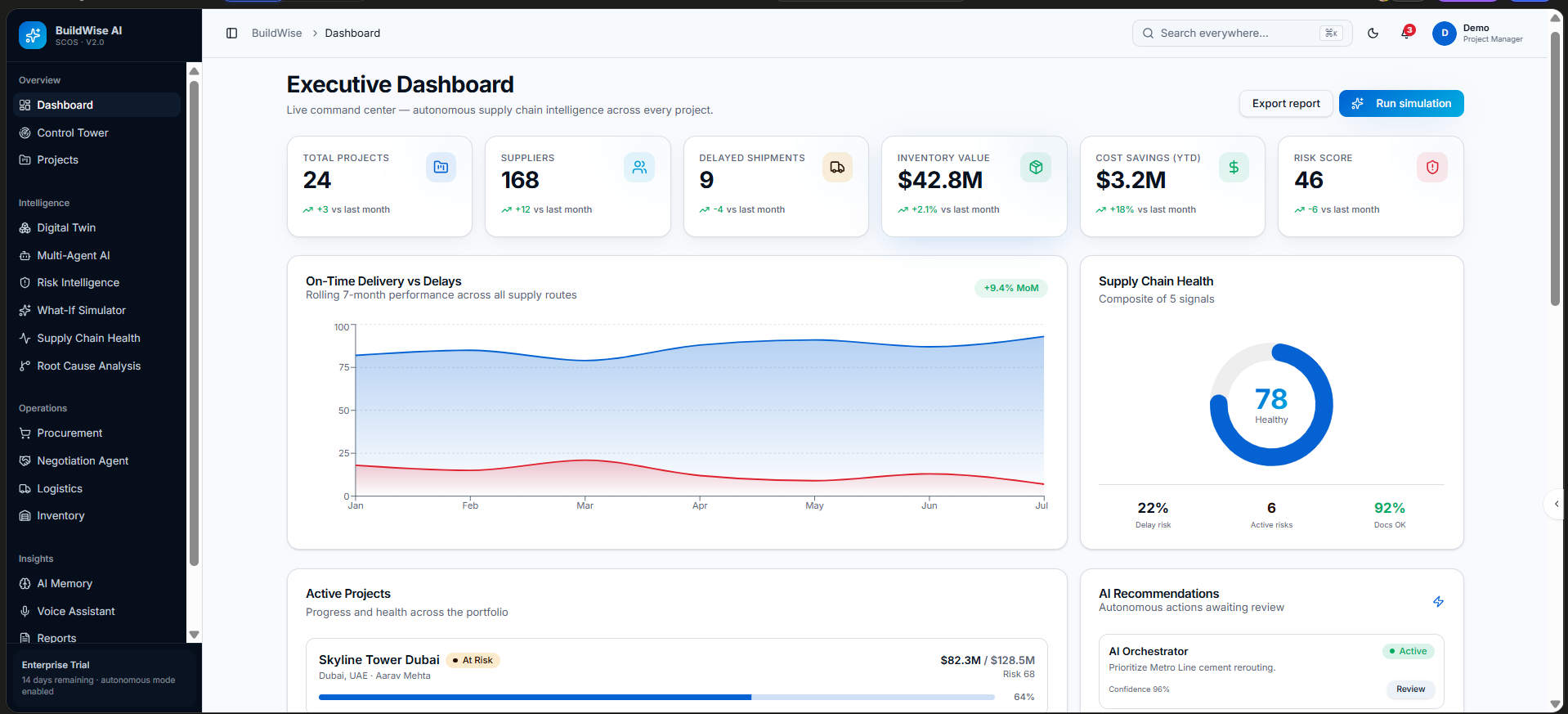
Dashboard Page - Overall project status, KPIs, AI insights, and live alerts.
-
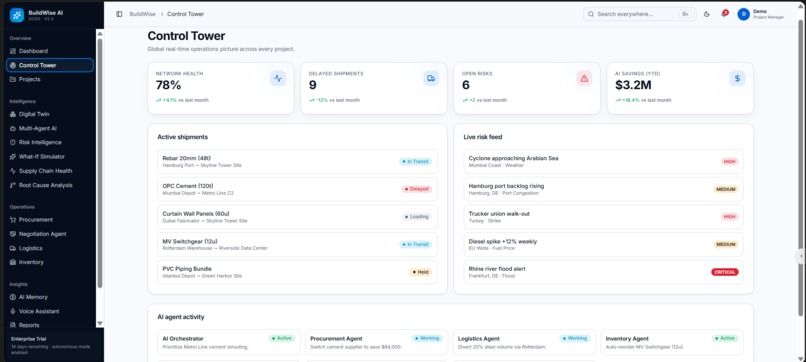
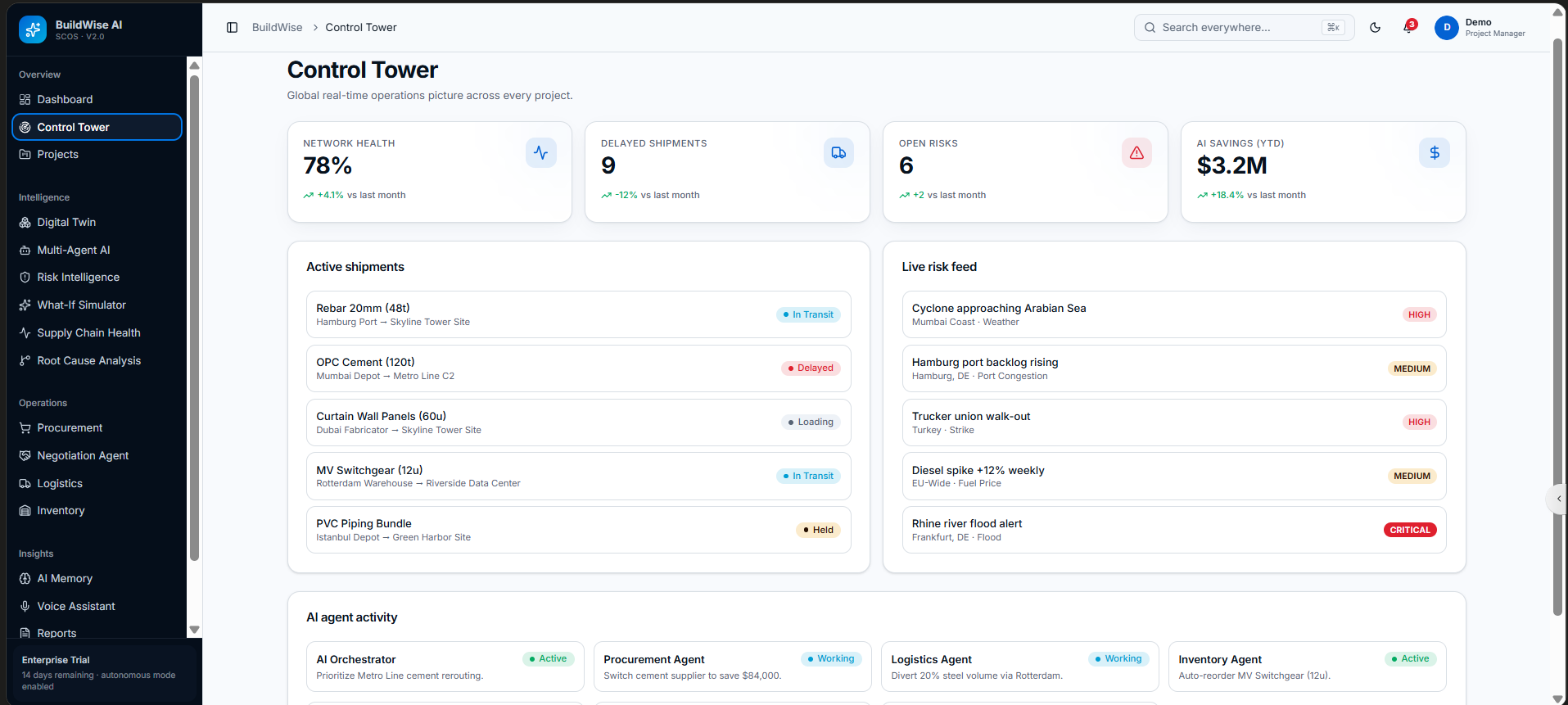
Control Tower Page -
-
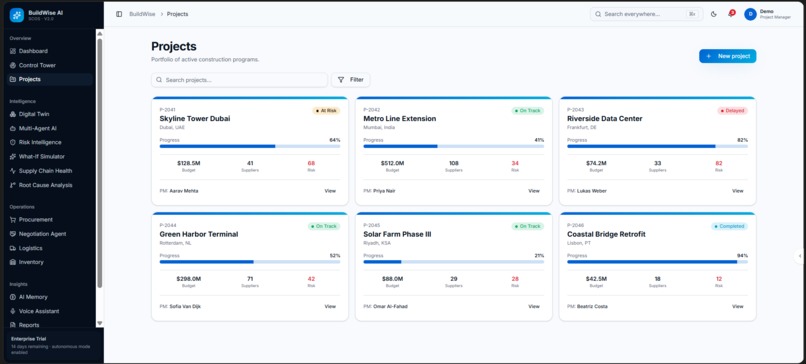
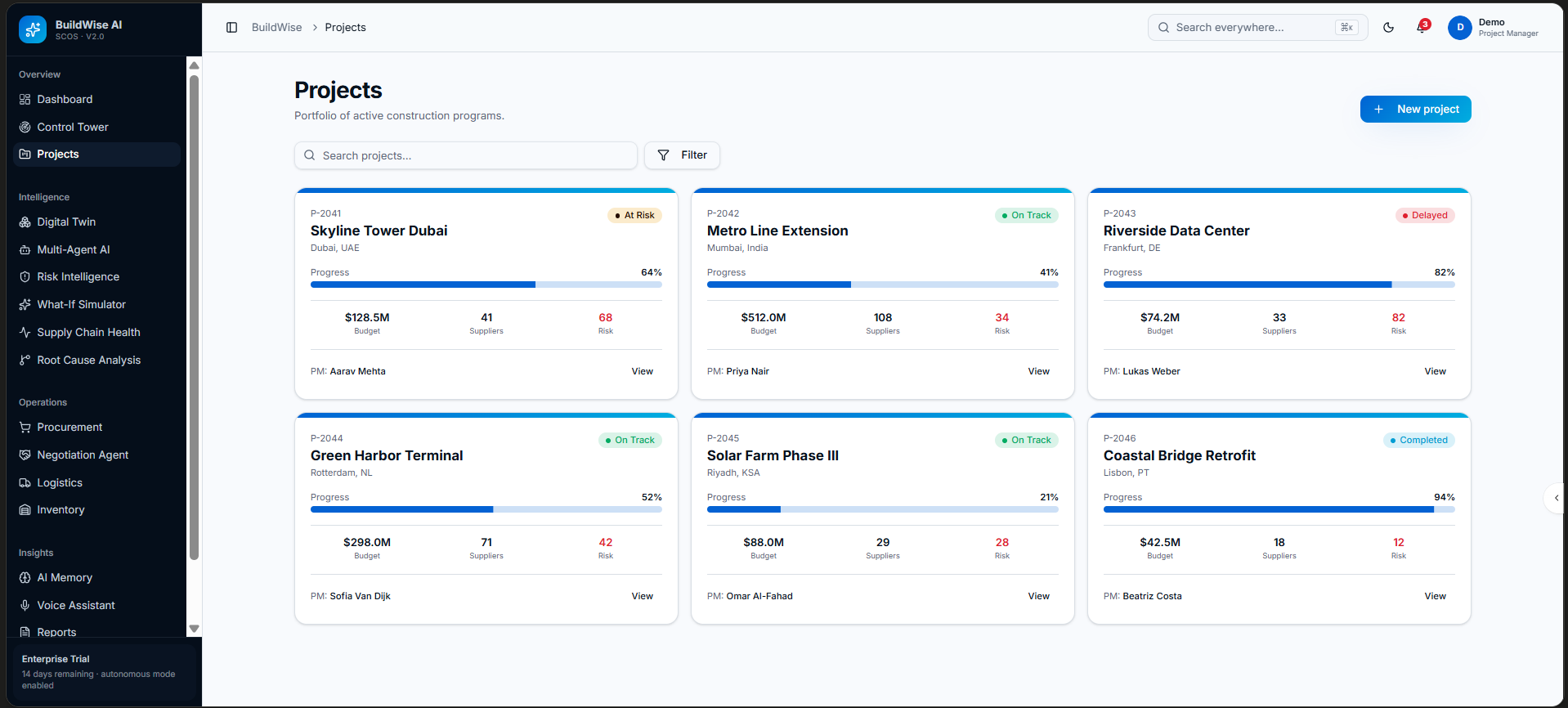
Projects Page - Manage construction projects, milestones, budgets, and progress.
-
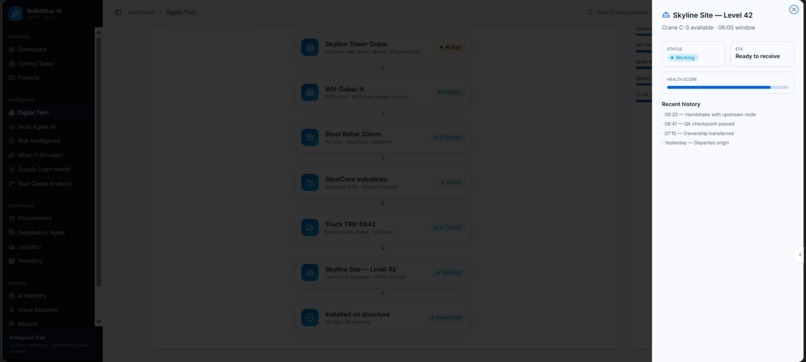
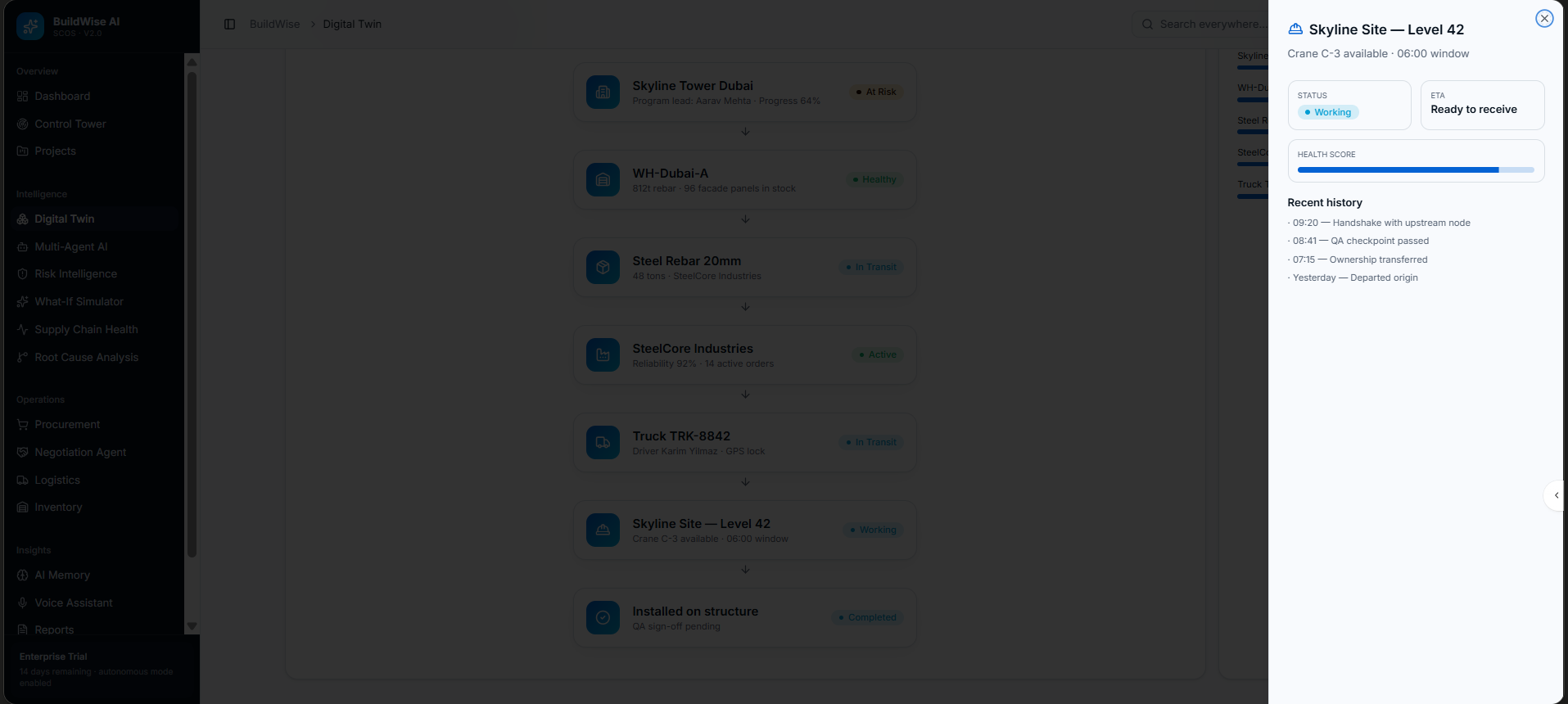
Digital Twin Page - Live virtual representation of projects, materials, warehouses, trucks, and suppliers.
-
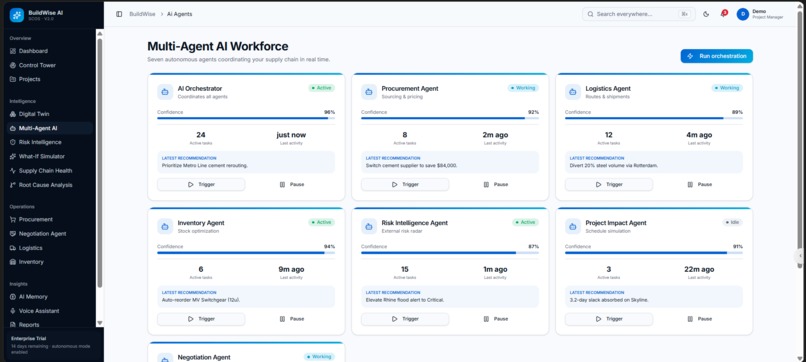
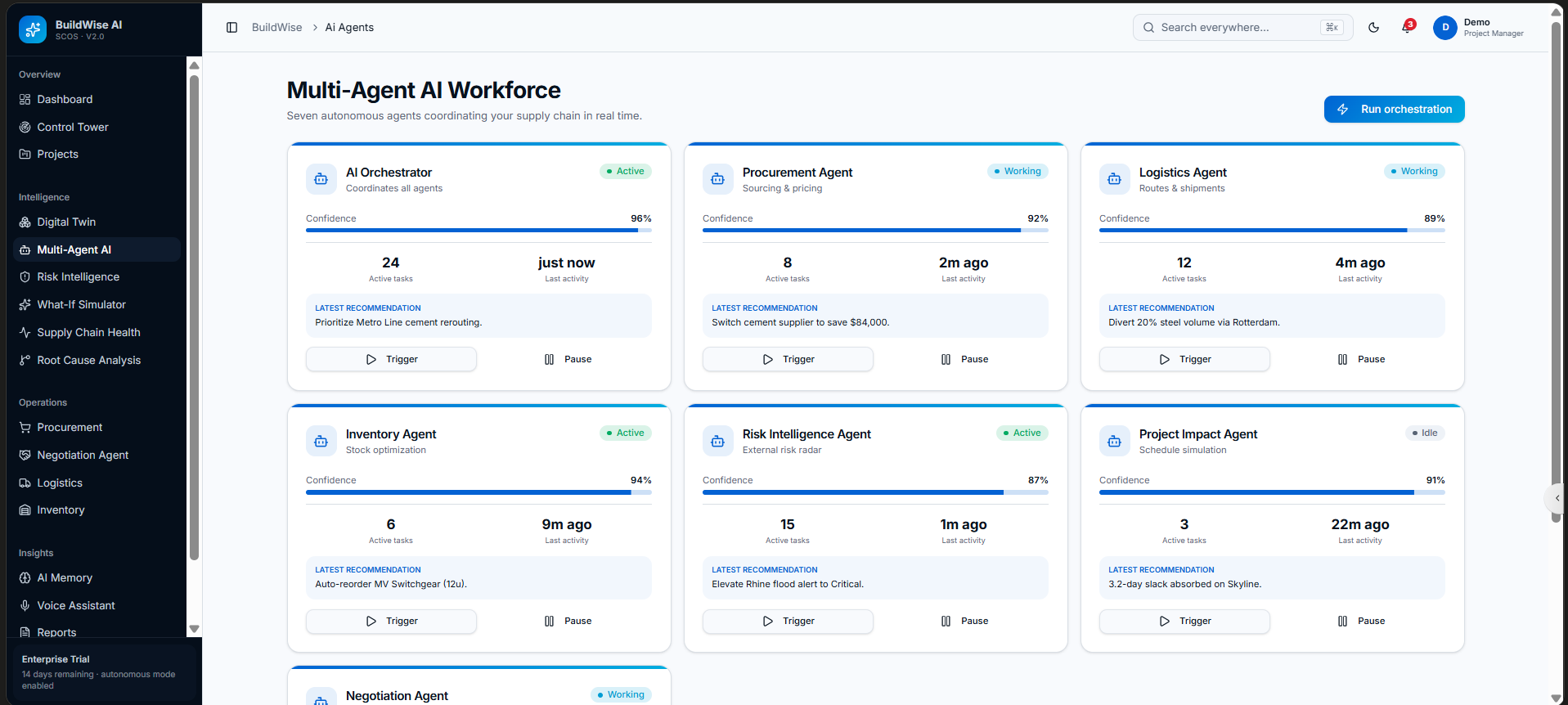
Multi-Agent AI Workforce Page - Monitor all AI agents, their tasks, recommendations, and status.
-
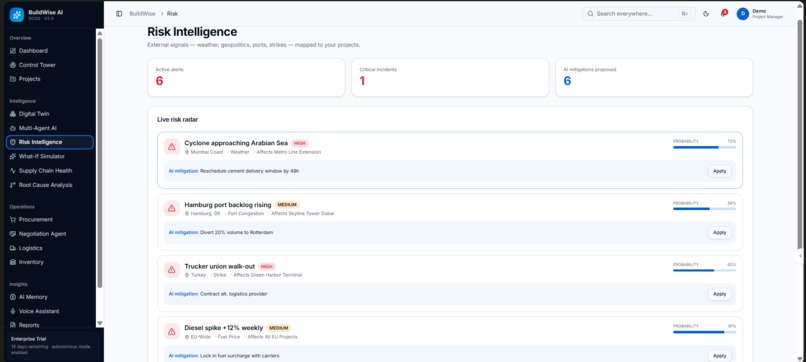
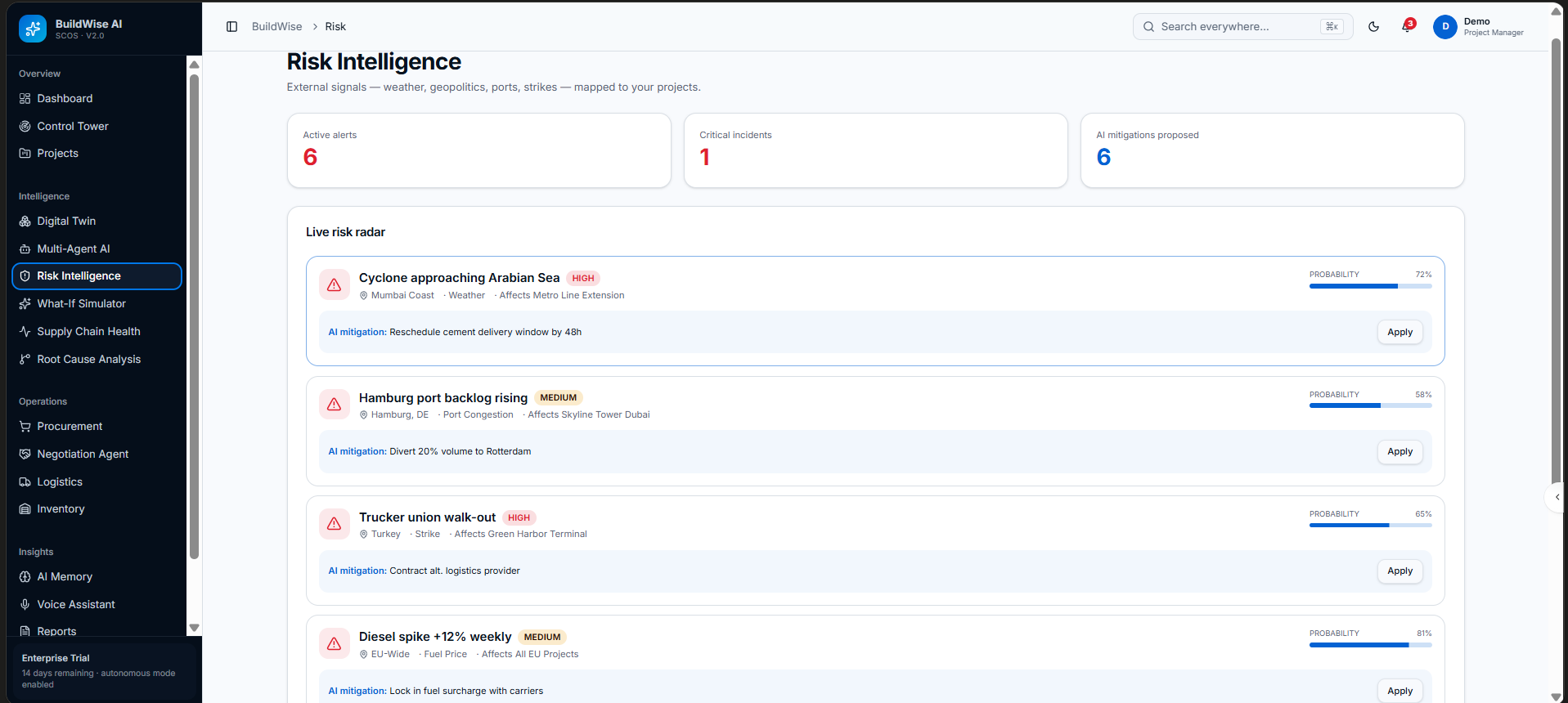
Risk Intelligence Page - Monitor weather, traffic, strikes, news, and external supply chain risks.
-
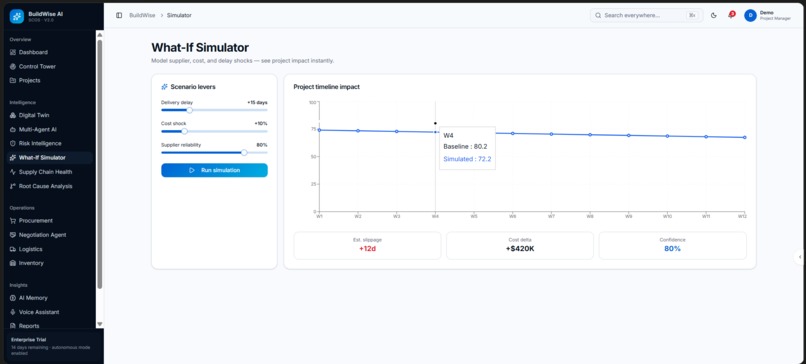
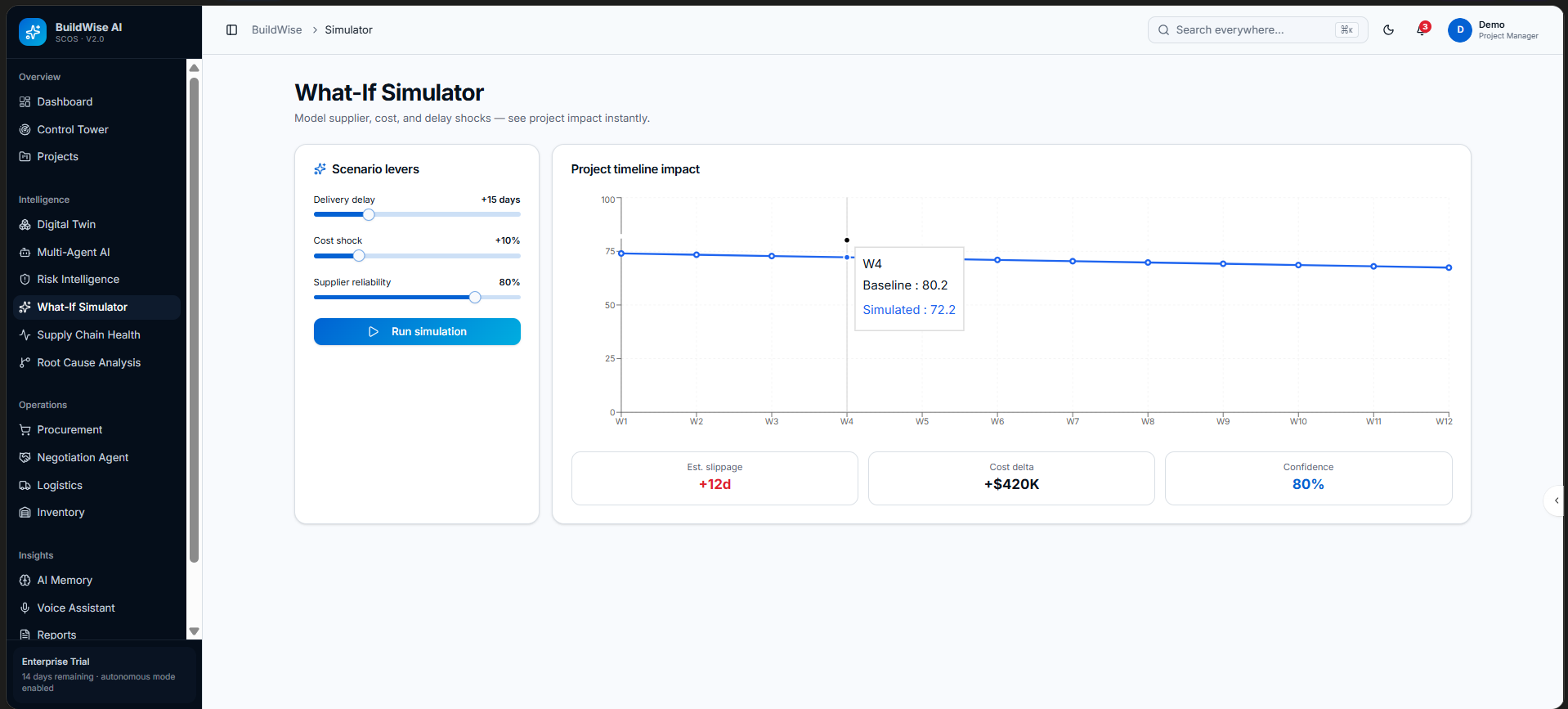
What-If Simulator Page - Simulate project scenarios and analyze cost, schedule, and delay impacts.
-
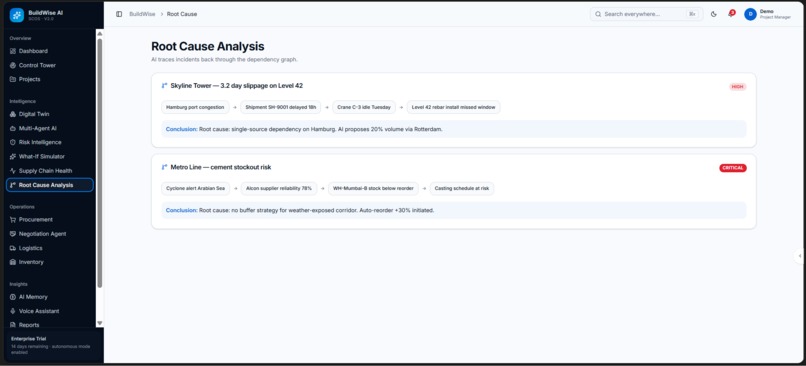
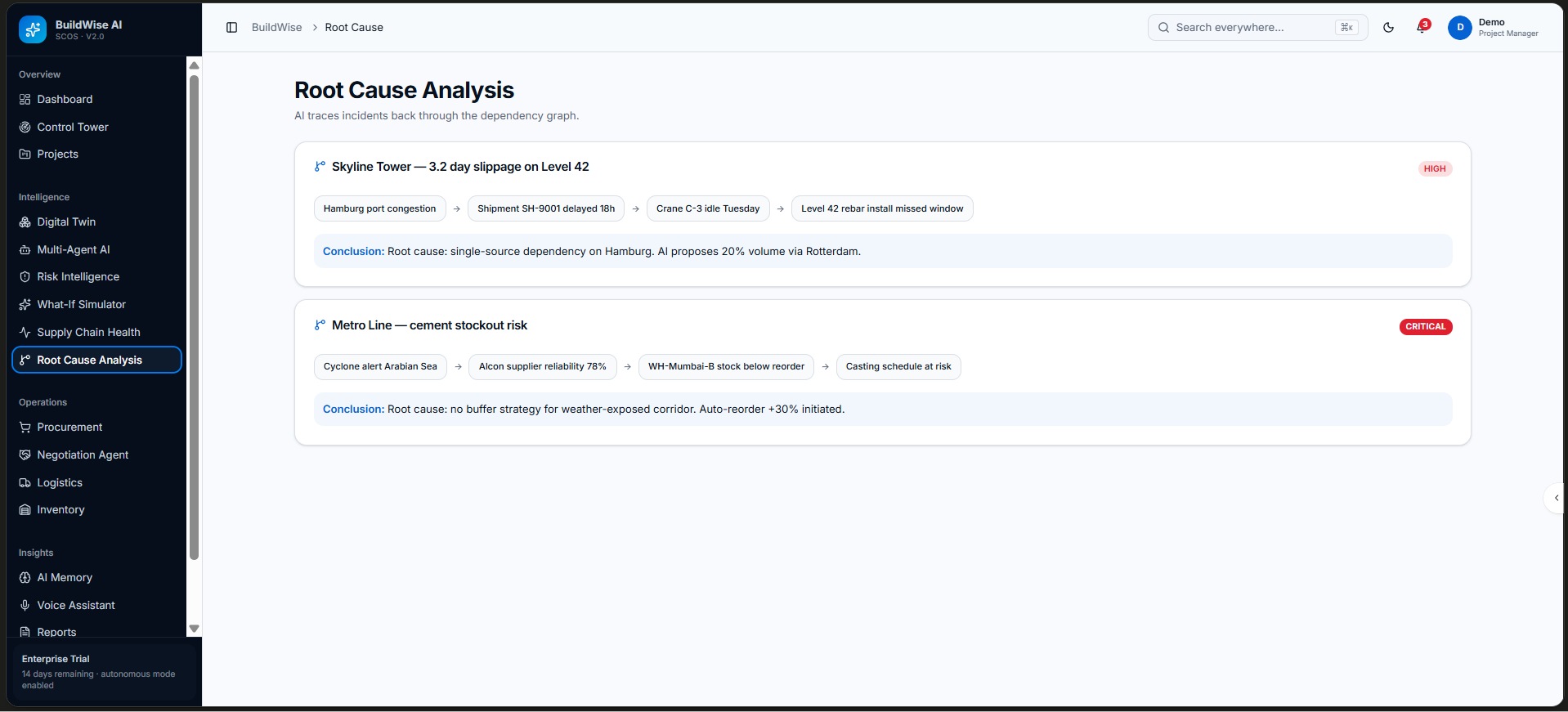
Root Cause Analysis Page - Explain the exact chain of events causing project delays using AI.
-
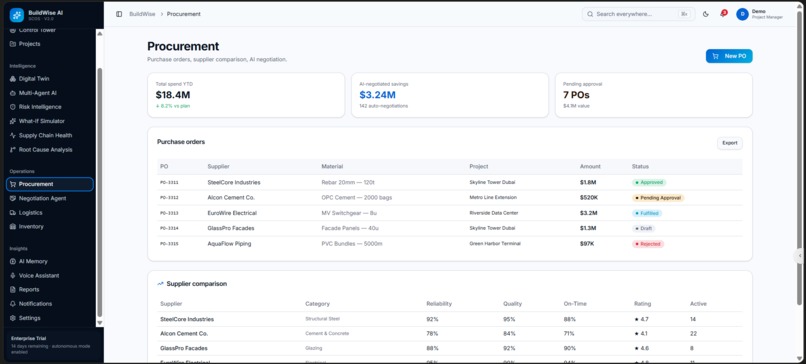
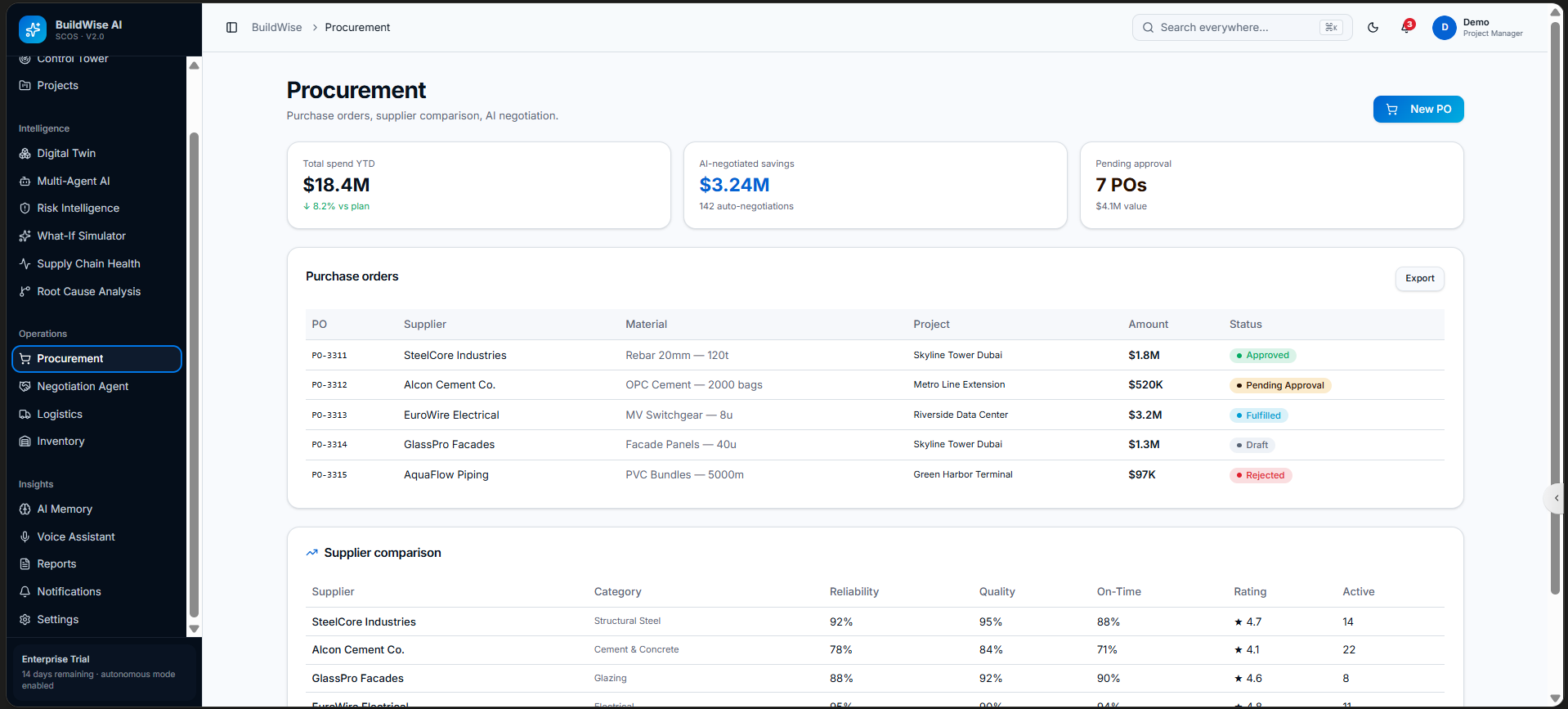
Procurement Page - Manage purchase orders, vendors, quotations, and procurement workflows.
-
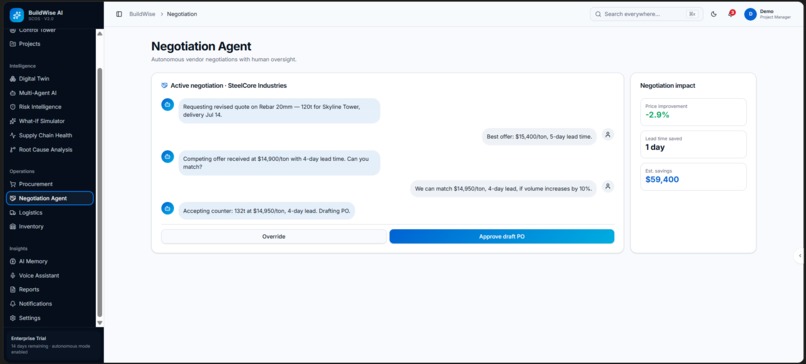
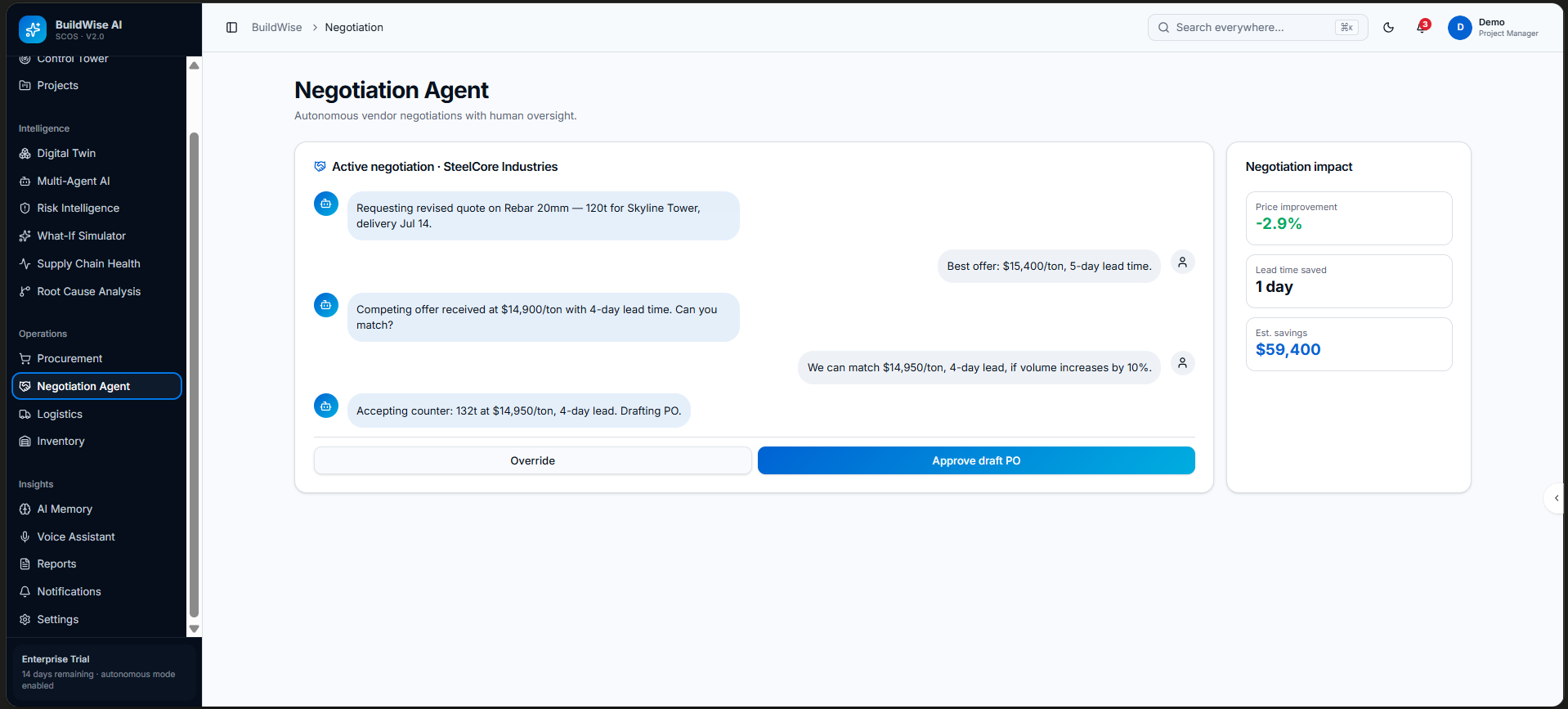
Negotiation Agent Page - Recommend alternative suppliers and generate RFQs and procurement emails.
-
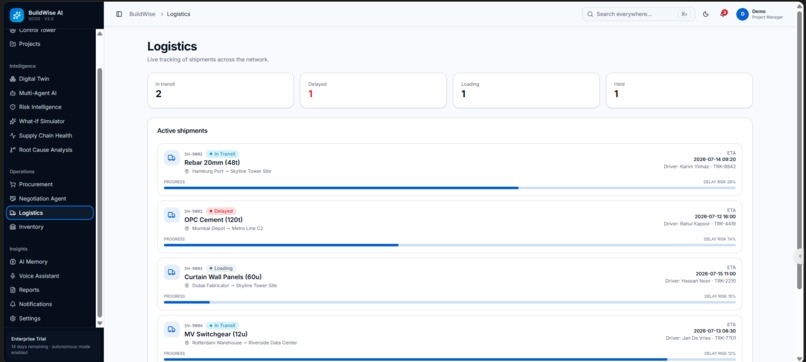
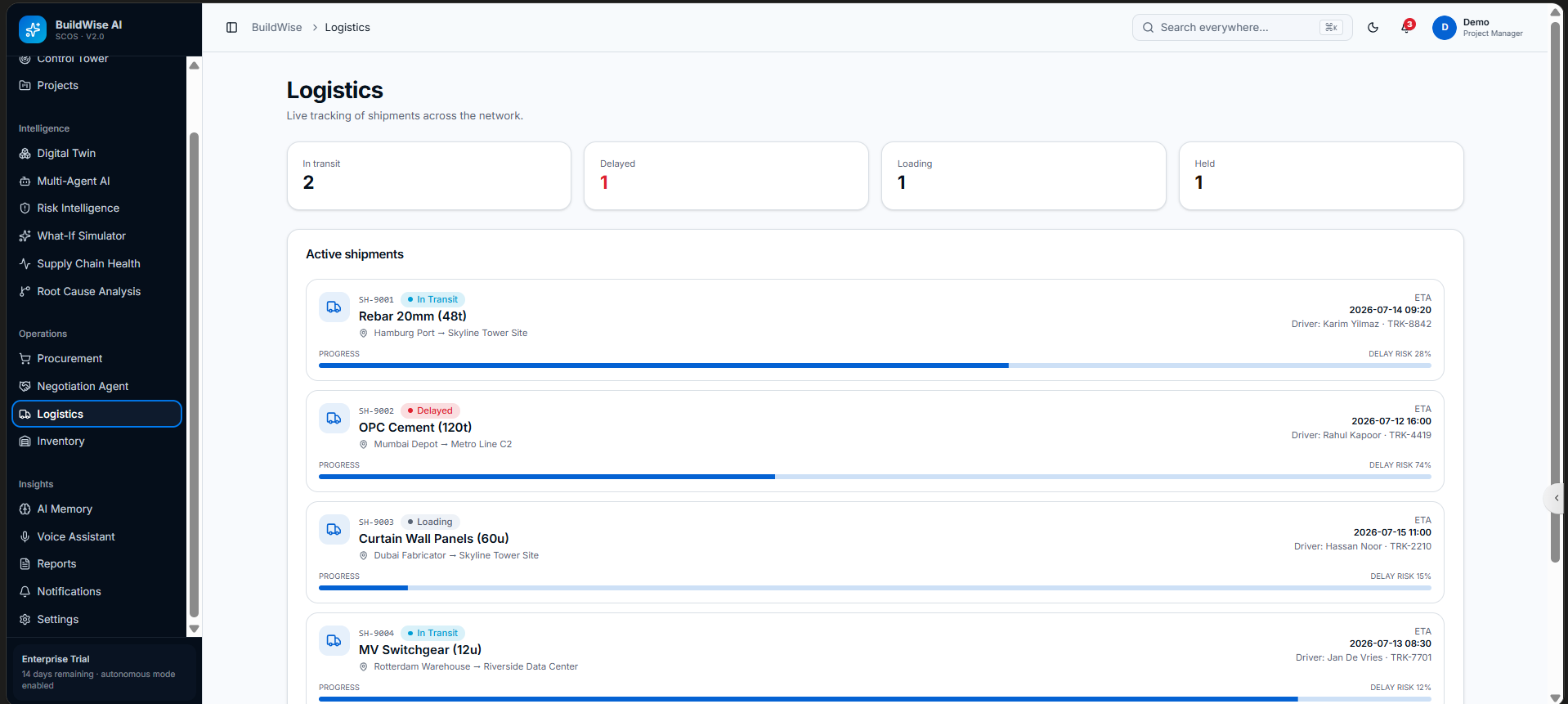
Logistics Page - Track shipments, trucks, GPS locations, ETAs, and delivery status.
-
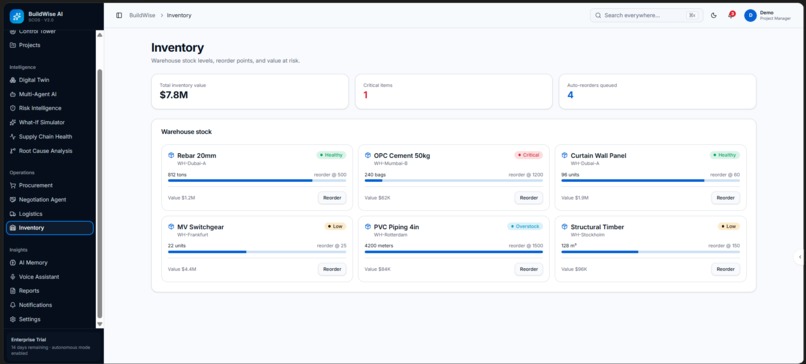
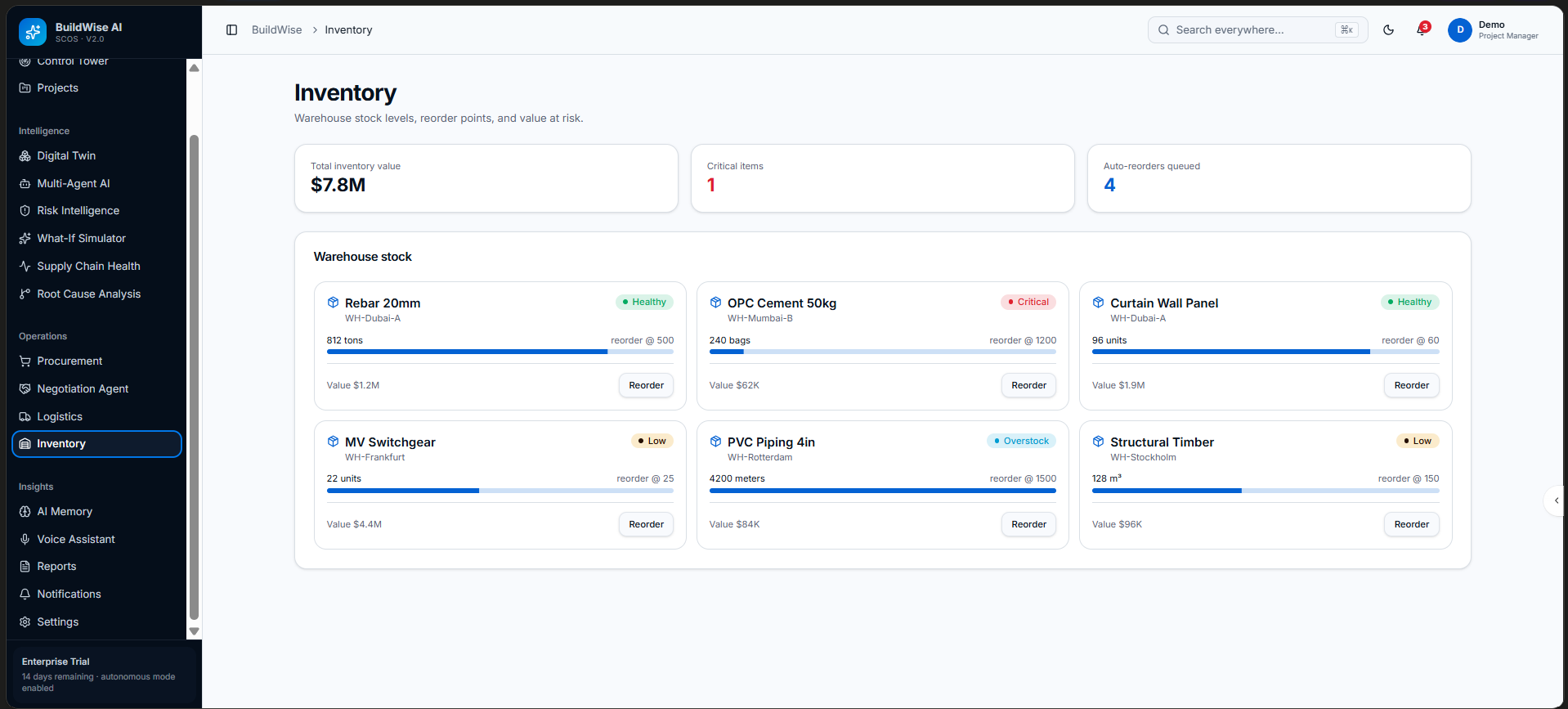
Inventory Page - Monitor warehouse stock levels, material usage, and reorder alerts.
-
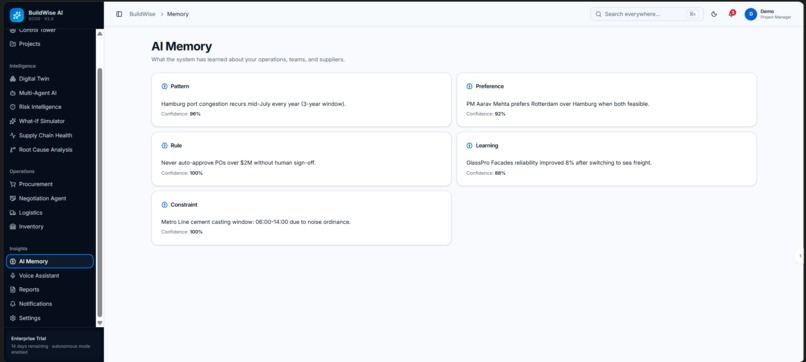
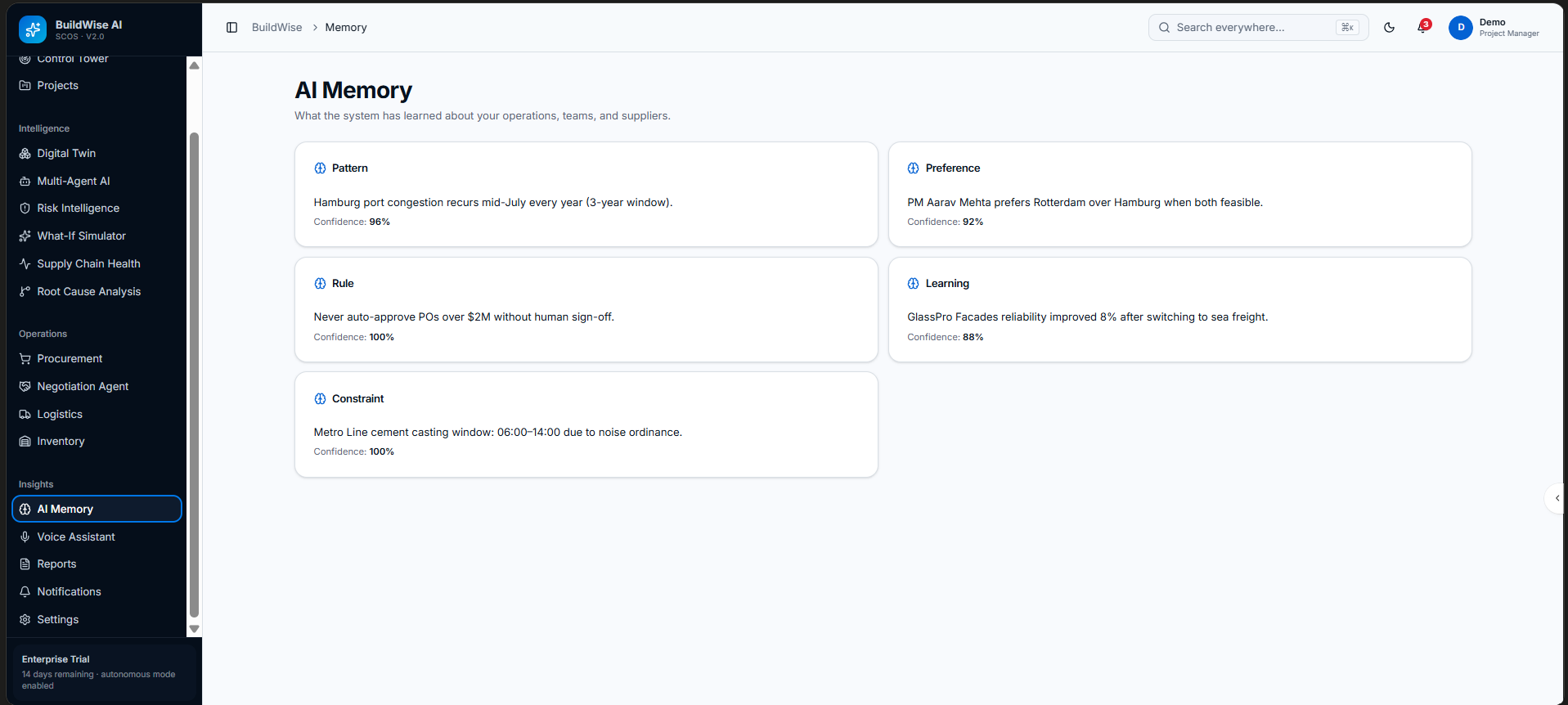
AI Memory Page - Store historical project data and AI-learned supplier performance.
-
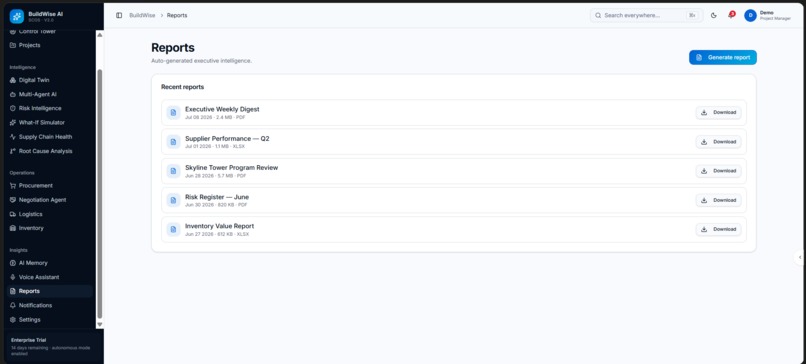
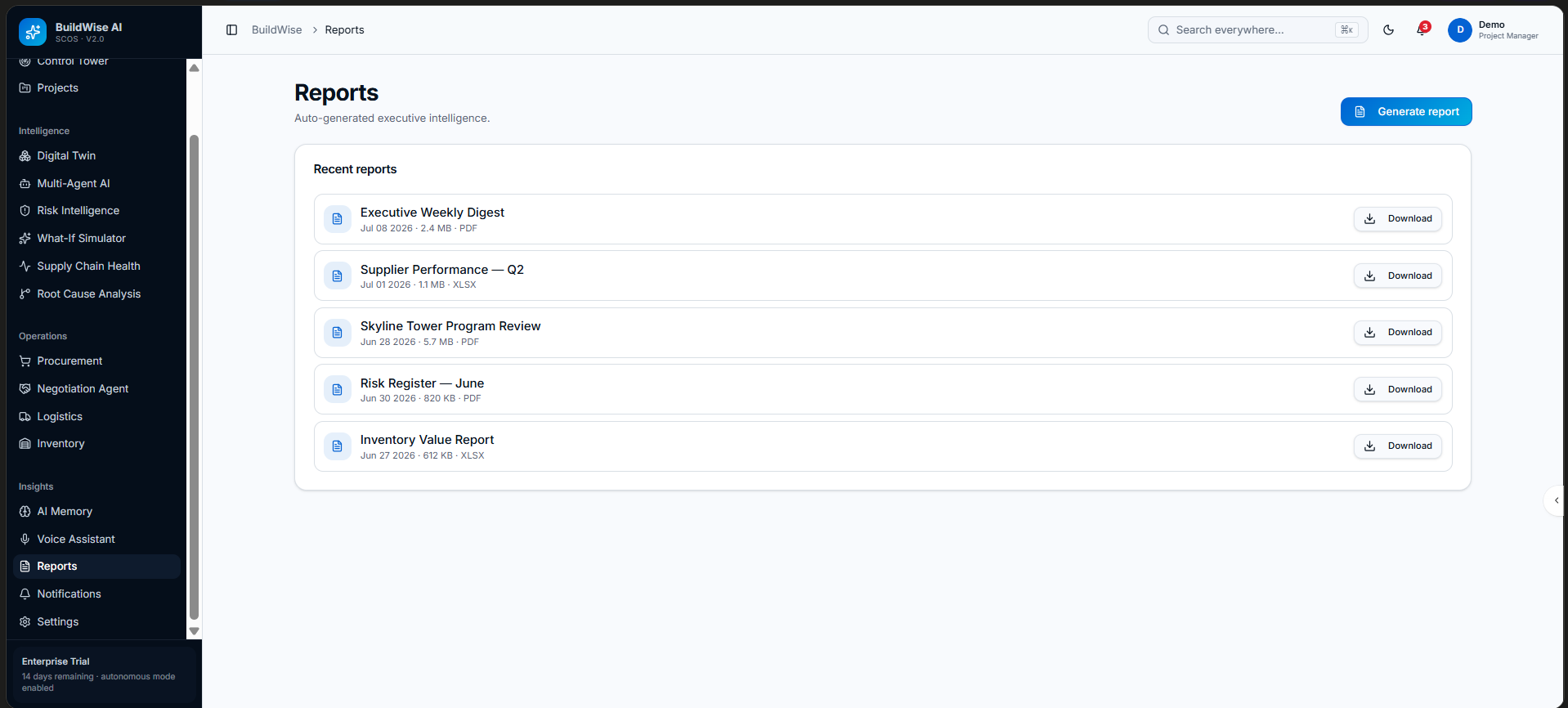
Reports Page - Generate project, procurement, inventory, delay, and risk reports.
Inspiration
Construction projects routinely lose weeks and lakhs of rupees to supply chain disruptions that are visible in hindsight but invisible in advance — a delayed steel shipment, a monsoon-blocked highway, a vendor quietly falling behind on production. Most existing tools only report these delays after they happen, through dashboards and spreadsheets that describe the past rather than change the outcome. We wanted to build something that shifts the conversation from "what went wrong" to "what should we do right now" — a system that predicts disruptions early enough for teams to actually act on them.
What it does
BuildWise AI is an autonomous supply chain intelligence platform for construction projects. It:
- Predicts delays by analyzing supplier performance, logistics data, and external risk factors (weather, traffic, and other disruptions)
- Simulates impact through a what-if engine that models how a delay in one material cascades through the project schedule and budget
- Recommends action by surfacing alternative suppliers, ranked by cost, lead time, and reliability, so managers can respond before a delay becomes a crisis
- Explains its reasoning with a root-cause view, so recommendations aren't a black box — managers can see why a delay is likely, not just that it is
How we built it
We built BuildWise AI with a [React/Next.js] frontend and a [Node.js/Python] backend. For the reasoning layer — delay prediction, root-cause analysis, and supplier recommendations — we ran Qwen3 (8B) locally via Ollama, instead of relying on a cloud API. We chose Qwen3 8B for its strong reasoning performance relative to its size, including solid support for structured output and step-by-step reasoning, while still being light enough to run on consumer hardware during the hackathon. Running locally gave us full control over inference, avoided per-request API costs during heavy development and testing, and kept all project and supplier data on-device — a meaningful advantage in construction, where vendor pricing and contract data are commercially sensitive.
[OCR/vision models] were used to extract data from purchase orders and invoices, feeding structured data into our prediction pipeline. We used [weather/traffic API] for real external risk signals and built a simulation module that models cascading schedule impact based on construction sequencing logic (CPM-style dependencies).
Challenges we ran into
- Balancing ambition with what's achievable in a hackathon timeframe — we scoped down from an initial multi-agent architecture to a focused pipeline we could actually demo end-to-end
- Running Qwen3 8B locally via Ollama meant working within the memory and speed limits of consumer hardware, which pushed us to optimize prompts and keep context windows lean rather than relying on a larger cloud-hosted model
- Sourcing realistic construction supply chain data, since most real datasets are proprietary; we built a representative synthetic dataset grounded in real-world delay patterns
- Getting the what-if simulation to reflect realistic cascading delays rather than a flat, linear estimate
- Making AI-generated recommendations explainable rather than a black box, which required rethinking our output format to show reasoning, not just conclusions
Accomplishments that we're proud of
- A working end-to-end flow: from raw data ingestion to a delay prediction to a simulated financial and schedule impact — running entirely on a locally-hosted Qwen3 8B model via Ollama, with no dependency on external AI APIs
- A what-if simulator that lets a user test a scenario and see the downstream effect in seconds, not hours of manual re-planning
- Designing the system so recommendations are explainable, which we believe matters more in construction — a high-stakes, low-tolerance-for-error industry — than in typical consumer AI applications
What we learned
We learned how much of the real challenge in "AI for operations" is not the model — it's the data pipeline, the domain logic (like construction schedule dependencies), and designing outputs that a non-technical site manager can actually trust and act on. Working with Qwen3 8B also taught us practical lessons in prompt optimization for smaller open-source models — getting consistent structured reasoning out of an 8B model requires much more deliberate prompt design than a large cloud model would need. We also learned to scope ruthlessly: an ambitious multi-agent vision is easy to design on paper and hard to demo convincingly in 36 hours, so we prioritized one strong, complete flow over ten shallow ones.
What's next for BuildWise AI – Autonomous Supply Chain Intelligence
- Expanding from a single reasoning pipeline to a true multi-agent architecture, with specialized locally-run agents for procurement, logistics, and risk monitoring working in coordination
- Fine-tuning Qwen3 8B on construction-specific supply chain data to improve prediction accuracy beyond general-purpose reasoning
- Integrating live data feeds (ERP systems, IoT sensors, GPS tracking) instead of synthetic data
- Building an autonomous negotiation layer that drafts and manages supplier outreach under human approval
- Piloting with a real construction firm to validate prediction accuracy against actual project outcomes
Built With
- api
- css
- git
- html/css
- javascript
- llm
- next.js
- node.js
- ocr
- ollama
- openweathermap
- pandas
- python
- qwen3
- react
- recharts
- rest
- sqlite
- tailwind
- tesseract
- typescript

Log in or sign up for Devpost to join the conversation.