-
-
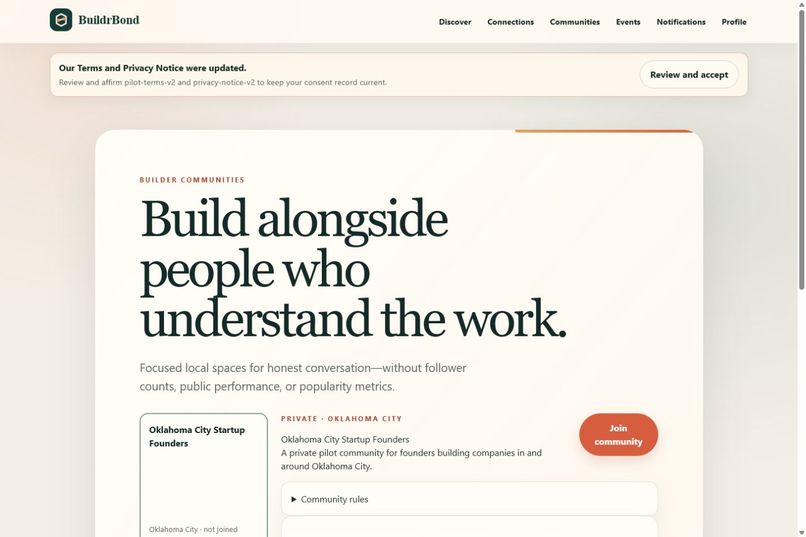
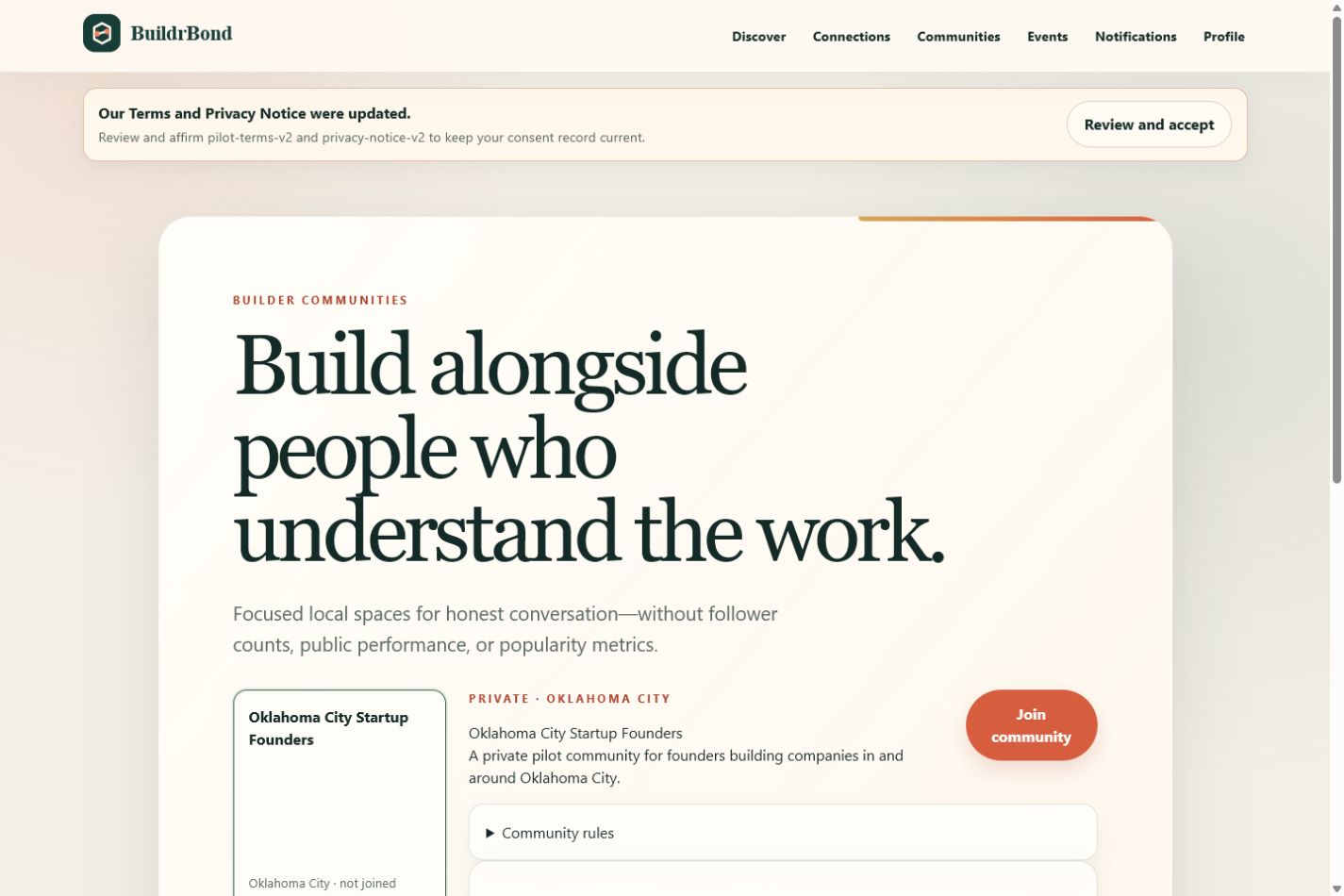
Private local founder communities create belonging without follower counts, popularity metrics, or public performance.
-
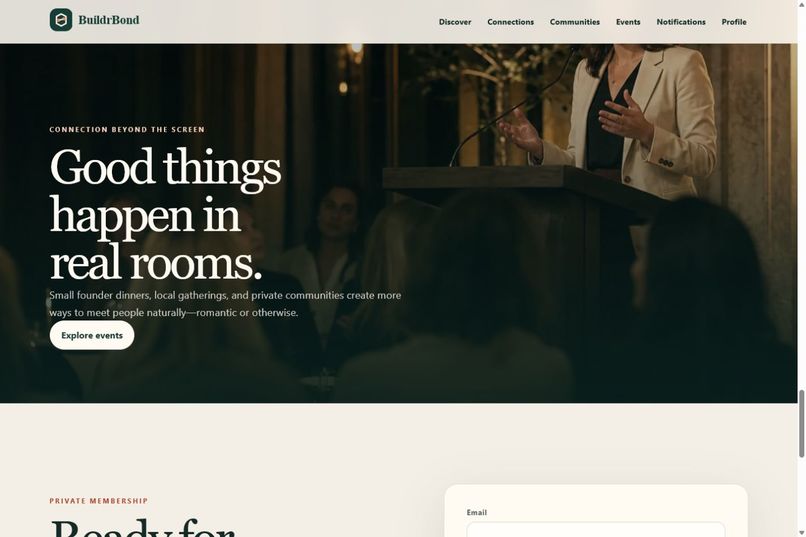
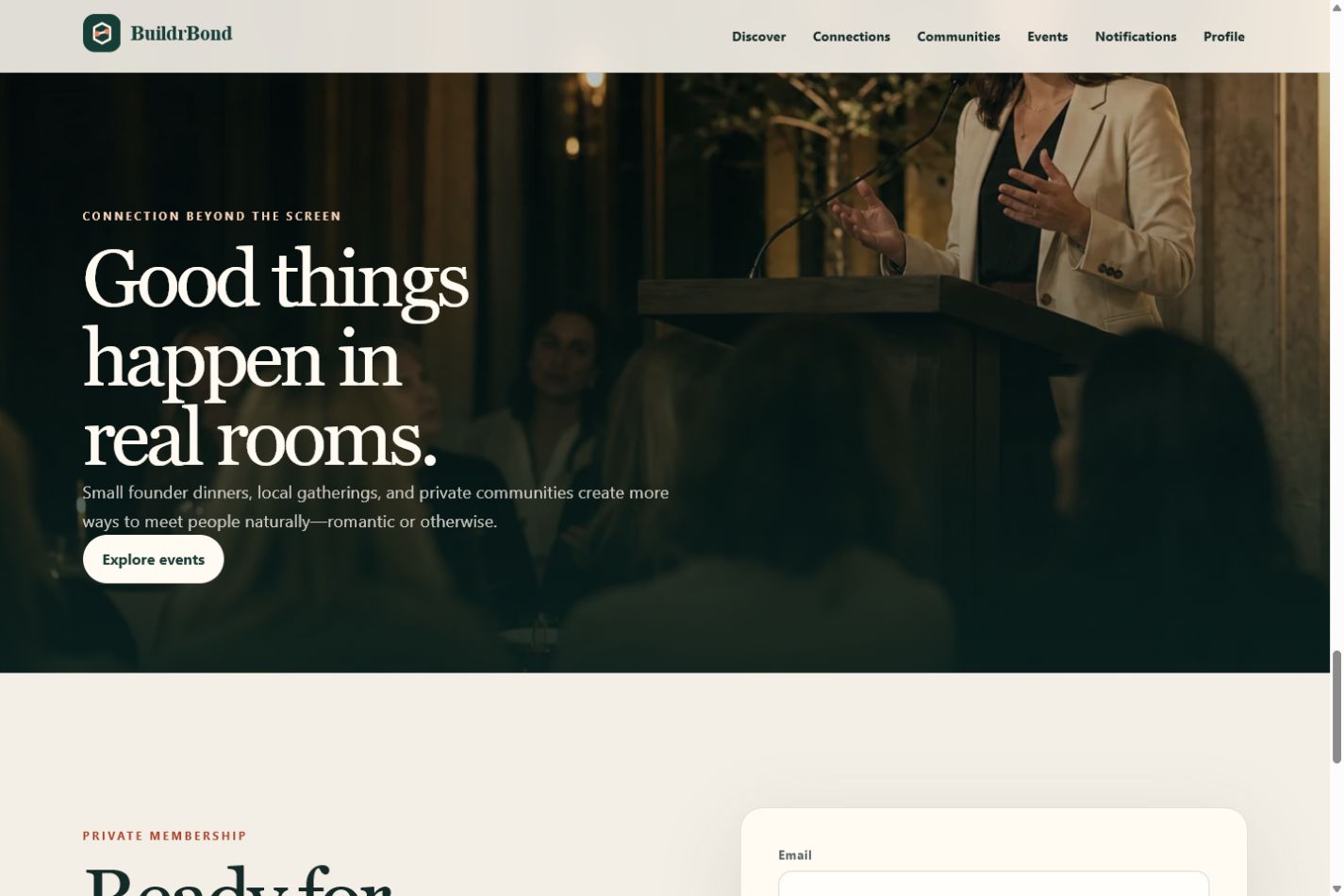
Curated founder gatherings help members move from thoughtful online introductions to meaningful real-world connection.
-
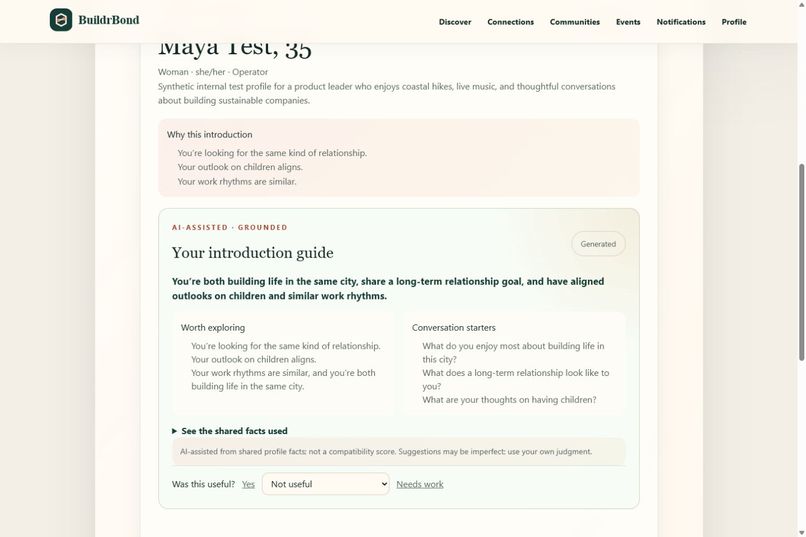
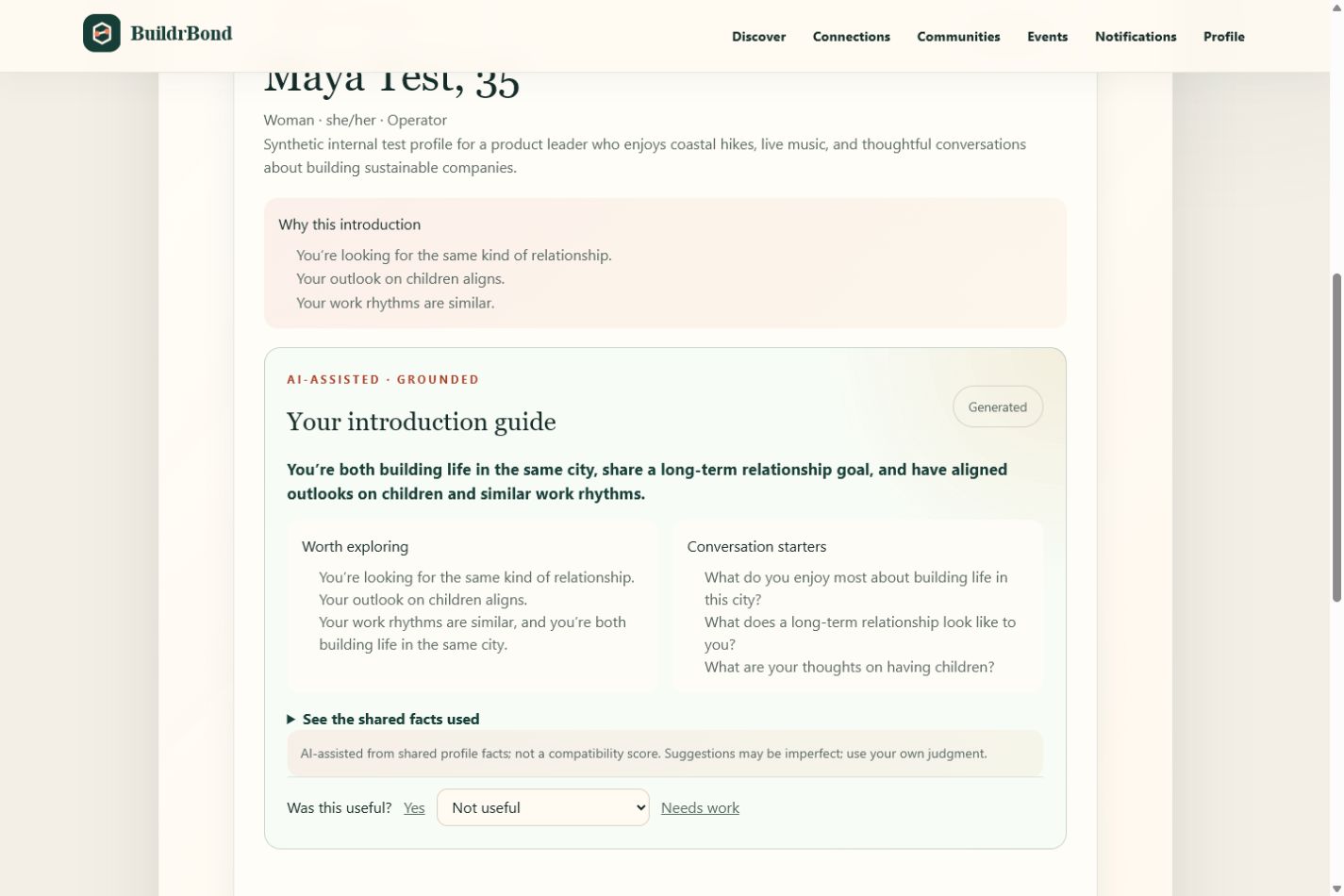
OpenAI turns allow-listed shared facts into a grounded introduction guide, conversation starters, and transparent feedback.
-
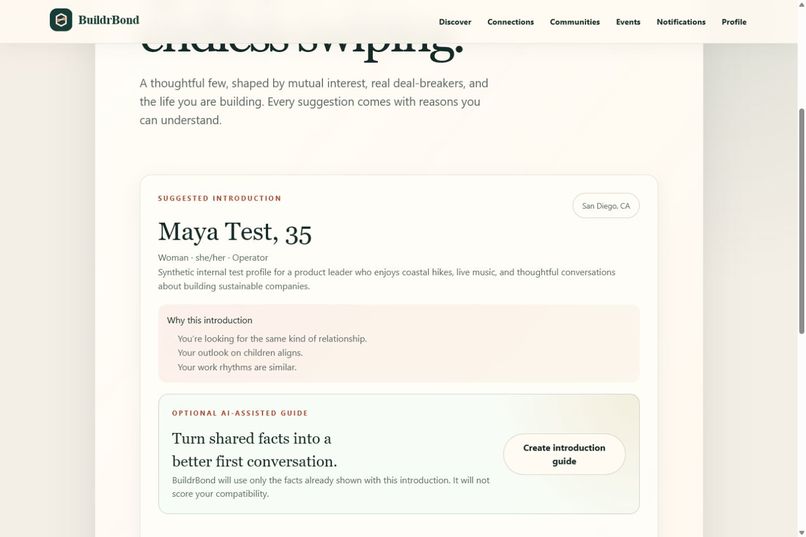
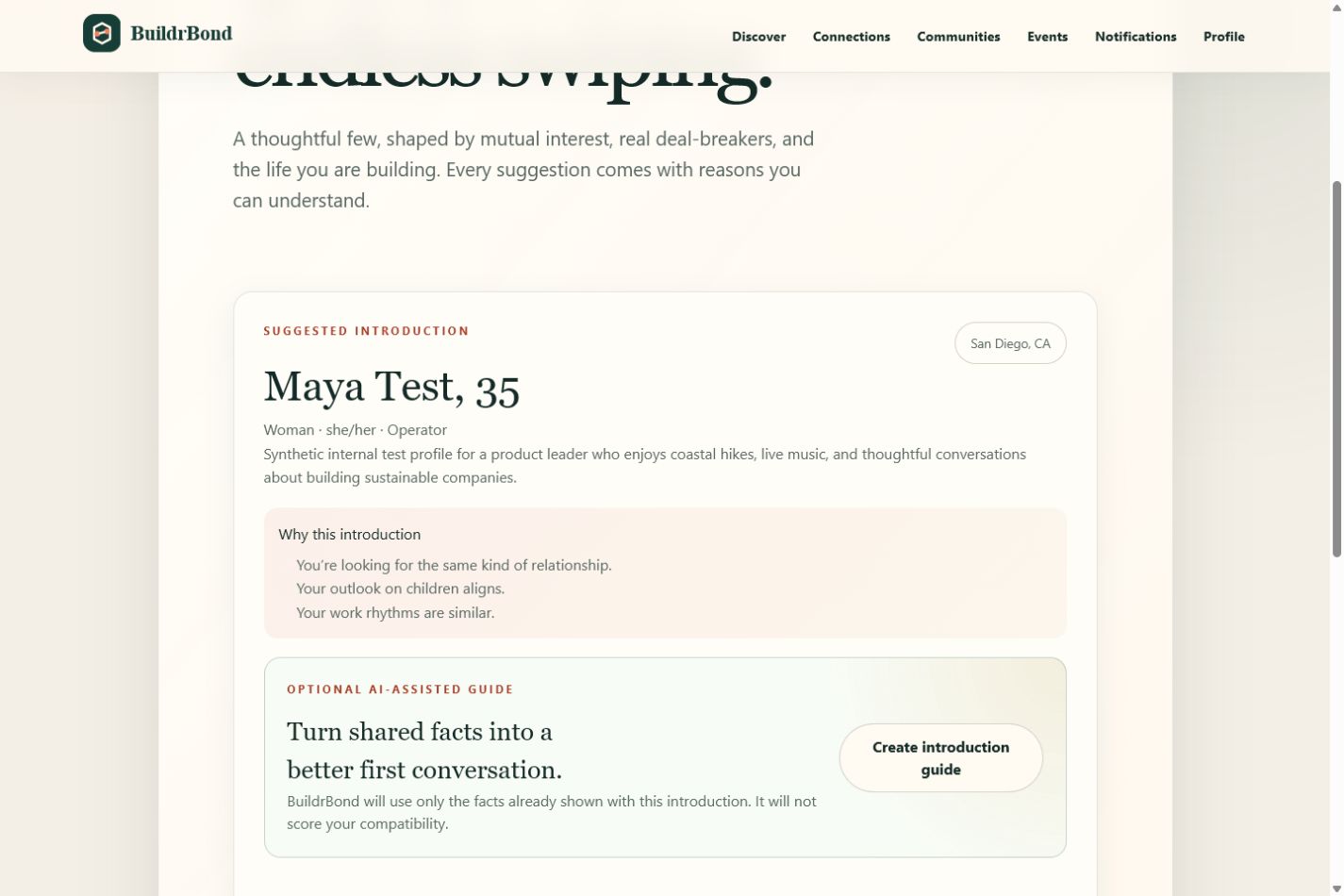
Deterministic matching explains why an introduction surfaced—without fake percentages or exposing private deal-breakers.
-
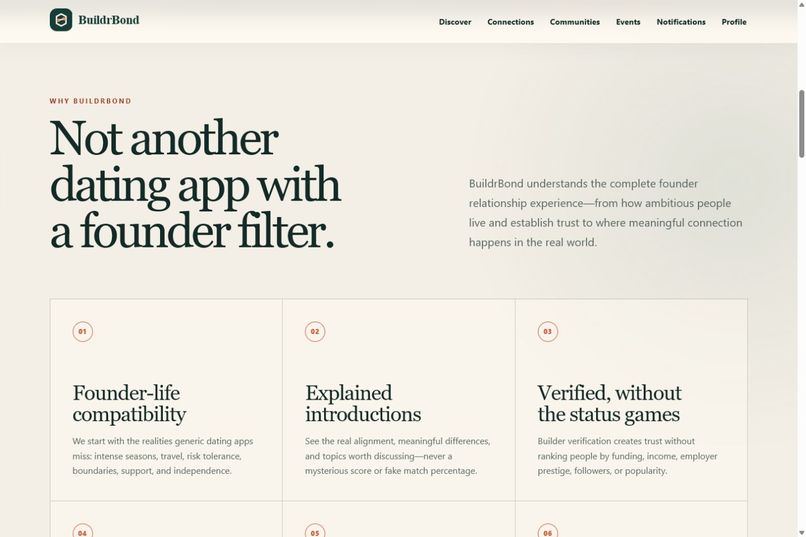
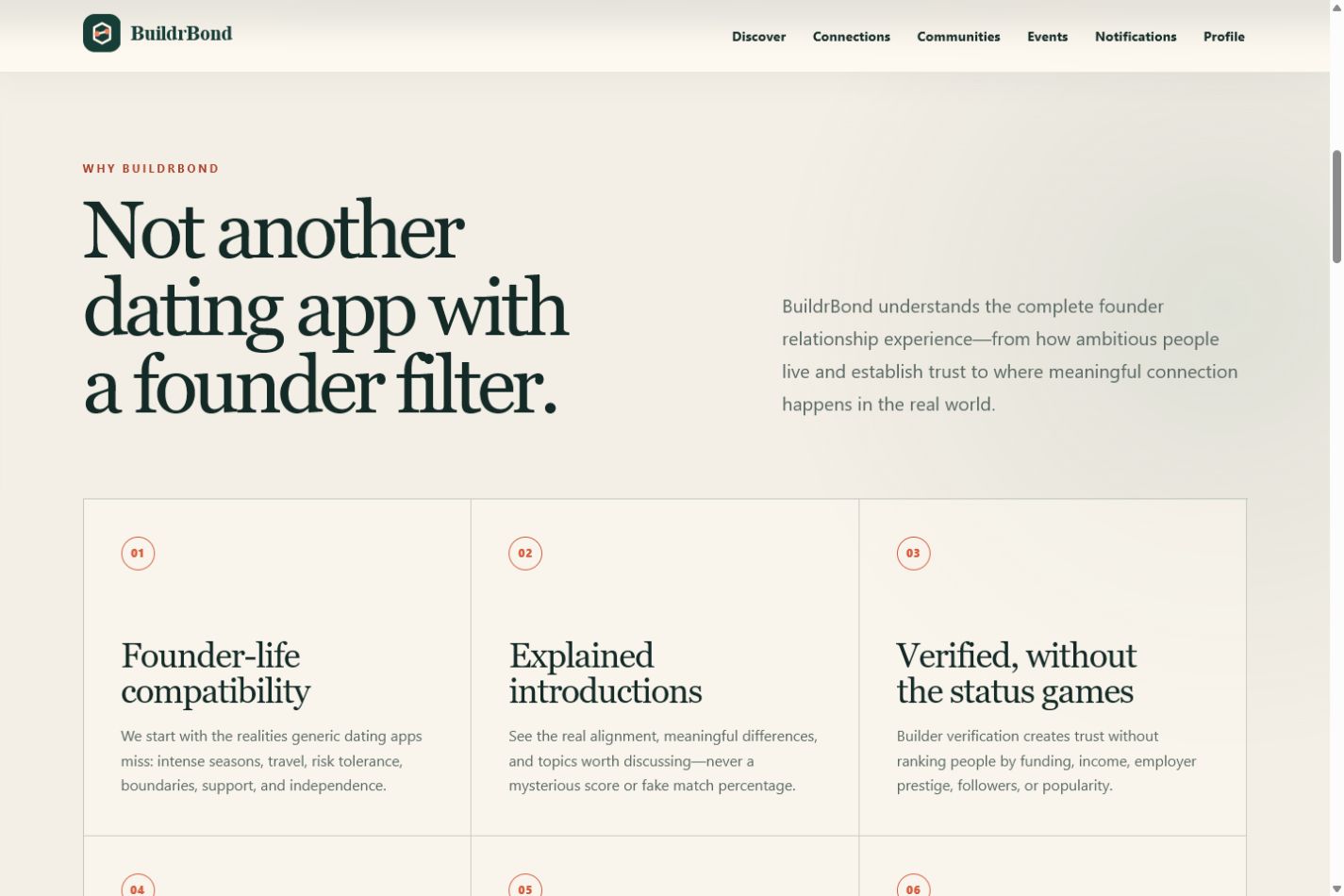
Founder-life compatibility, explained introductions, and verification without status games set BuildrBond apart.
-
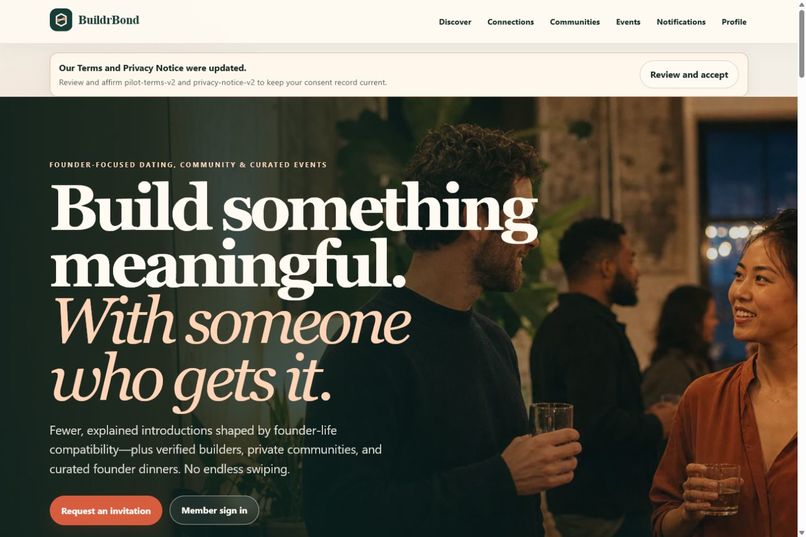
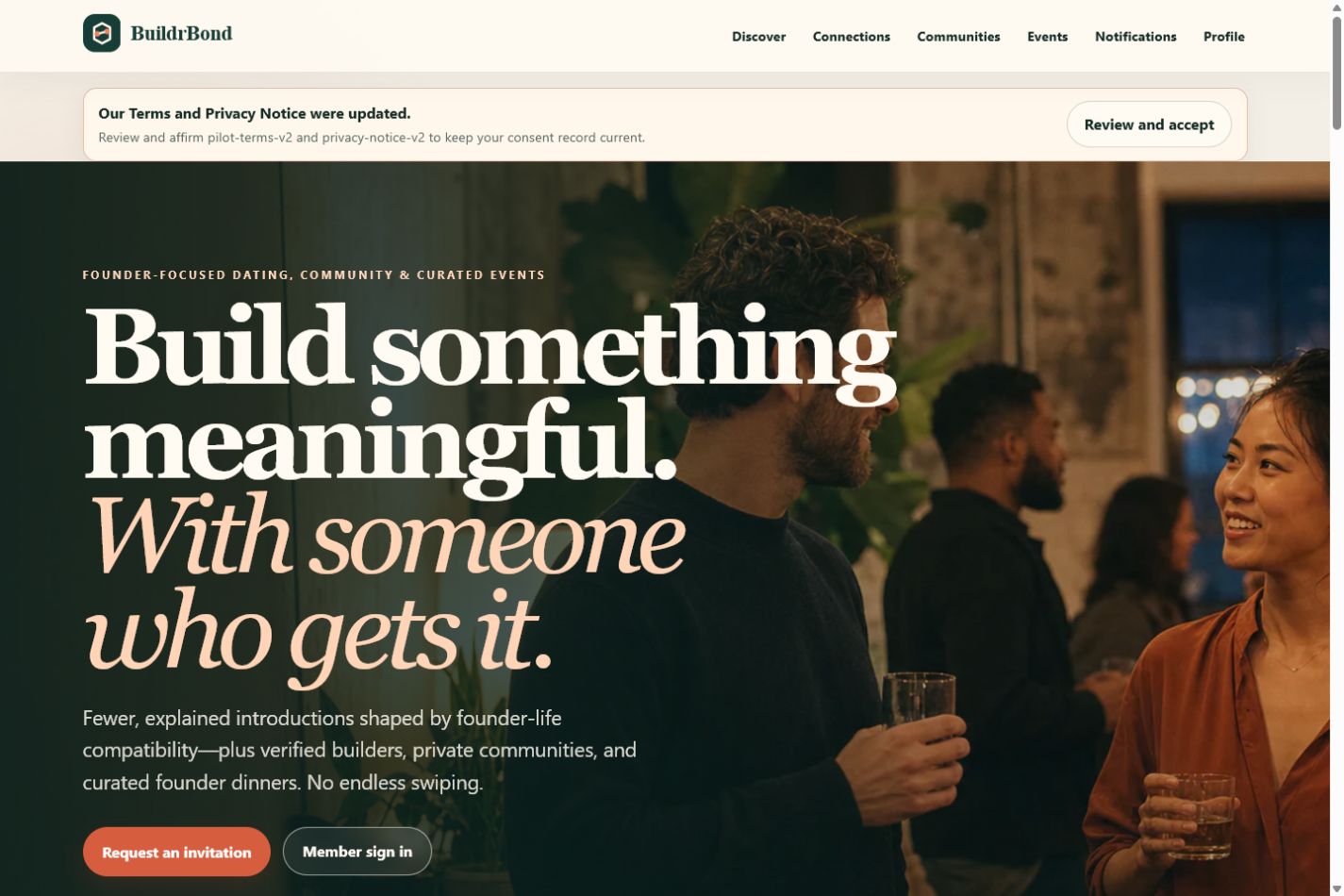
Founder-focused dating, private communities, and curated events-built around fewer, more meaningful introductions.
BuildrBond: OpenAI Build Week Project Story
Inspiration
Founders and builders often live unusually demanding lives. Their schedules are unpredictable, their work is deeply personal, and the line between career, community, and identity can become blurry. Yet most dating products reduce people to photos, short prompts, and an unexplained match percentage.
I wanted to build something different: a relationship platform designed around founder-life compatibility, trust, and meaningful context.
BuildrBond began with a simple question:
What if technology helped people understand why an introduction might be meaningful instead of merely encouraging them to swipe faster?
The goal was not to let AI choose people's partners. It was to create a privacy-conscious system that makes a small number of introductions more thoughtful, understandable, and easier to act on.
What BuildrBond does
BuildrBond is a founder-focused dating, community, and curated-events platform.
Members create profiles describing their work, lifestyle, relationship intentions, interests, boundaries, and founder-life preferences. The recommendation system applies real deal-breakers and bilateral preferences before ranking potential introductions.
Instead of displaying a questionable "93% match," BuildrBond explains the specific, permitted reasons an introduction surfaced.
The production MVP includes:
- Founder-focused profiles and compatibility onboarding
- Bilateral matching, where both members' preferences must permit the introduction
- A small, explainable discovery feed
- Likes, saves, passes, connections, messaging, unmatching, and blocking
- Private reporting and moderation workflows
- Communities, posts, comments, curated events, capacity controls, and waitlists
- Photo processing and verification workflows
- Notifications and privacy controls
- A safety center, community guidelines, privacy requests, and versioned consent
- A grounded AI Introduction Guide powered by GPT-5.6
How GPT-5.6 improves the experience
The GPT-5.6-powered feature is intentionally an assistant layered on top of deterministic matching, not an autonomous matchmaker.
The application first calculates a recommendation using structured product rules. It then creates a small set of approved fact identifiers representing only information that may be used in an explanation. The model never receives the entire private profile.
GPT-5.6 transforms those approved facts into:
- A concise explanation of why the introduction may be relevant
- Practical conversation starters
- A low-pressure suggestion for making the first interaction easier
The model must return structured output matching a strict schema. Every statement is then checked against the allow-listed facts before it can reach the member.
Conceptually, the rule is:
$$ \text{Visible AI claim} \subseteq \text{Allow-listed recommendation facts} $$
If the response fails validation, moderation, or grounding, BuildrBond uses a deterministic fallback. The product does not invent compatibility claims, expose private deal-breakers, infer sensitive characteristics, or present AI output as certainty.
The experience also clearly identifies AI-generated guidance and lets members privately rate whether it was useful.
How I built it
BuildrBond is deployed as a production AWS application using three repositories:
- Next.js and TypeScript for the responsive web application
- AWS Lambda and API Gateway for the serverless backend
- Aurora PostgreSQL for relational product data and transaction integrity
- Amazon Cognito for authentication and authorization
- S3 and CloudFront for the web application and protected media workflows
- SQS and SES for asynchronous processing and notifications
- Terraform for repeatable production infrastructure
- GPT-5.6 through the OpenAI Responses API with Structured Outputs for grounded assistance
- OpenAI moderation as an additional content-safety boundary
The AI workflow includes quotas, short-lived caching, bounded feedback, provider-error sanitization, and content-free operational metrics. Raw profile biographies, display names, city values, private preferences, and unrelated personal information are excluded from model input.
The platform also includes encrypted storage, least-privilege AWS permissions, immutable Lambda deployment versions, alarms, regular database backups, and a tested database restoration plan.
How Codex accelerated development
Codex served as my primary engineering collaborator across the BuildrBond web, backend, and Terraform repositories. I used it to turn the product plan into clean TypeScript and AWS Lambda boundaries, implement database migrations and production infrastructure, write and run automated tests, review privacy and authorization paths, validate the deployed product in a browser, and maintain architecture, operational, backup, and restore documentation.
I remained responsible for the product direction, privacy model, technical decisions, review, and production deployment. Codex made it possible to move from an ambitious plan to a tested production MVP during Build Week while keeping those decisions human-led.
Challenges
Grounding AI without making it useless
The hardest AI problem was finding the balance between useful writing and strict factual boundaries. Sending entire profiles would have made generation easier, but it would also have increased privacy exposure and hallucination risk.
I solved this by separating the system into two layers:
- A deterministic recommendation engine decides which facts are relevant and permitted.
- GPT-5.6 turns only those facts into useful, natural language through the OpenAI Responses API.
A second validator checks the returned fact references and generated copy before anything is displayed.
Preserving privacy while explaining recommendations
Dating and relationship data can be extremely sensitive. Some preferences must influence eligibility without ever being exposed to another member or analytics system.
BuildrBond therefore separates private matching inputs from public explanation fields. A preference can prevent an introduction without revealing why someone was excluded.
Building production infrastructure during a short event
The project grew beyond a prototype. Authentication, media processing, messaging, event waitlists, moderation, notification delivery, backups, legal consent, and AI controls all had to work together.
Infrastructure as code and serverless AWS services made it possible to deploy incrementally while maintaining a clear production architecture.
Testing real user journeys
Many defects only appeared across complete workflows: expired authentication tokens, asynchronous form behavior, cached database JSON, responsive navigation, and background photo processing.
I added unit, integration, infrastructure-contract, and Playwright browser tests. The final verification includes more than 180 application tests plus desktop and mobile production checks across every customer route.
What I learned
The biggest lesson was that trustworthy AI is often less about adding a larger prompt and more about designing stronger boundaries around the model.
A good AI product should define:
- What the model is allowed to know
- Which claims it may make
- How its output is validated
- What happens when it fails
- How users understand and control the experience
- Which decisions must remain deterministic or human-led
I also learned that explainability can itself be a product differentiator. Members do not need a mysterious score. A few truthful, grounded reasons are often more useful than artificial precision.
Finally, building the complete production path reinforced that privacy, safety, operations, and recovery cannot be postponed until after the exciting AI feature. They are part of the feature.
Accomplishments
During Build Week, BuildrBond became a deployed production MVP rather than a static demonstration.
I am especially proud that the project:
- Uses GPT-5.6 to assist communication without letting AI decide compatibility
- Produces grounded explanations from explicitly permitted facts
- Keeps sensitive and free-form profile data out of model prompts
- Supports real authentication, profiles, introductions, messaging, communities, and events
- Includes moderation, privacy, consent, monitoring, backups, and restoration procedures
- Runs as a cost-conscious serverless AWS architecture
- Has been tested through real desktop and mobile production journeys
What's next
BuildrBond is beginning as a controlled public pilot. The next phase is to evaluate whether grounded guidance improves profile completion, conversation quality, and introduction-to-meeting conversion without encouraging more superficial engagement.
Future work includes expanding the AI feature beyond the internal evaluation account, improving community and event discovery, adding paid membership capabilities, and developing privacy-conscious social-monitoring intelligence for paid plans.
The long-term vision remains deliberately simple:
Fewer introductions. Better context. More meaningful relationships for people building ambitious things.
Built With
- amazon-api-gateway
- amazon-aurora-postgresql
- amazon-cloudfront
- amazon-cognito
- amazon-ses
- amazon-sqs
- amazon-web-services
- aws-backup
- aws-lambda
- aws-secrets-manager
- github
- moderation-api
- next.js
- node.js
- openai
- openai-api
- playwright
- postgresql
- react
- responses-api
- structured-outputs
- terraform
- typescript
- vitest

Log in or sign up for Devpost to join the conversation.