-
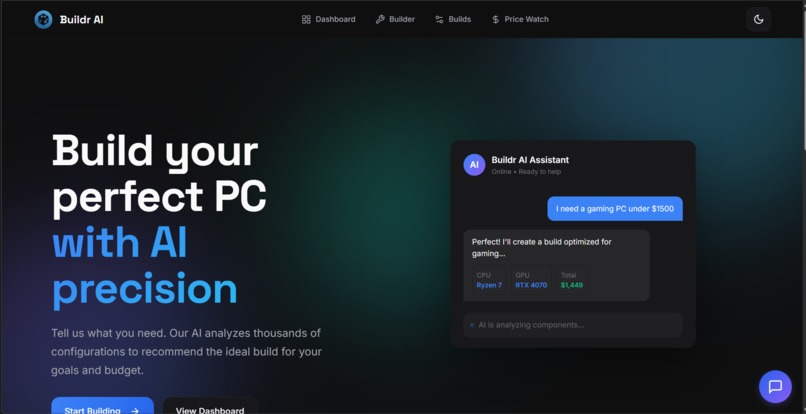
Front Page
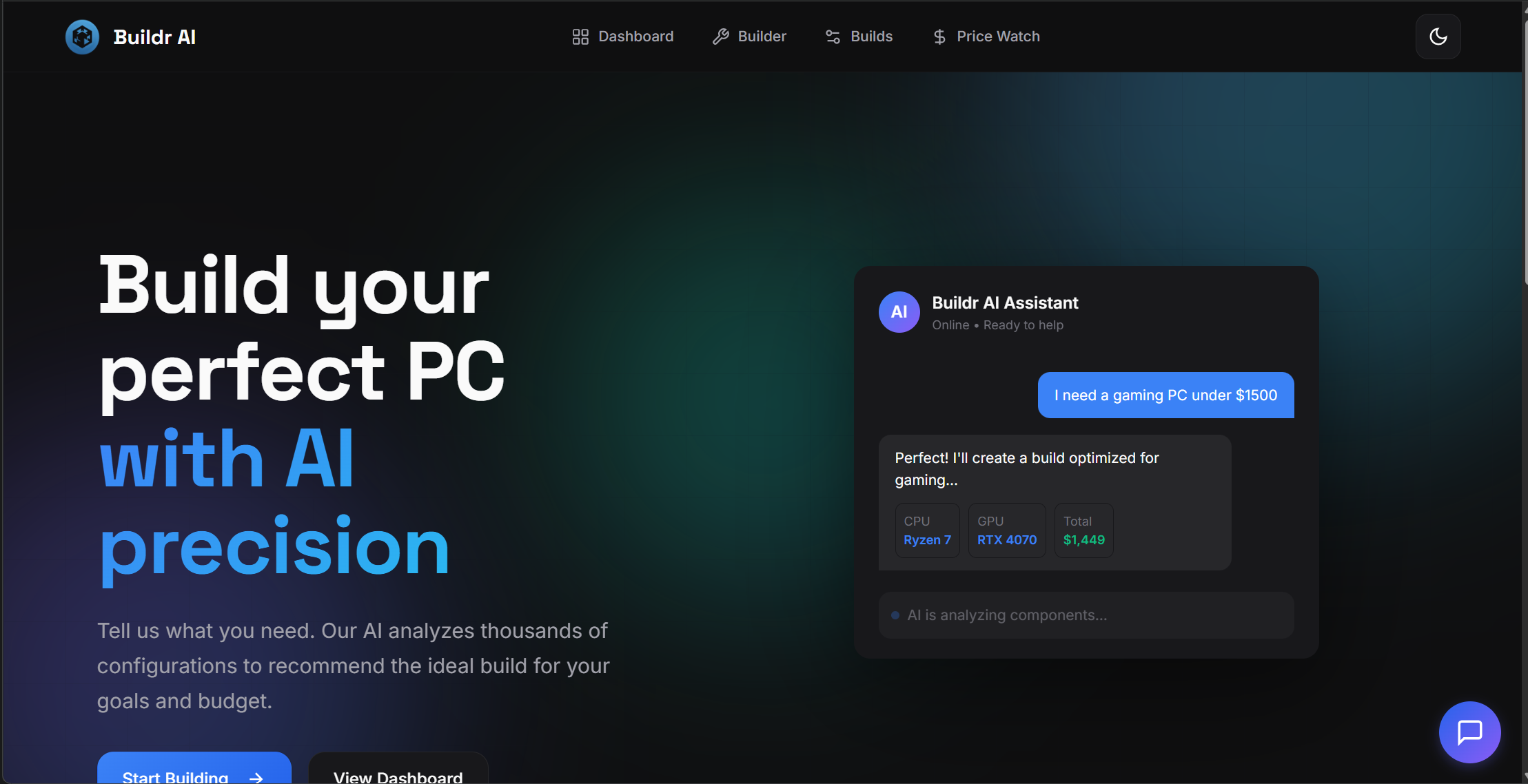
Inspiration Building a custom PC is daunting. Between confusing socket types, power requirements, and dimension constraints, many enthusiasts give up and buy pre-builts. We wanted to democratize PC building by creating an intelligent assistant that doesn't just "list parts" but actually understands aesthetics and functionality.
What it does Buildr AI is an agentic system that acts as your personal PC architect.
Conversational Design: You chat with it naturally ("I need a workstation for video editing under $2000"). Intelligent Orchestration: Our Orchestrator Agent analyzes your request and delegates tasks to specialized sub-agents. Compatibility Agent: Verifies every part matches (CPU to Motherboard, RAM clearance, PSU wattage). Price Tracking Agent: (Planned/Integrated) Checks current market rates to maximize your budget. Visualization Agent: Generates a stunning, photorealistic image of your specific build configuration using Cloudflare's Flux model. Visual Feedback: The generated "Hero" image is instantly pushed to the frontend, updating the website's main display to show your custom machine, not a generic stock photo. How we built it We utilized the Solace Agent Mesh (SAM) as the backbone of our multi-agent architecture.
Backend: Python-based agents running in Docker containers. LLM: Powered by Cerebras (zai-glm-4.7) for lightning-fast inference. Image Generation: Integrated Cloudflare Workers AI (Flux) for generating high-fidelity artifact images. Persistence: Configured shared SQLite and Docker volume mounts to ensure generated artifacts persist between sessions. Frontend: A responsive Vanilla JS/HTML web interface that connects to the SAM Gateway via REST and SSE (Server-Sent Events) for real-time streaming of agent thoughts and images. DevOps: Docker Compose for orchestrating the mesh, with custom environment configurations for API security. Challenges we ran into Artifact Persistence: We struggled significantly with Docker on Windows file synchronization. Generated images would exist inside the container but fail to appear on the host machine instantly. We solved this by implementing robust file copying and permissions handling in our Python tools and optimizing the Docker volume mounts. Agent Communication: Getting the "Orchestrator" to correctly identify and pass image artifacts to the frontend was tricky. We encountered "Artifact not found" errors due to isolated agent memory states. We resolved this by enabling a shared SQL database for agent state and implementing a "pass-through" mode for direct URI handling. Frontend-Backend Connection: connecting our custom UI to the Agent Mesh Gateway required reverse-engineering the API endpoints to correctly parse artifact:// URIs and render them dynamically in the browser.
Accomplishments that we're proud of Seeing the frontend hero section automatically update with a generated image of the PC we just described in the chat. It feels like magic. Robust Error Handling: We built a system that degrades gracefully—if an image generation fails, the chat continues; if the user's prompt is vague, the Orchestrator asks clarifying questions.
Performance: Leveraging Cerebras means our planning step is near-instant, making the chat feel incredibly responsive compared to standard LLMs. What we learned State Management is Key: In a multi-agent system, shareable state (like a shared database) is critical. Isolated agents lead to fragmented context.
Docker Volume Behavior: We learned way more than we expected about how Docker Desktop handles file IO on Windows versus Linux! The Power of Mesh: Breaking the problem into small, specialized agents (One for images, one for parts) made debugging and upgrading specific capabilities much easier than a monolithic app. What's next for Buildr AI Real-Time Price Alerts: Fully fleshing out the Price Tracking agent to alert users when their dream parts go on sale.
Built With
- ai
- css
- docker
- html
- javascript
- pypartpicker
- python

Log in or sign up for Devpost to join the conversation.