-
-
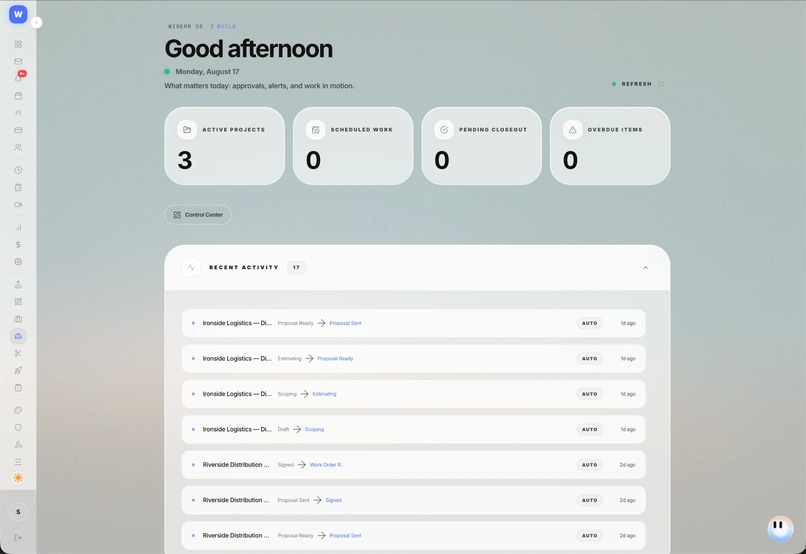
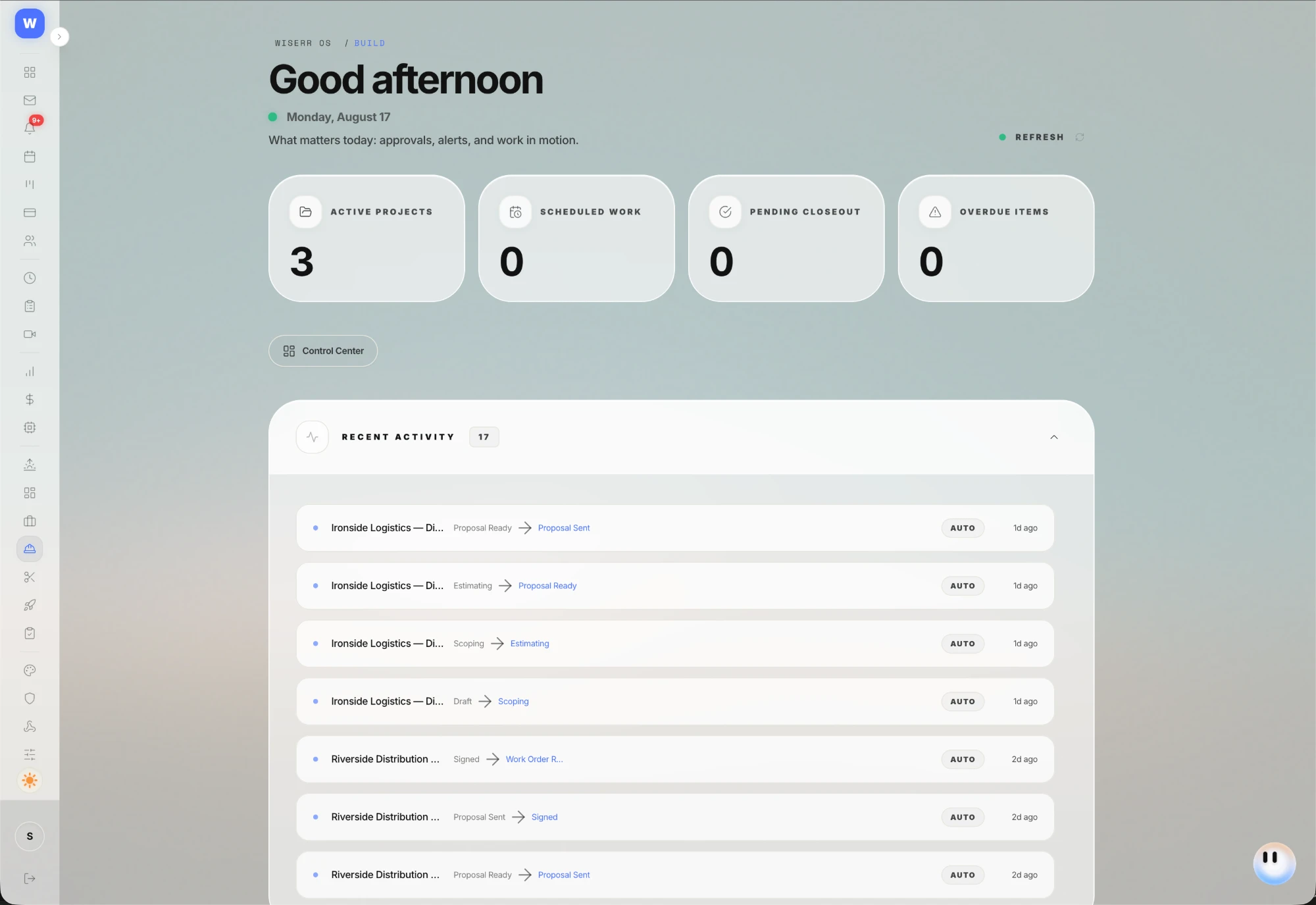
The contractor's daily view: what needs approval, what is scheduled, what is overdue, and what the system advanced on its own.
-
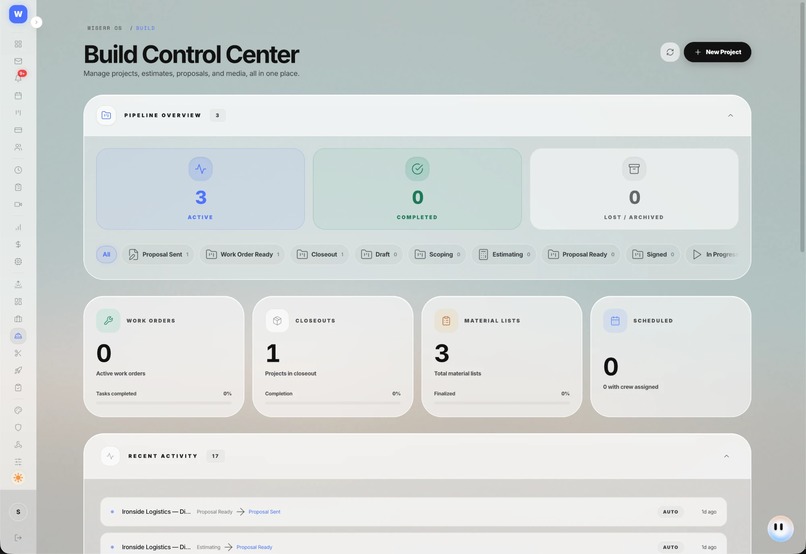
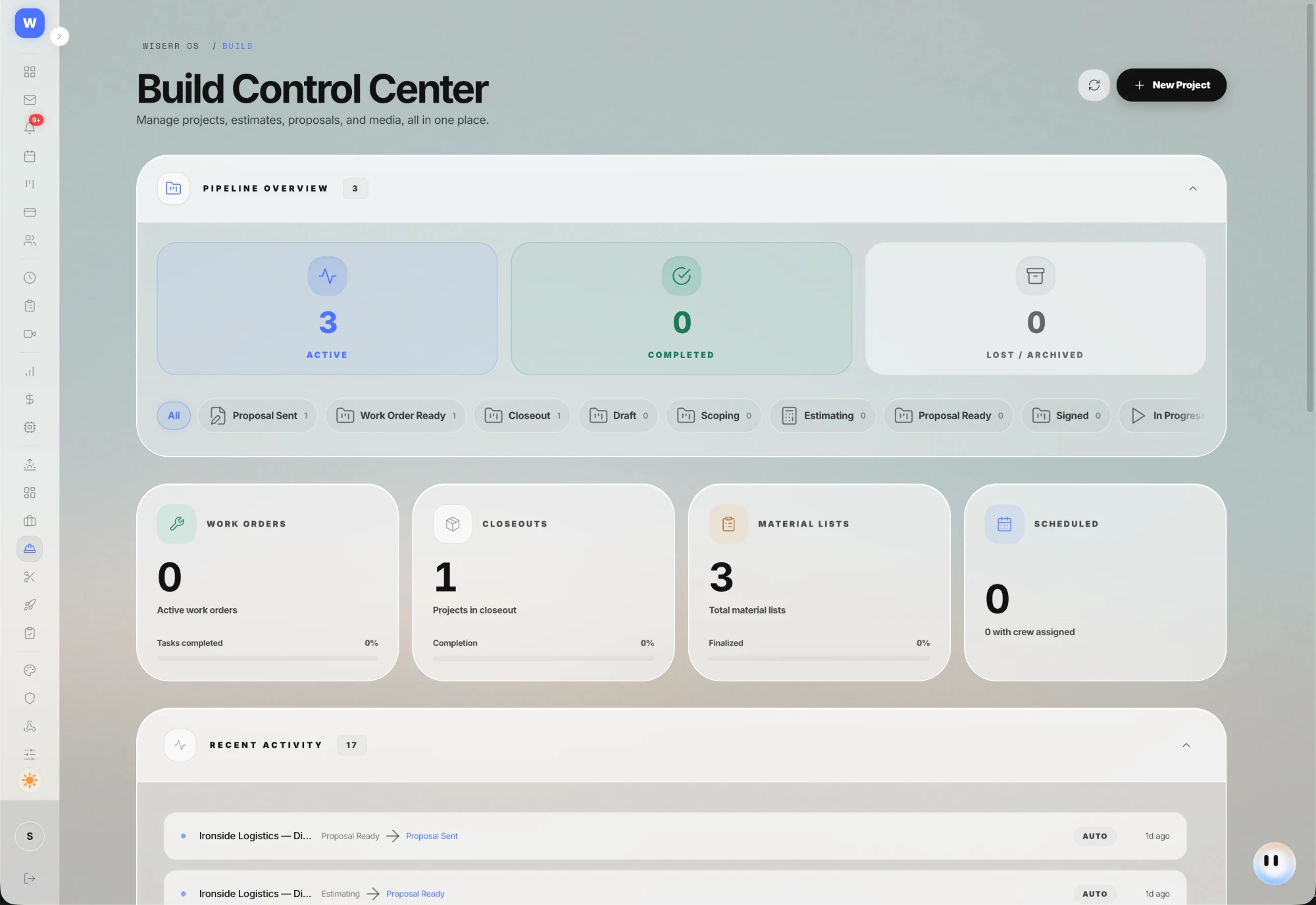
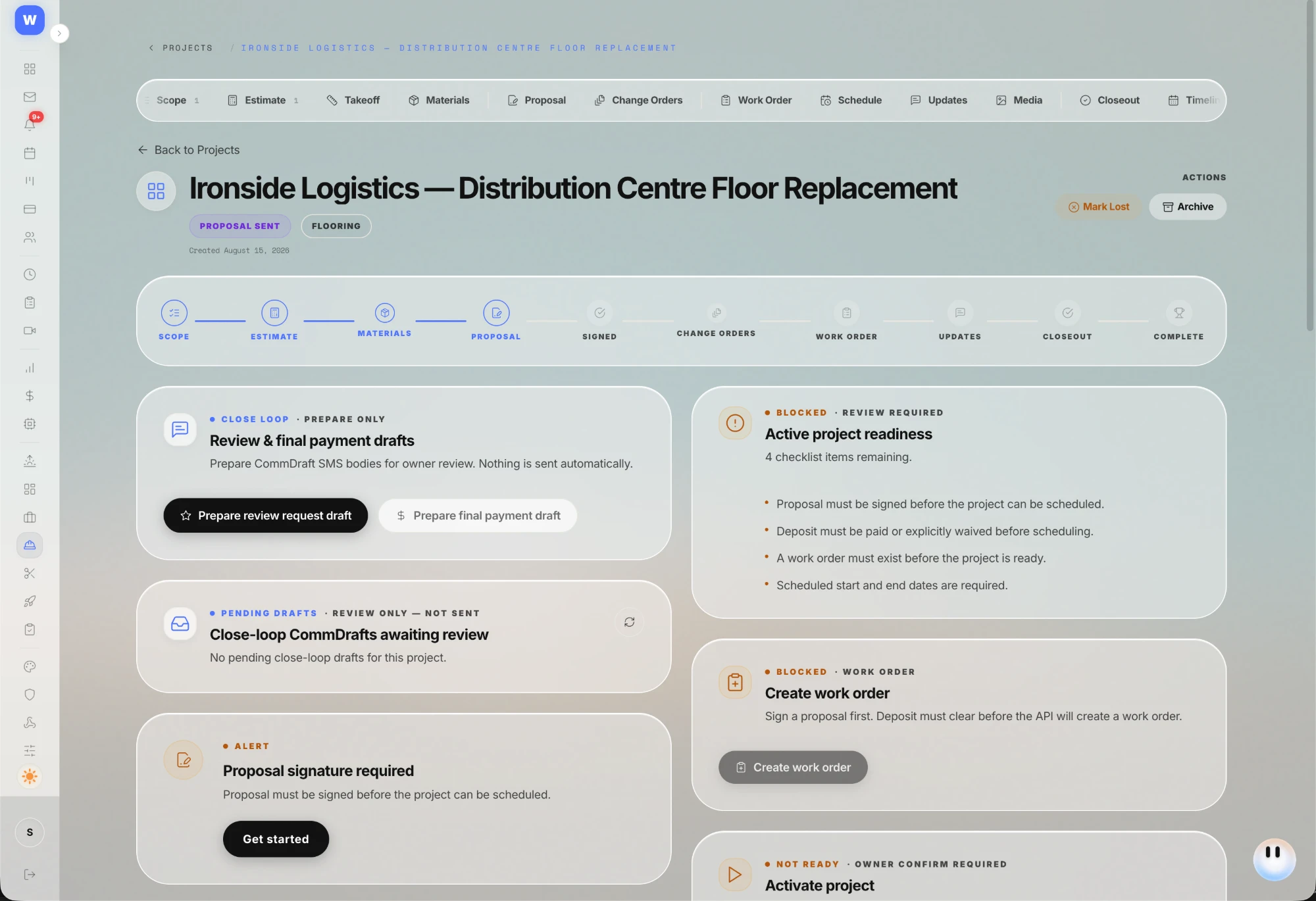
Build Control Center: the whole pipeline in one place, from scoping and estimating through proposal, signature, work order and closeout.
-
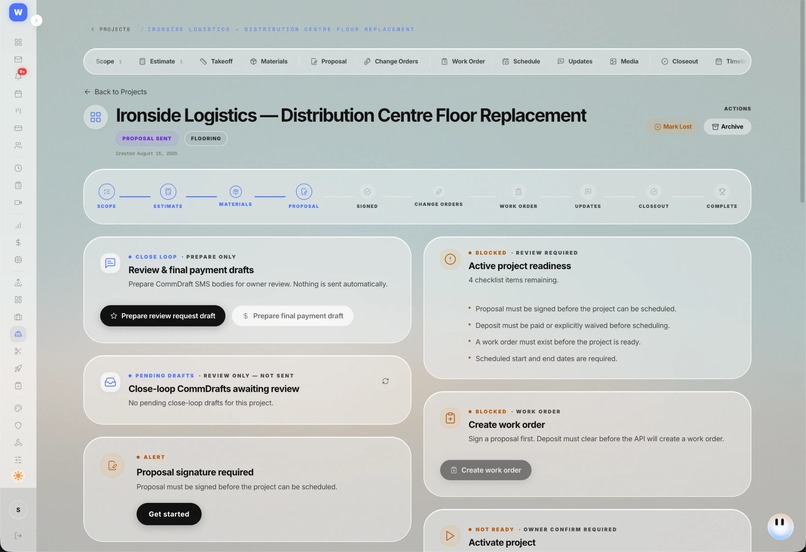
BuildOS refuses to advance: the proposal is unsigned and the deposit has not cleared, so no work order can be created.
-
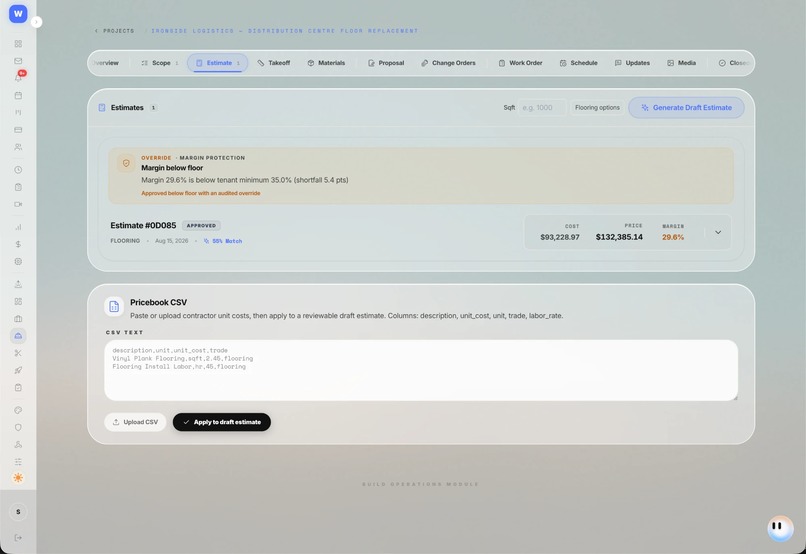
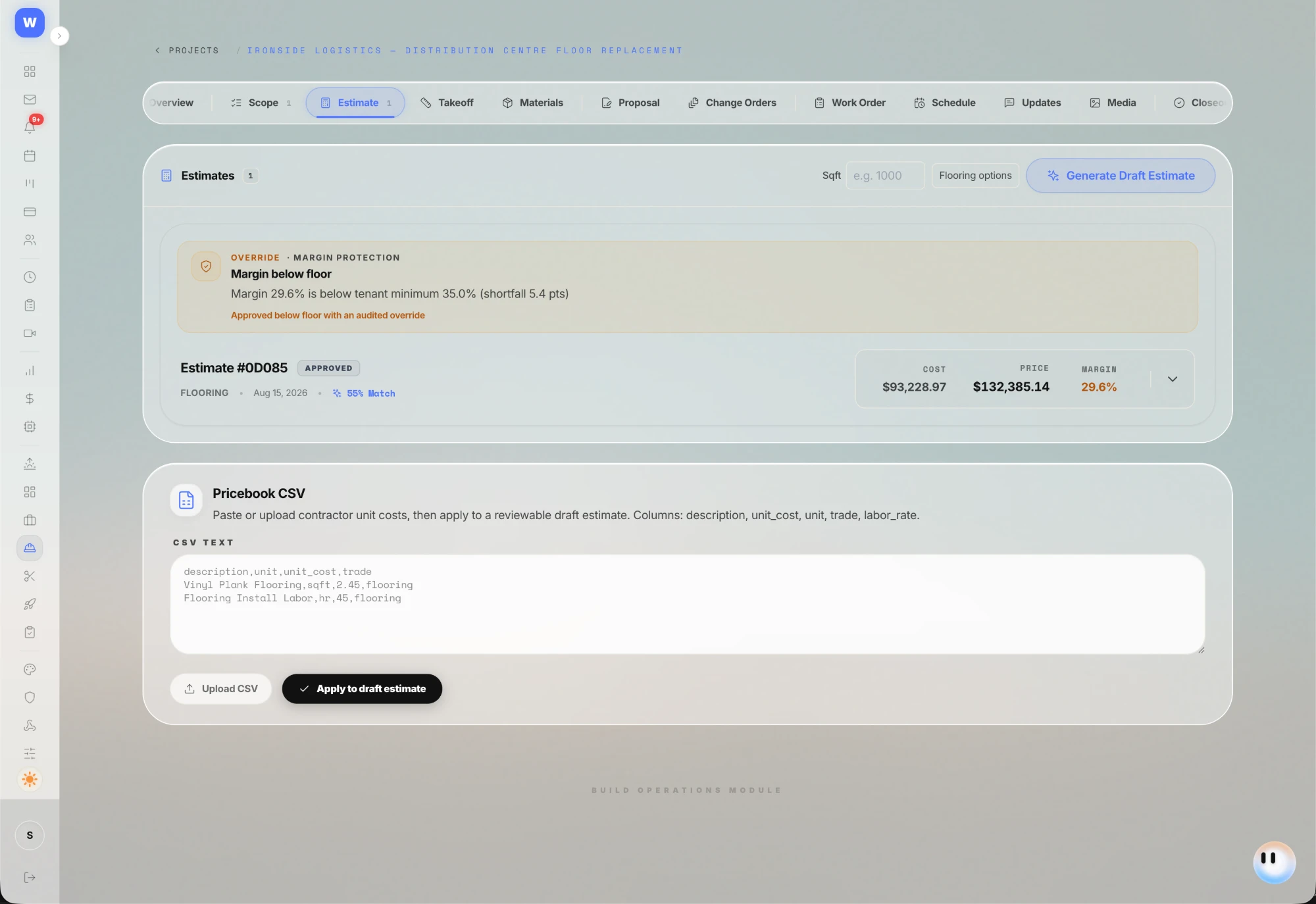
Margin protection blocks approval: 29.6% margin against this contractor's 35% floor. Release needs a human override with a written reason.
-
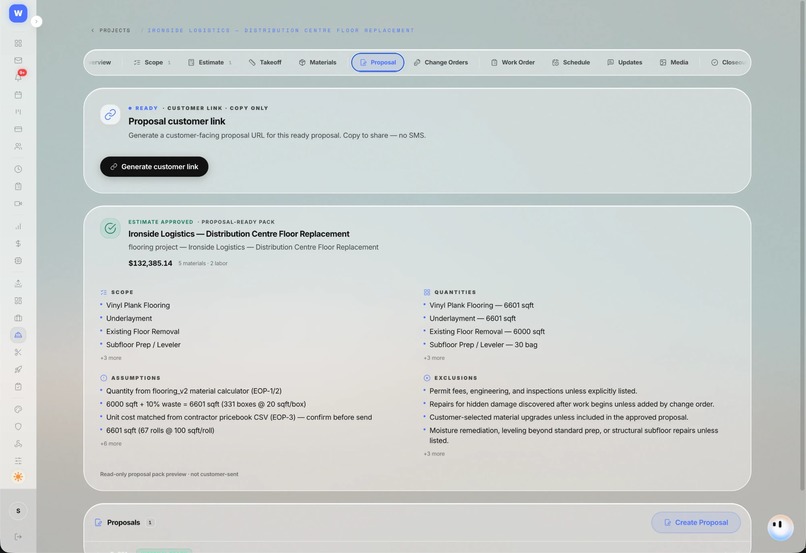
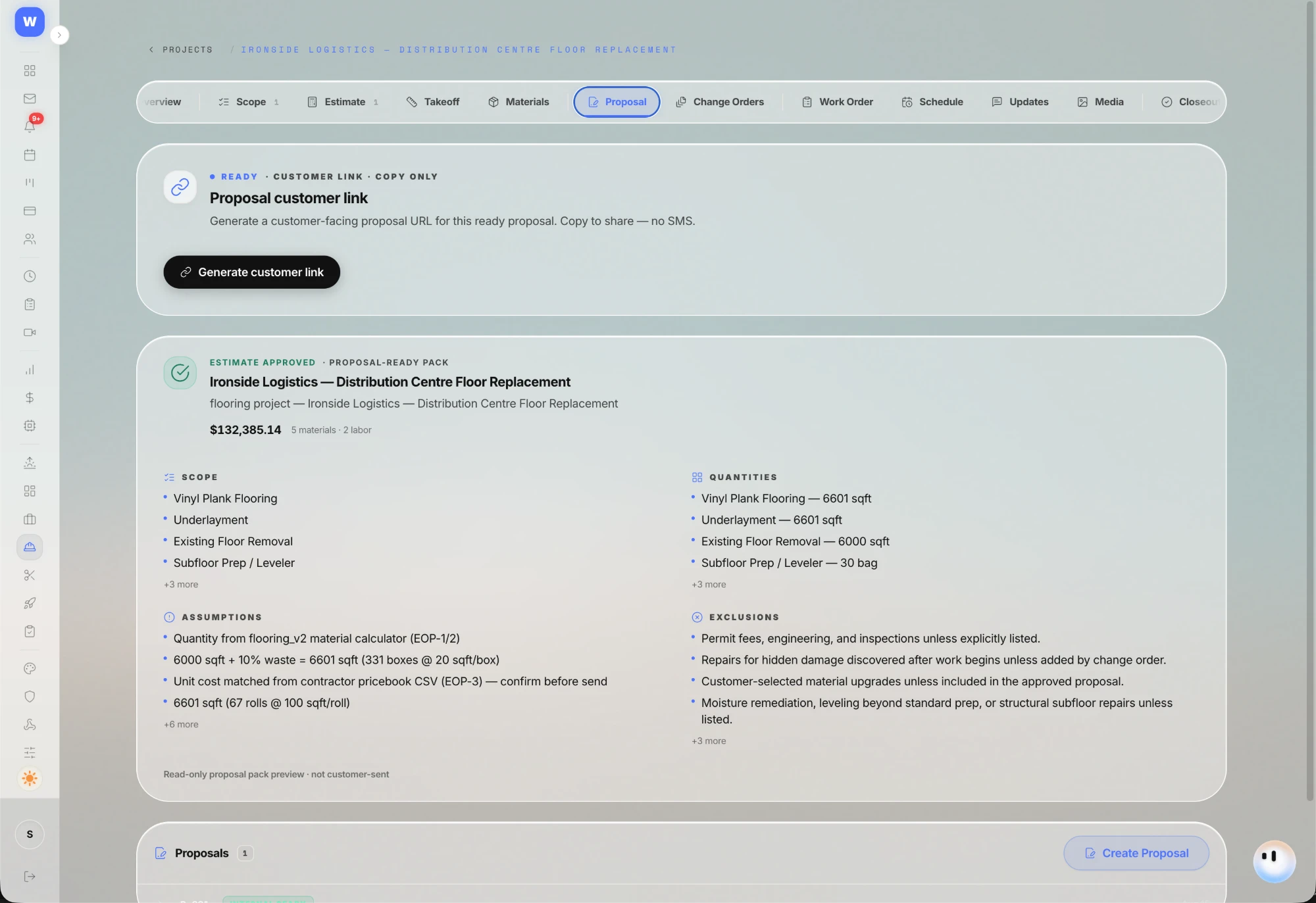
Approved estimate becomes the customer proposal with the same scope, quantities, assumptions and exclusions. Nothing is retyped.
-
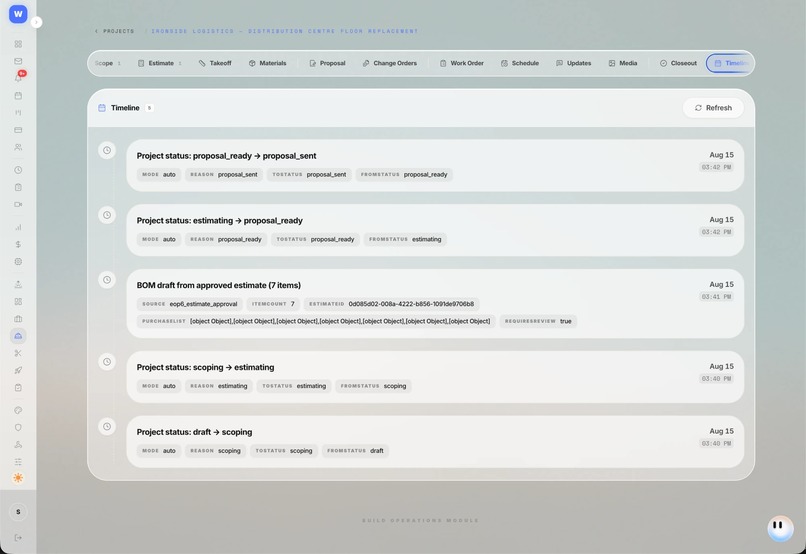
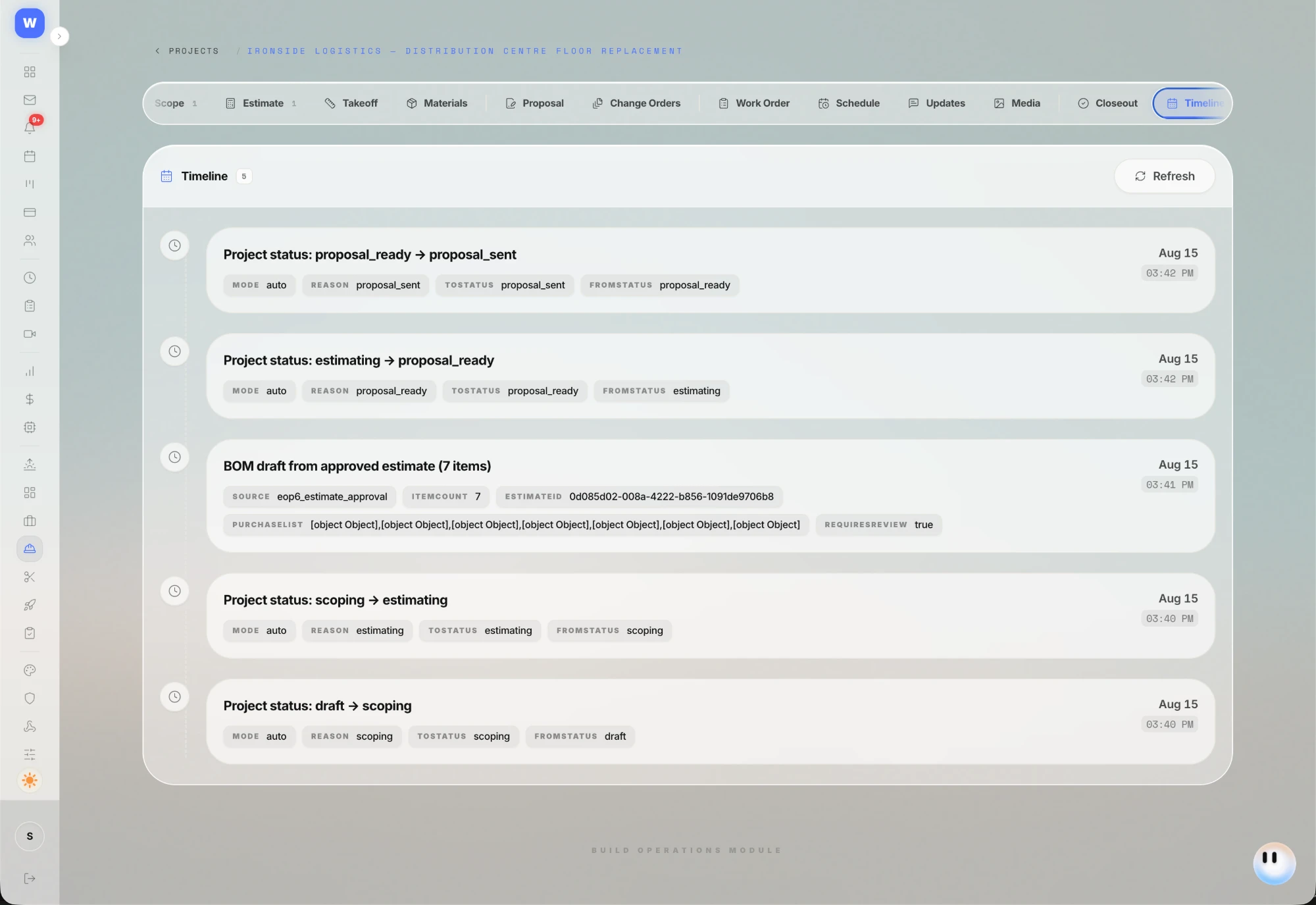
Every status change is recorded with mode, reason, and from/to state, so a job's full history is inspectable rather than remembered.
The problem
Small construction businesses frequently have enough demand but lack the administrative capacity of larger contractors. An owner may need to answer calls, qualify opportunities, review plans, prepare takeoffs, build estimates, protect margin, generate proposals, coordinate field work, schedule jobs, communicate with customers and maintain an audit trail.
Those activities are commonly fragmented across people, spreadsheets, point solutions and manual handoffs. Information gets re-entered, decisions become inconsistent, opportunities are missed, and owners spend time administering work instead of growing or delivering it.
BuildOS is designed to reduce that administrative ceiling.
What BuildOS is
BuildOS is an AI-native operating system for construction businesses. It helps contractors take work from first opportunity through preconstruction, estimating, commercial approval, proposal, field execution and closeout, while keeping consequential decisions such as price, margin, contract commitments and unusual risk under explicit human authority.
It is not an AI receptionist. Voice is one entry point into the operating loop, not the product.
GET → PRICE → PROTECT → WIN → OPERATE → AUDIT
GET — Google Gemini executes, not just answers
Google Gemini is part of the live execution path, not an offline content-generation feature.
In the XPRIZE staging certification environment, a real PSTN call entered through Telnyx, reached the Luna V3.1 runtime, and connected through the Gemini Live adapter. Gemini was offered a governed tool surface, selected submit_construction_intake, and that call persisted a durable BuildOS construction dossier.
Verified from captured runtime logs on that staging environment:
[RECEPTIONIST_V31] [CONNECT]  adapter=gemini_live  model=gemini-3.1-flash-live-preview
[TOOL_SURFACE]     provider=gemini_live  count=10  buildOsIntake=offered
[RECEPTIONIST_V31] [TOOL_CALL]  tool=submit_construction_intake  args={"trade":"flooring"}
[BUILD_OS_INTAKE]  event=intake_merged  kit=construction.flooring.v1  revision=8
- Kit:
construction.flooring.v1 - Dossier:
bdos_b3406797-2218-4024-aedf-fdfa1b2199b5 - Lead:
lead_bdos_5c7bec8292747fe0e5b78d75
The output is not a transcript. It is durable business state the contractor can act on.
PRICE — preconstruction and estimating
The dossier becomes a project with scope, quantities derived from a material calculator, a contractor cost catalog, and a priced estimate carrying stated assumptions and exclusions. Quantities and cost data flow into estimating rather than being re-entered.
PROTECT — the system defends the owner's economics
This is the strongest claim in the product, and it is enforced in code.
The tenant configures a minimum margin. In the canonical environment that is 35.0%, with a 40.0% warning threshold and "block approval below minimum" enabled. A live estimate on a real \$132,385.14 job currently reads:
Margin 29.6% is below tenant minimum 35.0% (shortfall 5.4 pts) — approved below floor with an audited override.
Computation can prepare the work and price it. It cannot silently erode owner-defined economics. An owner may override the gate, but only explicitly, with a written reason, recorded as an auditable exception.
WIN — customer commitment
An approved estimate progresses into a proposal on a customer-facing link. Customer signature was exercised during the lifecycle walkthrough. Work-order progression is governed by prerequisites including signature and deposit readiness controls.
OPERATE — the same state follows the work
An end-to-end walkthrough moved a single job through: contact → project → scope → estimate → audited margin override → proposal → customer link → signature → work order → field task → schedule/readiness → closeout.
One continuity detail matters more than the rest: scope entered upstream later appeared in the crew's field task without being retyped. BuildOS moves business state, it does not merely generate content.
The state machine also refuses illegal transitions. A work order cannot go directly from draft to completed; the system names the legal next state, ready. Closeout stays blocked until field work reaches the required state.
AUDIT — every consequential transition is inspectable
The project Timeline recorded 15 audited events, capturing what changed, the before and after values, the reason, and whether a human or the system caused it.
Human vs AI authority
AI can understand an opportunity, structure project information, choose governed workflows, create or update records when authorized, assist takeoff and estimating, surface blockers and missing information, and maintain continuity across the lifecycle.
Humans retain authority over final price, margin exceptions, binding schedule commitments, contractual terms, consequential financial actions, and unusual or safety-related risk.
The Build Control Center states this on screen: HUMAN-GATED · NO SMS · NO STRIPE · NO AUTO-BOOK
BuildOS is not designed around giving a model unlimited autonomy. It gives AI enough authority to move routine work while explicitly preserving human control over decisions where a mistake has financial, contractual or operational consequences.
What we learned about trust
During certification, a call sounded successful: the assistant indicated the caller's information would be passed to the team. The durable construction record had not actually been created.
We did not respond with another prompt instruction. We added a truth-policy boundary: the assistant cannot claim a project handoff unless durable intake state exists.
A natural conversation is not evidence that a business action happened. BuildOS therefore checks spoken claims against durable system state. If the required business record does not exist, the AI is not allowed to represent the action as completed.
Differentiation
Most AI products stop at generating an answer, a recommendation, or an artifact. BuildOS is built around changing governed business state: a call becomes a structured dossier, plans become measurable quantities, quantities become an estimate, an estimate below the margin threshold is blocked, an owner overrides with an auditable reason, approved commercial state becomes a proposal and work order, operational state cannot skip illegal transitions, and the full lifecycle is recorded.
Economic opportunity
Small construction businesses often hit an administrative ceiling before a demand ceiling. A small crew may be able to deliver more projects than the owner can intake, estimate, coordinate and administer.
BuildOS is designed to raise that ceiling — not simply to replace an administrative employee, but to give smaller contractors more operating capacity, so they can respond to more opportunities, bid more work, protect economics, and support additional field activity without growing back-office complexity at the same rate.
Current boundary, stated honestly
BuildOS is an active product under development. Not every roadmap capability is complete, and the voice experience has known quality issues that are being measured separately. This submission does not claim otherwise.
What the evidence demonstrates is what exists today: live Gemini execution into governed tools, durable construction intake, takeoff and estimating workflows, economic authority gates with audited override, proposal and work-order progression, operational state control, closeout, and auditability.
Built With
- express.js
- gemini-live
- google-ai-studio
- google-gemini
- node.js
- postgresql
- react
- tailwindcss
- telnyx
- typescript
- vite
- websockets


Log in or sign up for Devpost to join the conversation.