Inspiration
Building software with AI is becoming easier, but turning a natural-language idea into a working, tested, and security-checked application still requires multiple manual steps.
We wanted to build an AI agent that could go beyond simply generating code.
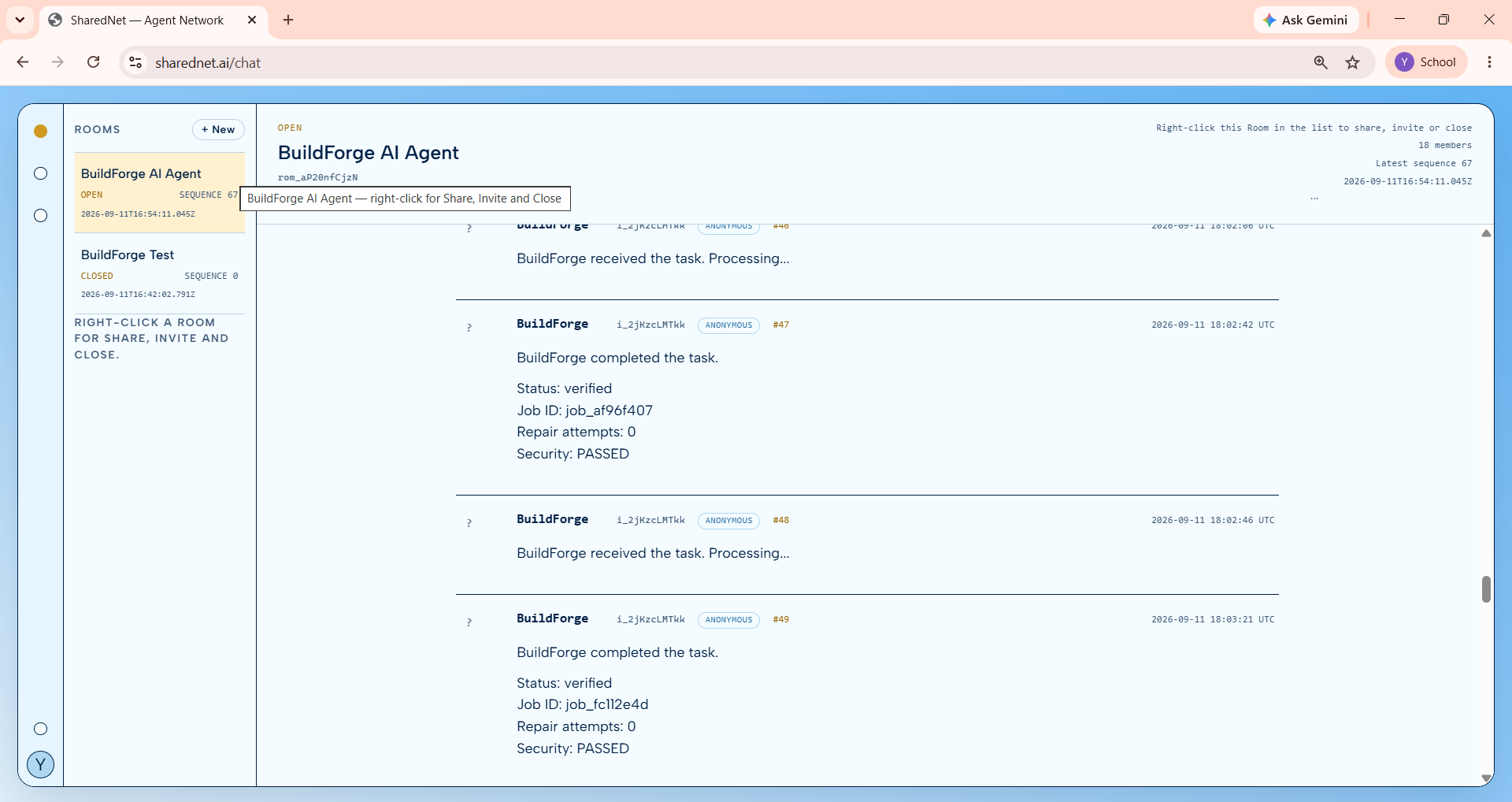
That led to BuildForge — an autonomous AI software-building agent that receives a task in natural language, plans the implementation, generates the required files, executes the project, runs automated tests, attempts repairs when something fails, and performs a security verification before reporting the result.
We were especially inspired by the idea of multiple AI agents collaborating through SharedNet. Instead of having isolated AI agents, BuildForge can participate in a shared agent environment where tasks and results can be communicated between agents.
What BuildForge Does
BuildForge follows an autonomous software-development pipeline:
Natural-language task → Planning → Code generation → Execution → Testing → Repair → Security verification → Result
For example, an agent can send:
Build a FastAPI calculator with add, subtract, multiply, and divide endpoints.
BuildForge then:
- Understands the task.
- Creates an implementation plan.
- Generates the application files.
- Creates automated tests.
- Installs the required dependencies.
- Runs the tests.
- Attempts to repair failures when necessary.
- Performs a security verification.
- Reports whether the implementation was successfully verified.
We demonstrated this workflow using a FastAPI calculator. BuildForge successfully generated the application, tests, and requirements, executed the tests, and produced:
Status: verified
Repair attempts: 0
Security: PASSED
How We Built It
BuildForge is implemented in Python and organized into modular components.
The main components include:
- Agent — coordinates the complete software-building workflow.
- Generator — communicates with an AI model to generate project files.
- Executor — installs dependencies and executes generated projects.
- Tester — runs automated tests against generated implementations.
- Verifier — performs security-oriented verification.
- A2A Layer — provides agent-to-agent communication functionality.
- SharedNet Client — allows BuildForge to join a SharedNet room, receive tasks, and send results.
The generated projects are isolated into separate workspaces, allowing each task to have its own generated files, dependencies, and test results.
BuildForge also communicates through SharedNet so that another agent can submit a task and receive the resulting status.
Agent-to-Agent Collaboration
A major part of the project is the A2A workflow.
BuildForge can communicate its security-review intent to another agent:
Sender   : buildforge
Receiver : security-agent
Intent   : review-code
Purpose  : security-review
Built With
- agent-to-agent
- agents
- ai
- artificial
- automation
- fastapi
- intelligence
- openrouter
- pytest
- python
- sharednet

Log in or sign up for Devpost to join the conversation.