-
-
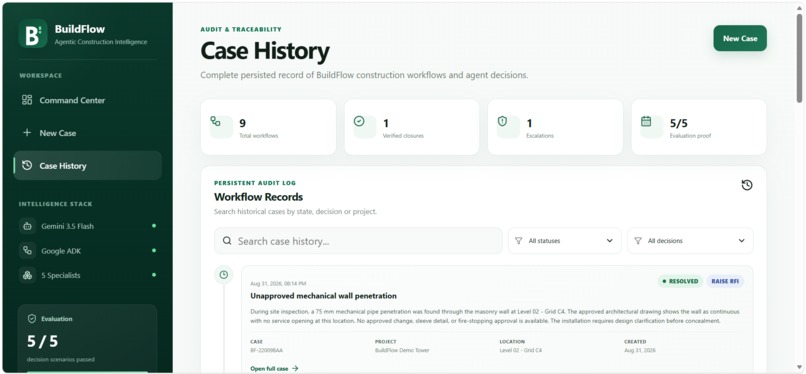
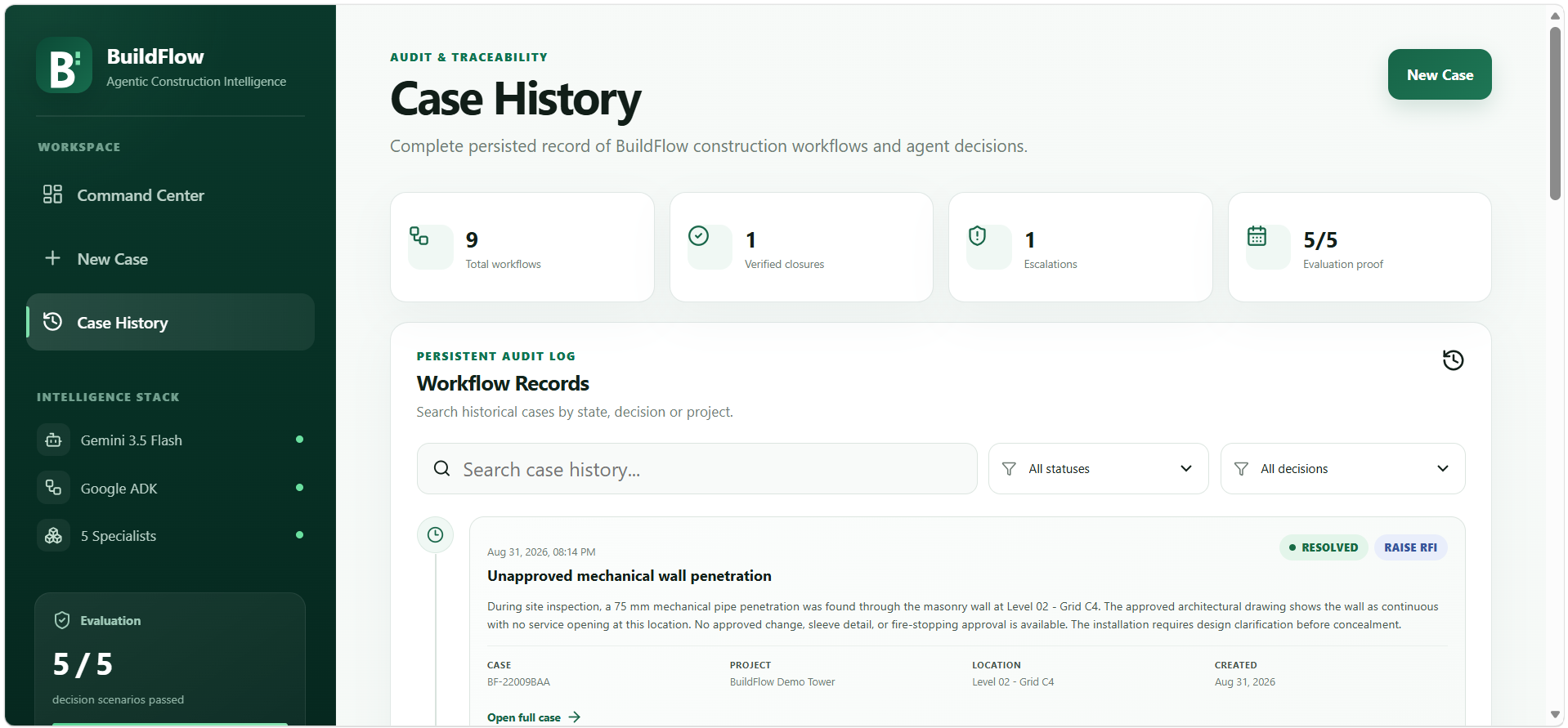
Centralized case history providing a traceable record of construction issues, decisions, workflow stages, and final outcomes.
-
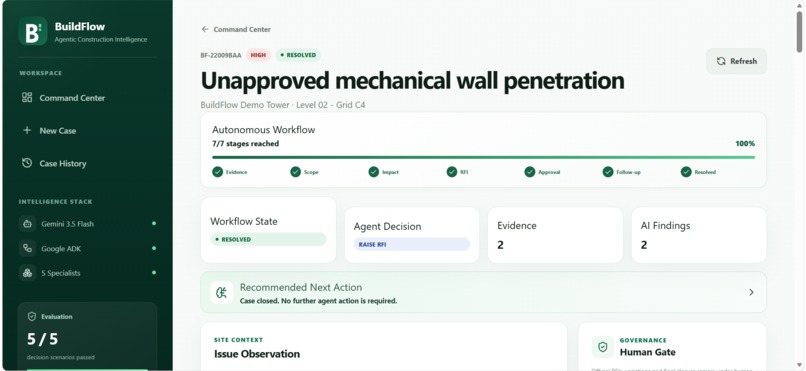
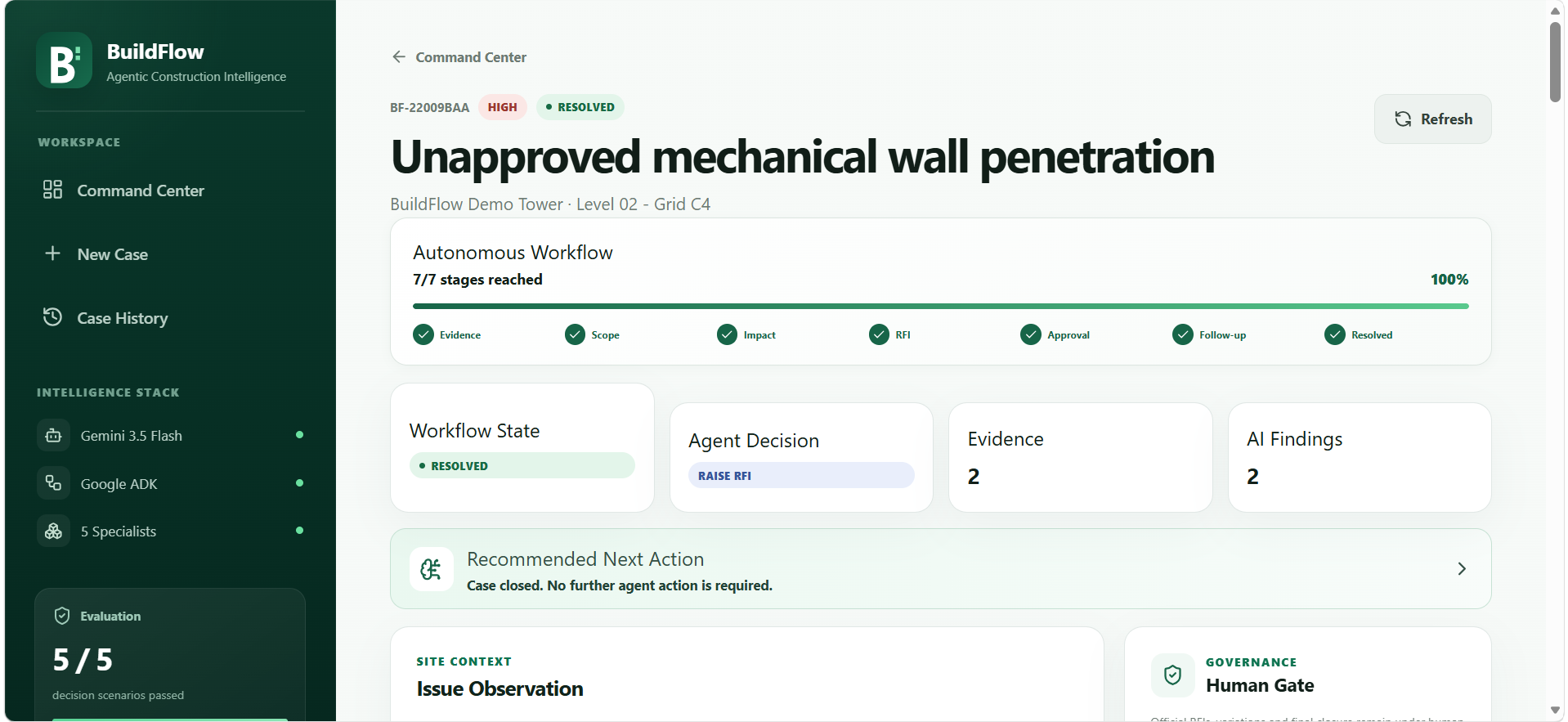
Complete case analysis from evidence to final resolution.
-
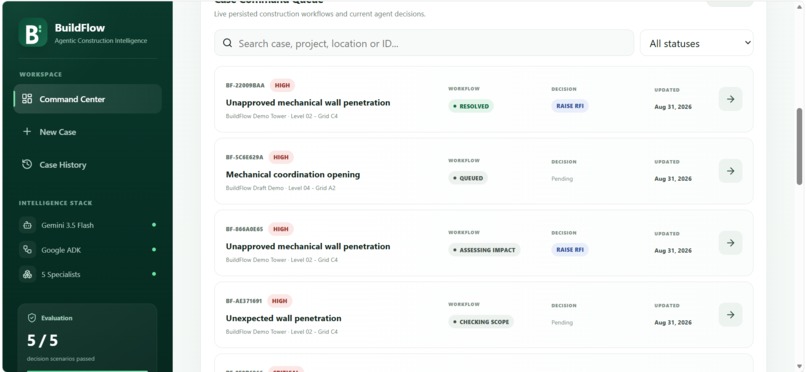
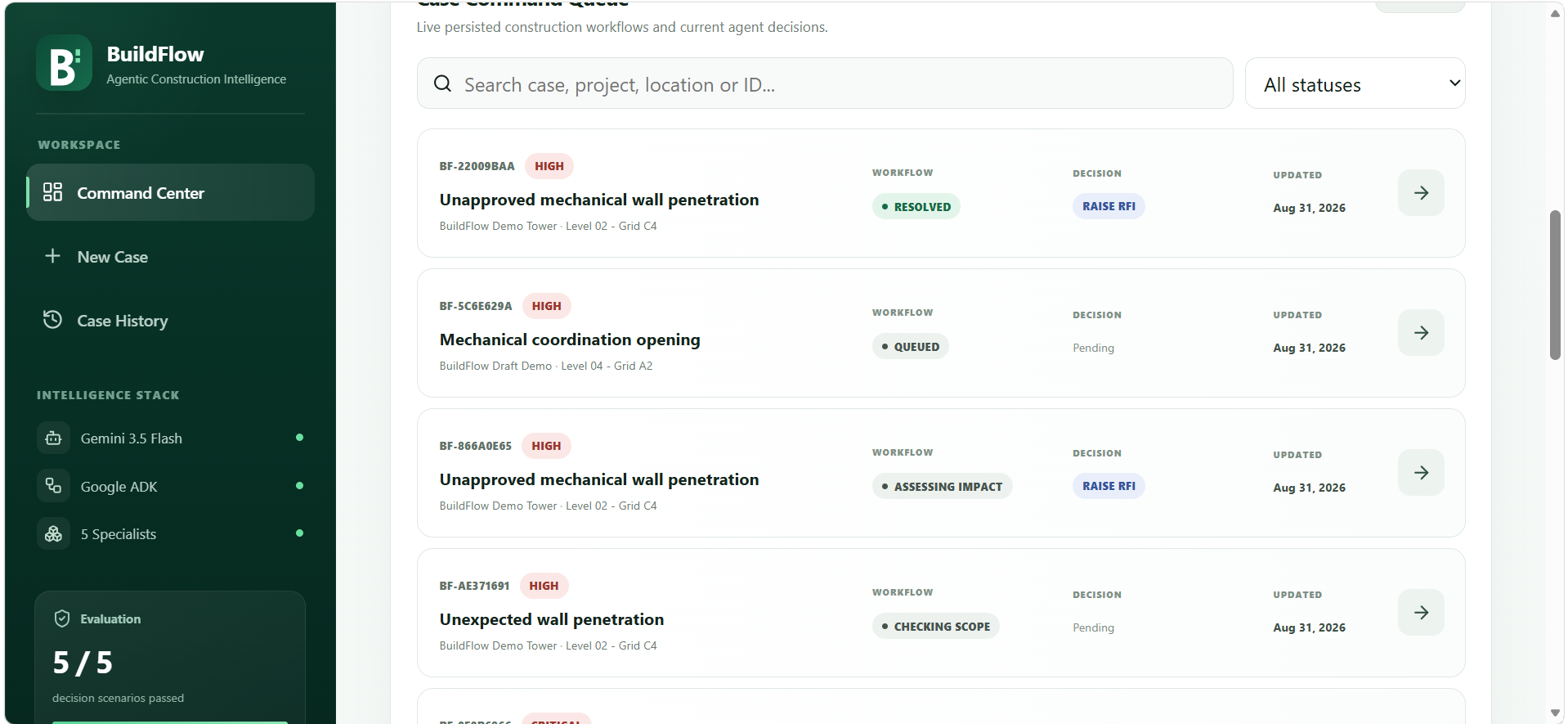
All construction cases with status, priority, and progress.
-
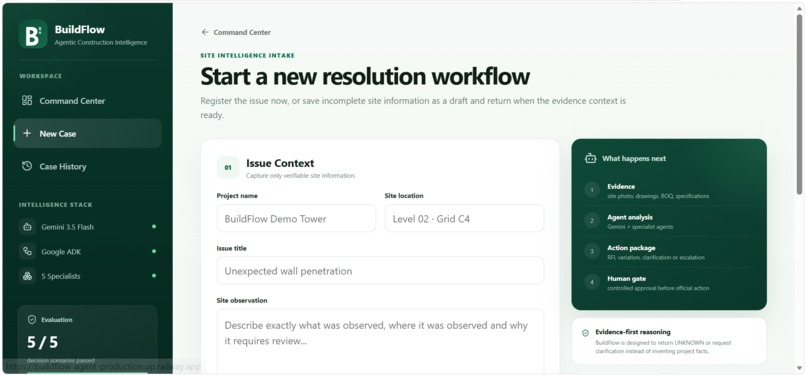
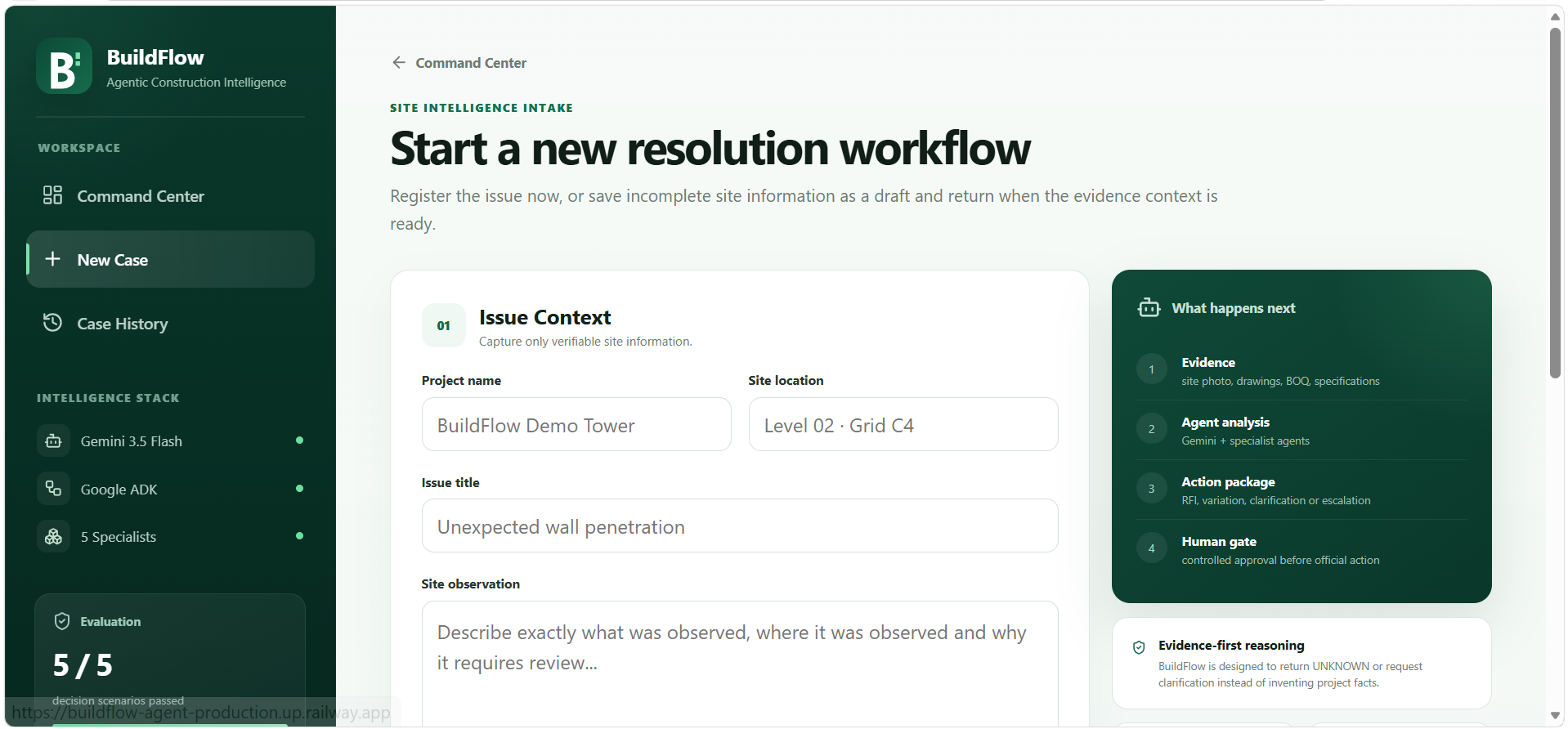
Create and submit a new construction issue.
-
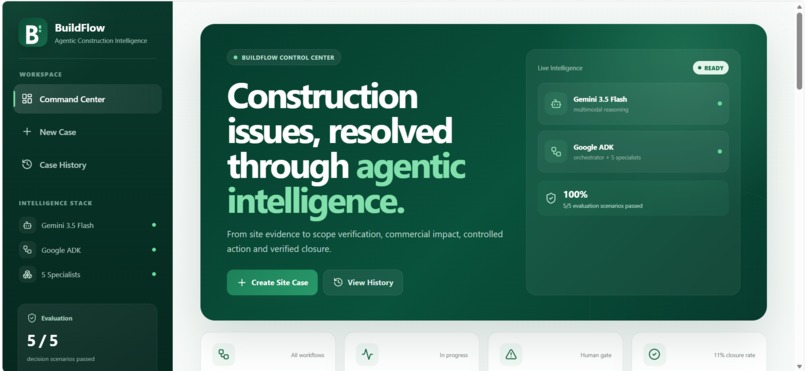
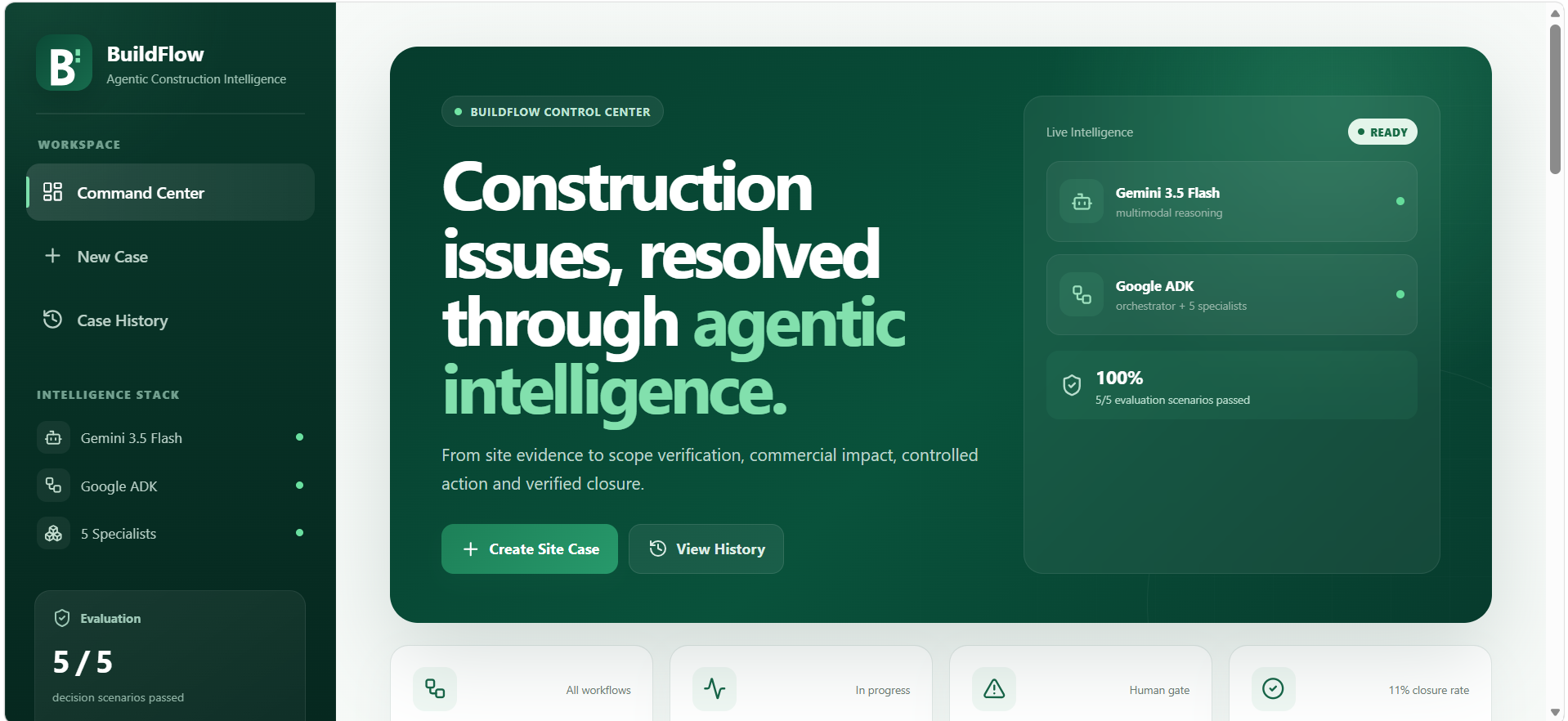
BuildFlow dashboard with workflow overview and key case metrics.
Inspiration
Construction projects generate site issues every day, including drawing conflicts, unexpected installations, missing approvals, scope gaps, potential variations, and safety concerns.
These issues are often managed across emails, drawings, site notes, spreadsheets, and follow-up messages, which makes coordination slow and fragmented.
I built BuildFlow Agent to turn that scattered process into a structured, evidence-backed workflow where specialized AI agents support the user while important decisions remain under human control.
What it does
BuildFlow Agent manages a construction issue from initial evidence to verified resolution.
It uses five specialized agents:
- Evidence Agent analyzes site observations, drawings, specifications, BOQs, and supporting evidence.
- Scope Agent identifies design conflicts, clarification needs, scope gaps, and potential variations.
- Impact Agent evaluates technical, cost, and schedule impact.
- RFI Agent prepares evidence-backed Requests for Information.
- Follow-up Agent tracks responses and recommends whether a case should continue, escalate, or be resolved.
The platform also includes a Human Gate, so protected actions such as RFI approval and final case closure remain under human control.
BuildFlow supports draft cases, persistent case history, structured workflow states, and safe recovery from temporary AI failures.
How I built it
The frontend is built with React, TypeScript, and Vite, while the backend uses FastAPI, Python, and Pydantic.
I used Google Agent Development Kit (ADK) to coordinate the multi-agent workflow and Gemini 3.5 Flash Lite for structured reasoning across evidence analysis, scope assessment, impact assessment, RFI generation, and follow-up.
Production workflow state is stored in Google Cloud Firestore, while the complete application is packaged using Docker and deployed as a production web application.
I also implemented an explicit workflow state machine to control how a case moves from evidence intake to final resolution.
Challenges I ran into
One of the biggest challenges was making AI output reliable enough for a workflow-driven construction application.
Model responses can occasionally be incomplete, malformed, or temporarily unavailable, so I added structured schemas, validation, retries, and a FAILED_RETRYABLE recovery flow.
Another challenge was preventing unsupported AI assumptions. I introduced evidence-grounding rules so BuildFlow does not invent drawing references, BOQ items, approvals, cost values, or schedule values.
I also needed to separate AI recommendations from official project actions, which led to the Human Gate for approval and final closure.
Accomplishments that I'm proud of
I built a complete end-to-end construction issue resolution workflow that moves from evidence analysis to final verified closure.
BuildFlow successfully completed all 7/7 workflow stages in the production demo.
The backend passed 50 automated tests, while the frontend passed TypeScript validation and production build checks.
I also evaluated five construction decision scenarios covering RFI, no action, clarification, variation, and escalation, with 5/5 scenarios passing.
I am especially proud that the system handles missing commercial data safely by returning UNKNOWN instead of generating unsupported cost or schedule estimates.
What I learned
I learned that useful agentic AI requires much more than connecting an LLM to a user interface.
Reliable agent systems need clear agent responsibilities, structured outputs, evidence grounding, persistent state, controlled workflow transitions, safe failure recovery, and human oversight.
I also learned that combining AI reasoning with deterministic software controls creates a much more trustworthy system than relying on a general-purpose chatbot.
What's next for BuildFlow Agent
The next step is to expand BuildFlow into a broader construction intelligence platform.
Future improvements could include BIM model comparison, Google Cloud Storage for project evidence, schedule and cost-system integrations, automated background follow-up, notifications, role-based access control, project email integration, and organization-wide dashboards.
My long-term vision is for BuildFlow Agent to become an intelligent coordination layer between site evidence, project documentation, AI agents, and accountable human decision makers.
Built With
- agentic-ai
- docker
- fastapi
- gemini
- google-adk
- google-cloud
- google-firestore
- react
- typescript


Log in or sign up for Devpost to join the conversation.