Inspiration Canada is facing a historic housing supply gap, with millions of new units needed by 2035 to restore affordability. A major bottleneck is the "regulatory lag"—the months of manual back-and-forth between developers and city officials over fragmented zoning bylaws and building codes. We were inspired by the 2026 Build Canada Homes Act and its mission to catalyze a new housing industry through modern construction methods and reduced red tape. We wanted to build the digital infrastructure that makes "gentle density" and modular housing a reality today.
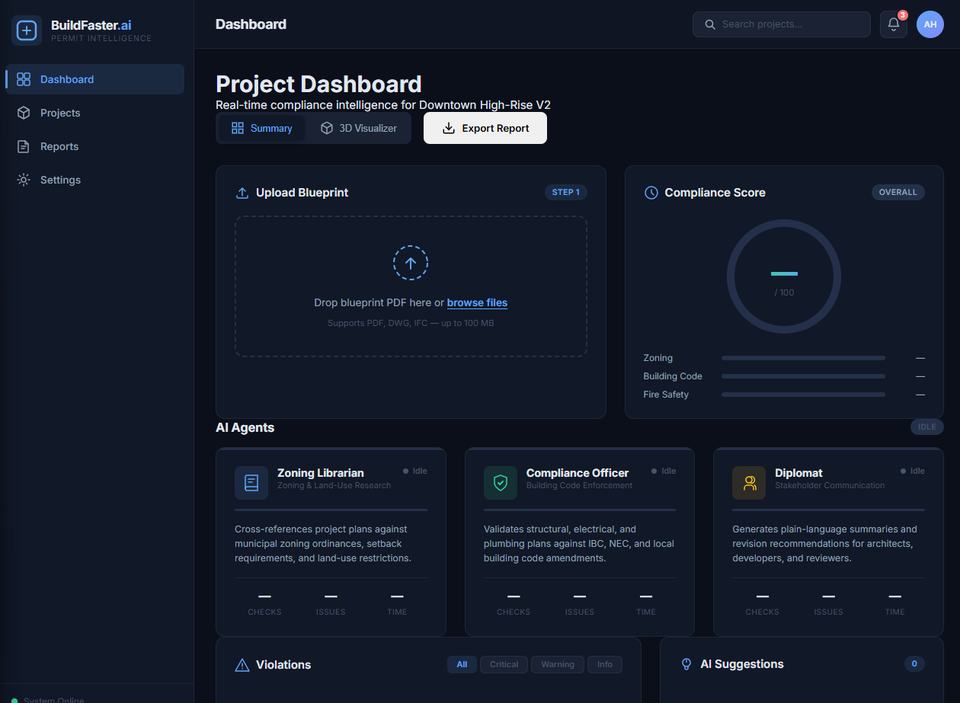
What it does BuildFaster.ai is a multi-agent AI platform that acts as a Digital Planning Officer. It automates the compliance-checking process by:
Zoning Analysis: Instantly parsing thousands of pages of municipal bylaws—like Ottawa's landmark 2026 Zoning By-law—to determine if a project meets new density and height requirements.
Automated Auditing: Using computer vision to "read" architectural blueprints and flag violations against the 2025 National Building Code (NBC).
Climate Resilience Verification: Ensuring designs comply with the 2026 mandates for Net-Zero Energy Ready buildings and greenhouse gas (GHG) emission limits.
How we built it We used a cutting-edge AI stack to handle the long-term, complex nature of construction projects:
Gemini 1.5 Pro & Flash: These served as our "brains." Pro handled the massive context needed for 50-page blueprint sets, while Flash provided rapid-fire answers for zoning lookups.
Backboard.io: Provided the stateful memory required to track a project's evolution over time, ensuring that a design change on day 10 didn't break a compliance rule flagged on day 1.
rPPG & Computer Vision: We integrated Python-based vision logic to analyze site plans for setback accuracy and structural compliance.
Challenges we faced The biggest challenge was the sheer fragmentation of Canadian regulations. Navigating the differences between the 2025 National Model Codes and specific provincial variations (like the BC Building Code or Ontario amendments) required building a robust Retrieval-Augmented Generation (RAG) pipeline. We also had to ensure the AI could handle the transition period where both old (2008) and new (2026) bylaws might apply to a single lot.
What we learned We learned that the "Missing Middle" isn't just a design problem; it’s a data problem. By digitizing the rules of the city, we can empower developers to build the 4-unit multiplexes and modular homes that the Build Canada Homes agency is currently prior
Built With
- antigravity-(frontend)
- backboard.io
- fastapi
- gemini-1.5-flash
- gemini-1.5-pro
- mediapipe
- opencv
- python
- rest-apis
- websockets


Log in or sign up for Devpost to join the conversation.