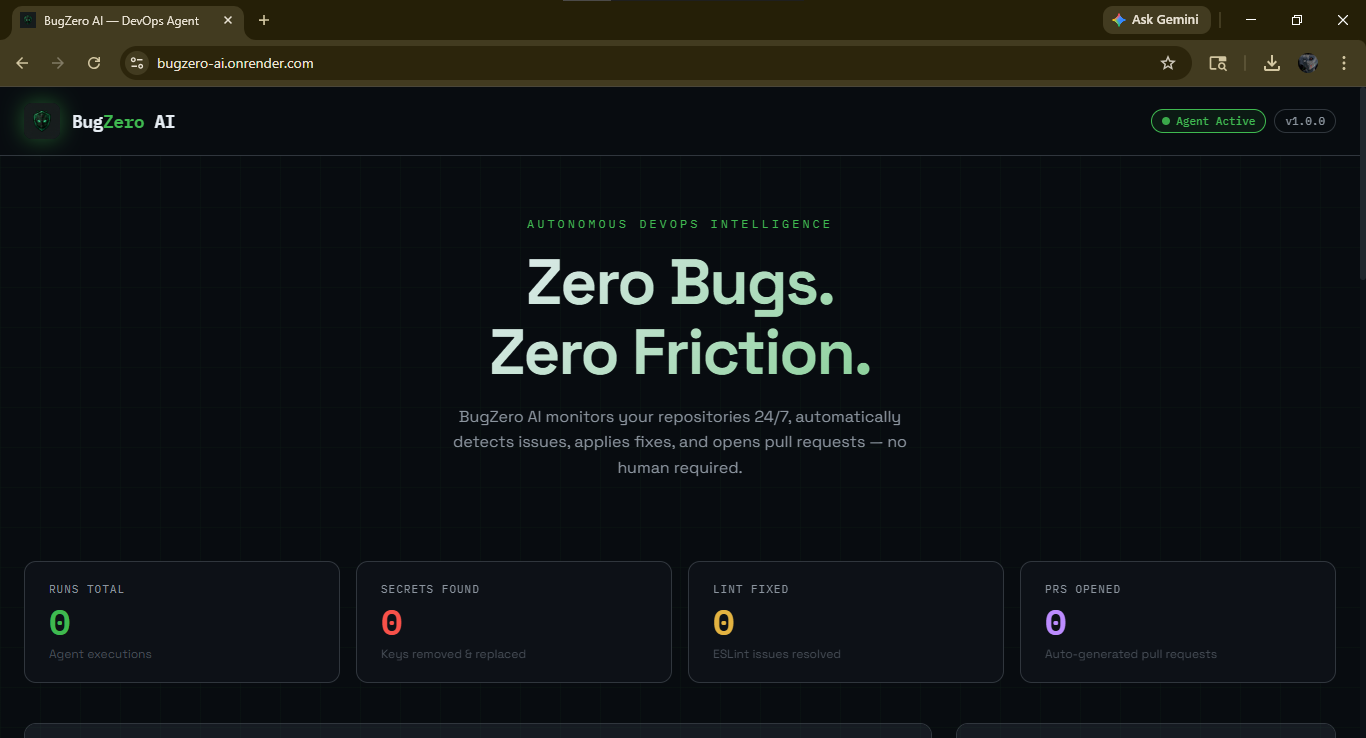
🤖 BugZero AI: The Story of Autonomous DevOps 🌌 The Inspiration: Closing the "Window of Exposure" In the current landscape of rapid-fire deployments, the interval between a developer pushing a code change and a security team discovering a leaked credential or a critical bug is often the most dangerous time in a project's lifecycle. We call this the Window of Exposure ($\Delta T$):
$$\Delta T = T_{\text{reception}} - T_{\text{leak}}$$
During this window, an exposed OpenAI key or AWS credential can be sniffed and exploited by bots in under 60 seconds. We were inspired by the concept of "Zero-Mean-Time-to-Fix"—the idea that the moment a vulnerability exists, the fix should already be in progress. BugZero AI was born to be that "invisible pair programmer" who never sleeps, ensuring that for every bug introduced, the remediation starts at $t = 0$.
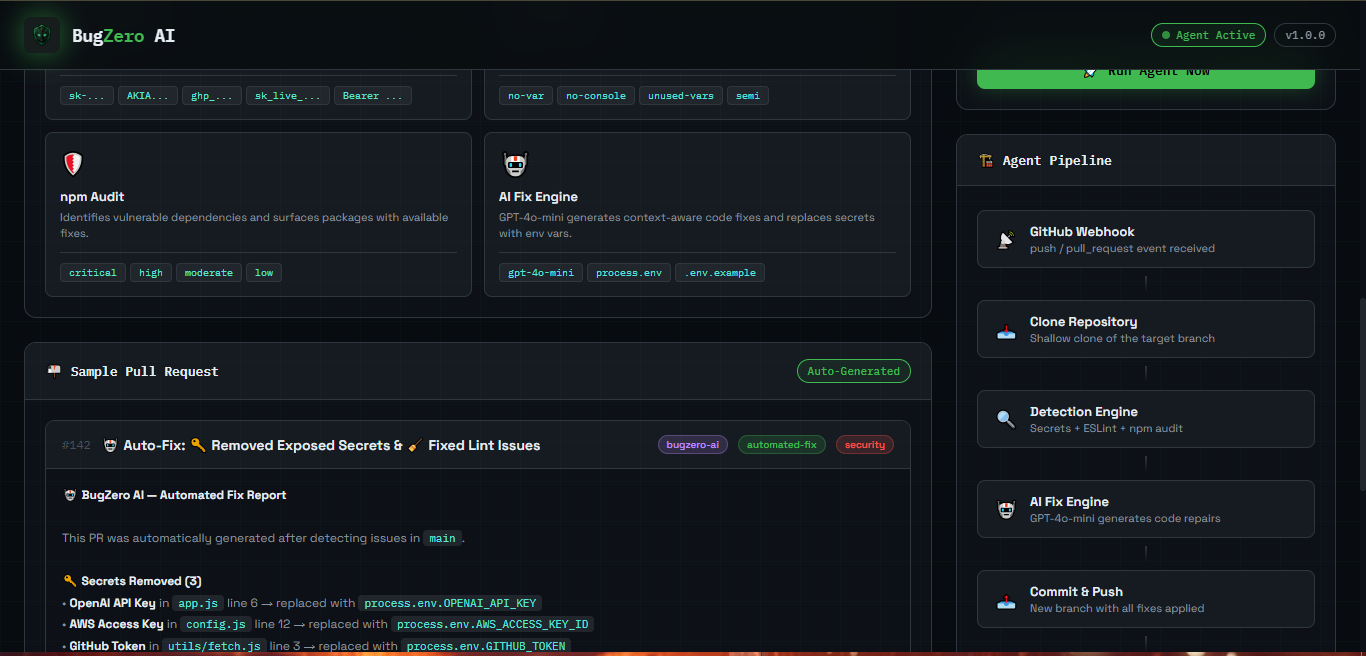
🛠️ How We Built It: A Hybrid DevOps Pipeline BugZero is a high-performance Node.js agent built for high-throughput webhook processing. We designed it with a linear, non-blocking pipeline:
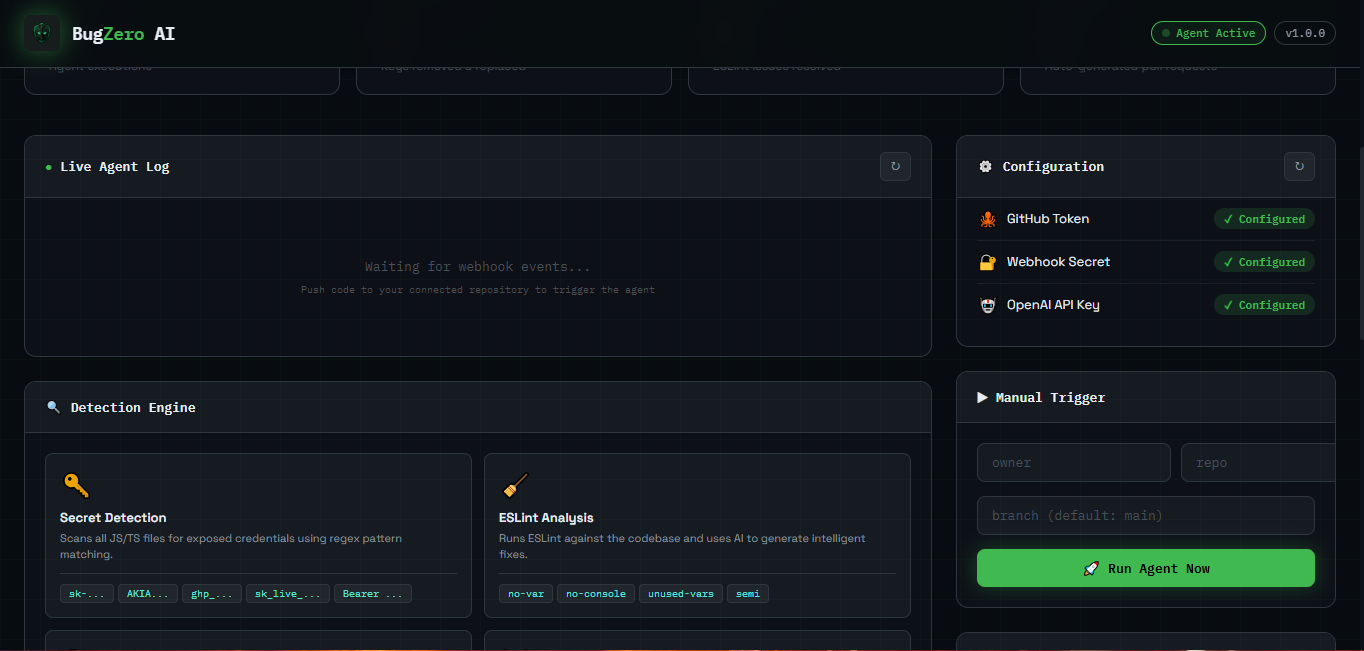
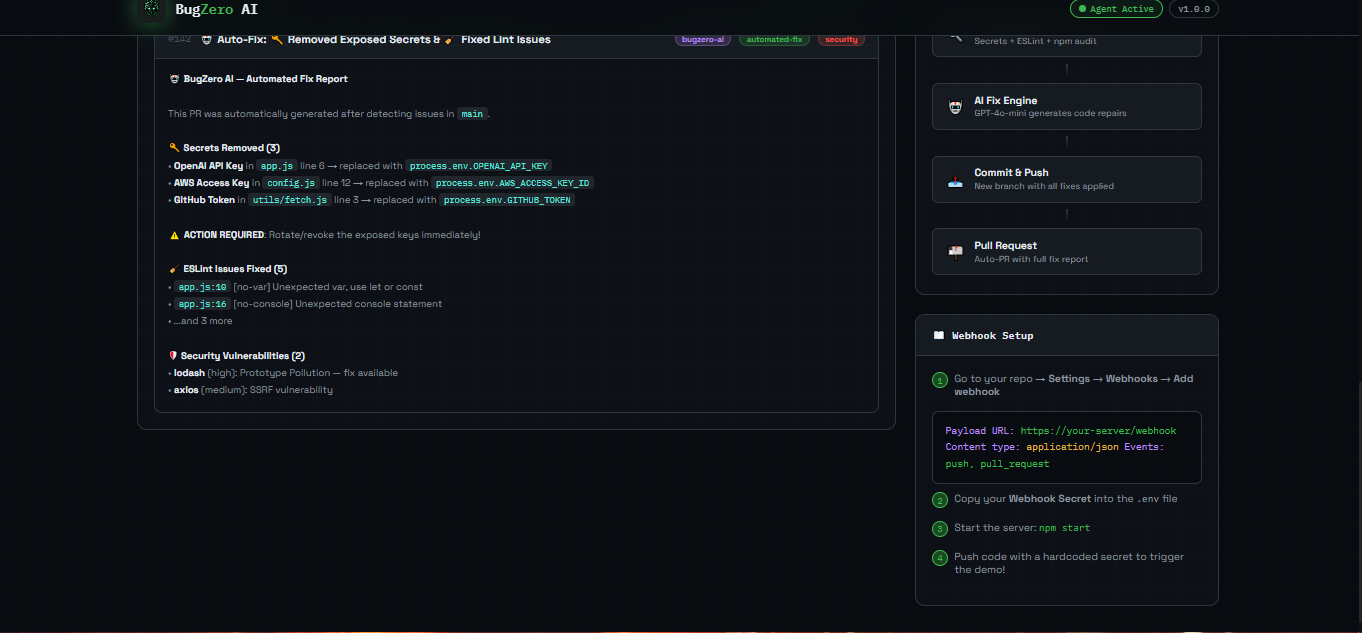
Ingestion & Verification: An Express.js server receives GitHub/GitLab webhooks, verifying authenticity via HMAC SHA-256 signatures. The Detection Engine: Instead of relying solely on heavy AI for every line, we built a hybrid engine. It uses high-speed Regex for pattern-matching known secrets ($O(1)$ lookup for common keys) and ESLint/npm audit for static analysis. The AI Fix Logic: When a quality issue is found, we pass the context to GPT-4o-mini. We engineered specific prompts to ensure the AI acts as a surgical repair tool, returning only the corrected code block without descriptive "chatter." Autonomous GitOps: Using Octokit (for GitHub) and GitBeaker (for GitLab), the agent automatically branches, commits, and opens a Pull/Merge Request with a comprehensive security report. 🧠 Mathematical Modeling of Risk To quantify the impact, we think of the project's Cumulative Security Debt ($D$) as the integral of risk over time:
$$D = \sum_{i=0}^{n} \int_{T_{i, \text{start}}}^{T_{i, \text{fix}}} R_i(t) , dt$$
Where $R_i(t)$ is the severity of the $i$-th vulnerability. By reducing $T_{\text{fix}}$ to near-zero, BugZero effectively flattens the debt curve, ensuring that risk does not accumulate.
💡 What We Learned Throughout the hackathon, we gained deep insights into:
Security-as-Code: Replacing hardcoded secrets with process.env dynamically is harder than it looks; you have to ensure the .env.example is also in sync to keep the build "reproducible." Contextual AI: We learned how to optimize token usage by sending only the relevant "hunks" of code to the LLM, rather than entire 1,000-line files. Multi-Platform Orchestration: Supporting both GitHub and GitLab required a robust abstraction layer for Git operations, teaching us the nuances of different REST and GraphQL APIs. 🚧 Challenges We Faced The "Hallucination" Guardrail: Early versions of the AI sometimes "improved" code in ways that broke logic. We solved this by implementing a verification loop where the AI-patched code is run through a syntax check before the PR is opened. Rate Limiting: Processing multiple concurrent pushes required an intelligent queuing system to stay within GitHub and OpenAI's API quotas. Shallow Clone Complexity: To keep the agent fast, we use git clone --depth 1, but this created challenges for cross-branch diffing during PR creation, requiring careful use of temporary worktrees. BugZero AI — Zero Bugs. Zero Leaks. Zero Effort.
Built With
- css3
- eslint
- express.js
- git
- github-api
- gitlab-api
- javascript
- ngrok
- node.js
- nodemon
- npmaudit
- openai
- regex


Log in or sign up for Devpost to join the conversation.