-
-
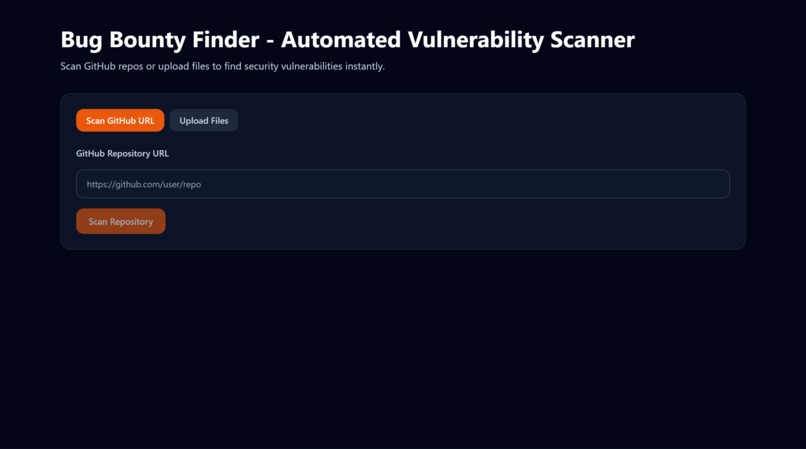
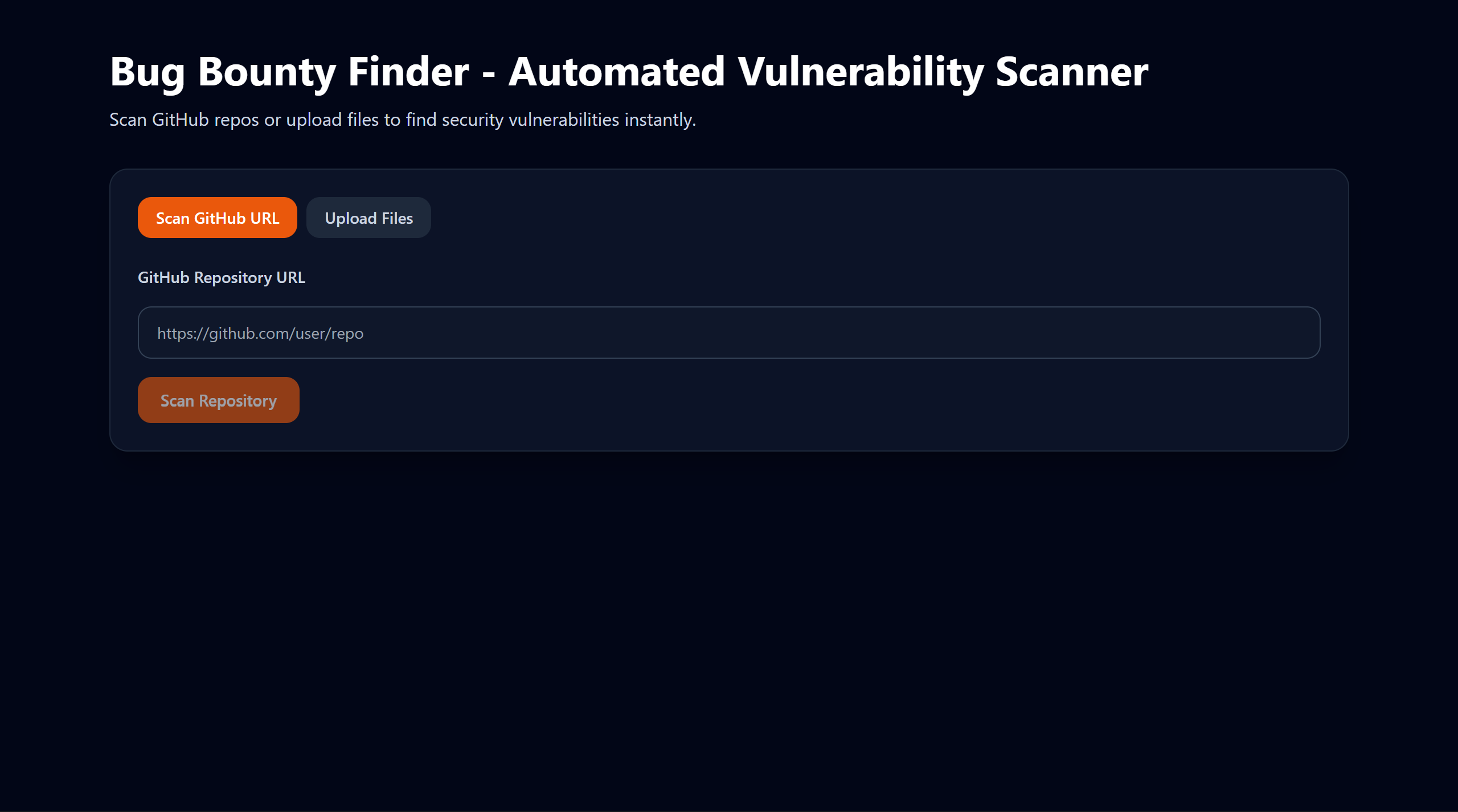
Homepage of Bugz
-
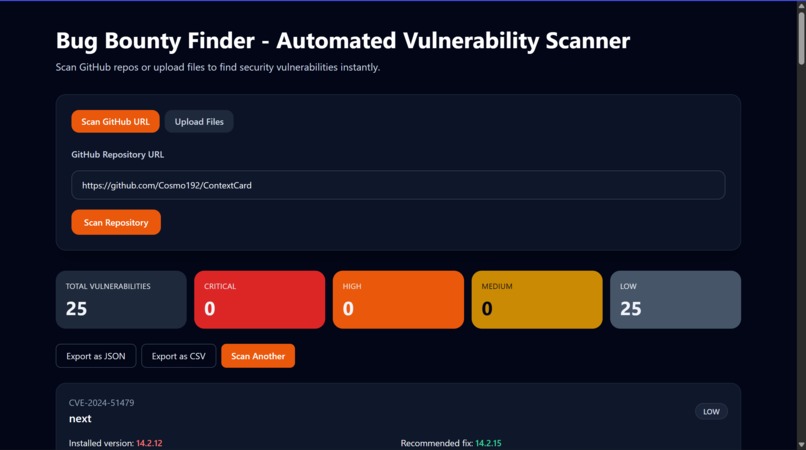
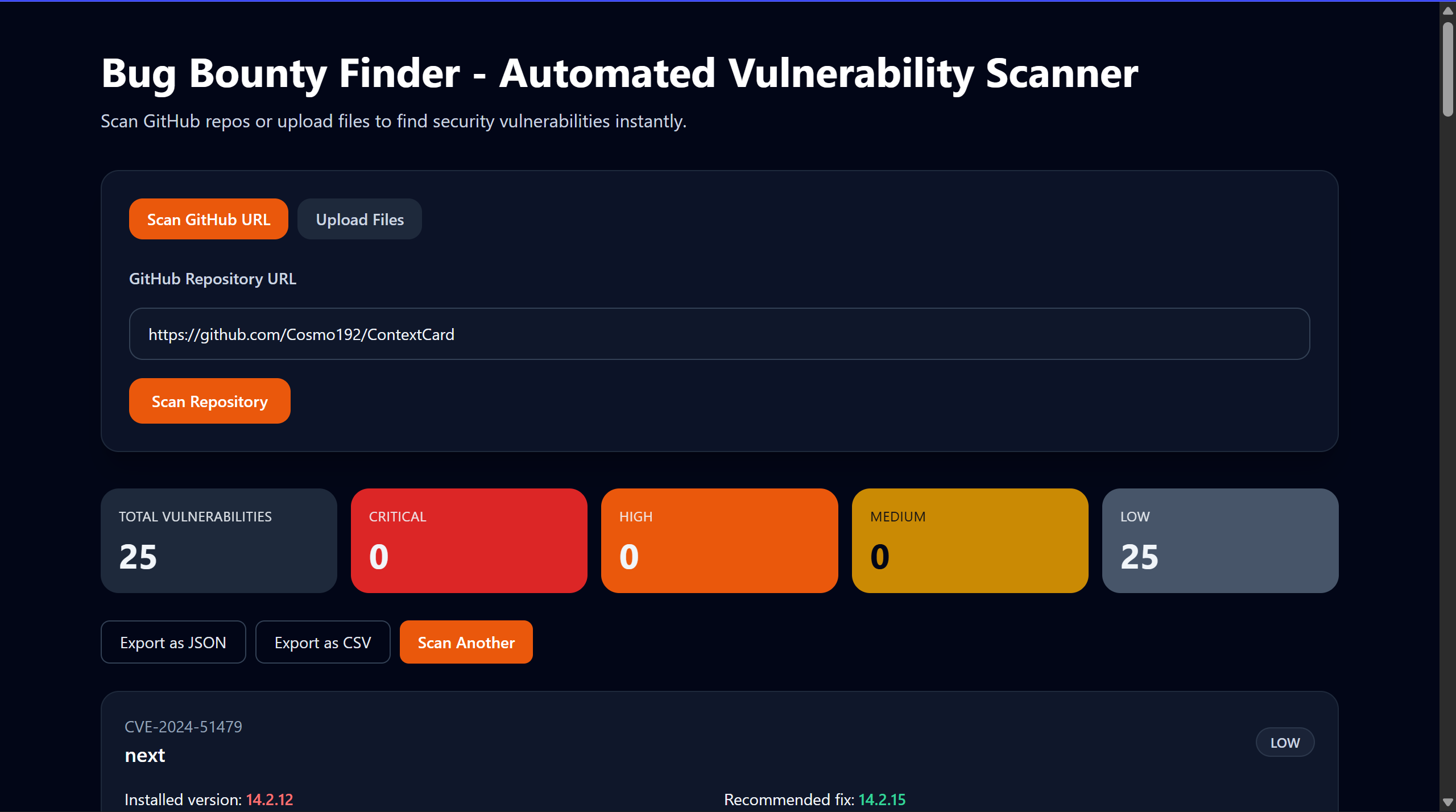
Results of a github link
Inspiration
Security teams waste hours manually checking dependencies against CVE databases. Every GitHub push, every npm install — another potential vulnerability. I built Bugz to automate this: developers paste a GitHub URL or upload their manifest files, and get instant security insights. No more manual hunting. No more vulnerabilities slipping through.
What it does
Bugz scans GitHub repositories and uploaded dependency files (package.json, requirements.txt, go.mod, Cargo.toml) and instantly identifies security vulnerabilities using the free OSV.dev and GitHub Security Advisories APIs.
Key features:
- GitHub URL input or file upload (drag-and-drop)
- Supports Node.js, Python, Go, and Rust projects
- Severity ranking (Critical → Low) with actionable fix suggestions
- Export results as JSON/CSV
- Real-time scanning (most repos in <10 seconds)
Users get: CVE IDs, package names, installed versions, recommended fixes, and direct links to vulnerability details.
How we built it
Frontend: React + Next.js 13 (TypeScript) Styling: Tailwind CSS Backend: Next.js API routes (serverless functions) Vulnerability data: OSV.dev API + GitHub Security Advisories (both free, no auth) Dependency parsing: Custom TypeScript parsers for package.json, requirements.txt, go.mod, Cargo.toml
Architecture:
- User uploads file or pastes GitHub URL
- Backend fetches repo files or parses upload
- Extracts all dependencies (name + version)
- Queries OSV.dev API for each dependency
- Deduplicates CVEs, sorts by severity
- Frontend renders interactive dashboard
Deployment: Vercel (zero-config for Next.js)
Challenges we ran into
OSV API rate limiting — querying 100+ dependencies meant hitting limits. Solution: Batch requests with backoff, cache results for 1 hour.
Dependency file parsing — package.json nesting vs requirements.txt format were totally different. Solution: Built separate parsers for each format.
GitHub raw content fetching — repos without a package.json would 404. Solution: Gracefully handle missing files, report which ones were found.
UI responsiveness during scanning — long waits on large repos felt broken. Solution: Real-time progress indicator + execution time display.
CVE deduplication — same vulnerability across multiple packages. Solution: Group by CVE ID, aggregate affected packages.
Accomplishments that we're proud of
-Multi-language support on day 1 (Node, Python, Go, Rust) -Zero authentication required — uses only free, public APIs -Sub-10-second scanning for typical repos (~50 dependencies) -Clean, UI -Handled edge cases: missing files, invalid repos, API failures -Export functionality (JSON/CSV) for integration with CI/CD pipelines -Zero external dependencies beyond React and Tailwind
Business impact: A dev team of 10 scanning daily would save ~80 hours/year in manual security audits. If caught even one critical 0-day per year, ROI is infinite.
What we learned
- OSV.dev is criminally underrated — it's a goldmine for free vuln data
- Dependency parsing is harder than expected (version pinning, ranges, etc.)
- Users hate spinning loaders — progress indicators convert anxiety to trust
- File upload + GitHub URL dual input increases adoption (users prefer drag-drop)
- Export formats matter — teams want JSON for pipelines, CSV for spreadsheets
- Security tools live or die on trust — one false positive = loses credibility
If I were rebuilding: Start with Node.js only, expand languages later. Real-time progress is non-negotiable for scanning UX.
What's next for Bugz
-Upgrading UI with more time on our hands
- GitHub webhook integration (auto-scan on push)
- Slack notifications for new critical vulns
- CI/CD pipeline integration (GitHub Actions, GitLab CI)
- Team dashboard (aggregate vuln trends across all repos)
- Fix suggestions (auto-generate PRs for patch updates)
- License compliance scanning (GPL, MIT conflicts)
- Supply chain risk scoring (how many transitive deps are outdated?)
- Integrations: Jira (auto-create tickets), PagerDuty (alert on critical)
Business potential:
- 40M+ developers on GitHub = massive TAM
- Every company with DevSecOps budget needs this
- Potential acquisition by GitHub, GitLab, or Snyk
- Freemium model: free for public repos, paid for private orgs
Built With
- github-api
- next
- node.js
- osv.dev
- react
- tailwind
- typescript

Log in or sign up for Devpost to join the conversation.