Inspiration
Cybersecurity threats are increasing, and identifying website vulnerabilities requires technical expertise and the use of multiple security tools. We were inspired to build a platform that simplifies authorized security assessments by combining traditional cybersecurity tools with Agentic AI. Our goal is to make vulnerability analysis more intelligent, automated, and accessible.
What it does
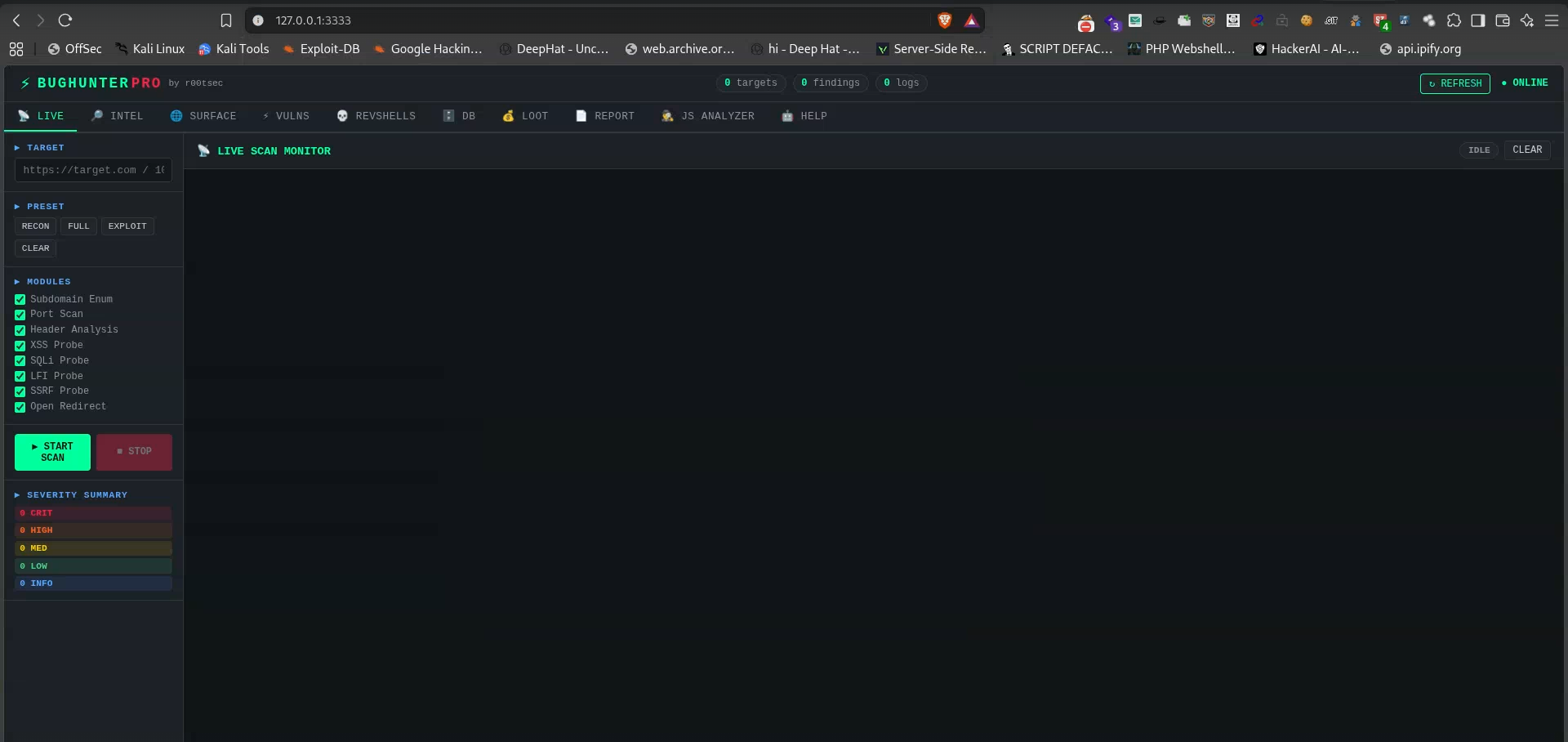
BugHunterPro AI is an AI-powered website security assessment platform that automates authorized reconnaissance, port discovery, and vulnerability scanning. It integrates Kali Linux security tools with locally hosted LLMs through Ollama to analyze scan results, prioritize security risks, explain vulnerabilities, suggest remediation steps, and generate professional security reports.
Key capabilities include:
- Automated domain reconnaissance.
- Port and service discovery using Nmap.
- Vulnerability assessment using Nuclei.
- Web security testing using OWASP ZAP.
- Technology fingerprinting using WhatWeb.
- AI-powered vulnerability analysis using Ollama.
- Automated PDF vulnerability reports.
- Conversational AI security assistant.
How we built it
We designed BugHunterPro AI using a modular architecture that integrates cybersecurity tools with an AI-powered backend.
Technologies used:
- Frontend: React.js, HTML, CSS, JavaScript.
- Backend: Python and FastAPI.
- AI: Ollama with locally hosted LLMs such as Qwen or Llama.
- Agent orchestration: LangGraph.
- Security tools: Kali Linux, Nmap, Nuclei, OWASP ZAP, and WhatWeb.
- Database: PostgreSQL.
- Reporting: Python ReportLab.
- Real-time communication: WebSockets.
The proposed multi-agent architecture consists of Planner, Reconnaissance, Scanning, Analysis, Verification, and Reporting agents. These agents coordinate authorized security assessment tasks and convert technical scan outputs into actionable security intelligence.
Challenges we ran into
- Integrating multiple cybersecurity tools into a unified platform.
- Processing and standardizing different security tool outputs.
- Integrating locally hosted LLMs through Ollama.
- Designing reliable AI agent workflows.
- Reducing false positives through evidence-based verification.
- Managing scan execution, performance, and real-time updates.
- Ensuring authorized and non-destructive security testing.
Accomplishments that we're proud of
- Developing a unified cybersecurity assessment dashboard.
- Designing an architecture that combines real security tools with Agentic AI.
- Integrating the concept of locally hosted AI intelligence using Ollama.
- Creating a multi-agent workflow for automated security analysis.
- Designing an automated vulnerability reporting system.
- Building a platform focused on practical, real-world cybersecurity challenges.
What we learned
Through this project, we explored how Agentic AI can interact with external tools and automate complex workflows. We gained experience in cybersecurity reconnaissance, vulnerability assessment, API integration, local LLM deployment, AI agent orchestration, evidence analysis, and security report generation.
We also learned the importance of responsible security testing, target authorization, evidence validation, and distinguishing genuine vulnerabilities from potential false positives.
What's next for BugHunterPro AI
Our future roadmap includes:
- Improving autonomous multi-agent orchestration.
- Adding advanced vulnerability verification.
- Enhancing AI-based risk prioritization.
- Introducing continuous security monitoring.
- Adding historical scan comparison.
- Integrating security assessments into CI/CD pipelines.
- Supporting cloud-based security assessment.
- Expanding report customization and compliance-oriented reporting.
Our vision is to make BugHunterPro AI an intelligent, privacy-conscious, and reliable cybersecurity assessment platform that helps organizations proactively identify and address security weaknesses.
Built With
- agentic-ai
- ai
- css
- cybersecurity
- fastapi
- html
- javascript
- kali-linux
- langgraph
- llm
- nmap
- nuclei
- ollama
- owasp-zap
- postgresql
- python
- react
- websockets
- whatweb

Log in or sign up for Devpost to join the conversation.