
Inspiration
Every developer debugs. It's the skill you use more than any algorithm — reading unfamiliar code, spotting what's wrong, fixing it under pressure. Yet there's no competitive platform for it. LeetCode tests algorithms. HackerRank tests data structures. Nothing tests the skill you actually use at 2am in production. We made that feeling a competitive sport.
What it does
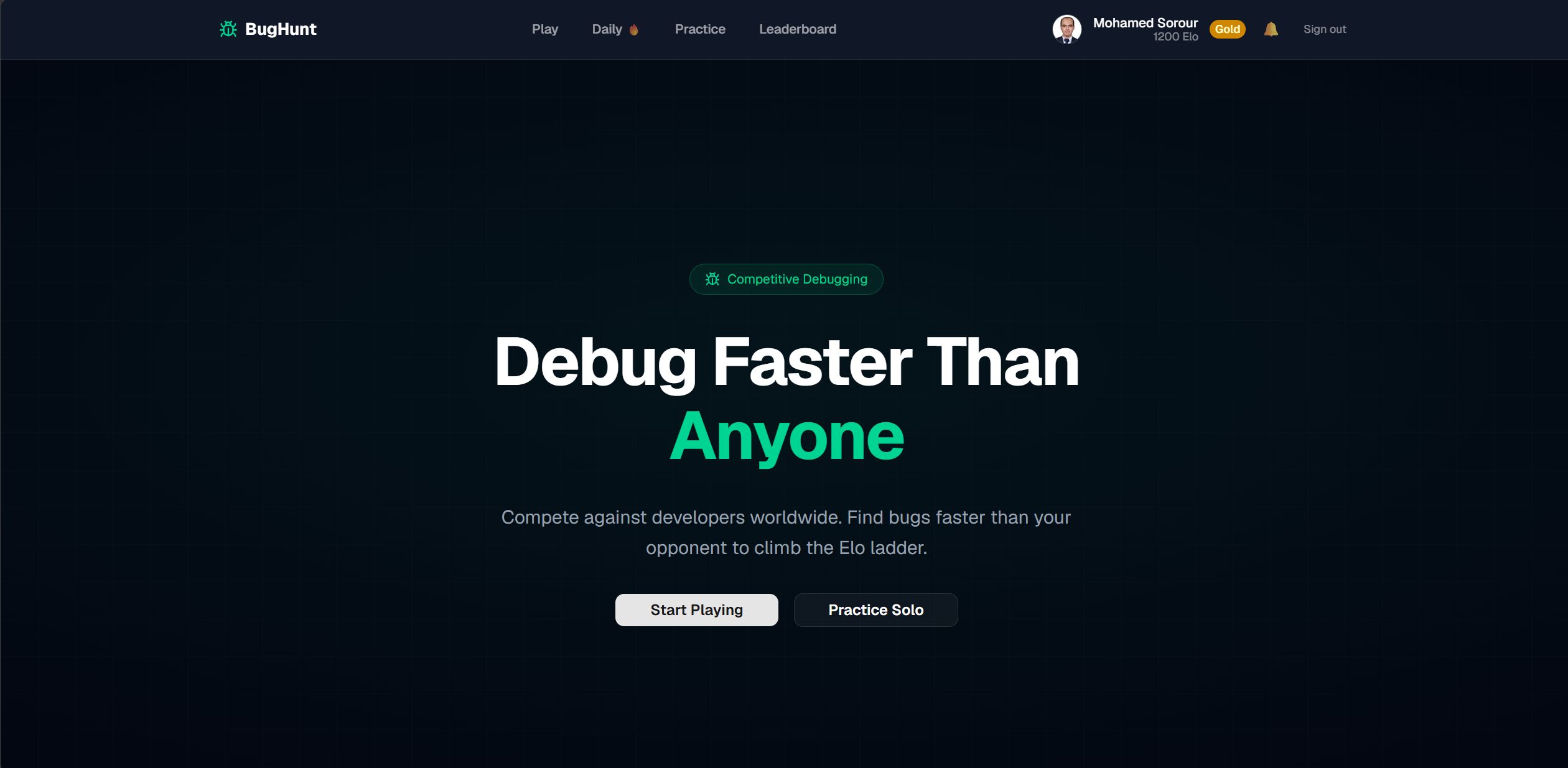
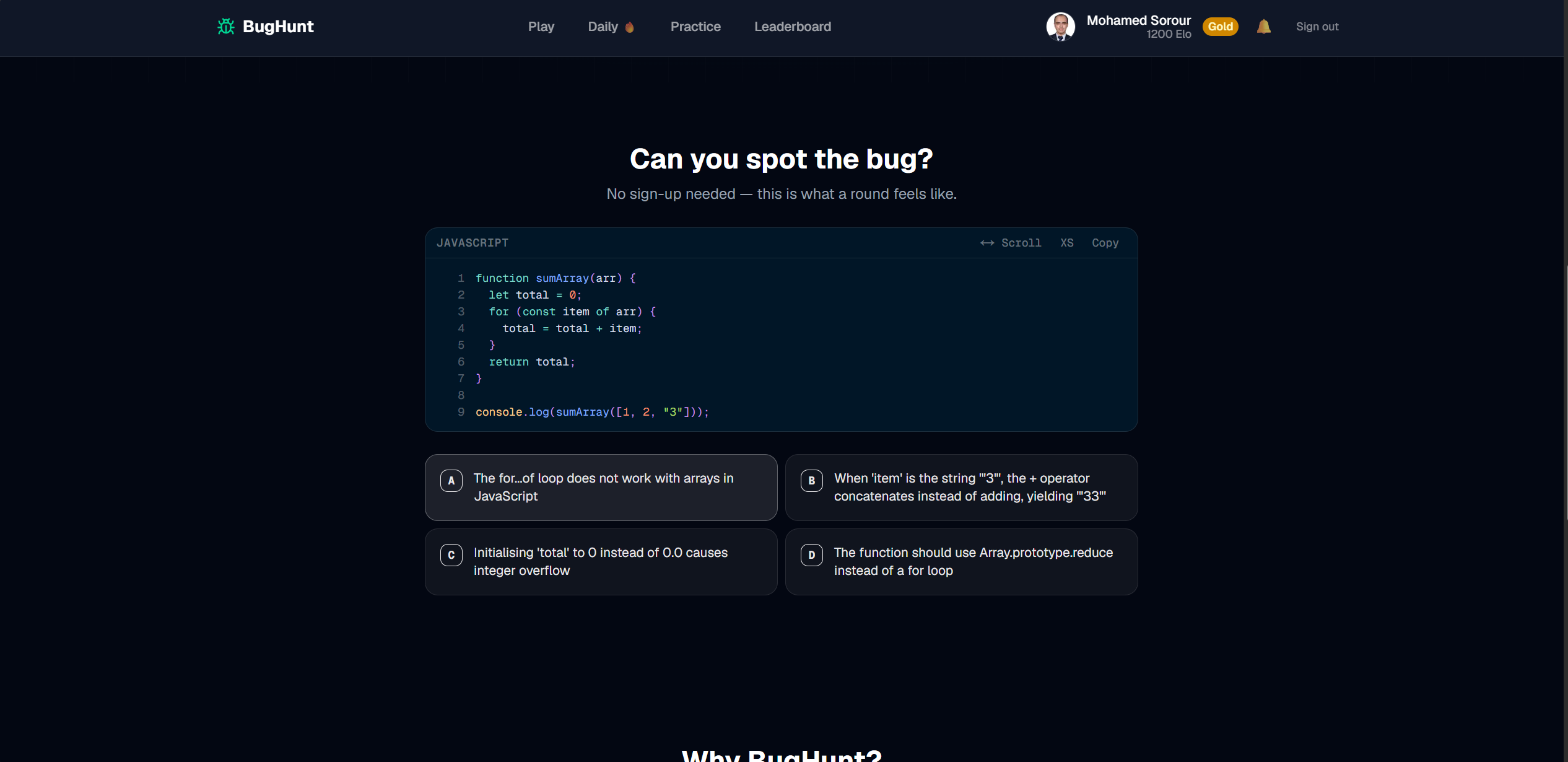
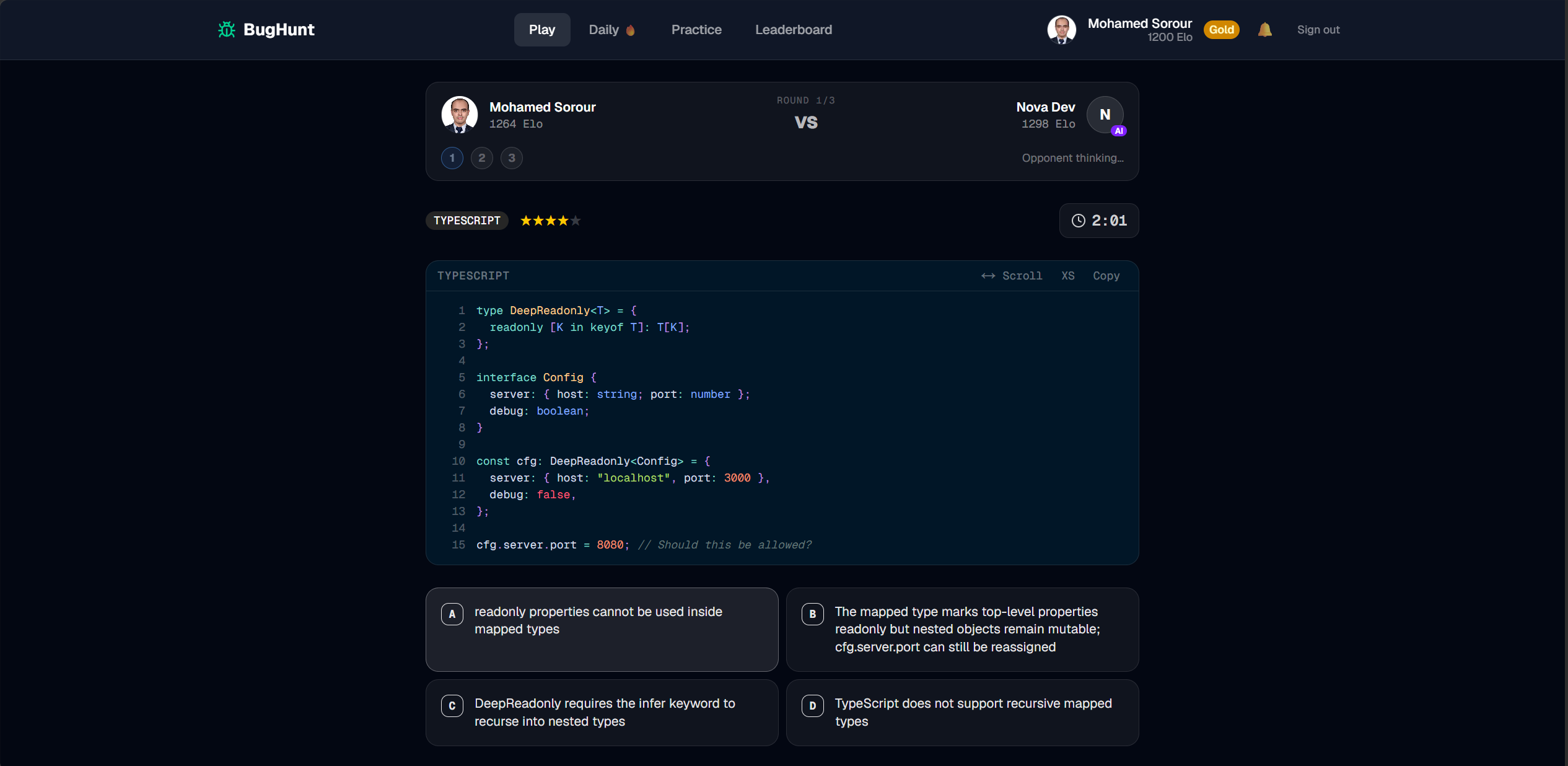
BugHunt is a real-time 1v1 competitive debugging game designed to scale to millions of concurrent players on a single DynamoDB table with no dedicated servers. Two players are matched by Elo rating through a Redis sorted-set queue, see the same buggy code snippet, and race to identify the bug in three 120-second rounds — fastest accurate answer wins. Every write is protected by a DynamoDB ConditionExpression so double-submits, double-resolves, and simultaneous joins are all clean no-ops at any traffic level.
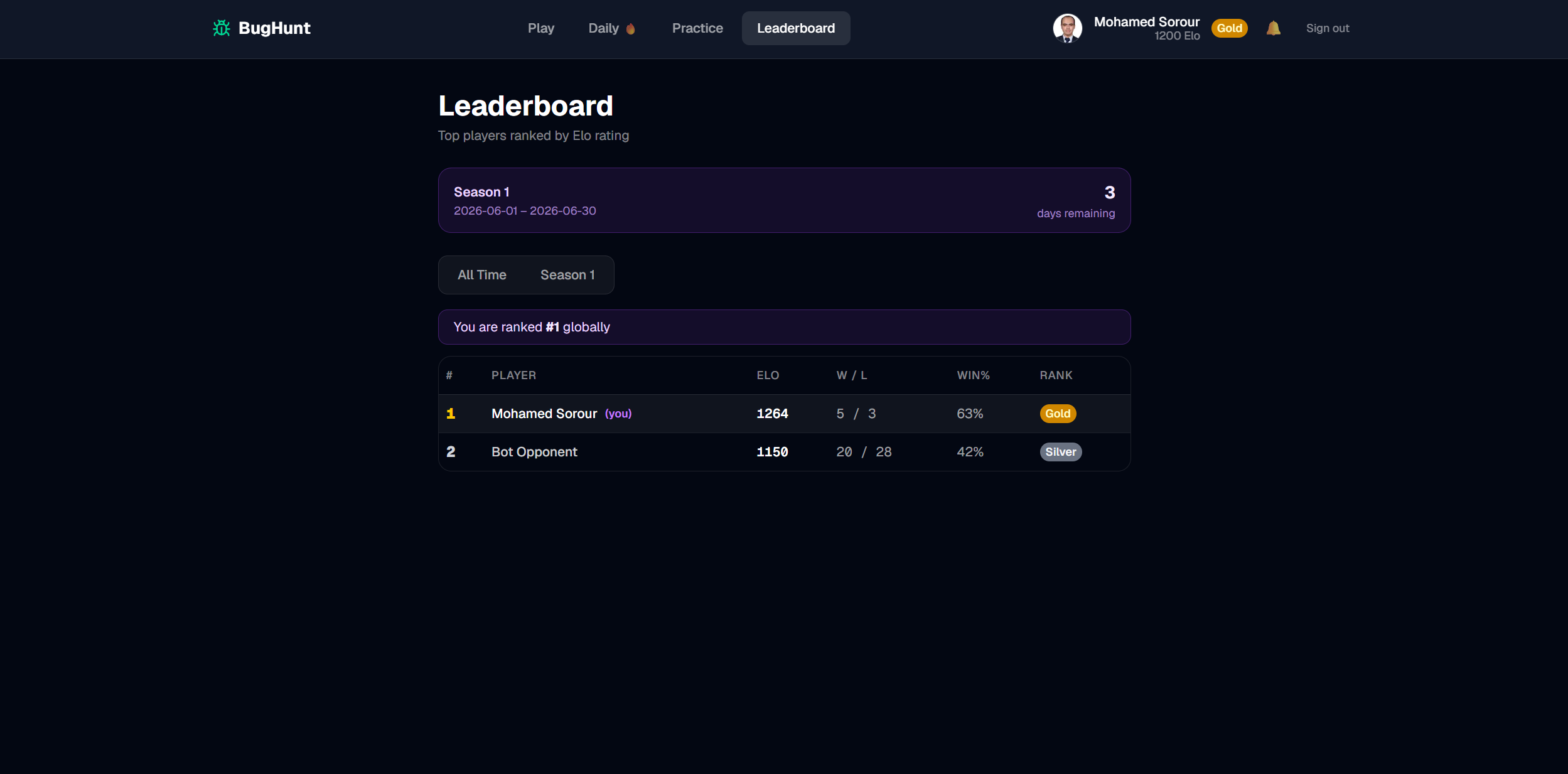
Beyond the core duel: chess-style Elo ratings and rank tiers; a DynamoDB Streams → Lambda leaderboard that is written not computed (constant-time reads at any user count); daily challenges with streaks; bracketed tournaments; org/team leaderboards; a social layer (follow, feed, direct challenges); community bug submissions quality-screened by Bedrock Nova; a VS Code extension; shareable result cards. When no human opponent is available after 10 seconds, a serverless bot (no process — driven by the human's own requests) fills the slot.
How we built it
Next.js 16 App Router on Vercel; one DynamoDB table (on-demand, TTL, 2 GSIs, Global Tables to 3 regions) as the source of truth; DynamoDB Streams → Lambda materializing the leaderboard as RANK# rows (top-100 = one Query); Upstash Redis for Elo-bucketed matchmaking queues, rate limits, and game-event pub/sub with DynamoDB-polling fallback; Bedrock Nova for content QA, generation, and bot play. 180+ tests (unit, API-against-real-DynamoDB, Playwright E2E) and a production artillery load test.
Challenges
Multiplayer on serverless is a pile of races: double-submits, double-resolution, rematch races, queue claim races. We settled every one with DynamoDB ConditionExpressions (and one optimistic-versioned index with bounded retries) rather than locks — the loser of any race gets a clean no-op. The second challenge was real-time without WebSockets: SSE with layered fallbacks (TCP pub/sub → DynamoDB polling → client polling).
Accomplishments
Designed and load-tested for 1M DAU: 58 games/s average, ~290/s peak, ~3,500 WCU/s across DynamoDB — absorbed by on-demand capacity with uniform UUID partition distribution. A leaderboard that is written, never computed (constant-time reads regardless of user count). Every race condition in a multiplayer game solved with ConditionExpressions rather than locks. Honest capacity math — including four known limits and concrete mitigations — published in the repo.
What we learned
Single-table design is a forcing function: you must know every access pattern up front. On-demand mode makes 95% of scale free; the engineering is in the other 5% (hot partitions, item ceilings, held-open functions).
What's next
Top-N write gating on the leaderboard Lambda, per-difficulty index sharding, multi-region writes once functions go multi-region, mobile PWA, language-specific ladders.
Built With
- amazon-web-services
- dynamo
- next.js
- vercal

Log in or sign up for Devpost to join the conversation.