-
Project Idea
-
App Layout 1
-
App Layout 2


Inspiration
Bug bites are incredibly common, yet most people have no idea what actually bit them or whether the reaction is normal. Friends, travelers, hikers — everyone seems to have the same experience: “I woke up with this bite… what is it?” We wanted to build something simple and accessible that gives people clarity in moments of uncertainty. With the rise of lightweight on-device AI, we realized we could create a tool that analyzes a photo privately, quickly, and reliably. That became the spark for Bug Bite Classifier.
What it does
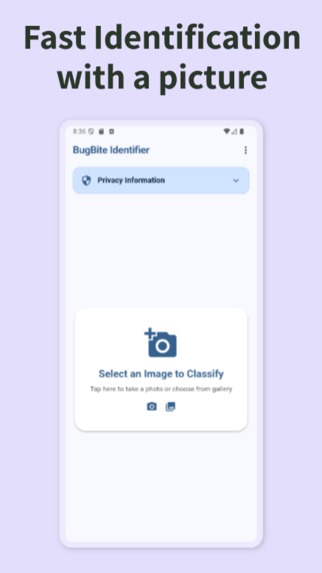
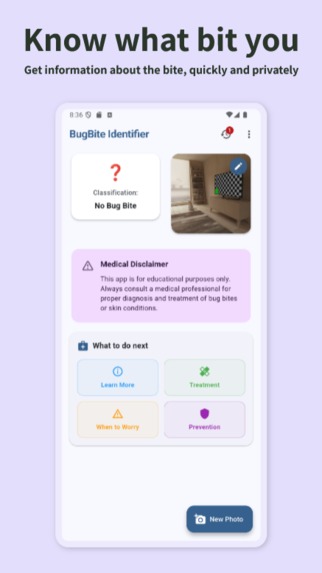
Bug Bite Classifier lets users take a photo of a bite and instantly get:
The most likely insect that caused it
Treatment recommendations tailored to the type of bite
Prevention tips to avoid future issues
Guidance on when to monitor or seek further help
Everything runs fully on-device, so images never leave the phone — preserving privacy for what can be considered health-related information. The goal is simple: help people make informed decisions within seconds.
How we built it
We trained a custom lightweight computer vision model optimized to run efficiently on mobile hardware. Development included:
Collecting and curating a dataset of common insect bite images
Training and optimizing an AI model to classify the skin reaction
Integrating the model directly into the Android app for offline, on-device inference
Designing a clean UI that guides users from photo capture → classification → treatment
Implementing a modular results system that delivers practical, easy-to-understand advice
We focused heavily on performance and privacy, ensuring the entire pipeline works smoothly without external servers.
Challenges we ran into
Data quality & consistency: Bug bites vary by skin tone, lighting, and severity. Creating a clean and diverse dataset was a real challenge.
Model size vs. accuracy: We needed the model to be small enough for mobile use without sacrificing reliability.
UI clarity: Presenting medical-adjacent information while avoiding overwhelming users required careful design choices.
On-device optimization: Running detection and classification locally demanded careful tuning to keep inference fast.
Accomplishments that we're proud of
Achieving fully offline, privacy-preserving AI inference
Building a model that performs reliably despite bite variability
Creating an app that is genuinely useful in real-world situations
Designing a streamlined user flow from photo to actionable advice
Turning a complex classification problem into something accessible to anyone
What we learned
How to optimize and deploy a custom AI model for mobile devices
The importance of dataset diversity in image classification tasks
How to write clear, helpful guidance for non-experts
That small UX decisions dramatically influence user confidence in AI tools
How to balance accuracy, speed, and user trust in a health-adjacent space
What's next for Bug Bite Classifier
Expanding the model to recognize more bite categories
Improving classification accuracy with additional curated data
Adding symptom-based questions to refine predictions
Supporting multiple languages for broader accessibility
Building a “bite log” so users can track symptoms over time
Potential future integration with expert-reviewed medical data.
Built With
- flutter
- litert
