Inspiration
Most of us know the feeling: the little drip you keep ignoring, the drawer that never closes, the “free trial” that quietly turned into a monthly charge, the smoke detector you meant to replace. None of it is catastrophic—until it is. Home maintenance and life admin don’t fail loudly; they fail through a thousand tiny paper cuts that drain money, time, and mental bandwidth. We wanted to build something that turns that invisible stress into something you can actually see, sort, and finish.
Home Bug Bounty(HBB) was inspired by bug bounties in security: make problems visible, make fixes rewarding, and prioritize what matters most. So we reimagined “adulting” as a playful security scan for household chaos—12 fast questions in, a prioritized bounty board out—complete with estimated dollars/time saved and a simple 7‑day ship plan. The goal isn’t to shame people into being perfect; it’s to give them a clear first step, a sense of momentum, and the satisfaction of actually shipping the fixes that have been living rent‑free in their head.
What it does
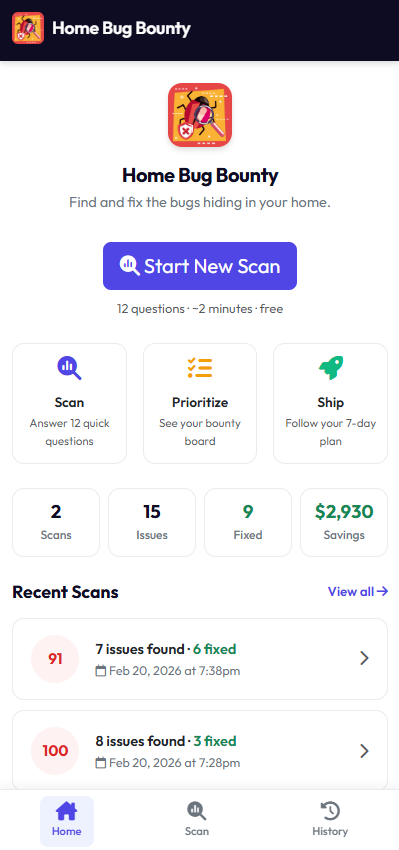
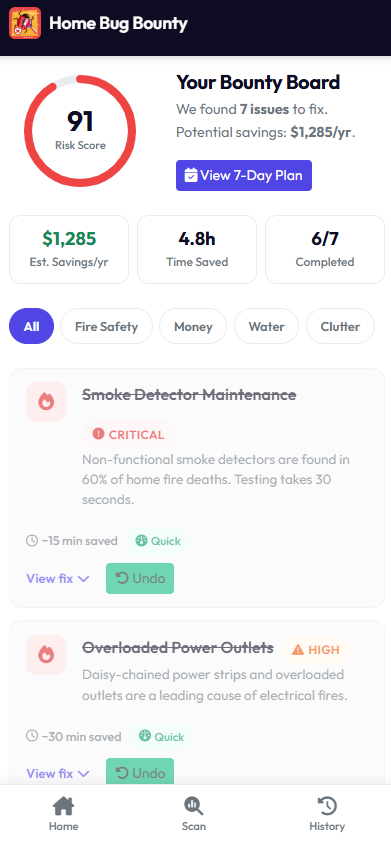
HBB is a “bug bounty for your home” that turns everyday household chaos into a lightweight, actionable security-style assessment. In ~2 minutes, you answer 12 targeted questions about common failure modes—water leaks, fire/electrical risks, subscription waste, and clutter hotspots. HBB then generates a prioritized bounty board: a ranked list of “findings” with severity, impact, and clear remediation steps, similar to a vulnerability report but for home operations.
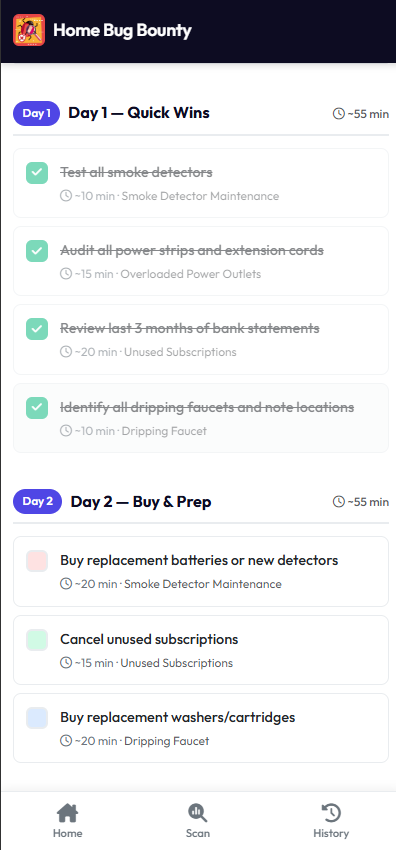
Each item includes estimated dollars saved, time saved, and effort level, so users can triage fixes like an engineer would—highest ROI and highest risk first. The output is optimized for execution: a 7‑day ship plan that sequences tasks into small, daily commits (buy/replace/clean/cancel/check), helping users move from diagnosis to measurable outcomes without getting overwhelmed.
How we built it
HBB is a lightweight “scan → prioritize → ship” pipeline. The front end is a single-page web flow that asks 12 rapid-fire questions (multiple choice + a couple numeric inputs) and normalizes answers into a compact “home state” JSON payload. We chose a simple, mobile-first UI with local state and optimistic progress so users can finish the scan in under a minute. On submit, the payload is sent to a small API layer that runs the scoring engine and returns a structured response (bounties + estimates + 7‑day plan) that the UI renders as a bounty board.
On the backend, we implemented a rules-and-weights engine (instead of a heavy ML approach) to keep results explainable and deterministic during a hackathon. Each potential “bounty” (e.g., leak risk, fire hazard, subscription waste, clutter hotspot) maps to a set of triggers from the questionnaire, a severity score, and an impact model that estimates dollars/time saved using conservative ranges. The engine outputs a prioritized list with “why this matters” rationale, quick-win vs. deeper-fix tags, and dependencies (e.g., “buy batteries before testing alarms”). This structure makes it easy to add new bounties by editing a config file rather than rewriting logic.
Finally, we generate the 7‑day ship plan by converting the top bounties into actionable tasks with time boxes, ordering constraints, and a daily capacity limit. The planner groups tasks into daily “sprints” (Day 1–7), balancing quick wins early to build momentum while scheduling higher-effort items across the week. We kept the response format strictly typed (bounty objects + plan objects) so the UI can render consistently and we can later plug in persistence, user accounts, or integrations (calendar reminders, shopping lists) without changing the core scan/scoring contract.
Challenges we ran into
The biggest challenge was scoping “HBB” down to something we could actually ship in hackathon time. The idea touches a lot of moving parts—capturing work-in-progress, turning it into a clear “next step,” and keeping the experience lightweight enough that people will use it. We had to make hard calls on what not to build (nice-to-have automations, deeper integrations, extra views) and focus on a tight loop that demonstrates the core value: helping you finally ship.
On the implementation side, getting reliability and polish under time pressure was harder than expected. Small UX details (how tasks are created, how progress is reflected, what happens when something fails) quickly became edge cases that could derail the flow. We also had to balance speed with maintainability—moving fast without creating a brittle prototype—so we spent time simplifying the architecture and tightening the happy path rather than chasing every feature.
Accomplishments that we're proud of
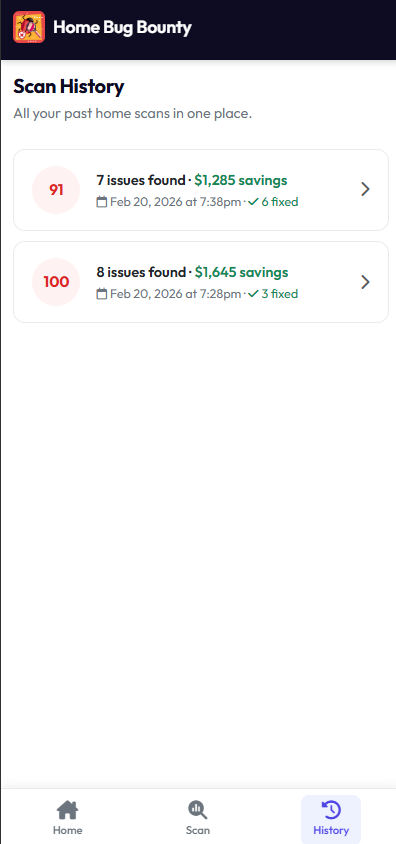
HBB turns “we should ship this” into a repeatable workflow. We built an end-to-end system that takes an idea from capture → prioritization → scoped plan → execution checklist, so teams can move from ambiguity to a shippable increment fast. The product is intentionally lightweight and opinionated: it reduces decision fatigue, keeps scope honest, and creates clear next actions that make shipping the default outcome.
On the technical side, we delivered a working, integrated prototype with a clean architecture that’s easy to extend. We implemented reliable state management across the core flow, structured data models for projects/tasks, and a responsive UI that keeps the experience fast and focused. We also prioritized “demo-ready” quality: sensible defaults, graceful handling of edge cases, and a cohesive user journey that shows real value in minutes.
What we learned
Building HBB taught us that “shipping” is less about having the perfect scanner and more about designing a tight loop from awareness → priority → action. The first versions tried to be comprehensive, but we learned that users don’t want a long diagnosis—they want a short, confident next step. Constraining the experience to 12 fast questions forced clarity: every question must earn its place by changing the ranking on the bounty board. We also learned that playful framing (bug bounty, bounty board, “ship plan”) isn’t just branding—it’s a usability tool that reduces shame around household chaos and turns vague stress into concrete, doable tasks.
We also grew in how we think about value: people trust recommendations more when we quantify the payoff (dollars/time saved) and explain the assumptions. “Estimated savings” can easily feel gimmicky; we learned to treat it like a transparent model—good enough to guide decisions, honest about uncertainty, and always paired with effort level. Finally, the 7-day ship plan became the real product: prioritization without scheduling still leads to procrastination. Turning the top bounties into a week of small, shippable wins helped us align the experience with the project’s promise—Finally Ship It—and reminded us to build for momentum, not just insight.
What's next for Home Bug Bounty(HBB)
Right after the hackathon, we’ll turn HBB from a fun scan into a repeatable, trustworthy “home bounty” system. We’ll expand the question bank from 12 to a modular intake (rent vs. own, apartment vs. house, pets/kids, climate) and improve scoring with clearer severity, confidence, and ROI assumptions. The bounty board will get sharper outputs: estimated dollars/time saved with sources/logic, quick-win vs. weekend tiers, and “ship it” checklists that translate each fix into the next 3 actions. We’ll also add lightweight evidence capture (photos + notes) so users can track before/after and see progress over time.
In the next 4–8 weeks, we’ll focus on retention and real-world outcomes: recurring “re-scans,” seasonal bounties (winterization, wildfire smoke, hurricane prep), and reminders that don’t nag—just nudge when ROI is highest. We’ll pilot integrations that make fixes frictionless: subscription audit links, local utility rebates, and a curated marketplace of parts/services (e.g., water leak sensors, dryer vent cleaning) with transparent pricing. Alongside this, we’ll run a small beta with 50–100 households, measuring completion rate of the 7-day plan, dollars saved, and incident prevention signals (leaks caught, hazards reduced), then iterate the scoring model based on what actually gets done.
Longer term, HBB becomes the “operating system” for household reliability: a personalized home risk profile, a living backlog of bounties, and a shared mode for partners/roommates with roles and accountability. We’ll explore partnerships with insurers, property managers, and retailers to subsidize scans and reward completed bounties, while keeping the product playful and user-first. The goal is simple: help people ship one meaningful home improvement per week—measurably reducing chaos, cost, and risk.

Log in or sign up for Devpost to join the conversation.