-
-
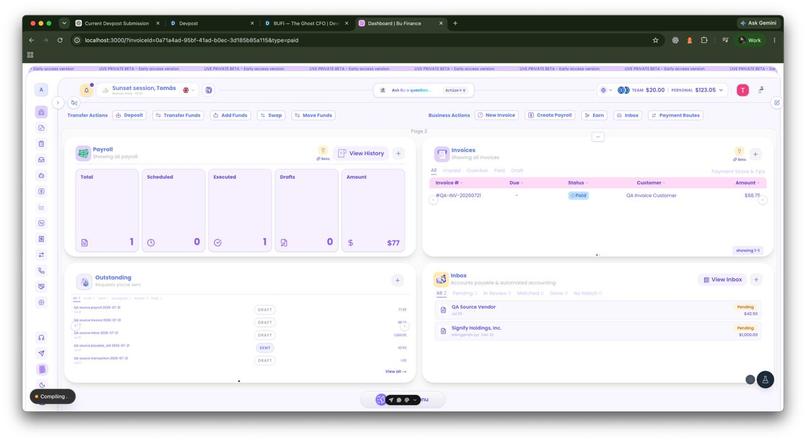
menu with features developed with Codex
-
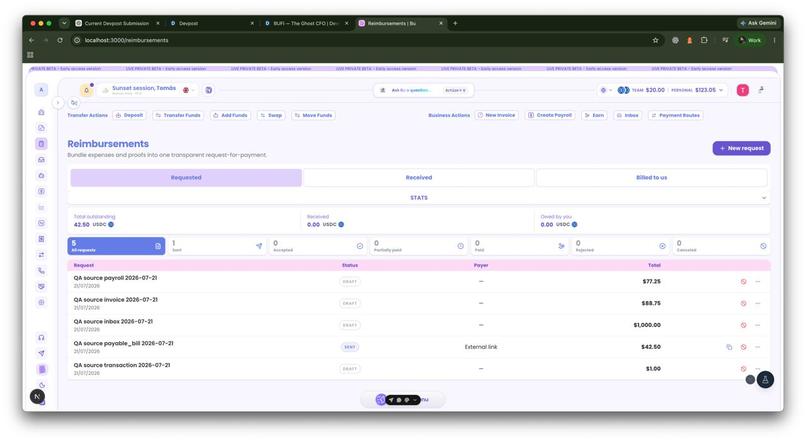
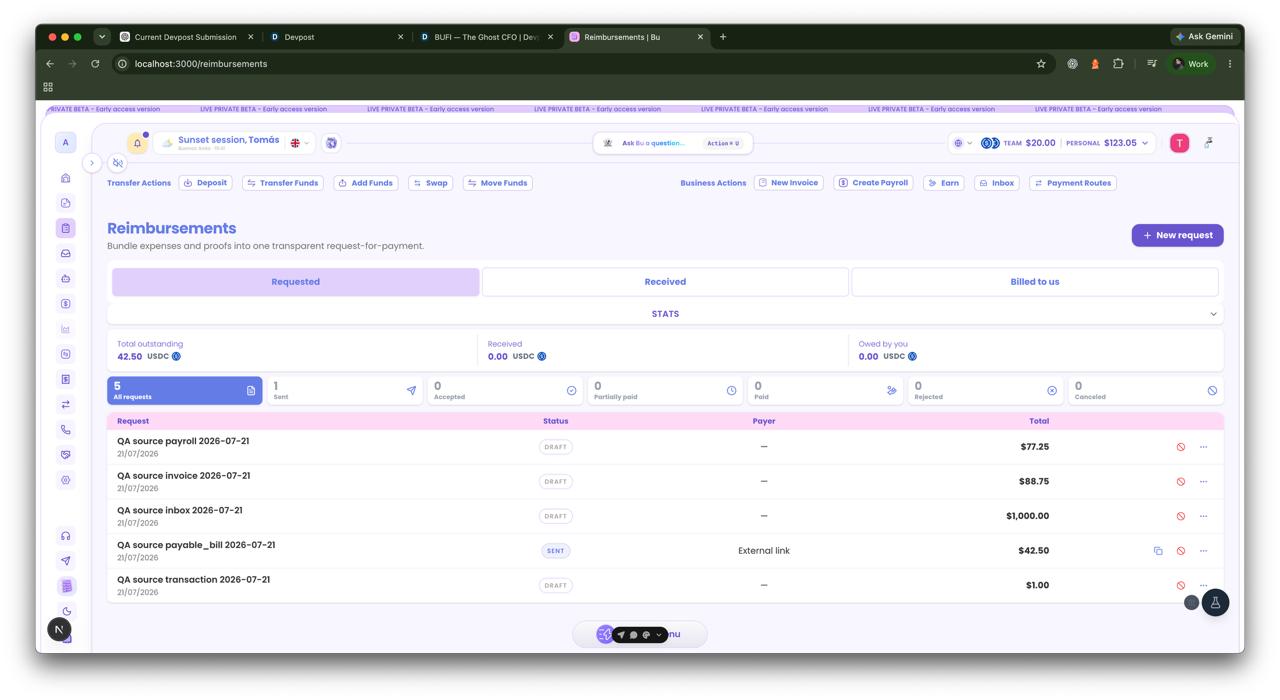
Reimbursements Menu
-
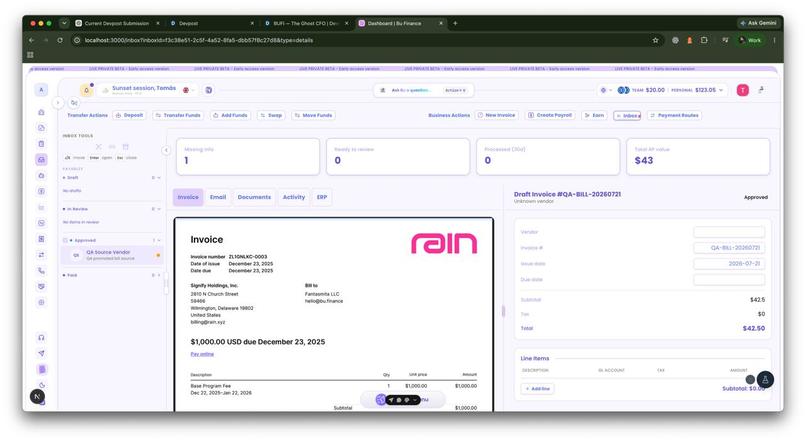
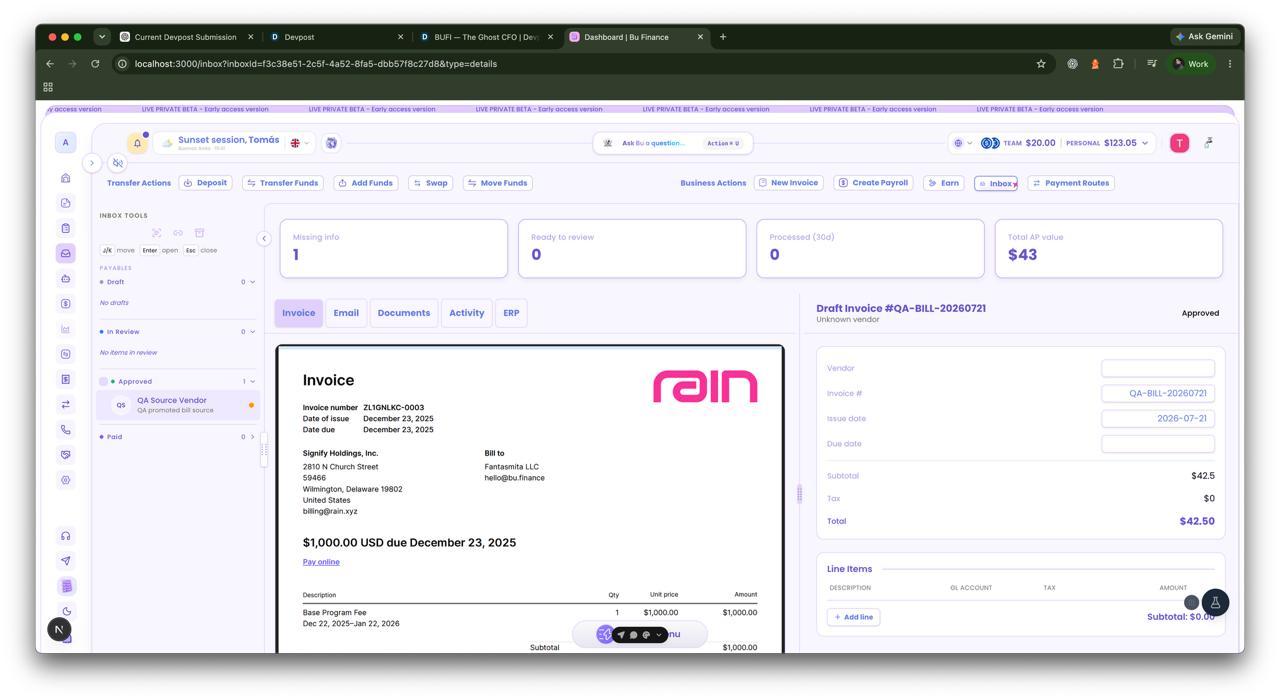
Magic Inbox Accounts Payable
-
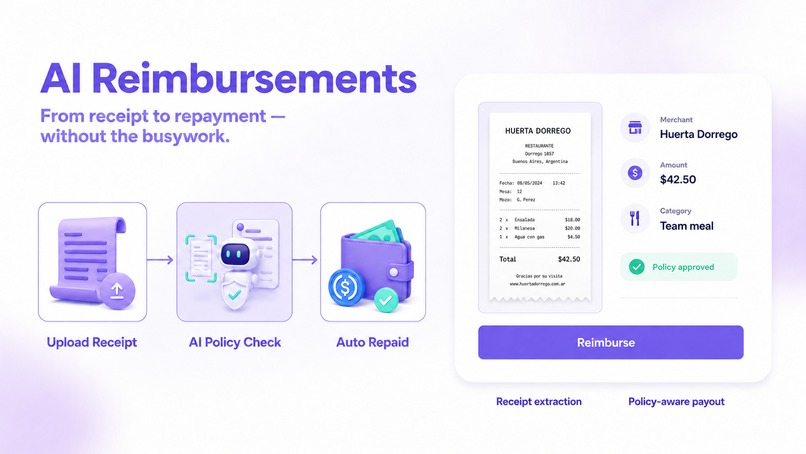
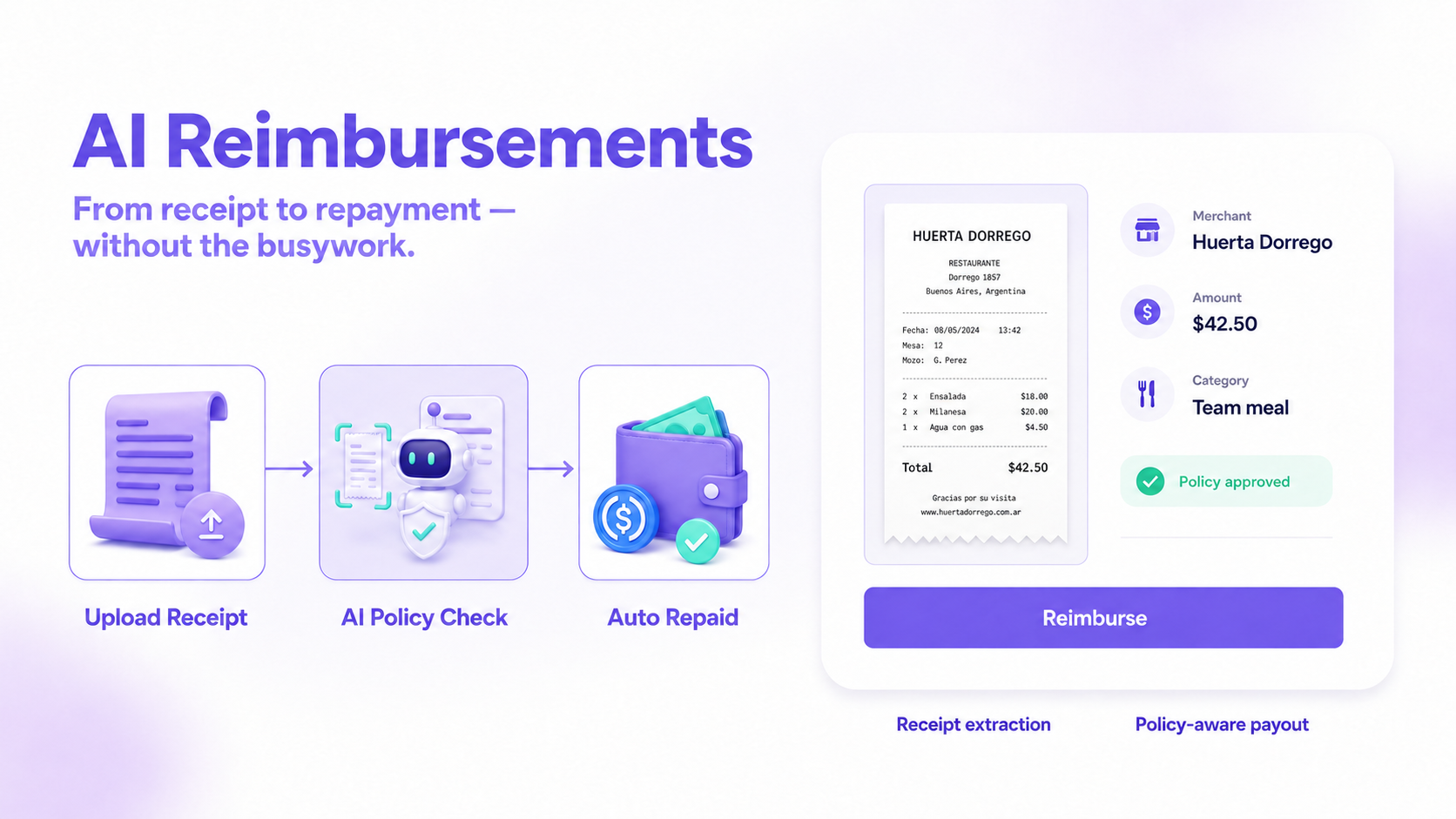
Vision: AI Reimbursements and AP
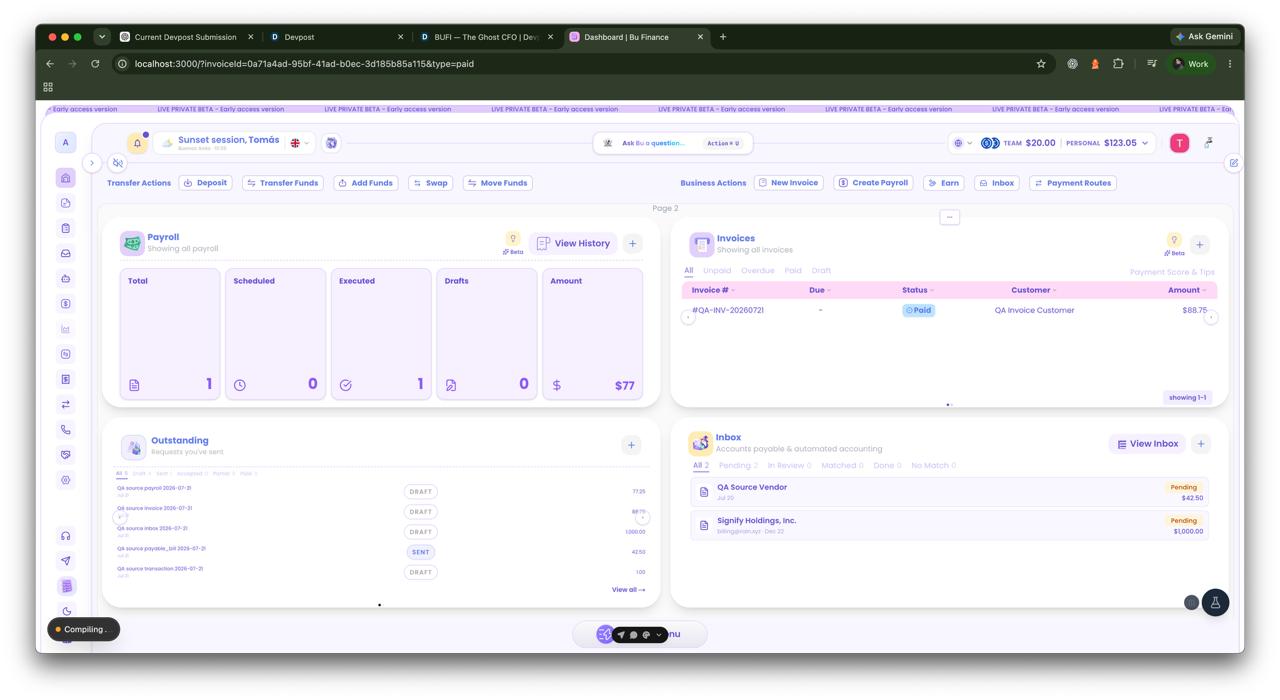
Inspiration
Small businesses do not need another dashboard. Global remote businesses, their employees, contractors and customers need an AI-first ERP that get's them and helps them manage and grow their business. They need a trusted financial operator that can read the documents already arriving in their email inbox, understand the business behind them, and safely execute the next step - including payments.
BUFI is a stablecoin-first, AI-native financial workspace for global SMEs and remote teams. It turns fragmented accounting, payments, payroll, reimbursements, subscriptions, identity, and treasury management workflows into one conversational operating system that is AI-first and an intuitive UX/UI that is human-first.
What it does
BUFI gives every workspace a Ghost CFO: an AI financial agent available across web, WhatsApp, voice, and collaborative workspaces.
Magic Inbox and automated accounting
Invoices and receipts arriving through Gmail or upload are classified, extracted, matched to entities, and routed into accounts payable or accounts receivable workflows. The agent can prepare accounting entries and reconcile context across QuickBooks, Xero, Conta Azul, and Plaid rather than treating each document as an isolated file.
Knowledge entity graph
The BUFI Brain connects people, companies, invoices, contracts, bank accounts, wallets, subscriptions, reimbursements, and payments into a reusable entity graph. This gives the agent durable business context while keeping tools and workflows auditable.
Reimbursements
The reimbursements flow lets workspaces or employees submit a receipt, automatically extracts the merchant, amount, currency, tax, and category, checks policy and duplicates, routes approval, and pays the approved claim for a given project or expenses. It is designed to work with both fiat and stablecoin settlement, with a clear status trail from submission to repayment.
Stripe subscriptions and monetization
Stripe subscriptions give workspaces production-ready plans, entitlements, billing state, and upgrade/downgrade flows. Subscription context is available to the agent so access control and paid capabilities remain consistent throughout the product.
Invoices, factoring, escrow, and international trade
BUFI creates and ingests invoices, supports milestone contracts and stablecoin escrow, and enables factoring and working-capital workflows. For disputes, structured evidence can be routed to an AI-assisted tribunal while deterministic contract and payment rules remain the source of truth.
Private global payments
A Ghost Wallet balance gives teams a private interface for international payments. Identity is verified through Persona and reused across eligible services. BUFI validates compliance facts without placing raw personal identity information into the agent's memory. Zero-knowledge proofs can attest to required properties without revealing the underlying data.
On/off ramps and wallet connectivity let users fund and withdraw through bank, card, crypto deposits, or supported cross-chain routes. Stablecoins make settlement programmable and global.
Voice-native finance
The voice pipeline lets users speak naturally to BUFI to inspect balances, understand cash flow, create invoices, prepare payments, and navigate workflows. Sensitive actions still require explicit authorization and policy checks.
How we built it
The product uses a Next.js and TypeScript application layer with agentic tools, structured workflows, a business entity graph, and integrations across financial, accounting, identity, communications, and payment providers.
GPT-5.6 powers the reasoning layer for ambiguous back-office work: understanding messy financial documents, connecting context across entities, explaining decisions, and choosing the correct workflow. It does not bypass financial controls. Deterministic validation, permissions, approval policies, identity checks, and transaction confirmation surround every consequential action.
Codex was used as an active engineering collaborator to investigate existing systems, trace end-to-end flows, connect previously separate dialogs and services, implement new functionality, find missing states, and validate cross-cutting behavior. The work included the entity graph and BUFI Brain package, Magic Inbox ingestion, invoicing and factoring, reimbursements, Stripe subscriptions, Persona reuse, on/off ramps, wallet privacy, voice tools, and contract/escrow lifecycles.
Challenges we ran into
The hardest problem was not generating UI or isolated features. It was making financial workflows coherent across many sources of truth. Connecting different technologies to reach the AHA moment as a single button for user's automating complex processes.
A reimbursement touches receipt extraction, entity resolution, policy, accounting, approvals, identity, payment rails, and audit history. An invoice can become accounts receivable, a payment request, a factoring asset, or evidence in an escrow dispute. The agent therefore needed both semantic context and strict execution boundaries.
We also had to design privacy into the architecture. Financial agents become dangerous if convenience means copying identity documents and sensitive balances into prompts. BUFI separates reasoning context from protected identity data and uses scoped attestations, permissions, and explicit transaction approvals.
Accomplishments that we're proud of
- One agentic workspace connecting accounting, payments, identity, contracts, and treasury. Each workspace can collaborate with one another for these features. Making every receivable or sendable a growth lever for the platform.
- A knowledge entity graph spanning Plaid, QuickBooks, Xero, Conta Azul, invoices, wallets, and workspaces
- Magic Inbox ingestion for accounts payable and accounts receivable
- A complete reimbursement lifecycle from receipt to policy review, approval, accounting, and repayment
- Stripe subscriptions and entitlement-aware product access
- Reusable Persona verification across supported services
- Stablecoin invoicing, payroll, factoring, escrow, and settlement workflows
- Privacy-preserving Ghost Wallet balances and zero-knowledge attestations
- A realtime voice interface with guarded financial tools
- Codex-driven investigation and implementation across the full system instead of a disposable demo
What we learned
Agentic finance works best when the model is not treated as the ledger or the policy engine. GPT-5.6 is strongest at interpreting intent, assembling context, explaining tradeoffs, and navigating exceptions. Deterministic systems should still own balances, permissions, accounting rules, compliance state, and execution.
We also learned that Codex is especially valuable for mature products where the real challenge is architectural archaeology: finding what already exists, understanding why it behaves the way it does, and safely connecting it into a coherent end-to-end experience.
What's next for BUFI
Next we are expanding production pilots with global SMEs, strengthening accounting reconciliation and reimbursement policy controls, and bringing more international trade and working-capital workflows into the Ghost CFO.
The long-term goal is simple: every small business should be able to operate globally with the financial infrastructure and intelligence of a much larger company.
Codex Build Ledger
Primary /feedback session:
019f82b3-e1e7-7c33-913d-265e884d8175
This session anchors the majority of the submitted Build Week work. It covers the core implementation and integration work represented in this submission, including the newer Stripe subscription and reimbursement functionality.
Built With
- circle-usdc
- codex
- conta-azul
- next.js
- openai-gpt-5.6
- openai-realtime-api
- persona
- plaid
- quickbooks
- react
- stripe
- supabase
- typescript
- vercel-ai-sdk
- xero
- zero-knowledge-proofs
