-
-
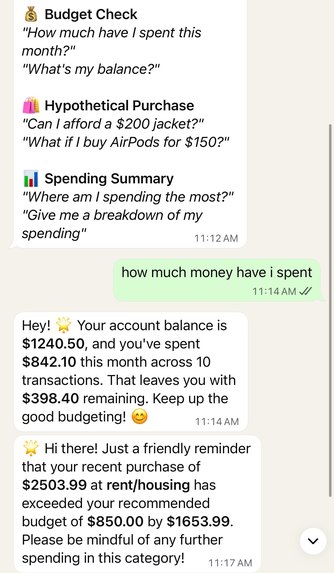
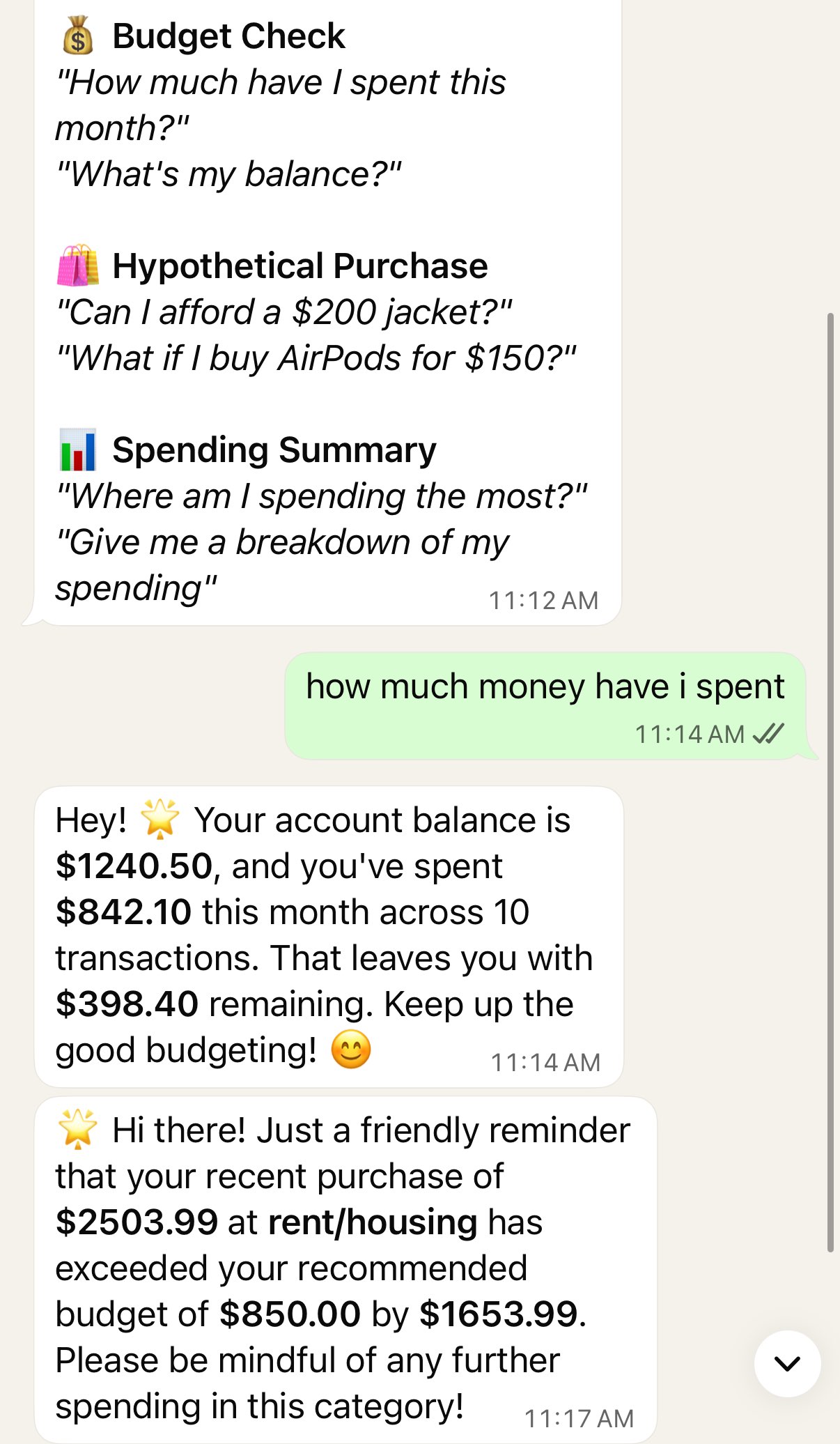
Screenshot of text messages with our application
Inspiration
As college students, we know first-hand how hard it is to stick to a budget. Most modern budgeting practices require manual tracking of purchases, which is slow and time-consuming. That's why we built BudgetLess, an application that connects to your bank account and automatically tracks purchases against your budget goal.
What it does
This application is meant to be quick and easy-to-access. We connected a Twilio business number to our program, so just text that business number and you can get automatic updates from our application when your spending pattern is higher than normal or causing you to exceed your budget, as well as quickly get information about current spending amounts or how buying certain items will affect your planned budget for the rest of the month.
How we built it
We used Python for the backend and HTML for the frontend. We utilized OpenAI to help filter incoming messages so that for our backend server to then process and respond accordingly. We manually calculated people's spending behaviors based on past transactions and purchase history to then build a model for projected spending and use that as a comparison against current spending to detect any unusual purchases and warn the user. We also have a Supabase backend to store budgets, transaction history, and user account information. We used Nessie API to simulate real banking data for our project.
Challenges we ran into
There was a lot of challenges wrangling the data for our application as well as setting up Twilio to receive and text messages back to users.
Accomplishments that we're proud of
Having both a dashboard that shows real-time updates from our application and integrating texting as the main mode of access/communication between users and our application.
What's next for BudgetLess
We hope to expand on the number of services supported by BudgetLess.

Log in or sign up for Devpost to join the conversation.