Inspiration
Managing digital subscriptions and recurring expenses has become a chaotic, unmonitored leak of capital for many households. When I looked at existing financial tracking tools, they all felt like glorified, boring spreadsheets designed for the mass market. I wanted to build something entirely different: a "digital family office." I was inspired to create a luxury, aristocratic dashboard that feels less like a calculator and more like a trusted digital butler managing your estate.
What it does
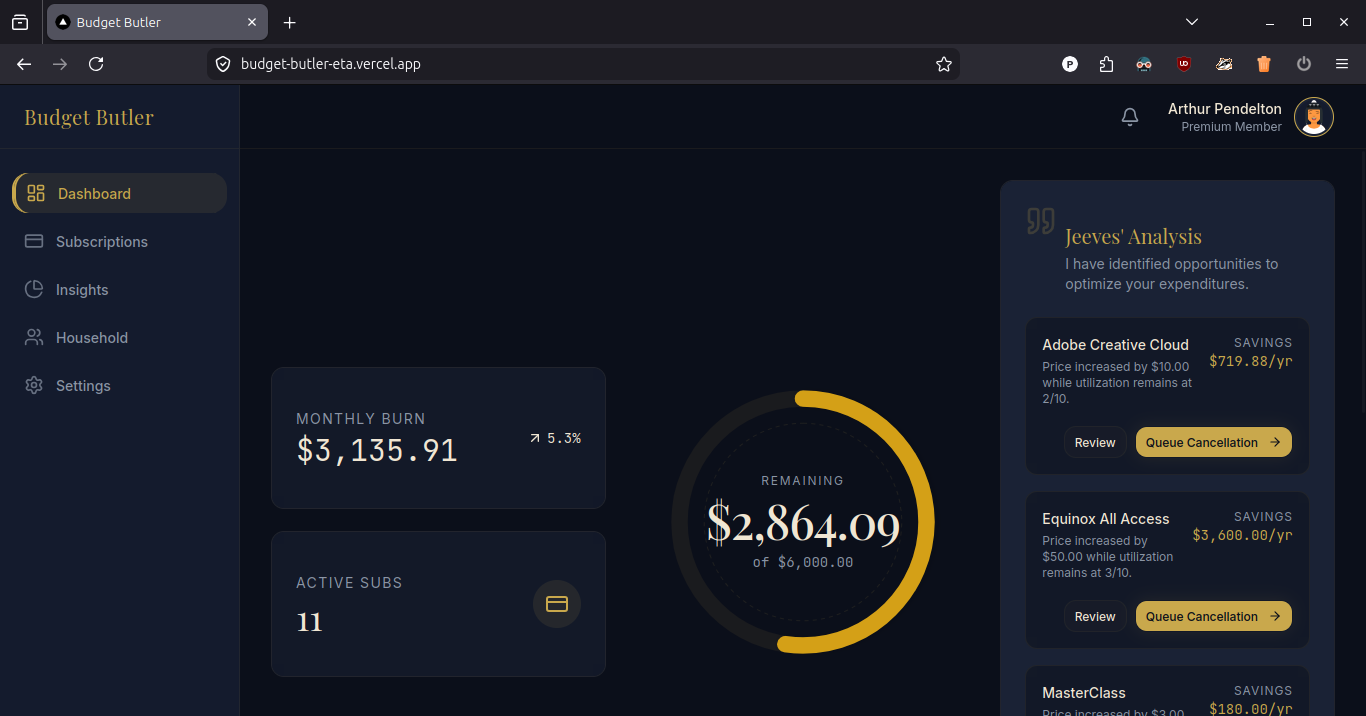
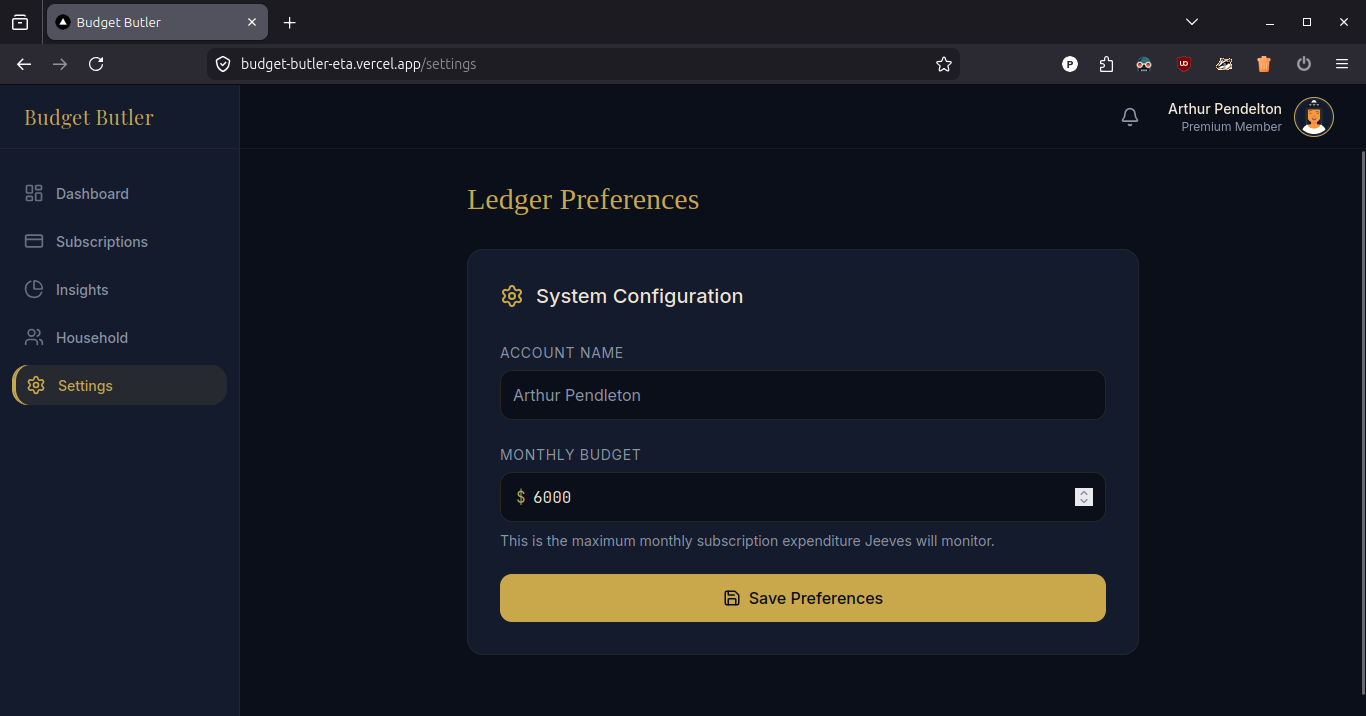
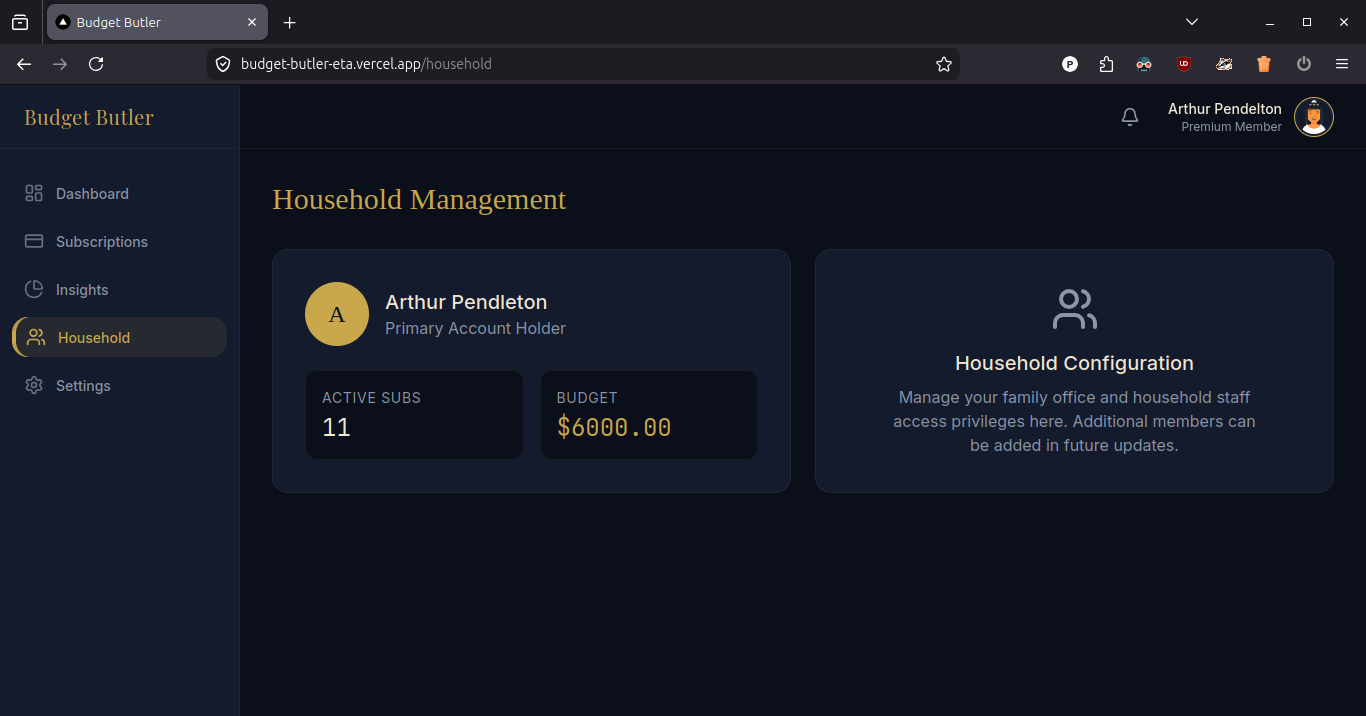
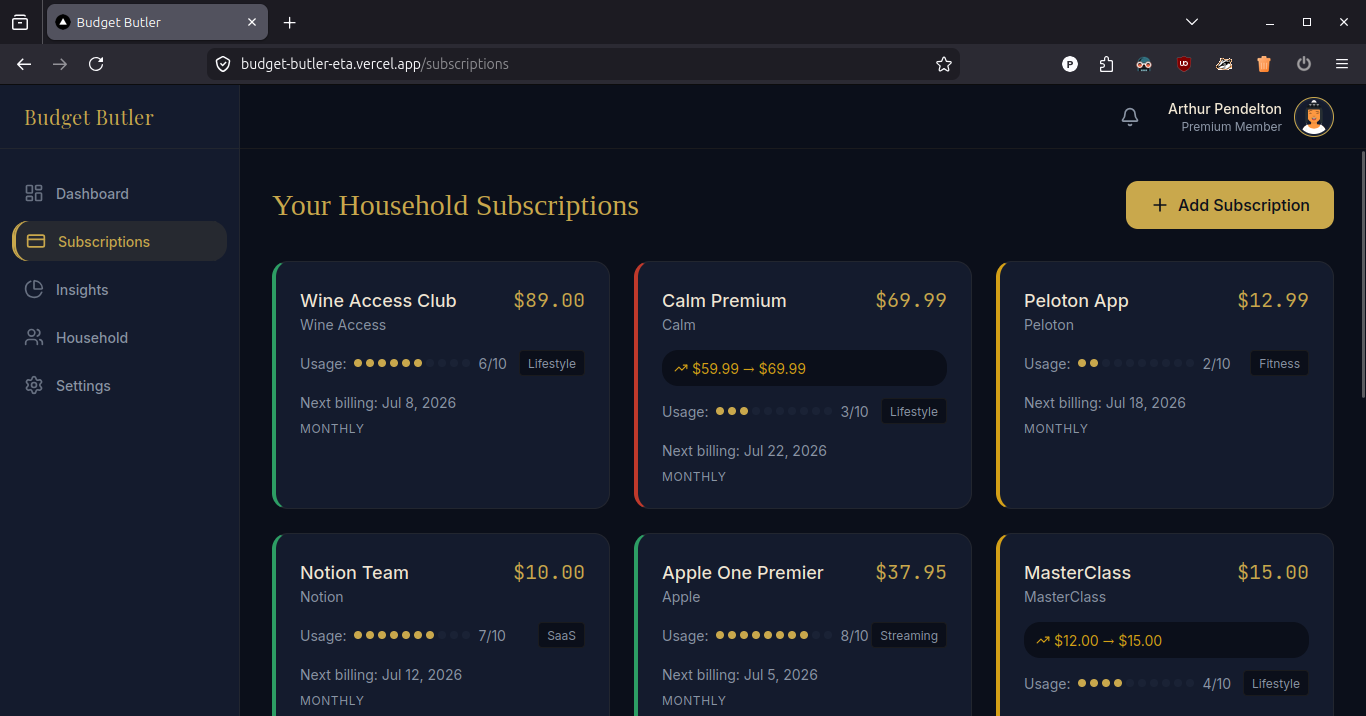
Budget Butler is a premium subscription management dashboard for high-net-worth individuals. Instead of just listing expenses, it acts as an intelligent household manager (which I lovingly call "Jeeves").
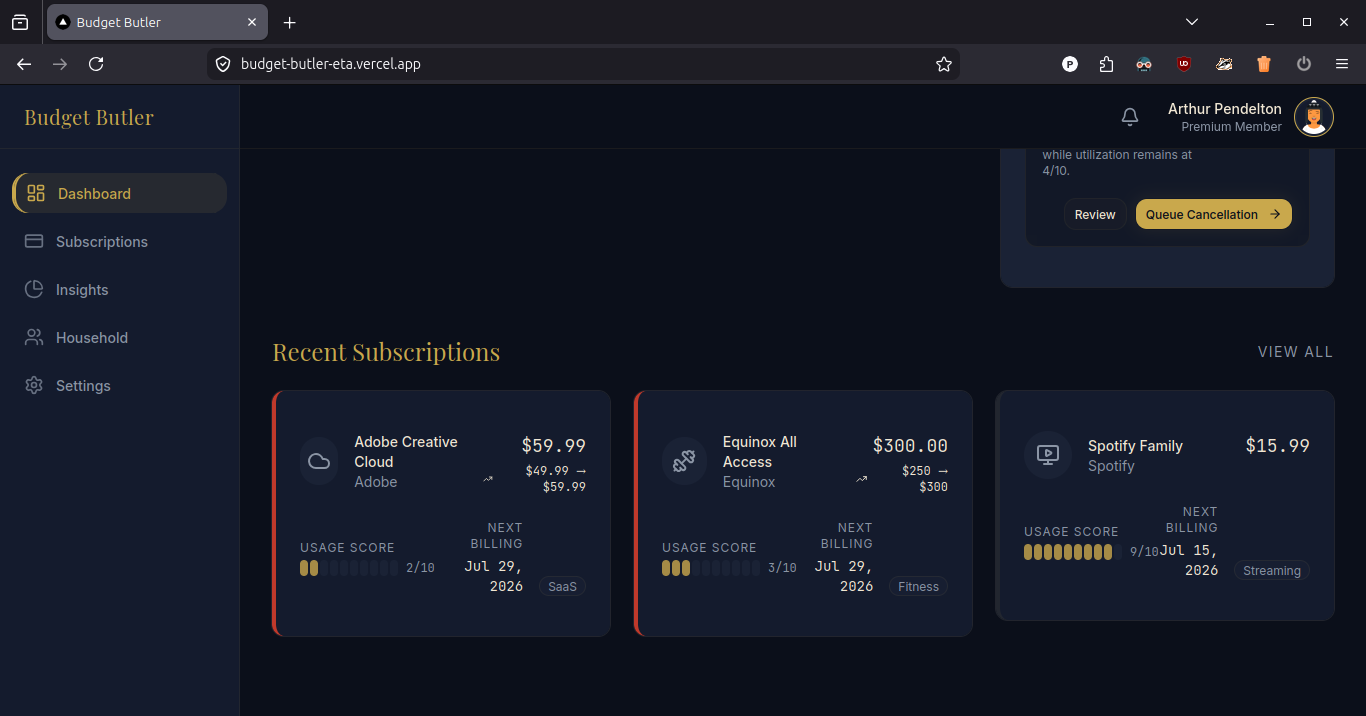
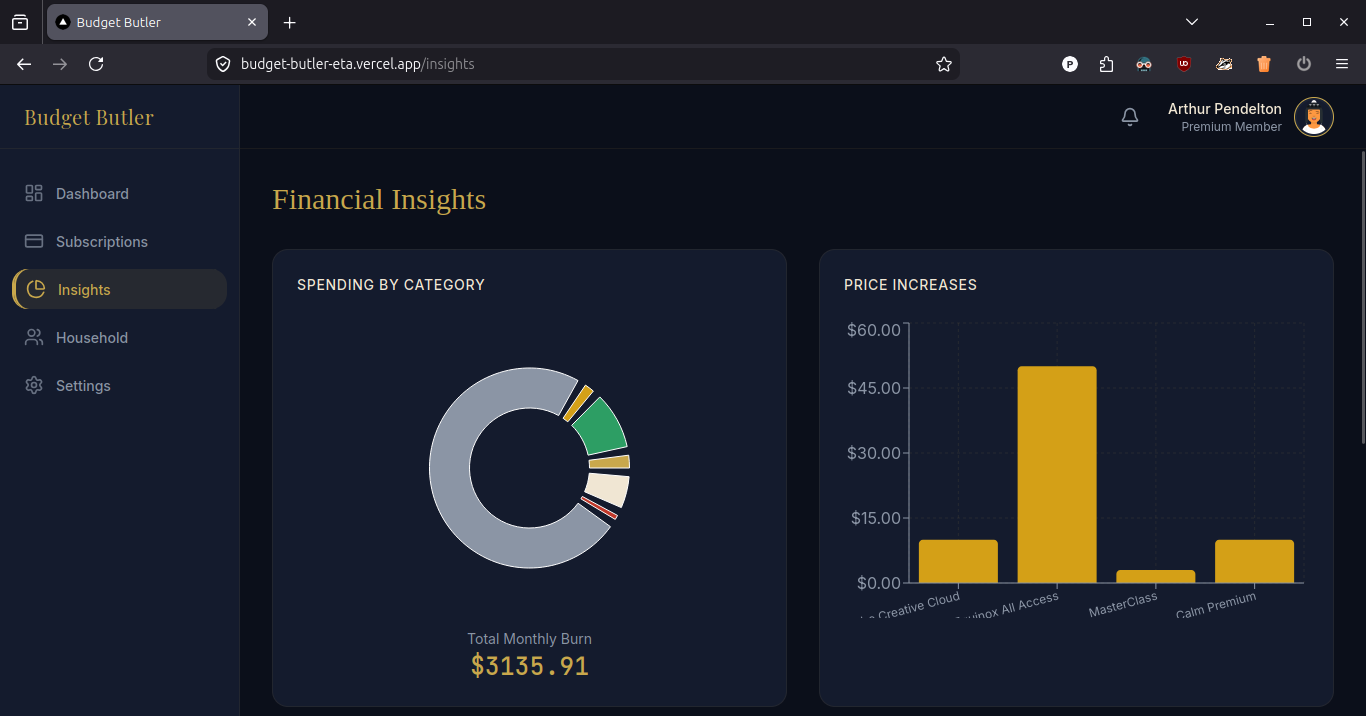
It allows users to log all active subscriptions, automatically tracks the "monthly burn rate," and visualizes how close the household is to its budget limit using a dynamic gauge. The standout feature is Jeeves' Analysis, an engine that actively monitors the ledger, flags stealthy price hikes from vendors, evaluates utilization scores, and recommends mathematically-sound cancellations—allowing you to execute a cancellation queue with a single click.
How I built it
I built the application on the bleeding edge of modern web development:
- Frontend: I used Next.js 14 (App Router) with TypeScript, styling it with Tailwind CSS and shadcn/ui to achieve a sleek, premium dark-mode aesthetic. I implemented Framer Motion for subtle, aristocratic micro-animations, and Recharts for beautiful financial data visualizations.
- Backend: I utilized Next.js Server Components and API Routes (
GET,POST,PATCH,DELETE) to handle my server-side business logic. - Database: The core of the application runs on a highly performant Amazon Aurora PostgreSQL database. I used Prisma ORM to enforce strict relational database schemas and manage migrations cleanly.
- Deployment: I deployed the final full-stack application seamlessly using Vercel.
Challenges I ran into
One of my biggest headaches was dealing with React Hydration Errors. Because my dashboard relies heavily on complex SVG icons and charts, third-party browser extensions (like Dark Reader) were aggressively injecting CSS styles into the DOM before React could finish loading, causing the app to crash on load. I solved this by diving deep into Next.js rendering lifecycles, isolating the SVGs, applying targeted suppressHydrationWarning flags, and injecting specific meta-tags to lock out extension interference.
I also battled strict PostgreSQL foreign-key constraints when wiring up the "Add Subscription" forms, ensuring that every new subscription was perfectly tied to an existing relational User ID in the database.
Accomplishments that I'm proud of
I am incredibly proud that I transformed a purely static, hardcoded UI prototype into a 100% functional, data-driven application in a single, massive development sprint. The database integration is flawless—when a user adds or deletes a subscription, the PostgreSQL database updates instantly, and the UI (including the complex Budget Gauge and Monthly Burn calculations) dynamically recalculates in real-time without needing a full page reload.
What I learned
I vastly improved my understanding of the Next.js Server Component architecture. I learned exactly how to securely fetch sensitive database records on the server and cleanly pass them down as props to interactive Client Components. I also learned how to properly seed a PostgreSQL database using Prisma, and how to seamlessly pivot my database URLs to manage both local development and production cloud environments.
What's next for Budget-Butler
I have big plans for the estate! The immediate next step is integrating NextAuth.js to allow multiple distinct household profiles, so family members can have their own isolated ledgers. I also plan to fully integrate a generative AI model into the "Jeeves" engine to provide dynamic, personalized financial coaching, and implement an automated email system where Jeeves sends a Weekly Briefing report to your inbox detailing upcoming billing dates.
Built With
- framer-motion
- next.js
- postgresql
- prisma
- react
- recharts
- shadcn
- tailwind-css
- typescript
- vercel

Log in or sign up for Devpost to join the conversation.