-
-
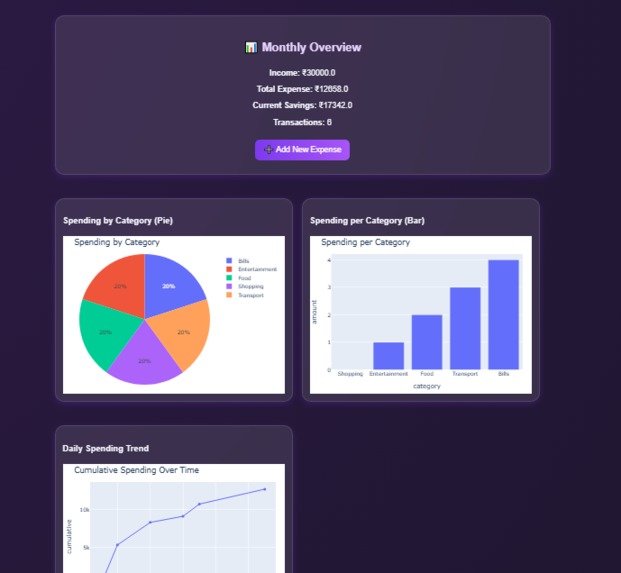
Dashboard of Daily expenses
-
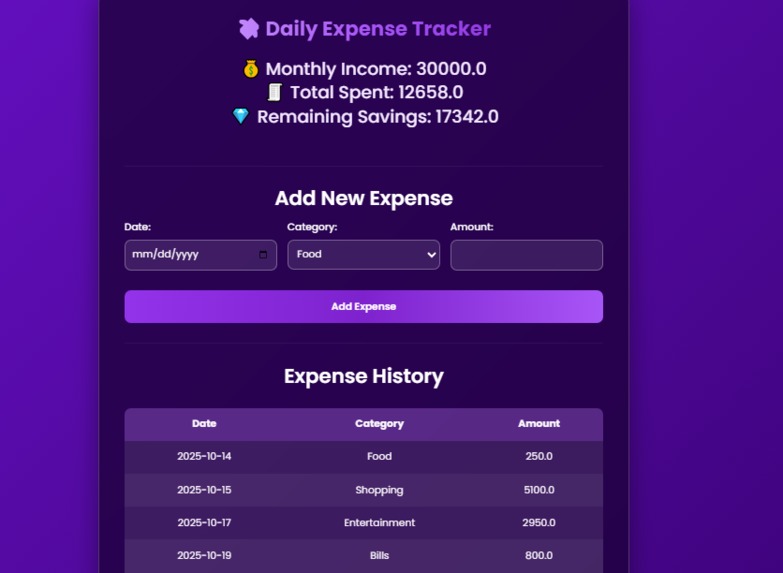
Entering Expenses
-
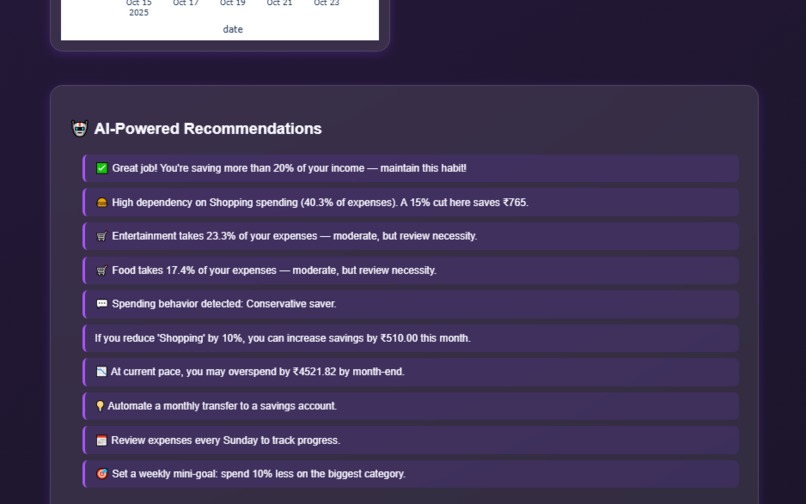
AI based Suggestions where to FOCUS


🧾 Project Story – Web Budget Buddy AI 💡 Inspiration
Managing money sounds simple, but in real life, it’s tough — especially for students, beginners, and families who don’t track every expense. We realized that most budgeting apps require bank statements, bank integration, or complex setup, which discourages new users.
So, we thought:
“What if we build a minimal, AI-powered financial buddy that understands your spending, guides you with insights, and motivates you to save — all without uploading bank data?, just telling your monthly income and how ever you do any expense add them. the ai will give dashborad visual of where to reduce and ai suggestion.”
That’s how Budget Buddy AI was born — a simple yet intelligent web-based dashboard that helps you track, analyze, and improve your financial habits in real time.
🏗️ How We Built It
We followed an 8-phase modular approach to ensure clarity, simplicity, and scalability.
FastAPI Backend — for quick, modern web handling.
Jinja2 Templates — to dynamically render expense and dashboard pages.
In-memory Data Storage — for income and daily expenses (no database needed).
Plotly Visualizations — for interactive charts: pie, bar, and line graphs.
AI Advisor Module — rule-based heuristic analysis to detect overspending and generate saving tips.
Dynamic Dashboard — auto-refreshing data visualization + AI text recommendations.
User Flow Optimization — fully manual input to simulate real-world behavior tracking.
Hackathon-ready Testing — ensured instant setup, no login, and cross-browser functionality.
🧠 What We Learned
How to integrate AI-style reasoning into a lightweight Python app without full ML training.
Using Plotly + FastAPI + Jinja2 together for real-time, reactive data dashboards.
Designing with the user-first principle — keeping interfaces simple but meaningful.
How financial behavior can be represented as measurable data and analyzed like:
Savings=Income−i=1∑nExpensei
And through this, we learned to detect overspending patterns using simple ratios like: Expense Ratio=Category Expense/Total Income×100%
to help users maintain savings of at least 20% of income.
🚧 Challenges We Faced
Balancing simplicity and intelligence: Making the app feel “smart” without overcomplicating the setup.
Real-time updates: Getting Plotly charts and FastAPI templates to refresh automatically without lag.
Data structure handling: Ensuring accurate cumulative totals and category-wise aggregation in memory.
Motivational AI logic: Writing rules that feel human — not robotic — when giving suggestions.
No-database mode: Designing all logic in runtime memory so users don’t need any config files.
🧭 Impact
Budget Buddy AI helps:
Teens & Students → develop early financial discipline.
Working Professionals → see how small habits affect long-term savings.
Families → visualize their expense distribution and plan together.
It’s not just an expense tracker — it’s a motivational AI coach for better money habits.
🔮 Future Vision
We plan to extend Budget Buddy AI with:
🕒 Time-based expense insights (hourly spending patterns)
💳 Secure integration with UPI or payment apps for auto expense detection
🧠 GenAI-powered personalized coaching and daily financial motivation
📱 Mobile version with reminders, savings challenges, and goals
🌍 Multilingual support and cultural localization
🏁 Conclusion
Budget Buddy AI proves that AI doesn’t have to be complex to be helpful. Sometimes, a simple app that helps people make smarter financial choices is enough to change lives. Our project shows that technology can empower people to spend wisely, save consistently, and live better — all while learning AI and finance the fun way.
Built With
- css3
- fastapi
- html5
- javascript
- jinja
- plotly
- python
- scikit-learn
- uvicorn

Log in or sign up for Devpost to join the conversation.