Inspiration
Kids love stories. They also love learning how storytelling works, how memorable characters take shape, how quirky worlds are built, and how ideas connect. Few tools teach narrative concepts at a child's level while leaving the child in control. By giving children a head start as authors and abstract thinkers, we can help them build lifelong creative skills.
What it does
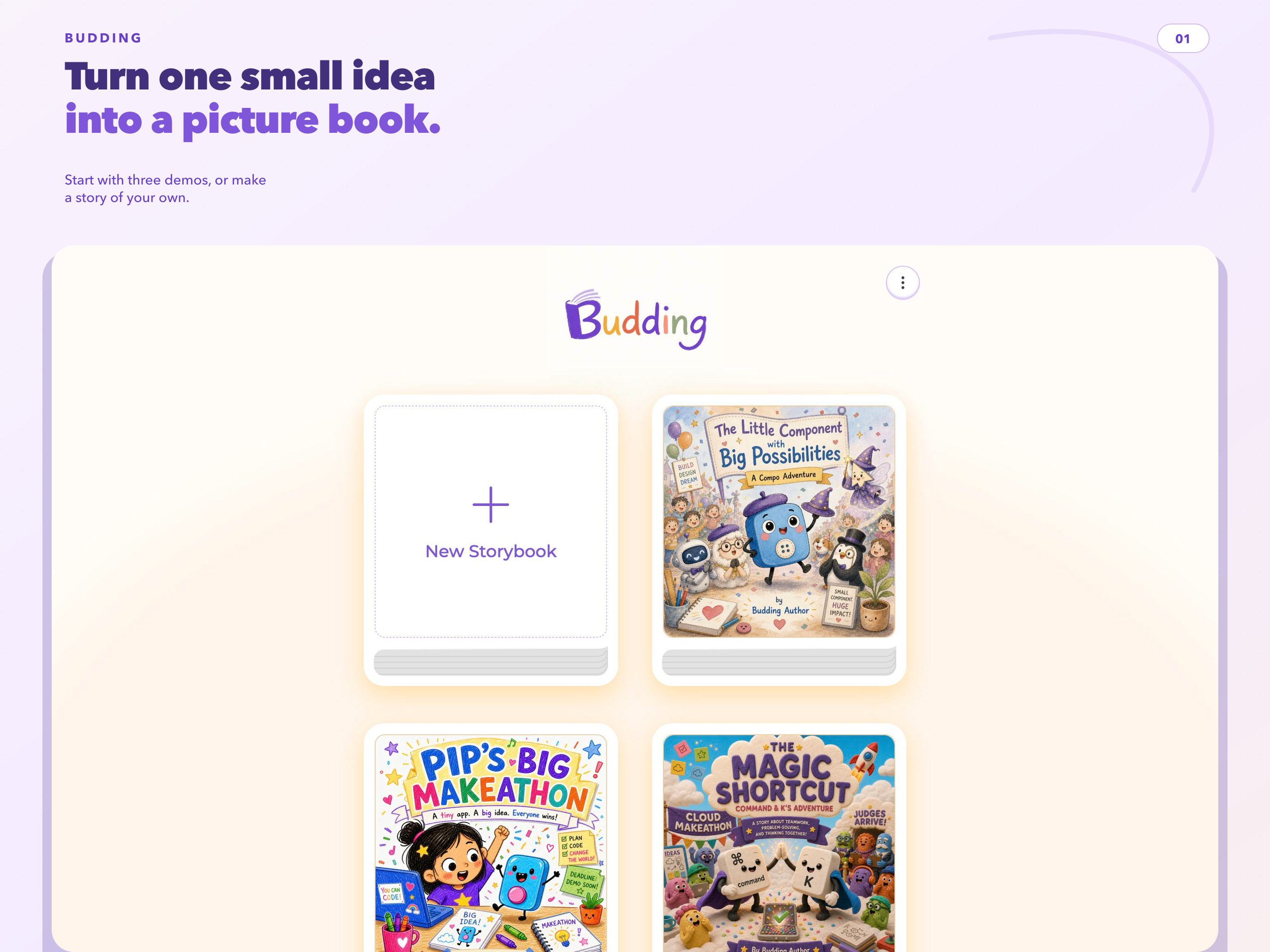
Budding is designed to let the child lead a story with their imagination. When a grown-up joins them, it becomes a unique and creative group exercise.
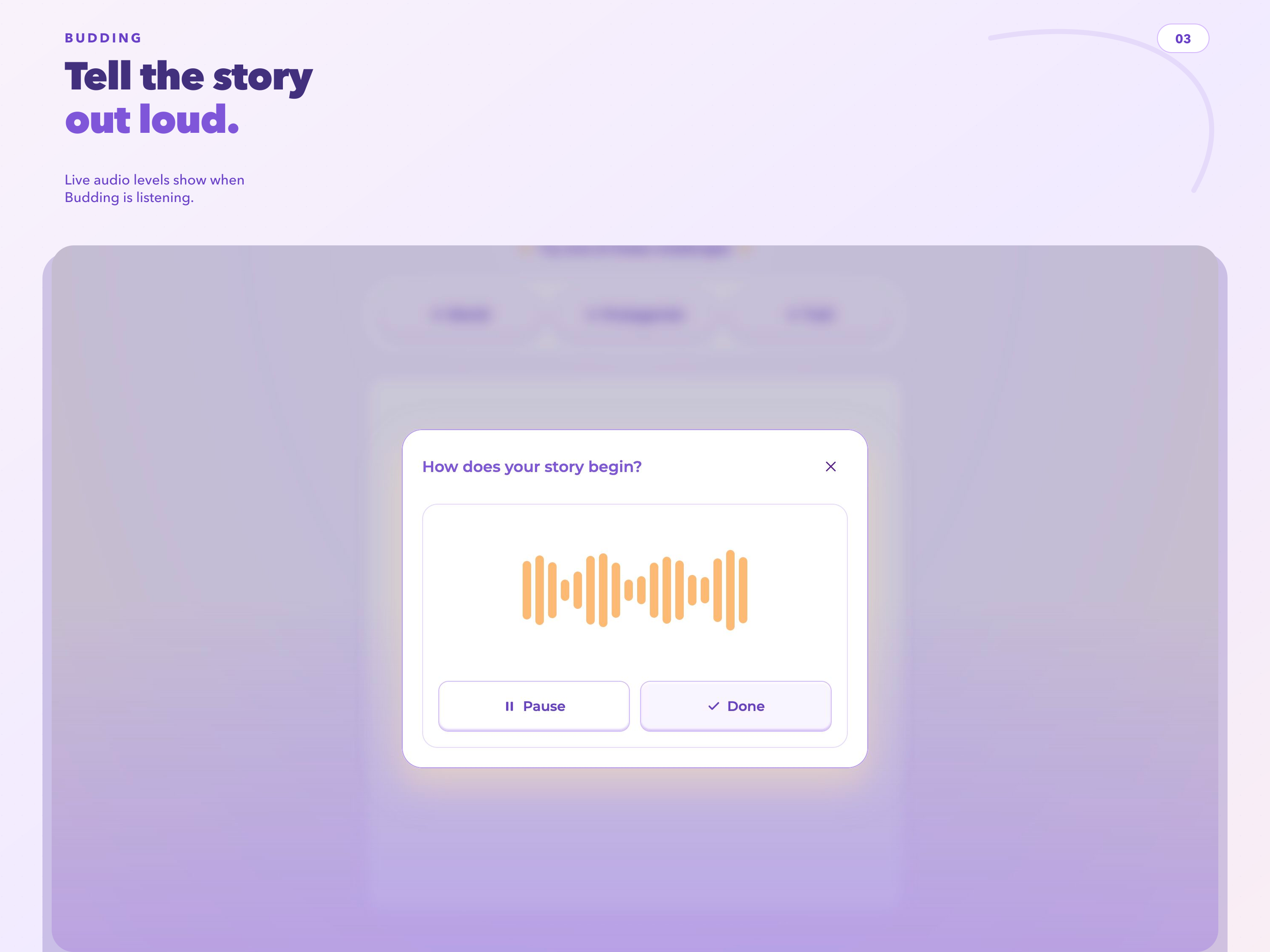
You choose one of 22 illustration styles. The child can speak the first story moment, and Budding creates the illustrated page and carries relevant story and visual context forward. It even adds narration to their pages.
Based on your specific story, Budding gives you optional prompts to imagine the next page. It is all open-ended, letting the child's imagination run wild. A big reason kids stay excited is the anticipation of seeing their ideas come alive as beautiful pictures that talk.
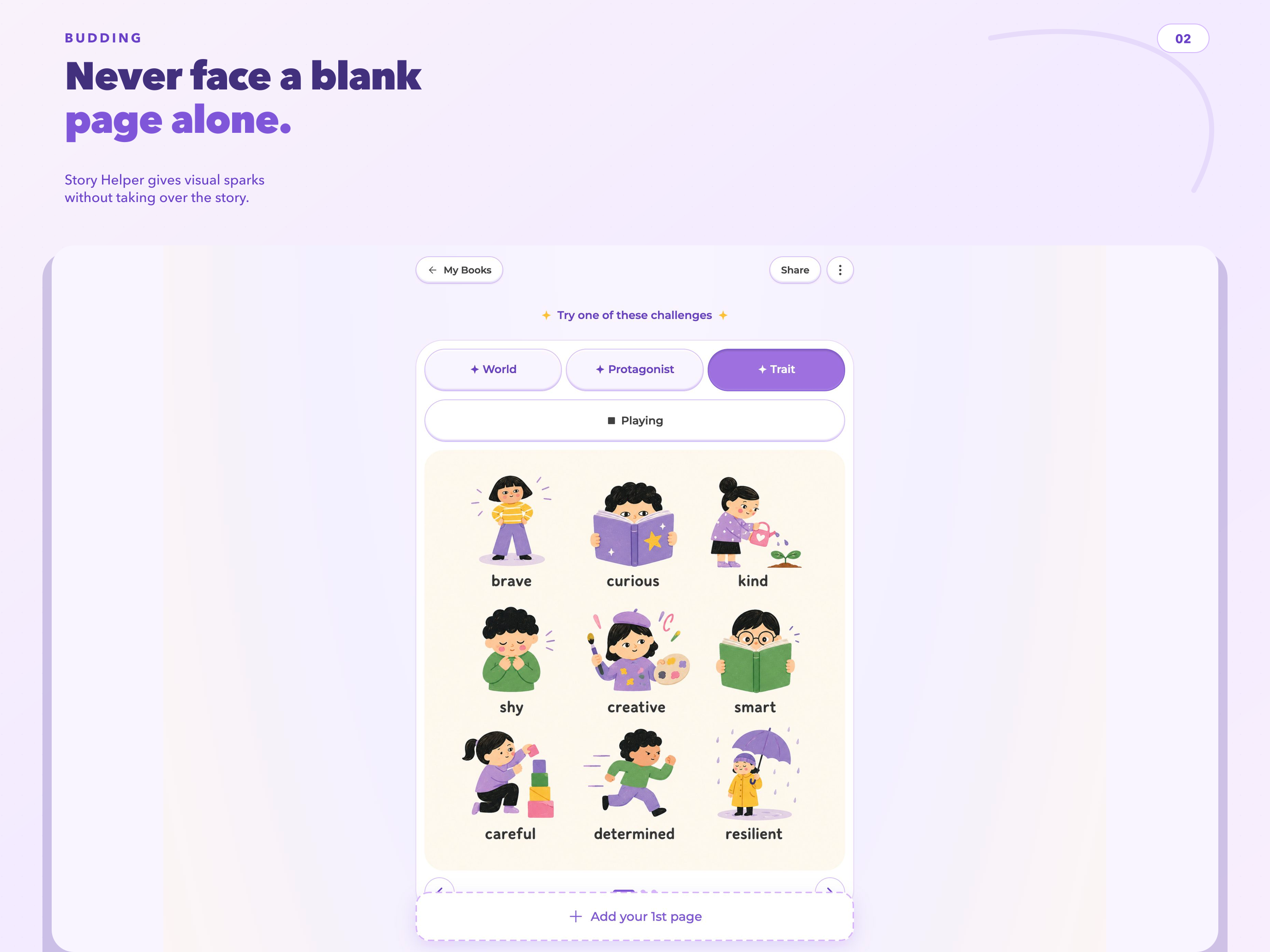
When the child needs help, Story Helper offers idea sheets for each of the three creative challenges shown for every page. The child can ignore them, choose one, or invent something else. What is especially interesting is that, instead of simply choosing an idea presented on screen, children often invent adjacent ideas inspired by what they see. This makes Budding an excellent way to grow their “idea muscle.”
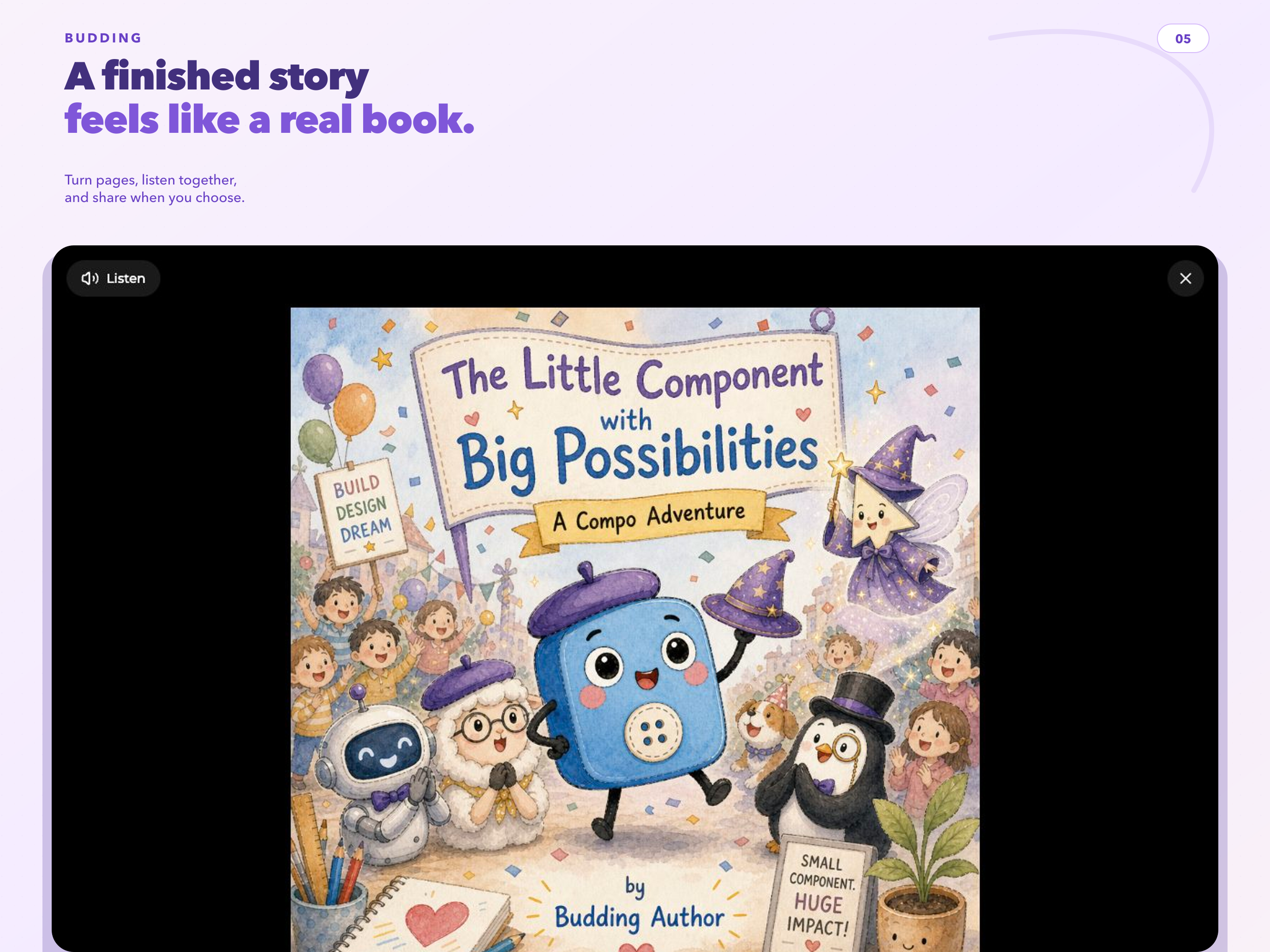
They can redo or change pages simply by talking. Every book gets a cover. Books are private by default, but families can make one public and share it.
How GPT-5.6 is integrated
Budding's Story Helper uses GPT-5.6 Terra through the OpenAI Responses API. The Worker sends a compact, bounded representation of the child's existing pages, detected story state, current three-act beat, and three deterministic focus labels. GPT-5.6 returns strict JSON Schema output with exactly three creative constraints. The product validates the result, rejects vague or plot-taking suggestions, can run one bounded repair pass, and falls back safely if the provider is unavailable.
The request uses low-verbosity output, explicit no-reasoning mode for child-facing latency, and a pseudonymous safety identifier. The cache identity includes the model and story-state contract, so model changes cannot silently reuse older guidance.
How Codex was used
Codex was the primary engineering collaborator throughout the project. During Build Week, it helped inspect and extend the existing system, implement the shared iPhone/iPad shell and security boundaries, create focused regression tests, run browser and device-oriented visual QA, optimize Story Helper latency and media delivery, build narration cache controls, and design the image-reference collage approach used to reduce generation cost and improve continuity.
The repository includes durable regression notes for material changes, with commands, release evidence, and rollback boundaries. The main Codex /feedback Session ID is recorded in the repository and in the Devpost field.
What was built during Build Week
Before July 13, Budding was a working product skeleton: core flows existed, but frequent issues and quirks meant I had to constantly assist and oversee every use. The meaningful extension built during the submission window turned that skeleton into a shareable, self-serve experience and includes:
- a production-ready, self-serve experience that no longer requires hands-on supervision
- image-generation quirks fixed across finished-book flows
- working character consistency and story continuity, with lower generation cost and latency
- a complete Story Helper asset expansion and faster, truthful helper loading and audio behavior
- a production-capable Capacitor iPhone/iPad shell with parent-owned native auth, Keychain restoration, private media, native sharing, safe-area handling, and a child-safe Grown-up Space
- GPT-5.6 Terra as Story Helper's primary structured-output engine
- sequential long-idea page splitting that preserves the child's exact words
- image-aware reference selection and identity-safe illustration edits
- request-level narration reuse, leases, stable character voices, and determinate preparation progress
- comprehensive web and native security hardening, iPad layout improvements, and page-delete reconciliation
Only this post-start extension is presented for Build Week judging. Dated commit and regression evidence is included in the repository.
How it was built
- Codex as the primary engineering collaborator
- React + TypeScript + Vite frontend
- Cloudflare Workers, D1, R2, and Queues backend
- OpenAI Responses API with GPT-5.6 Terra for Story Helper
- OpenAI image generation for page art and edits
- Gemini TTS for expressive page narration with request-level reuse
- Capacitor 8 for the shared iPhone/iPad shell
Challenges
The hardest product constraint was preserving the child's authorship while still making AI genuinely useful—not creating a generic choose-your-story app. Story Helper cannot simply answer “what happens next.” It has to understand story state, offer bounded creative pressure, keep the visible labels stable, and remain safe and fast enough for a child-facing flow.
Reducing cost and latency while improving image quality, character consistency, continuity, and overall story flow was a challenge to do all at once.
The other major challenge was sharing one product across web, iPhone, and iPad without weakening private media access, parent ownership, or the existing child-first interaction. That required explicit native auth, private-media bridges, safe-area ownership, device lifecycle handling, and a large regression suite.
It was also challenging to have generated pages narrated accurately, in the correct order, without flaws or redundancies. Narration preparation time was reduced as part of this work.
Accomplishments
- In hands-on use, children stayed engaged, and growth in their abstract thinking became visible in the stories they created.
- The live product supports the complete idea-to-book loop.
- Book pages prepare narration faster and more accurately.
- GPT-5.6 Terra returns validated, structured, story-aware creative challenges through the Responses API.
- The same core product runs in a bundled Capacitor shell while keeping server credentials and private media protected.
- Long ideas can become multiple pages without rewriting, omitting, or reordering the child's words.
- Public shared books remain opt-in, unlisted, and excluded from search indexing.
- Focused Build Week tests, broader release gates, dependency audits, and production no-charge checks are automated.
What we learned
AI can be more empowering in education when it opens paths to creation. The strongest Story Helper suggestions are constraints, questions, and surprising boundaries—not plot answers.
What's next
The immediate next step is distributing the existing iPhone/iPad shell after Apple completes its approvals. Longer term, Budding can expand its child-led interaction and narration to more languages while keeping parent ownership, private-by-default books, and the child's authorship intact.
Built With
- capacitor
- cloudflare-workers
- d1
- gpt-5.6-terra
- ios
- ipados
- openai-image-generation
- openai-responses-api
- r2
- react
- typescript
- vite

Log in or sign up for Devpost to join the conversation.