Inspiration
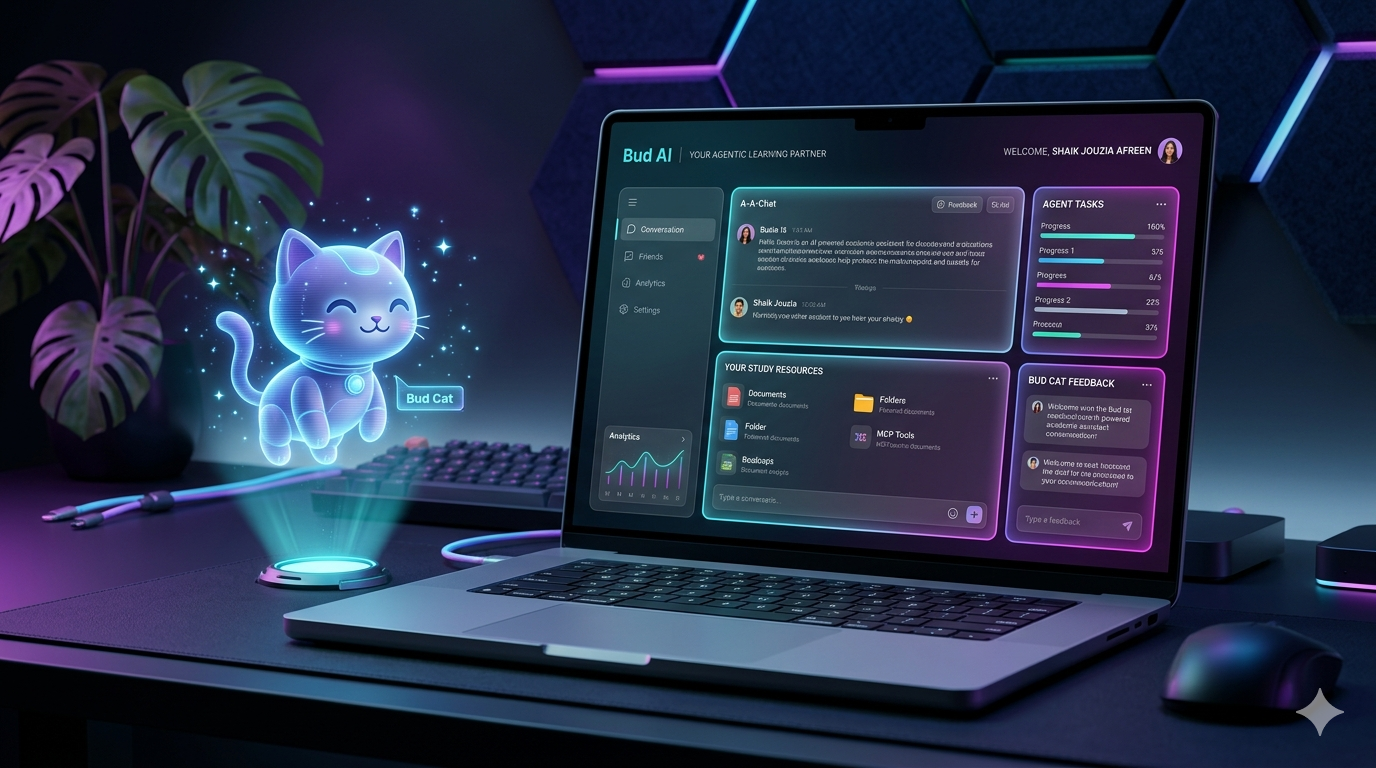
Traditional learning platforms often feel cold, static, and disengaging. We wanted to build an AI tutor that feels truly interactive and supportive—a smart companion that doesn't just display static text, but dynamically visualizes concepts, guides students through step-by-step problem solving, and adapts to individual learning paces.
What it does
Bud AI is an agentic, interactive learning platform designed to make complex concepts intuitive and accessible. Key features include:
- Interactive AI Tutor: Engages students in real-time dialog to clarify concepts, answer questions, and test comprehension.
- Dynamic Multimodal Visualizations: Generates custom visual aids and video walkthroughs on demand to explain abstract ideas.
- Adaptive Learning Paths: Tracks student understanding and tailors explanations to match their pace and knowledge level.
- Instant Feedback & Evaluation: Provides constructive, detailed feedback on practice problems.
How we built it
- Frontend: Built with Next.js, React, and Tailwind CSS for a responsive, fast, and modern user interface.
- Backend: Powered by FastAPI to manage high-throughput async connections and seamless streaming responses.
- AI & Agentic Framework: Integrated state-of-the-art LLMs and multimodal generation models to coordinate reasoning, response generation, and media creation.
- Deployment: Hosted with Vercel and Render for seamless real-time API performance.
Challenges we ran into
- Latency Management: Streaming real-time agent responses alongside visual asset generation required optimizing API orchestration to avoid delay.
- Context Preservation: Ensuring the AI tutor remembered multi-turn user context accurately throughout complex problem-solving sessions.
- UI/UX for Real-Time Streaming: Designing a fluid user interface that updates seamlessly as the agent streams text and media concurrently.
Accomplishments that we're proud of
- Built a end-to-end functional prototype within the hackathon timeframe.
- Created a seamless interface that blends text, dynamic media, and multi-agent AI interactions smoothly.
- Achieved fast real-time response times using streaming pipelines.
What we learned
- Best practices for orchestrating agentic workflows and async streaming pipelines.
- Techniques for visual prompt engineering to ensure concise, accurate educational content.
- How to design intuitive UI components for real-time agent feedback.
What's next for Bud AI
- Gamified Progress Tracking: Adding badges, learning streaks, and skill mastery trees.
- Voice & Multilingual Support: Enabling real-time voice conversations and multi-language support for global accessibility.
- Collaborative Study Rooms: Allowing multiple students to interact with Bud AI in group study sessions.
Built With
- ai-agents
- fastapi
- llm
- next.js
- python
- react
- tailwind-css
- typescript
- vercel

Log in or sign up for Devpost to join the conversation.