Inspiration
With the rise of social media, we wanted to be able to harness its great power in order to create some sort of social and mental/physical health benefit. While Instagram focuses on showing off past activities and BeReal on the current present moment, we decided to create a social media app revolving around the future, helping to push people to be more intentional with their future planning and activities. We felt that our app is needed as the world is currently facing amotivation and loneliness, with about 1 in 2 adults reporting that they felt lonely in America alone back in 2023. That's where the idea of Buck-It came from, the bucket list. Because let's be honest, bucket lists are created but rarely ever completely finished before it's too late. Therefore, we constructed Buck-It to promote users to be active and to take pride in their accomplishments by displaying their posts to the their friends and/or the world, hoping to push users to do the things they care about and become active adults while inspiring each other to do the same.
What it does
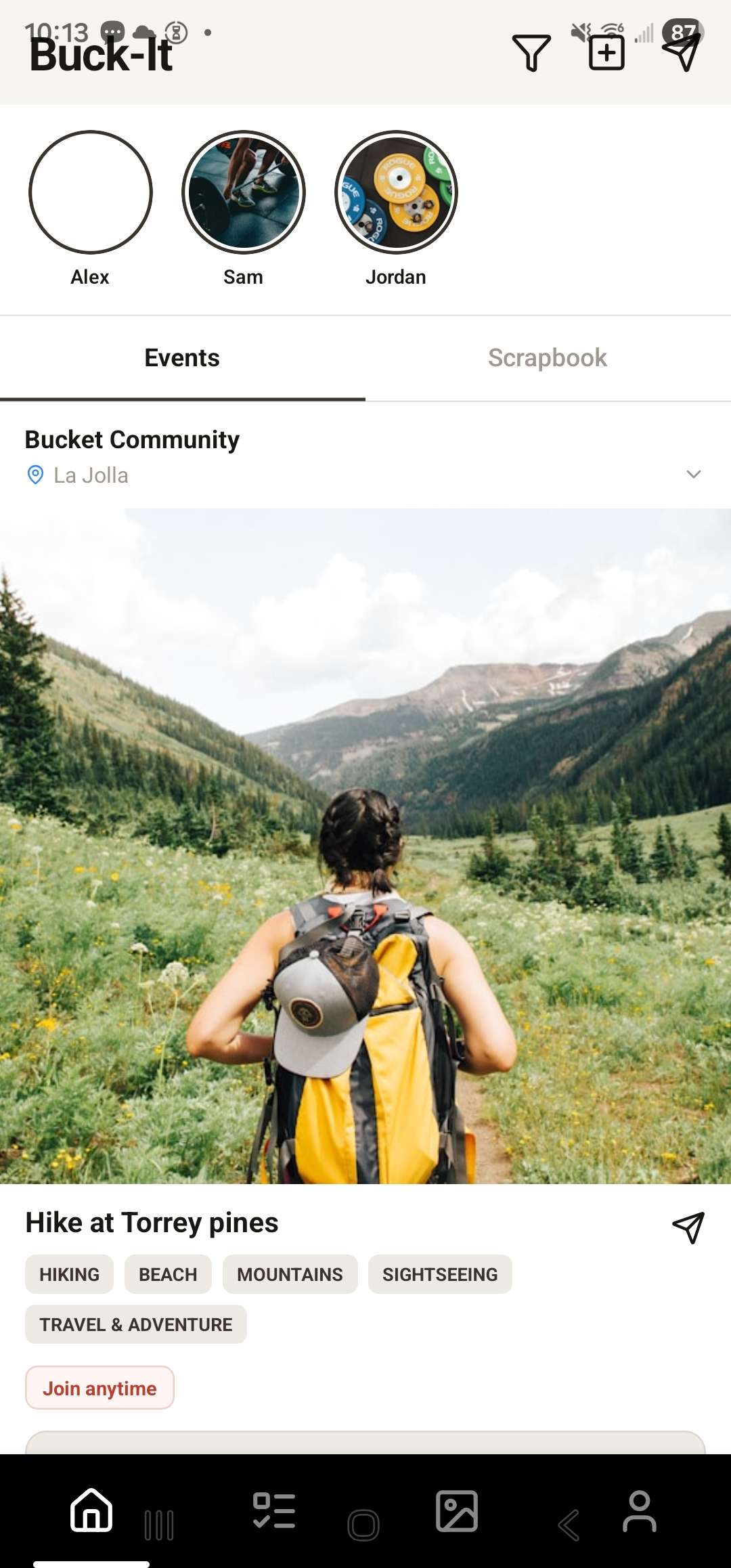
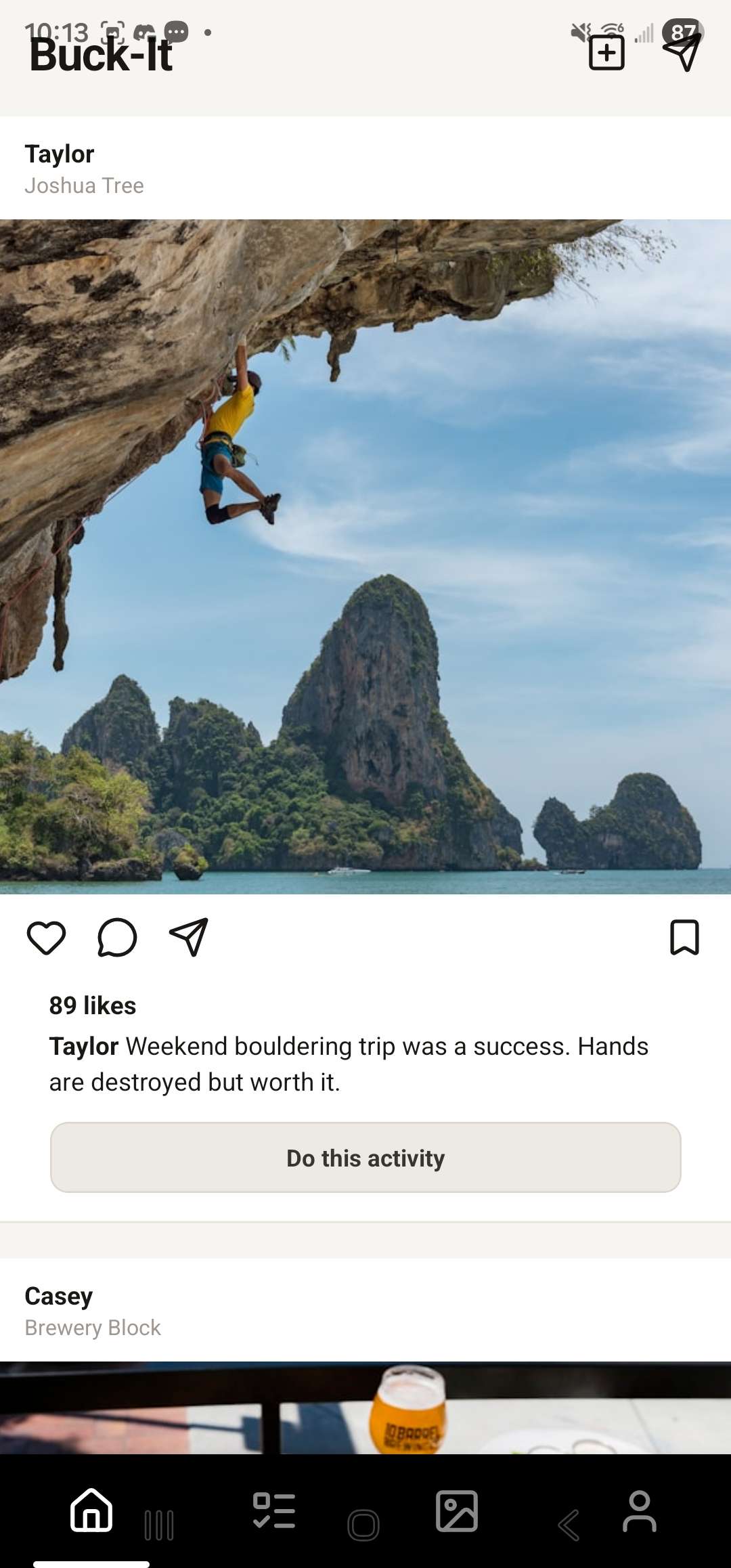
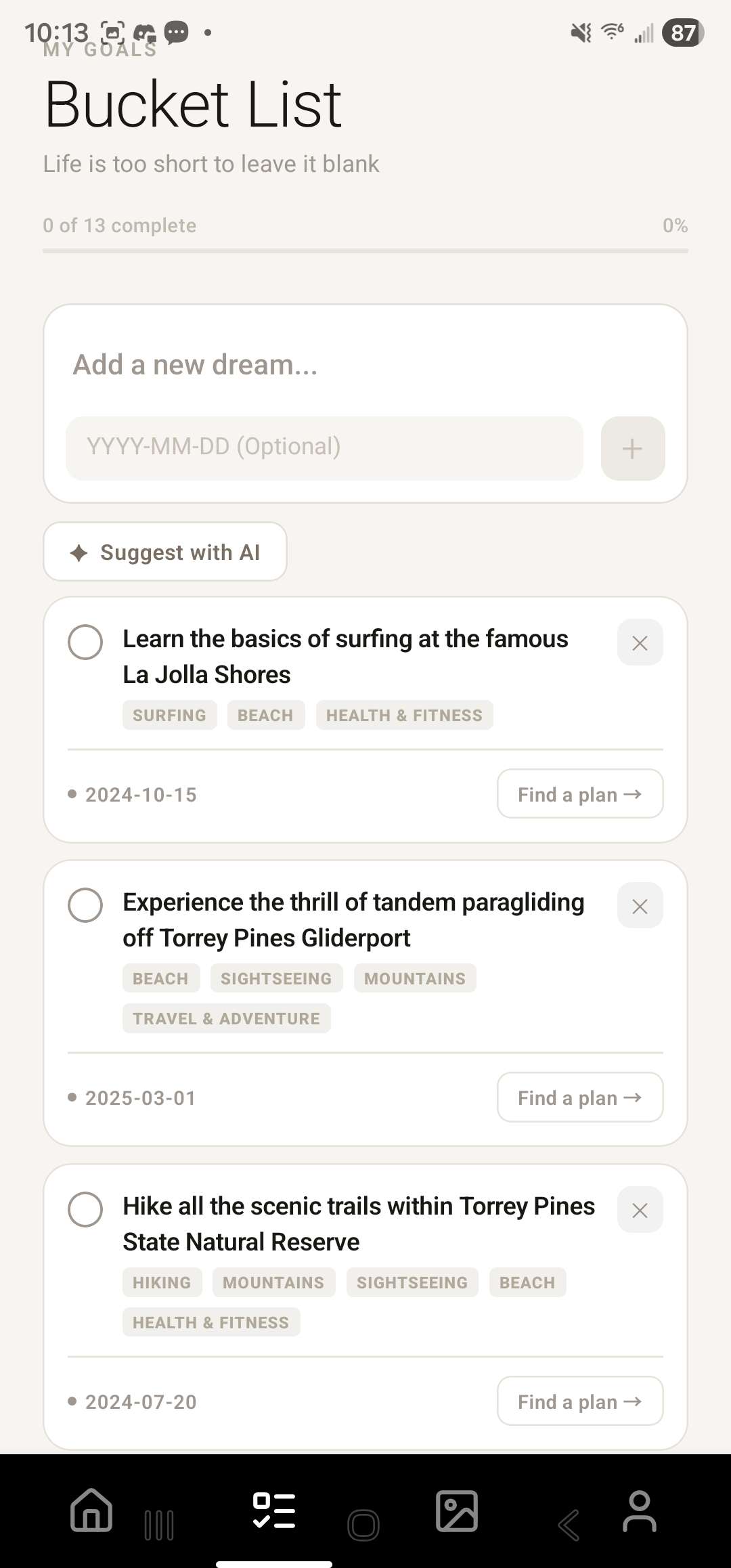
Buck-It is a social media app designed around the idea of a bucket list to promote users to be intentional and active with accomplishing goals/activities they set for themselves. Similar to every social media app, Buck-It allows users to post their accomplished bucket list items with photos and videos of them doing it. These posts are then shared to friends and/or the world for others to see, like, comment, and react. Additionally, the posts are then archived for the user to later look back in the form of a scrapbook when the item is tapped/clicked on and where friends can contribute to if appropriate. For activities requiring others, a group chat feature is also supported to users can collaborate and plan out their bucket list items. However, Buck-It also includes features unique to it as well. To start off, users create and update their bucket lists with items that show its status of completion. People can invite others to join their bucket list activity and group chats, ask to join others' bucket list item, or even take another bucket list item for their own to do with the click of a button. We also kept in mind that we can allow ads/promotions to run on our app as well to receive revenue, allow local/small business to promote themselves and connect to people interested in planning a related activity, and for other helpful promotions to take presence such as promotions of a beach cleanup hangout. Another feature we added was an availability matrix, like When2Meet, so group chats can have an easier time planning out their activities. Last but not least, we created an AI Concierge that allows users to interact with it, making broad general plans into more concrete bucket list items.
How we built it
Bucket is a mobile planning app that helps users turn inspiration into shared experiences. We centered our product around one object - bucket - so onboarding, discovery, planning, collaboration and social sharing all operate within a single unified system.
Frontend
- Build with Expo, Reactive Native, Expo Router
- Designed core experiences
- Onboarding
- Discovery feeds
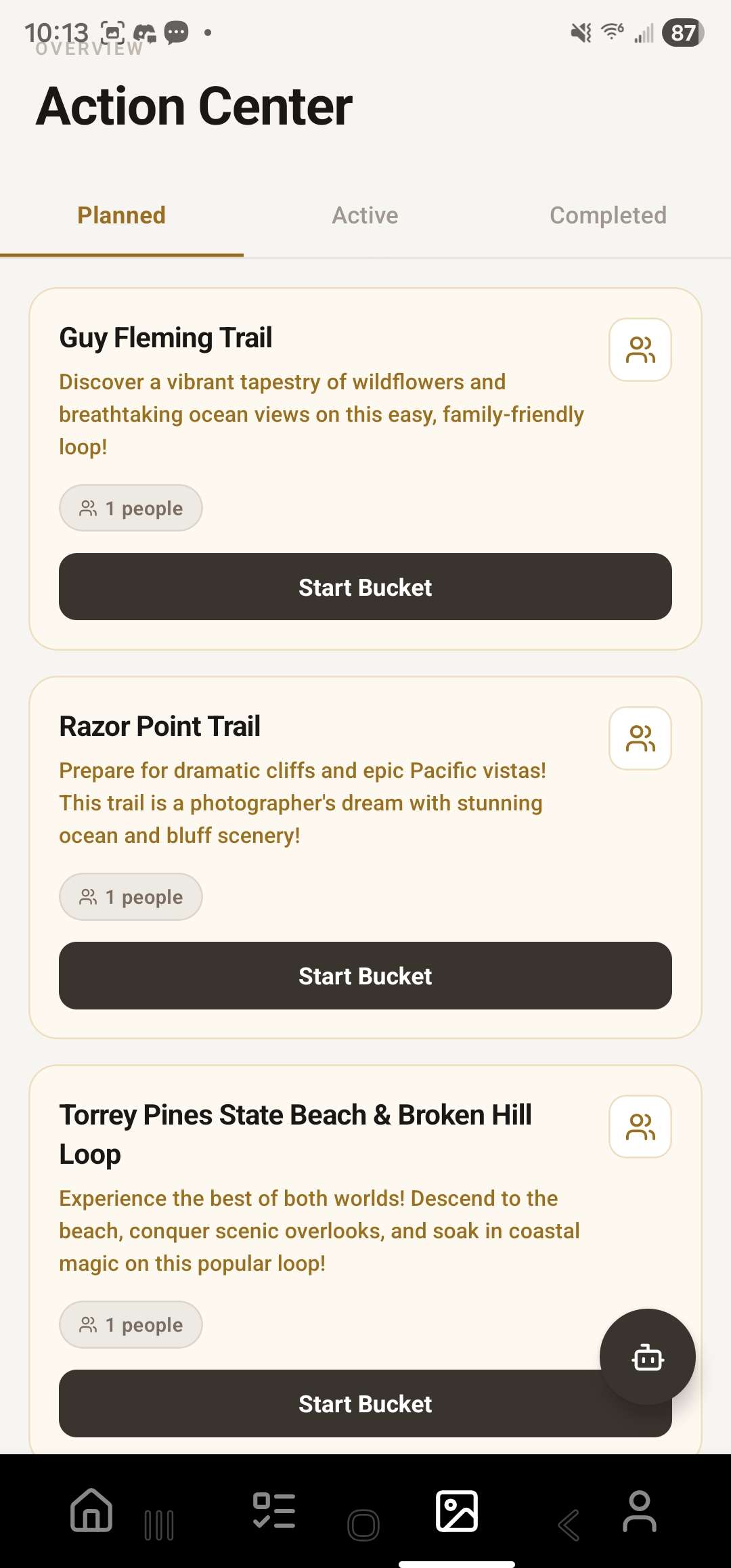
- Action Center
- Bucket creation and detail views
- Collaborative interactions
- Structured navigation so users can seamlessly move from discovering an idea → planning it → managing it, without breaking flow
Backend
- Built with FastAPI and Supabase
- Implemented modular API routes for:
- Onboarding
- Users
- Bucket lists & buckets
- Invitations
- Comments & media
- Concierge planning
- Used a service-layer architecture on the frontend to maintain a consistent API contract and avoid scattered request logic
Core Product Architecture We unified all functionality under the bucket model, enabling:
- Onboarding-generated goals
- Discovery-based suggestions
- Public/shared bucket recommendations
- Cloning completed experiences into future plans
- Joining shared/public buckets
- Invitation-based collaboration
- Comments and media on active or completed experiences This approach made the system scalable and ensured every feature fit naturally into the product.
AI Features We used AI intentionally and sparingly:
- Onboarding: Generates personalized goals
- Concierge flow: Activated only when users explicitly request help (e.g., planning or idea generation)
- Structured outputs: Designed AI responses to be predictable and directly usable by the frontend This kept AI helpful and actionable—not noisy or overwhelming.
Validation To ensure reliability:
- Added backend audit tests for:
- Onboarding
- User creation
- Bulk goal saving
- Bucket creation & joining
- Invitations
- Comments & media
- Planning routes
- Performed full frontend type-checking after integrating new flows
Challenges we ran into
Integrating with Existing Systems The biggest challenge wasn’t building features—it was integrating them into a live app with legacy flows.
Legacy Frontend vs. New Backend
- Older screens relied on direct Supabase queries and local logic
- We migrated these to structured backend APIs without breaking UX
AI Control and Usefullness
- Avoided unstructured, unpredictable outputs
- Designed AI to operate within clear workflows and return structured data
Mobile Development Friction
- Expo environment issues
- Dependency mismatches
- Route typing bugs
- Device connection issues
Accomplishments that we're proud of
End-to-End Product Flow Users can go from: onboarding → discovery → planning → collaboration all within one seamless experience.
Unified Architecture A single bucket model powers the entire product, making it scalable and extensible.
Meaningful AI Integration AI adds real value in:
- Goal generation
- Planning asisstance
- Discovery recommendations
Social and Collaborative Depth Buckets are dynamic and interactive
- Joinable
- Cloneable
- Shareable
- Commentable
- Media-rich
Real Validation
- Backend flows are tested
- Frontend is type-safe and integrated
- Core features are reliable, not just demo-ready
What we learned
Systems Thinking Matters A polished product comes from strong architecture—not just features.
Good Architecture Pays Off Early Unifying around the bucket model made future development significantly easier.
AI Needs Boundaries Structured outputs and explicit triggers made AI far more effective.
Reliability Is Product Work Stability, testing, and consistency directly impact user experience.
Testing Reduces Uncertainty Audit tests helped us quickly validate what was truly complete.
Integration > Implementation Building a feature is easy. Making it work within the full system is the real challenge.
What's next for Buck-It
Obviously as proto-type, there are many things we found we can improve and add to our design. We thought of making the UI more fit to be trendy and adding features such as customizable scrapbooks.
Built With
- expo.io
- fastapi
- gemini
- integration
- python
- react-native
- supabase
- typescript
- typescript-backend:-python

Log in or sign up for Devpost to join the conversation.