-
-
Demo
-

system design

Inspiration
Developers trying to build behind the meter data centers face a messy problem. There are thousands of parcels, inconsistent data sources, long interconnection queues, and no fast way to screen land and power economics together. The goal was to build a tool that cuts through the noise and tells a developer which sites are actually worth investigating.
What it does
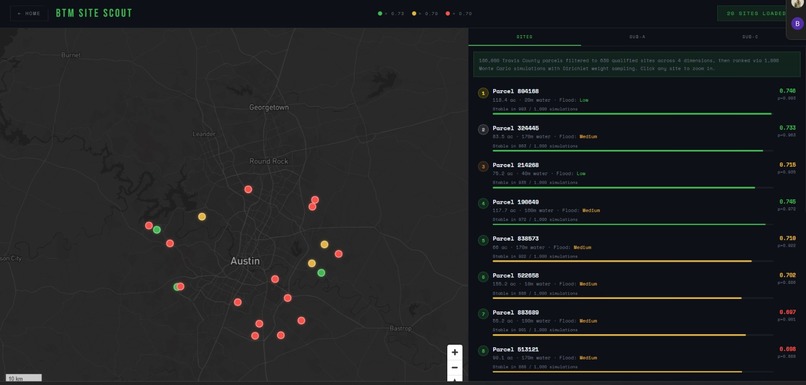
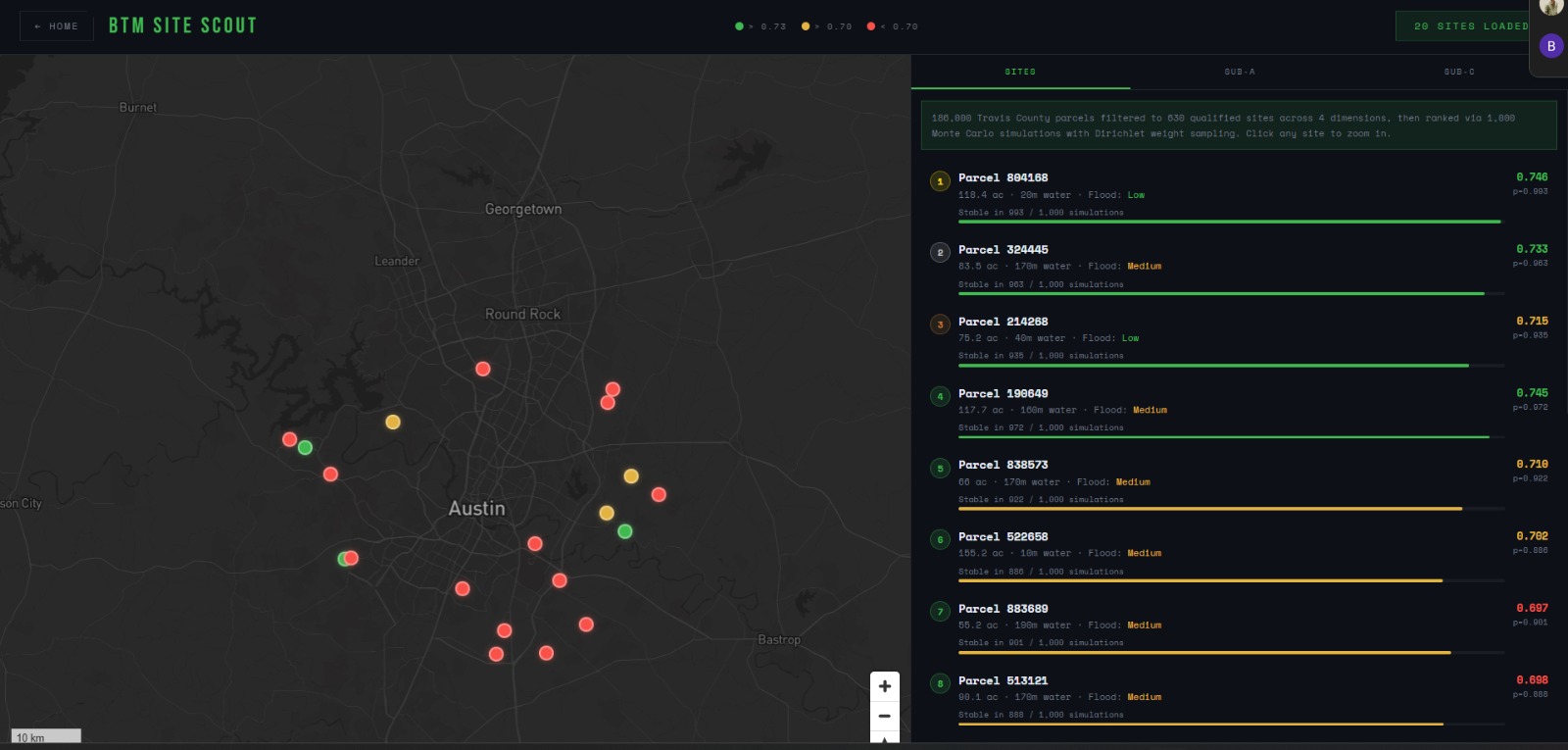
BTM Site Scout takes 186,000 parcels in Travis County and narrows them to the 20 most promising locations for a behind the meter natural gas data center. It scores land, water access, and flood risk, then stress tests the rankings with 1,000 Monte Carlo simulations. It also analyzes real ERCOT and Henry Hub data to estimate when on site generation is profitable. Everything is wrapped in a simple interactive dashboard that shows the map, the scores, and the power economics.
How we built it
We pulled parcel, waterbody, and flowline data from public APIs and applied hard filters to remove parcels that were too small or too risky. We engineered features like acreage, water proximity, and a flood risk proxy. We used a Dirichlet based Monte Carlo approach to test how stable each site is under different weighting assumptions. For power economics, we downloaded ERCOT and EIA data, computed the behind the meter spread, and trained a SARIMA model to forecast short term value. Finally, we built a lightweight frontend that runs entirely in the browser using Mapbox and simple JavaScript.
Challenges we ran into
Parcel data was huge and inconsistent. Some layers like fiber were incomplete and had to be excluded. Flood data was not available in a clean form, so we had to build a proxy. ERCOT changed its API format, so we had to create a synthetic fallback. And making the dashboard run with no backend required careful handling of large GeoJSON files.
Accomplishments that we're proud of
We reduced 186,000 parcels to a ranked shortlist of 20 with clear reasoning behind every step. The Monte Carlo engine gave us confidence that the top sites are stable under many scenarios. The power economics module showed that behind the meter generation is viable most of the time and extremely valuable during extreme events. And the dashboard makes the whole pipeline easy to explore.
What we learned
Geospatial screening benefits a lot from hard filters before scoring. Weighting choices matter less when you test them with Monte Carlo. Public data is powerful but messy. And simple visual tools help people understand complex models much faster.
What's next for BTM Site Scout Land and Power Viability for BTM Data Centers
We want to add real FEMA flood zones, zoning and land use layers, and ownership data. We also plan to expand beyond Travis County and add a full gas pipeline reliability module. The long term goal is a statewide or even national screening tool that helps developers move faster and make better decisions.

Log in or sign up for Devpost to join the conversation.