Inspiration
Current accessibility tools focus on visual access. But cognitive accessibility is still massively underserved.
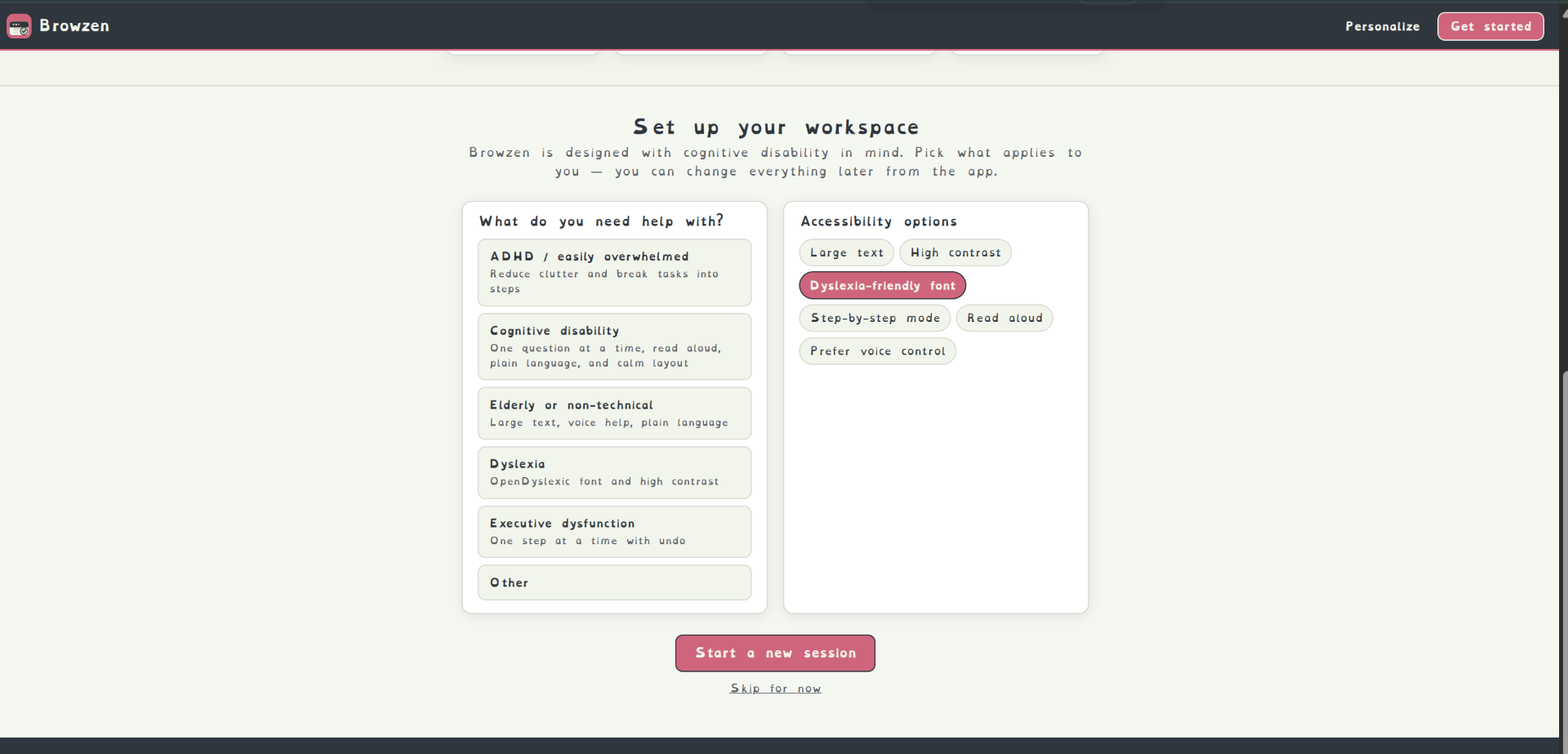
For users with ADHD, dyslexia, executive dysfunction, or cognitive disabilities, websites like DMV portals and government services can be overwhelming and difficult to use due to dense UI, multi step workflows, unclear navigation, and information overload.
We built something that reduces cognitive overload instead of just changing colors or font sizes.
What it does
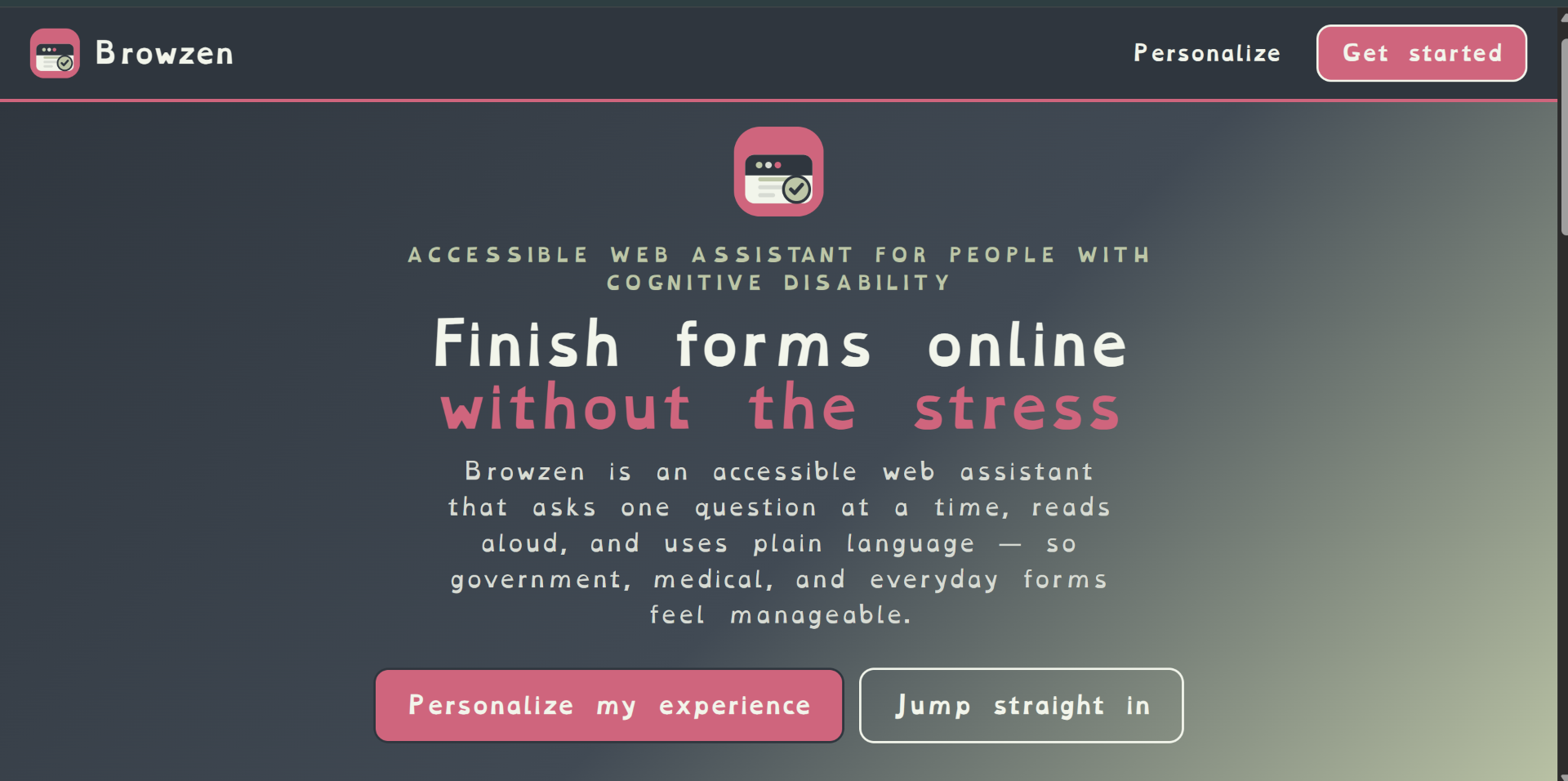
Browzen is an AI-powered cognitive accessibility assistant that simplifies complex websites into guided, easy-to-understand workflows.
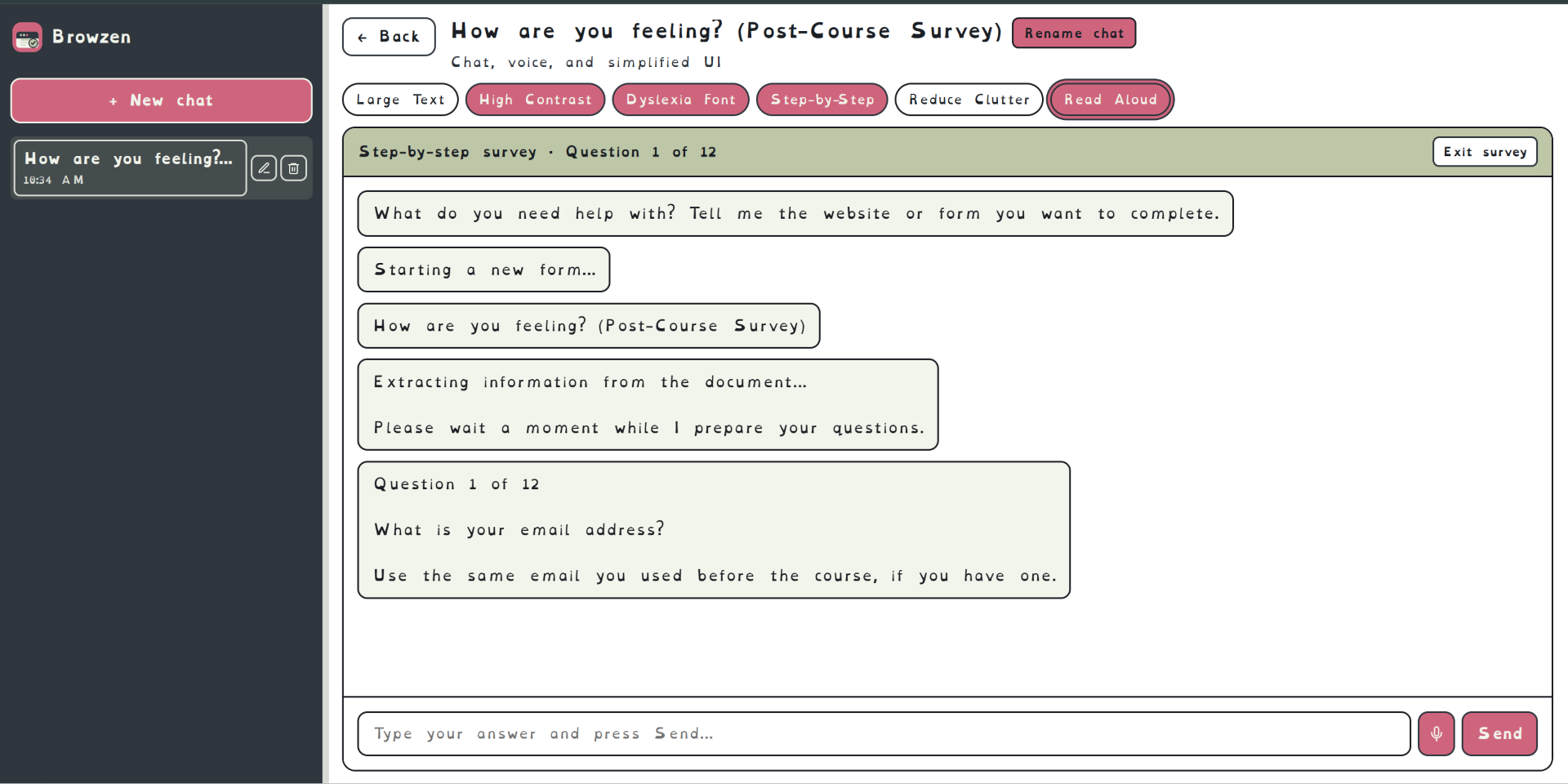
Users interact through voice commands or a simplified interface while our browser agent navigates the actual website in the background. The system extracts only the relevant information, reduces clutter, and guides users step-by-step through tasks like filling out forms or navigating multi-page workflows.
How we built it
We built Browzen using a FastAPI backend orchestrating sandboxed browser sessions through Playwright and the browser-use agent framework. Each user session maintains an isolated browser context capable of real-time navigation, DOM interaction, and workflow execution across arbitrary websites.
For reasoning and workflow understanding, we integrated DeepSeek LLMs to perform intent parsing, action planning, and contextual UI interpretation. The model analyzes website state and user input to generate structured representations of complex interfaces, allowing the frontend to dynamically render simplified, cognitively accessible UI components.
Redis was used as a low-latency session and state layer to synchronize browser state, agent actions, UI updates, and user events in real time. We also implemented bidirectional event streaming between the frontend and browser agent to maintain consistent interaction state across generated interfaces and live web sessions.
Challenges we ran into
One of the biggest challenges was translating unpredictable website layouts into a consistent and simplified interface. Every website structures forms and navigation differently, so building reliable UI extraction and event synchronization was difficult.
We also had to handle real-time browser interactions while keeping the experience responsive and accessible for the user.
Accomplishments that we're proud of
We're proud that Browzen goes beyond traditional accessibility overlays and actively assists users in completing tasks online.
We successfully built:
- Real-time browser automation
- Voice-driven interaction
- Dynamic simplified UI rendering
- Structured workflow guidance
- Sandboxed browsing sessions tied to user intent
Most importantly, we built a working system that demonstrates how AI can improve cognitive accessibility in a meaningful and practical way.
What we learned
We learned how to build reliable abstractions on top of unpredictable web interfaces. Translating arbitrary website layouts into structured, simplified UI components required solving challenges around DOM parsing, event synchronization, state management, and maintaining consistency across dynamic workflows.
We also learned the importance of combining browser automation with intent-aware AI systems. Handling real-time user interactions while continuously updating browser state, accessibility context, and generated UI required tight coordination between the frontend, backend, and automation layers.
What's next for Browzen
We want to continue improving Browzen’s ability to adapt to any website automatically and generate more personalized accessibility experiences for each user.
Future plans include:
- Personalized accessibility profiles
- More advanced voice navigation
- Smarter workflow understanding
- Adaptive interfaces based on user behavior
- Support for larger-scale real-world deployments
Our goal is to make complex websites understandable and usable for everyone, regardless of cognitive ability.

Log in or sign up for Devpost to join the conversation.