-
-

Logo
-
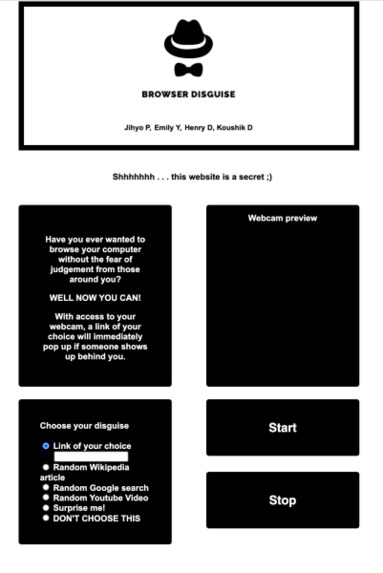
Website Screenshot

Inspiration
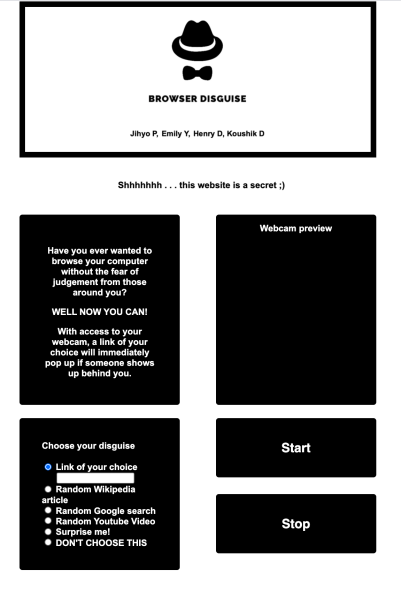
Sometimes, the people whom we live with have no sense of privacy. Especially now with quarantine, we cannot even enjoy the deepest and darkest corners of the internet without the fear of someone else barging in. That’s why we came up with Browser Disguise. Through the usage of AI, as soon as the computer detects someone walking into your room, a website of your choice will pop up and block anything that you were previously browsing. You can choose from a variety of possibilities such as a randomized Wikipedia article or a specific link of your choice.
How we built it
After being granted access to the user’s webcam, the hack starts taking pictures continuously and predicts whether or not there is a person behind the user: returning a number between 0 and 1, 0 meaning there is no one behind the user and 1 meaning that there is a person. We achieved this by adopting code from Google’s Teachable Machine which simplified the entire process. We each manually made a dataset to feed and teach this machine. Using this API, we were able to take pictures, predict, and even display a webcam preview on our website. Overall, we programmed the code by using HTML, CSS and JavaScript.
Challenges we ran into
We were inexperienced with using HTML and CSS, encountered some formatting issues with the website, and were originally using Python but had to completely change plans
Accomplishments that we're proud of
It works! and we learned/persevered a lot
What we learned
How to use HTML and CSS, how to integrate Google Teachable Machine
What's next for Browser Disguise
Tweaking out the issues, making Chrome Extension, adding more links and fun options
Built With
- css
- google-teachable-machine
- html
- javascript
- tensorflow

Log in or sign up for Devpost to join the conversation.