-
-
FoodVisionPro
Inspiration
I am a Diabetes and Endocrinology Consultant and deal with metabolic issues daily.
- Many patients struggle to track their food accurately, not because they lack motivation, but because the process is time-consuming and confusing.
- Portion sizes are often guessed wrong, leading to poor decisions despite good intentions.
- Most nutrition apps are abandoned within weeks due to friction and overwhelm.
- One moment stood out: a patient said, "I’ve tried every app. I just can’t keep up."
- That made us realize, it’s not about effort, it’s about making the experience simpler.
What it does
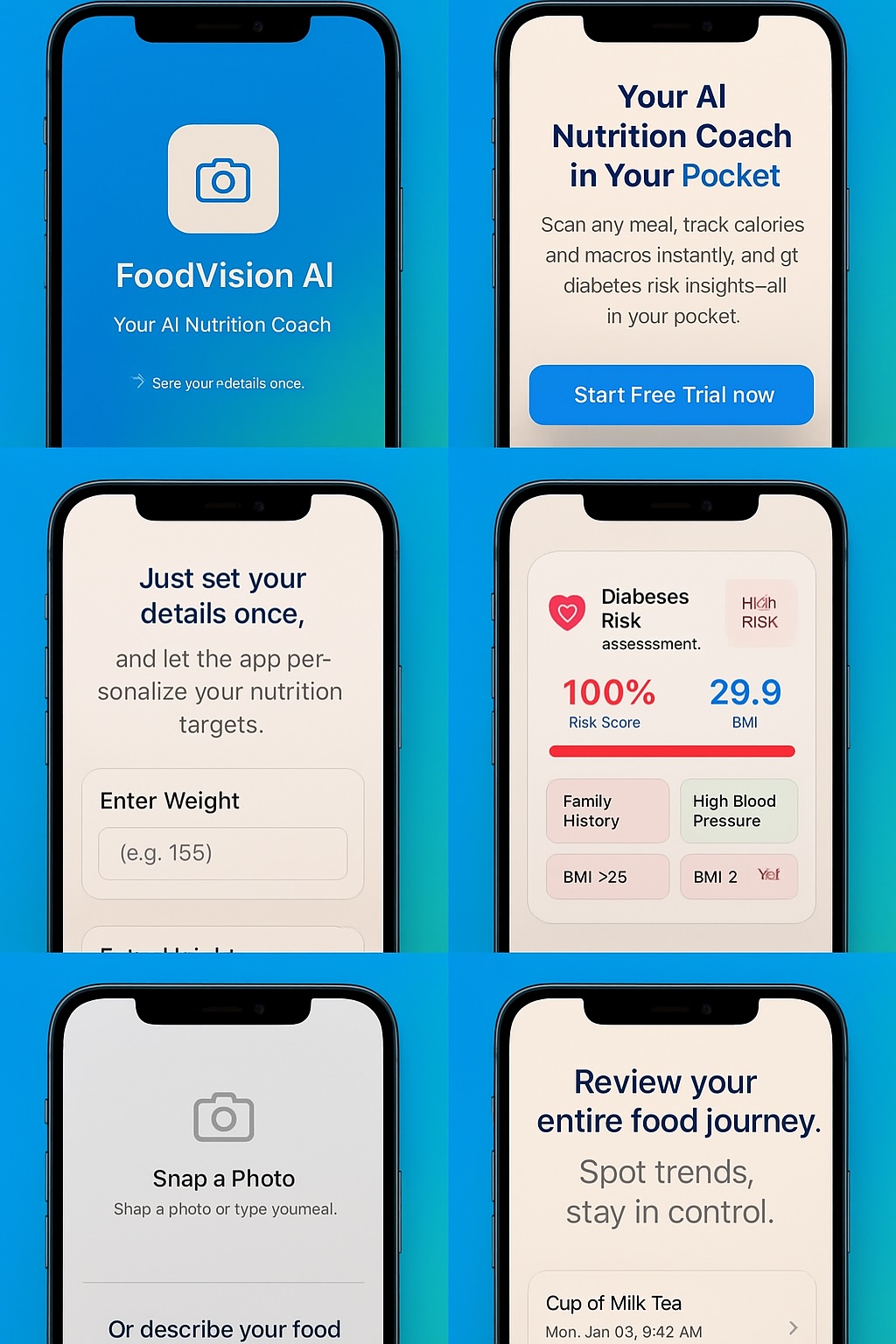
- Lets users take a photo of their meal and instantly view nutrition details.
- Uses AI to recognize food with high accuracy (85–92% for common dishes).
- Provides real-time diabetes risk estimates based on the meal and user profile.
- Automatically tracks macronutrients and visualizes trends over time.
- Designed to reduce food logging time from minutes to just a few seconds.
How we built it
- Started with real patient feedback about daily tracking challenges.
- Used React Native for cross-platform mobile development (via Lovable.dev).
- Integrated OpenAI’s GPT-4 Vision API for food recognition.
- Built backend services using Supabase for authentication and data storage.
- Plan to integrate RevenueCat for managing in-app subscriptions across app stores.
Challenges we ran into
- Food recognition is challenging, especially with mixed or homemade meals.
- Balancing AI accuracy and a simple user experience took careful iteration.
- App store payment rules were more complex than expected, still a work in progress.
- Maintaining clinical value without overwhelming users required thoughtful design.
- Scaling OpenAI usage cost-effectively was a key technical concern.
Accomplishments that we're proud of
- Developed a working MVP that delivers real-time photo-to-nutrition analysis.
- Achieved fast response times of 2–3 seconds per food scan.
- Reduced meal logging time by over 95% compared to traditional methods.
- Incorporated ADA-aligned diabetes risk scoring to ensure clinical relevance.
- Built something that people genuinely enjoy using, not just another tracking app.
What we learned
- Simplicity beats feature-packed designs in health-focused apps.
- Visual, instant feedback is much more engaging than traditional logs.
- Even small barriers can cause users to give up on long-term habits.
- Confidence scoring helps build trust in AI-powered decisions.
- You can blend AI with medical insights in a way that feels approachable, not overwhelming. ## What's next for FoodVision Pro
- Launching the free version on iOS and Android to gather real-world feedback.
- Running pilot programs to validate usability in clinical and everyday settings.
- Education & Prevention: Introduce guided programs focused on diabetes prevention and to help users build lasting habits.
- Enhance food recognition accuracy with feedback loops and ongoing training.
- Explore features like meal planning, smart grocery suggestions, and food label decoding.
- Long-term vision: global expansion and integration with healthcare systems and EMRs.
Built With
- bolt
- github
- gpt
- html5
- javascript
- openai
- supabase
- typescript

Log in or sign up for Devpost to join the conversation.