-
-
brightroots-hero
-
source-linked-guidance
-
learning-breadth
-
color-lab
-
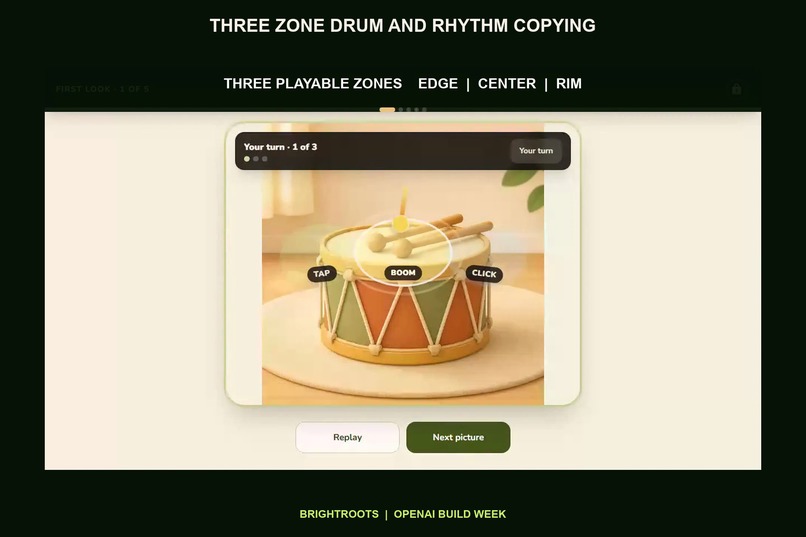
three-zone-drum
-
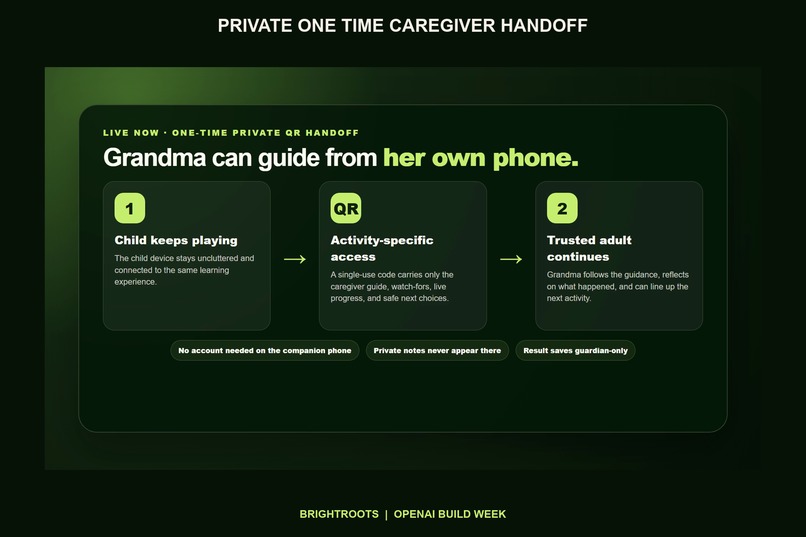
caregiver-handoff
-
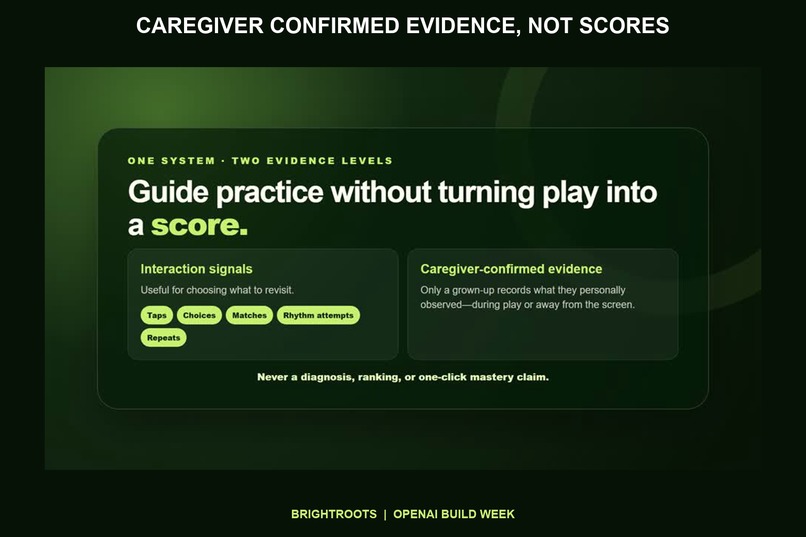
caregiver-confirmed-evidence
-
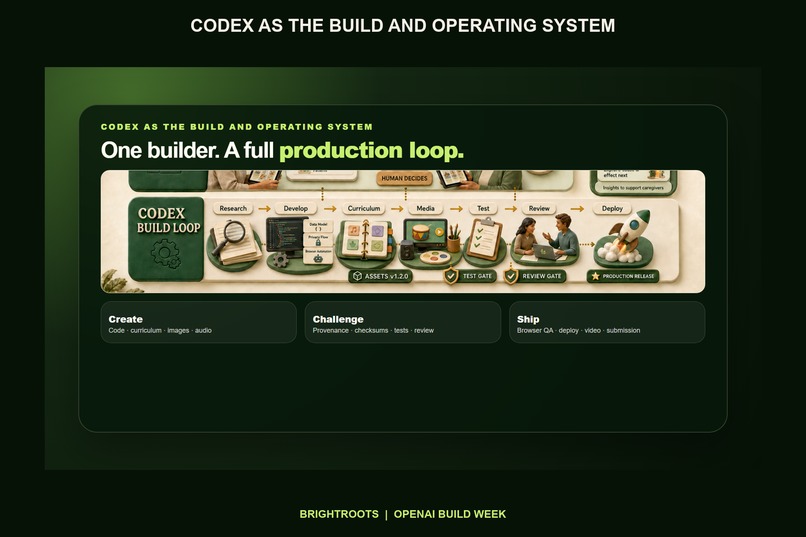
codex-production-loop
-
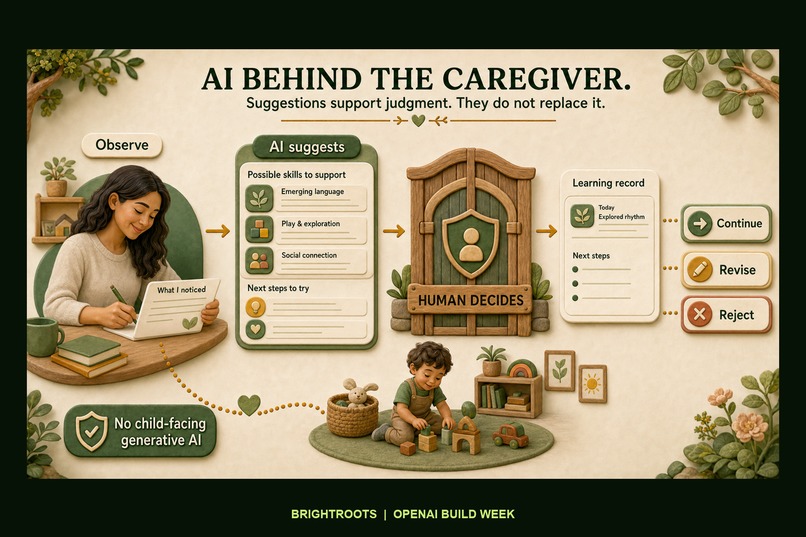
ai-behind-the-caregiver
-
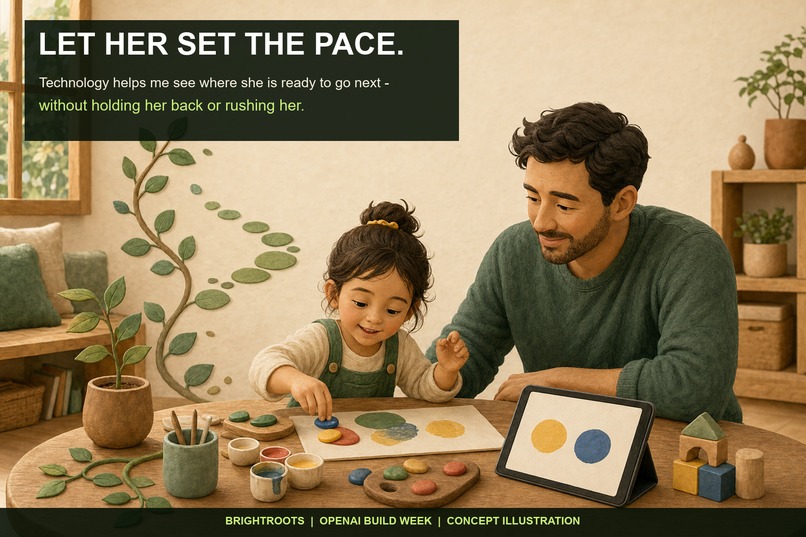
let-her-set-the-pace
-
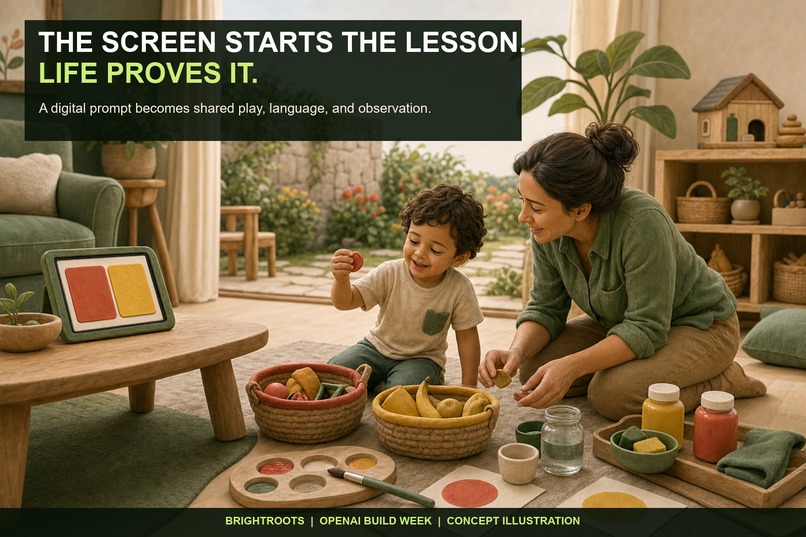
screen-starts-life-proves
-
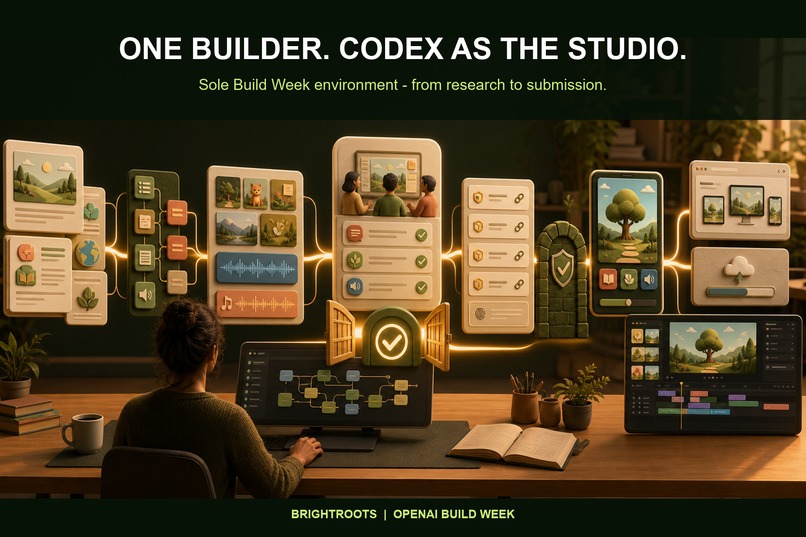
one-builder-codex-studio
-
build-week-verified
-
human-approved-gates


Inspiration
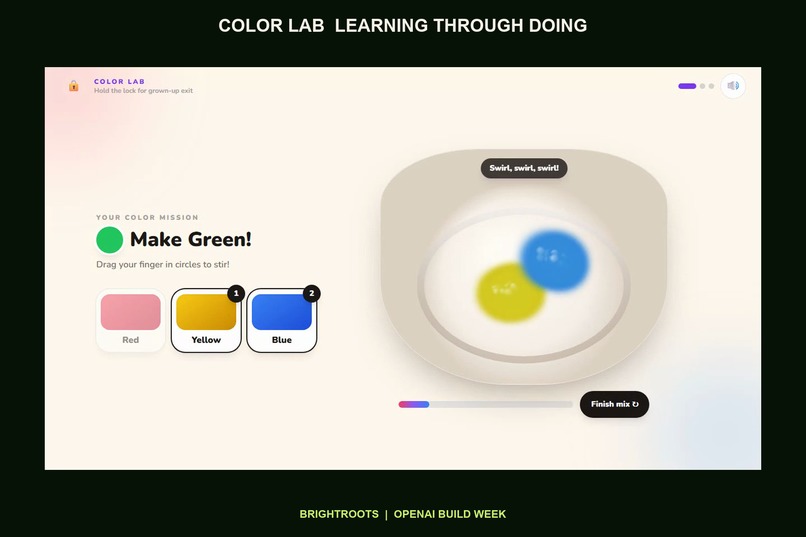
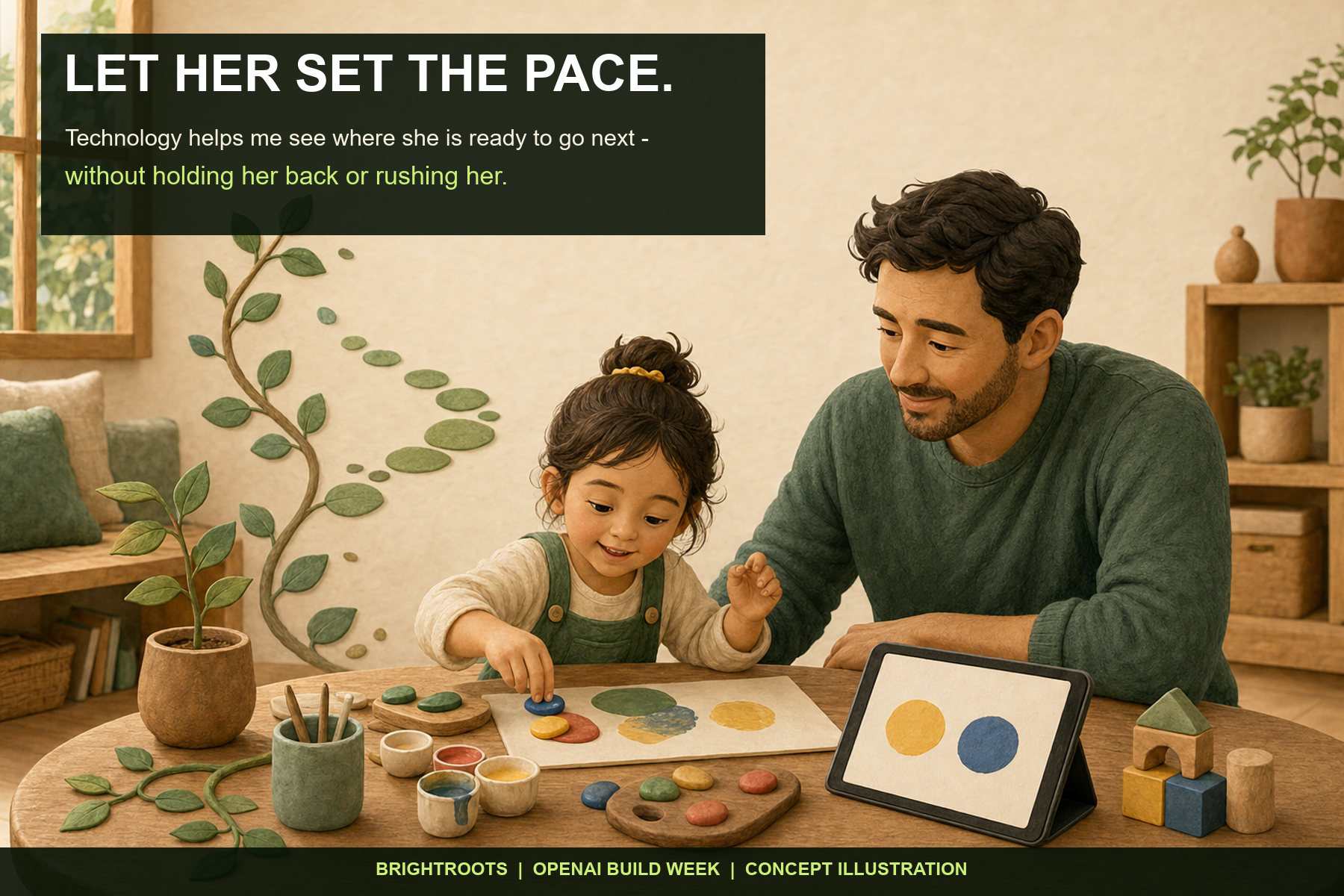
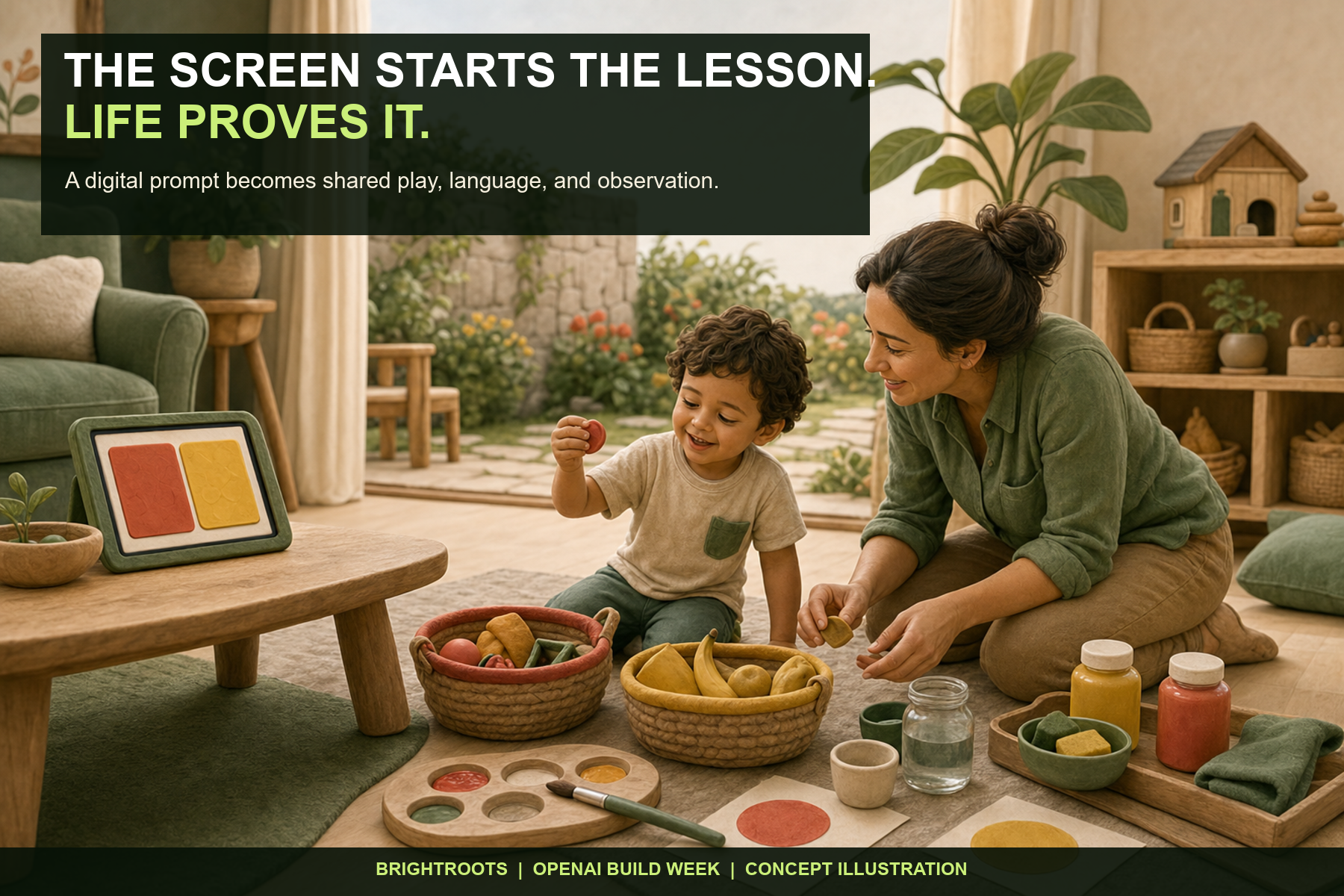
Here is the vision from our house. Our daughter picks two paints in Color Lab and stirs; the mixture answers in color and sound. The experience ends by handing her back to us with something to try away from the screen. If she later points to something purple in the kitchen, a parent—not software—decides what happened and whether to record it. The Learning Garden grows because a caregiver confirmed a real moment, not because software decided a child "knows purple."
I'm Jesse, an AI builder and dad to an almost-two-year-old, and I have been the sole human builder from the first proof of concept through this submission. The question driving BrightRoots is personal: How can I use technology to become the best teacher I can be for my daughter—letting her follow her curiosity at her own pace, within boundaries we choose, while my wife, my mom, and other trusted caregivers can pick up where we left off?
That question is why age bands are guides rather than advancement gates, why practice can respond to what a child actually does, and why caregivers retain authority over what those signals mean. BrightRoots is deepest at the 18–24 month stage my family is living now. The system represents a broader ages 1–9 path, but equally deep coverage across those ages remains future work.
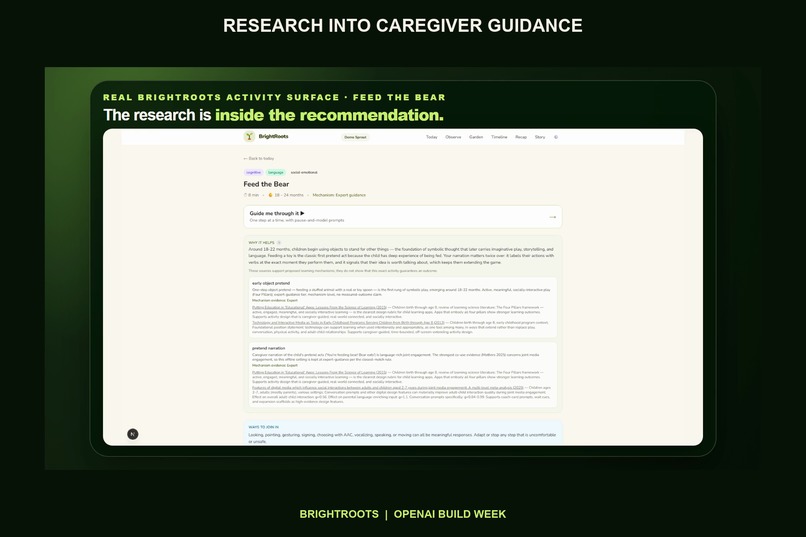
With GPT-5.6 Sol in Codex, I researched and challenged the learning design while I built it. Research on active, engaged, meaningful, and socially interactive learning shaped experiences such as Color Lab, the playable drum, and prompts that move play back into the child's world. A 2025 meta-analysis of adults and children using media together informed caregiver conversation prompts, wait cues, and language expansion, including Feed the Bear's "model once, wait, narrate" sequence. NAEYC/Fred Rogers Center guidance reinforced short, bounded experiences that extend—not replace—movement, conversation, play, and relationships.
Those sources support design mechanisms and caregiver recommendations. They do not yet prove a BrightRoots learning outcome. My family's use, including Color Lab with my daughter, is informal dogfooding—not a controlled study.
What it does
BrightRoots connects two ways to learn:
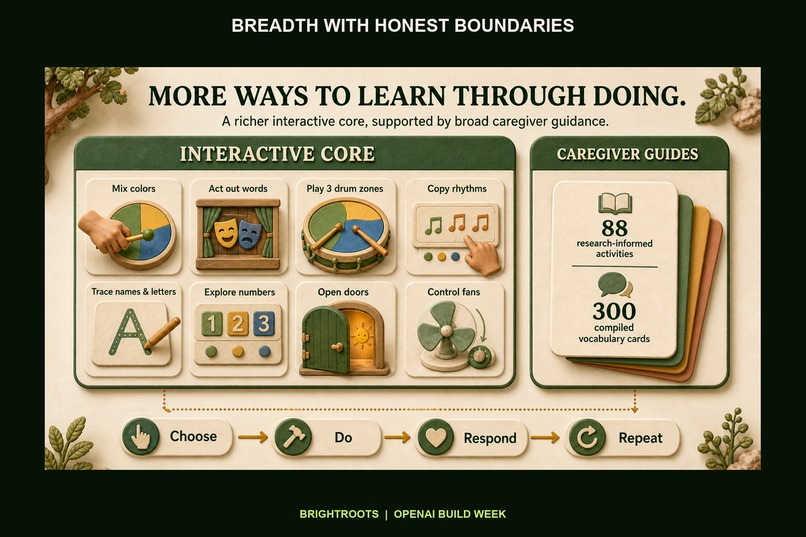
- Learn together offers 88 structured, research-informed activity guides for caregivers and children. These are not 88 games; they turn ordinary objects, movement, conversation, and play into short learning opportunities.
- Child leads offers a smaller, richer interactive core. Children can pour
and stir colors, act out words, operate doors and fans, trace names and
letters, explore numbers, and play a real three-zone drum. Copy a Beat judges
the proportions between taps, with a
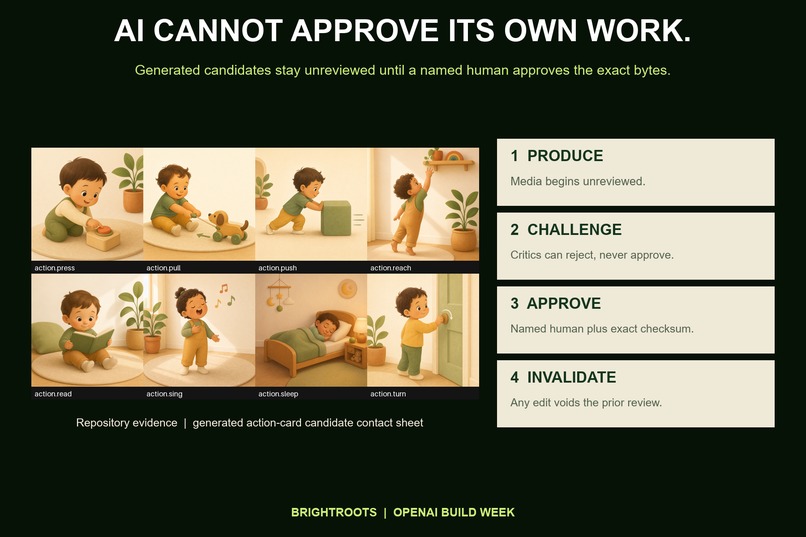
0.55–1.8xtempo allowance, so a slower but proportional toddler response can succeed. - A deterministic preview compiles 300 checksum-validated vocabulary cards from 17 families plus four catalog experiences. It demonstrates breadth and governed production—not a finished 300-card game. Every item is visibly labeled unreviewed and cannot be promoted without named human approval.
The compiled catalog has primary, secondary, and prompt-speech files for all 300 cards, but file coverage is not approval. Audio quality, language, and sensory review remain incomplete; authentic-effect coverage is partial; and 190 cards currently have preview challenge authoring. Those distractors and the broader child answer space have not yet been comprehensively evaluated. Child-facing content is authored or pre-generated; no generative model speaks to a child at runtime.
Families can share one device or move the caregiver role to another phone with a private, one-time QR code. A trusted adult—including a grandparent—can scan it without an account, receive only activity-specific guidance and watch-fors, follow live progress, reflect after completion, and line up a bounded next activity. The QR is scoped to that activity rather than the family's broader learning record. Private caregiver notes never appear on the companion phone, and a confirmed result saves only to the guardian's record.
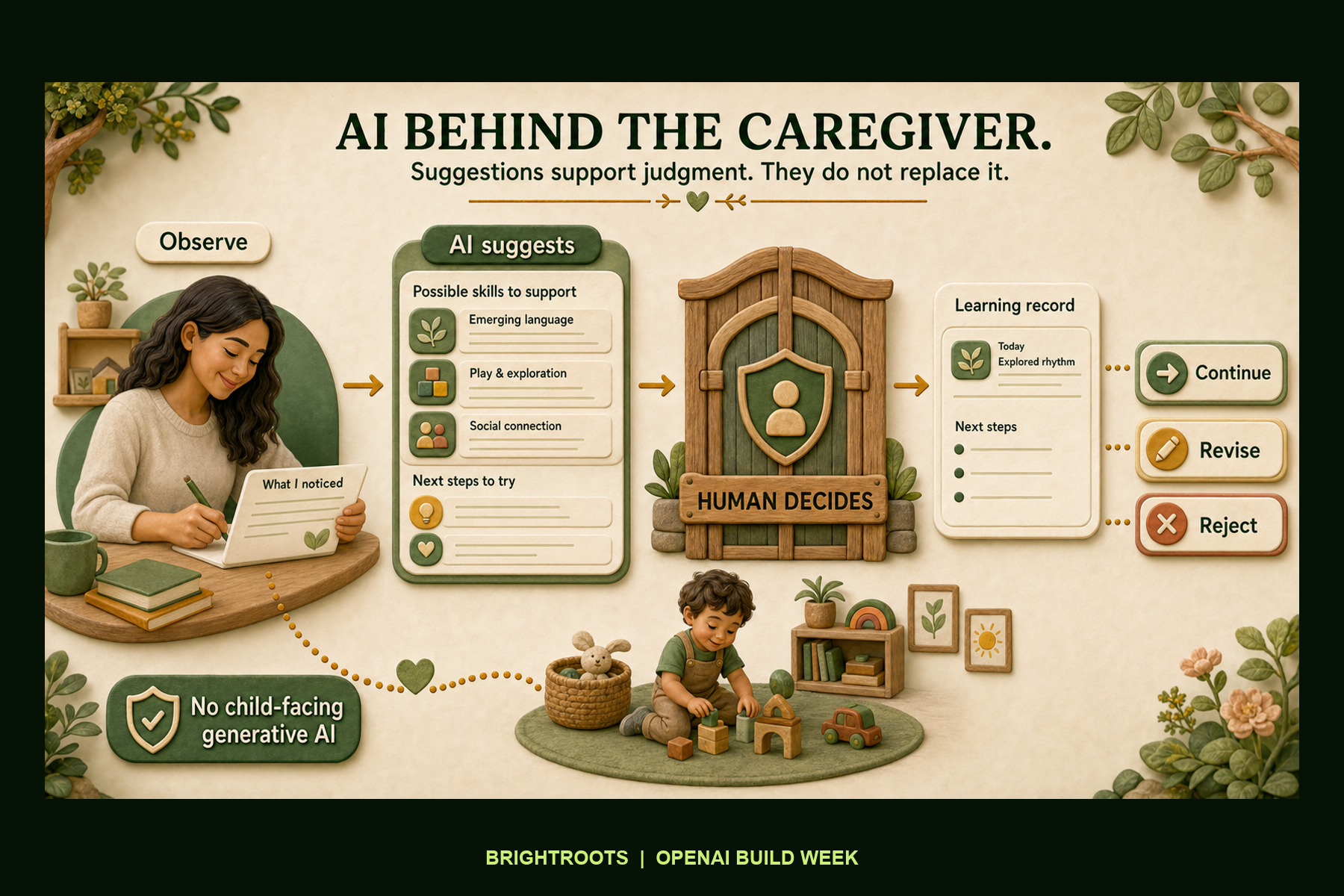
The observation assistant helps an adult capture what happened. A caregiver can select an observed behavior, record the adult response, speak or type a short note, and ask adult-facing AI to suggest possible skills or a next thing to try. Nothing is selected automatically. Only the caregiver's choices enter the descriptive record. The current judge build saves observations to Just me; household and close-family audiences are visibly disabled as Coming soon.
Interaction signals—what was selected, repeated, completed, or revisited—can shape later practice without being called proof of mastery. The Garden and its Matrix group caregiver-confirmed patterns without grades, rankings, diagnoses, or comparisons with other children. BrightRoots has no child-facing countdowns, streaks, points, leaderboards, or autoplay. Sessions are bounded, the child can stop, and an adult-only hold gate protects caregiver controls.
How we built it
Before Build Week, BrightRoots was a proof-of-concept slice I had built on my own with AI assistance: activity cards, adult observation capture, AI suggestion review, a Learning Garden, stories, and an early tap-play mode. It was not the coordinated, production-deployed system shown here. There was no team, inherited product, or production-ready platform.
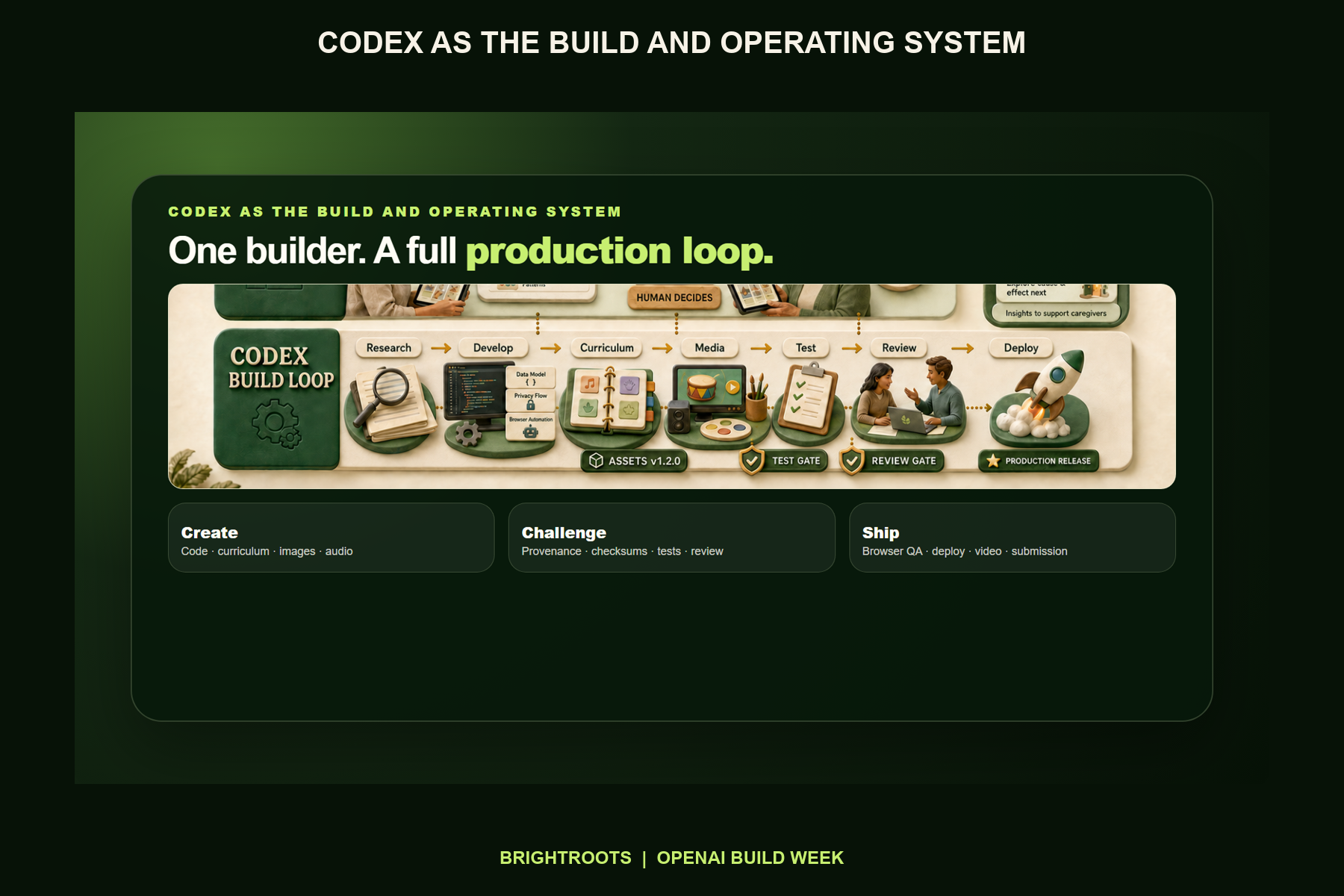
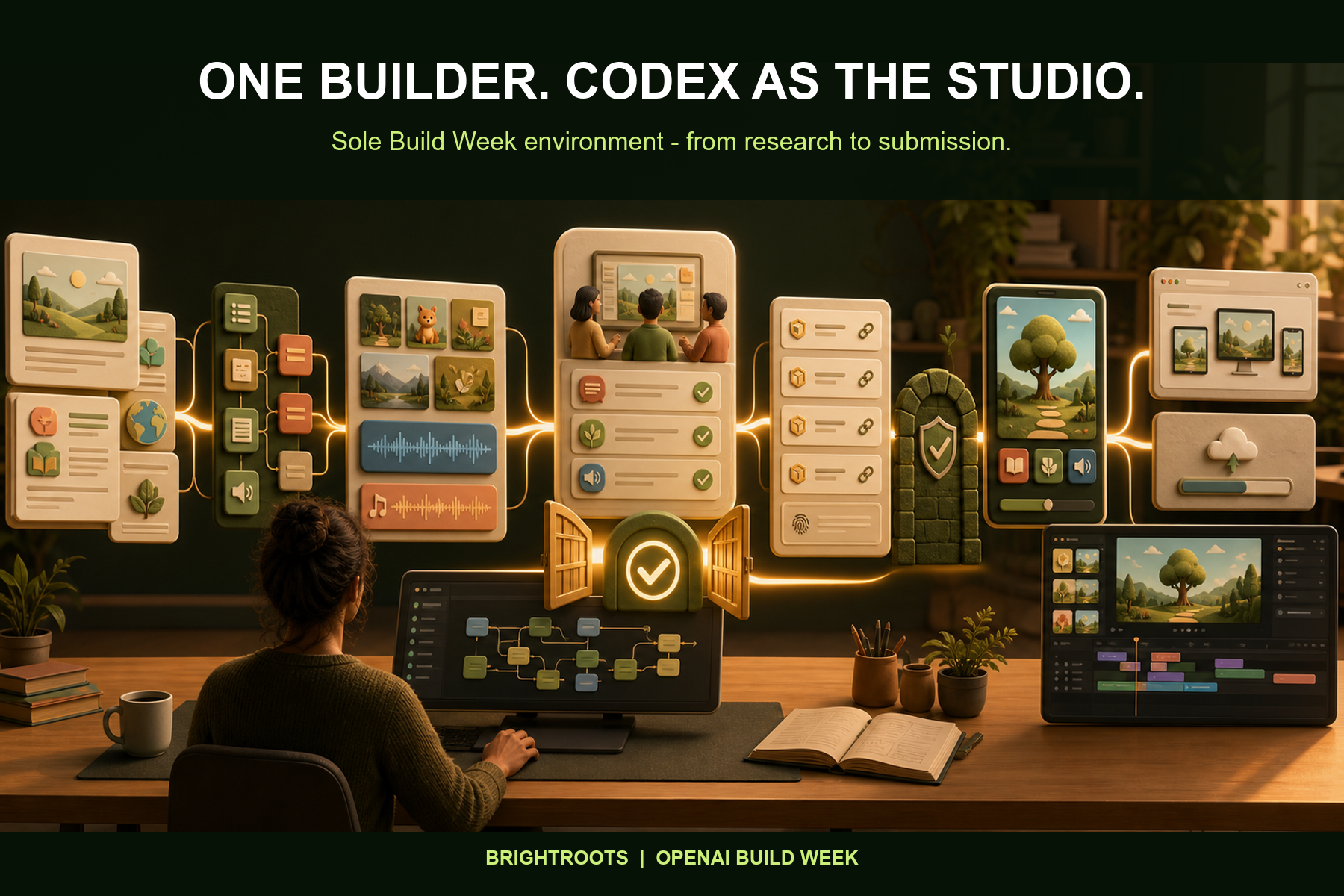
During Build Week, Codex powered by GPT-5.6 Sol became my sole development and orchestration environment. I used it to turn that proof of concept into the typed Play 2.0 runtime, adaptive session planning, distinct interaction mechanics, the live one-time caregiver handoff, the Garden/Matrix view, the governed curriculum and media factory, browser journeys, privacy checks, and the production release system around them.
The repository became durable shared memory for that work. Research maps, domain contracts, code, tests, generation plans, provenance ledgers, review packets, browser evidence, and release checks allowed one Codex task to verify and continue another's work. An agent reporting "done" was never the release condition: loops ended in rejecting validators, focused tests, browser or production evidence, and human judgment where judgment was required.
The content counts describe different layers:
- 88 caregiver-guided activity files are available in the product;
- an editorial inventory contains 301 concepts and 52 experience drafts;
- the current deterministic preview compiles 300 vocabulary cards from 17 families plus four catalog experiences.
That breadth should not be confused with 88 interactive games, a completed 300-card child experience, or equally deep curriculum across ages 1–9.
How I used Codex and GPT-5.6
Codex was not autocomplete added after the product was designed. It was the development and orchestration engine for the Build Week transformation:
- Task orchestration: The primary Codex task maintained whole-product context, the evolving plan, and trust constraints; delegated bounded research, architecture, implementation, media, critic, and QA work to specialist tasks; reconciled their findings; and used the repository as durable shared memory between them.
- Architecture and product engineering: GPT-5.6 Sol inspected the POC, modeled the learning and privacy domains, and helped design and implement typed runtimes, adaptive session planning, custom interaction mechanics, session memory, caregiver workflows, data models, migrations, privacy boundaries, and deployment controls.
- Research and curriculum operations: Codex located and reviewed sources, narrowed overconfident claims, translated evidence into product constraints, prepared revision-bound accessibility drafts, built typed activity schemas, database synchronization, and a deterministic curriculum compiler, and created a review queue where GPT-5.6 can pre-assess the current lesson revision. The model can raise concerns; only a named human with a recorded role can approve it.
- Media production: Codex orchestrated GPT Image API and ElevenLabs work, generation plans, exact provider-call budgets, prompt and model provenance, checksums, multiple candidates, and independent visual/audio criticism using signal measurements, spectrograms, local Whisper, AudioSet/AST, CLAP, and child-safety rubrics. Tracked critic scopes include 78 audio takes for 39 concepts and 45 visual candidates.
- Privacy engineering: Codex built household-isolation checks, deletion drills, and an optional voice-answer capability with tap-to-start transient recognition. That capability retains neither audio nor transcript and is feature-flagged off in the current judge UI.
- QA, production, and release: Codex created deterministic validators, focused and adversarial tests, simulated acceptance-test users, browser automation and capture, real-browser journeys, PWA production-worker and household-isolation checks, production diagnosis, migration/release tooling, verified deployments, and hosted smoke evidence.
- Submission writing and video orchestration: Codex was my iterative writing partner for both the video script and this Devpost submission, helping me translate my founder intent and the repository evidence into language that stayed personal, technically specific, and appropriately qualified. It also orchestrated the video as a production workflow: scripted product capture, candidate narration and cuts, timing and selection reviews, synchronized interaction audio, captions, evidence slides, manifests, checksums, the thumbnail and YouTube upload package, and a parent-facing 90-second edit. Codex then derived long-form blog and article drafts and platform-specific social posts from the same checked narrative. The same rejecting release discipline was applied to the videos and every public claim; I made the final editorial, performance, selection, and publication decisions. The research scope and evidence map records what the sources support and what BrightRoots has not established. The Codex evidence catalog maps unusual workflow claims to exact scripts, tests, and authority boundaries.
The audit is reproducible. At final V15 source checkpoint 29970b5, 133
commits are reachable after the pre-window baseline. In a defined code-only
scope, the repository grew from 18,042 lines in 199 files to 64,012 lines in
631 files: a net increase of 45,970 lines, or 71.8% of the measured checkpoint.
The diff contains 47,978 additions and 2,008 deletions across 565 files,
including 8,362 additions in 120 changed test files. The scope includes
TypeScript, JavaScript, stylesheets, SQL, and Python; generated catalogs,
media, Markdown, and database snapshots are excluded. These figures measure
scope and timing—not model authorship.
All 60 session artifacts linked to the primary project task record
gpt-5.6-sol; 53 descendant sessions began after the official start of Build
Week. The consequential decisions stayed human: the family problem,
screen-to-world philosophy, prohibition on child-facing runtime AI, evidence
meaning, privacy defaults, non-diagnostic language, and whether generated
assets are ready for production.
Challenges we ran into
The hardest problem was making adaptation useful without allowing interaction data to impersonate developmental proof. Every useful signal invited the same question: what could this number be misread as? That led to separate concepts for interest, recognition, transfer, caregiver confirmation, and evidence provenance—and to product language that refuses to turn them into mastery.
I also migrated the application to a secure Next.js 15 release, eliminated dependency-audit findings, stabilized Windows browser testing, and diagnosed a resource-related multi-worker failure that had looked like random UI flakiness.
Accomplishments that we're proud of
The accomplishment I care about most is not technical: my daughter likes using BrightRoots, and my wife likes having it as a tool for our family. In our everyday use, our daughter is showing stronger color understanding and continuing to advance through other lessons. She is expanding her vocabulary and starting to chain words together, and BrightRoots gives us a concerted way to support that progress. I am excited to give her a head start in writing soon through low-pressure letter and name play, at her pace. This is meaningful family dogfooding—not a controlled study or a claim that the product caused every step—but it is the clearest reason this project matters to me.
The largest technical accomplishment is not any single screen. During Build Week, I turned my small AI-assisted proof of concept into a live, testable child-caregiver learning system, using GPT-5.6 Sol in Codex as my sole development and orchestration environment.
- A complete learning loop, not a collection of mini-games. A caregiver chooses a path; the child acts; the experience responds; conservative signals can shape later practice; an adult supplies context; and only a caregiver-confirmed observation reaches the descriptive Garden and Matrix. Nothing grades, ranks, diagnoses, or declares the child "mastered."
- Interaction depth that would have been impractical for me to hand-code alone at this breadth. BrightRoots combines 88 caregiver-guided activities across eight learning domains with a 300-card, 17-family vocabulary preview and purpose-built child interactions: pouring and stirring colors, a real three-zone drum with proportional rhythm copying, gestures, comparisons, action sequences, letter and name tracing, touch counting, doors, and fan controls. The product does not disguise one repeated card template as that breadth.
- Parents and trusted caregivers can teach together. Source-linked guidance, teaching moves, watch-fors, adaptations, and off-screen extensions keep the adult inside the experience. A co-parent or grandparent can move the guide to their own phone through the private QR handoff, follow live progress, and reflect afterward. The handoff includes only what that activity needs, not private notes or the broader learning record.
- AI helps the adults without becoming the child's teacher or judge. It can structure a caregiver's observation draft, surface relevant guidance, and suggest a bounded next activity. Child-facing experiences remain authored or pre-generated, and the caregiver controls the teaching choice, interpretation, record, pace, and sharing.
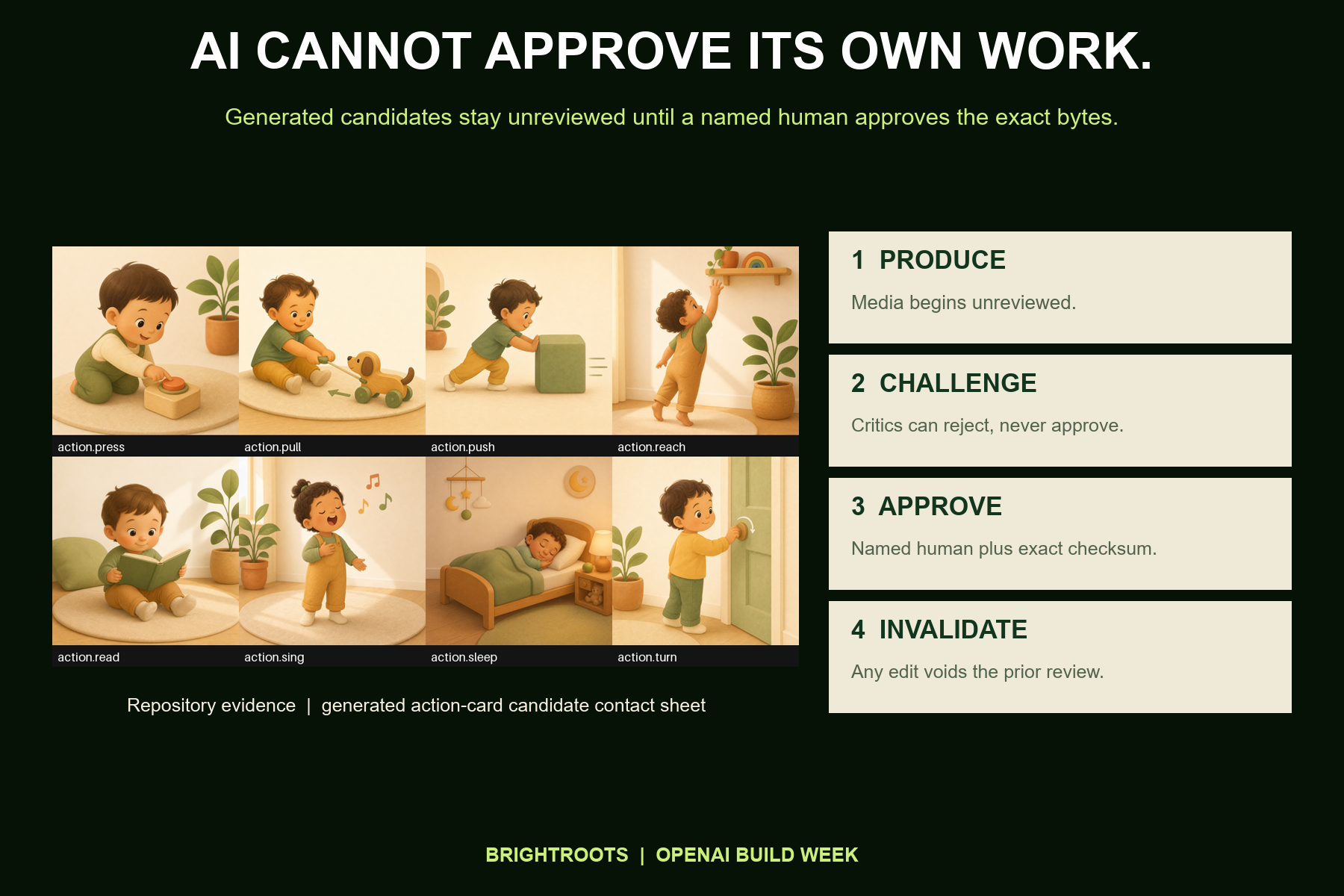
- The production system is as intentional as the visible product. Codex helped build and operate research review, typed curriculum compilation, generated-media intake, independent criticism, accessibility drafting, browser QA, deployment, and submission production. The preview pipeline validates 300 cards and exposes incomplete review coverage; generated content cannot silently acquire human approval, and edits invalidate digest- or checksum-bound decisions.
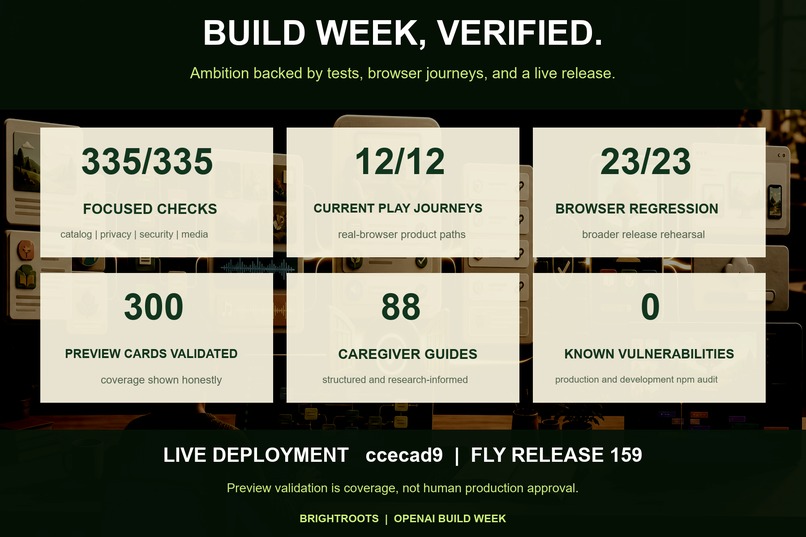
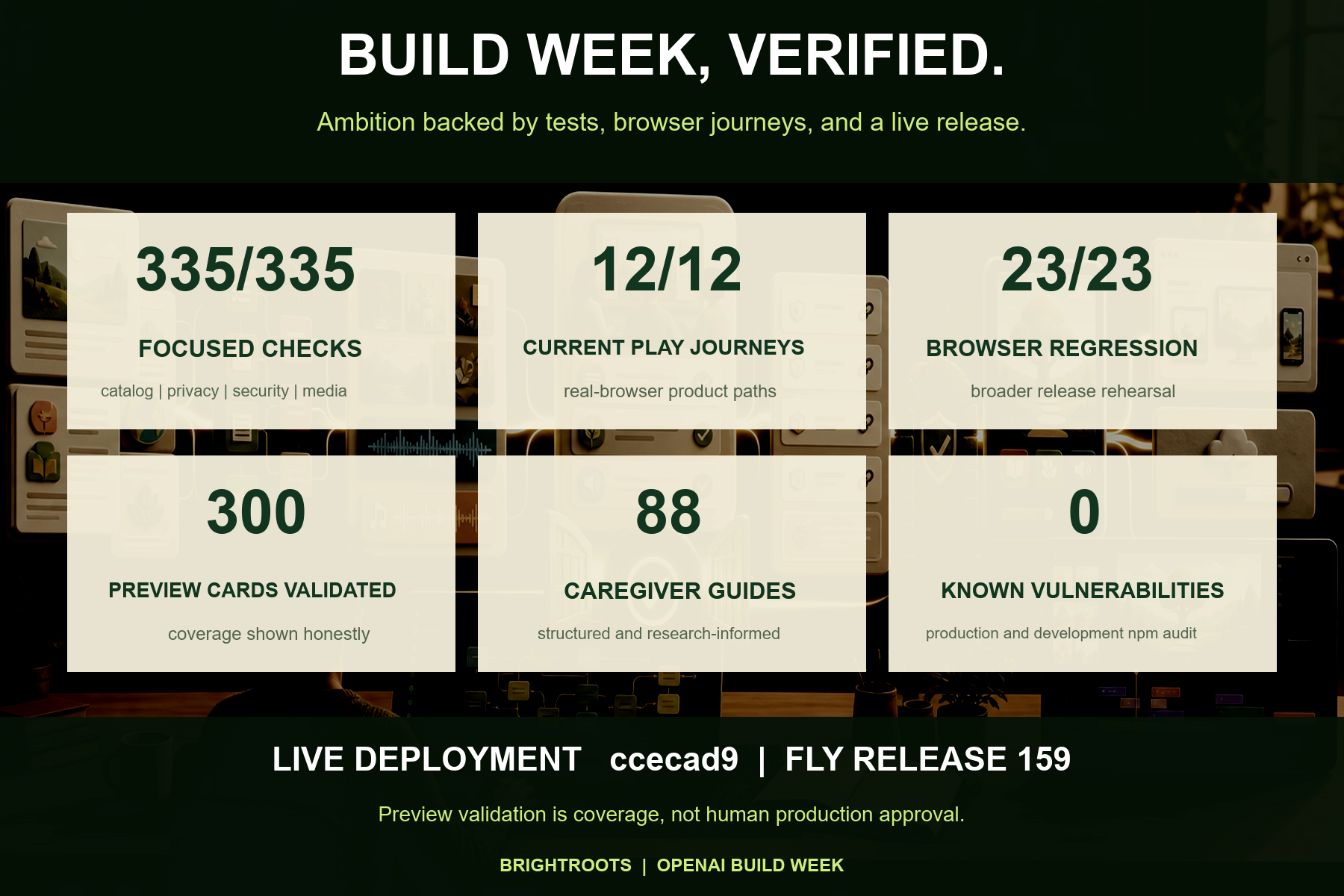
- It is deployed and tested as a real system. The final candidate passed
335 focused checks, 12/12 current Play browser journeys, and an optimized
production build. A broader rehearsal passed 23/23 browser regression
journeys and a production-worker household-isolation journey. A fresh install
reports zero known production or development dependency vulnerabilities
through
npm audit. The live deployment is verified at commitccecad9, Fly release 159. ## What we learned My goal is to use technology to help my daughter learn as deeply and efficiently as she is ready to—without me holding her back or rushing her. Build Week reinforced the importance of separating that ambition from the evidence available today. Meaningful action, adaptive revisiting, useful repetition, and caregiver collaboration are deliberate design mechanisms, but their long-term effect must be measured over time. A tap cannot prove a developmental claim. Responsive software can help inside caregiver-selected boundaries; people must still supply context and confirm any durable evidence.
I came into Build Week with extensive experience building software with AI tools and orchestrating agentic work. The new lesson was not that agents can write code or that complex work needs coordination; it was seeing how far I could take that practice with GPT-5.6 Sol in Codex as my sole development environment. Durable repository artifacts let specialist tasks carry research, architecture, implementation, media, QA, deployment, and submission work forward without losing the product's intent. Explicit authority boundaries and rejecting tests kept that speed from silently changing the rules. Codex could help me operate and continually challenge the factory; it could not open the human approval gates.
What's next for BrightRoots
First, I plan to keep improving BrightRoots for my daughter at her current age range: better content, capabilities, and interactions that help us learn together while letting her curiosity and pace lead. From there, I want to expand into more topics, richer interaction families, and broader learning needs while keeping interactive parent-child partnership at the center. If other families find BrightRoots useful and there is enough interest to support it responsibly, I may continue maintaining the public site at https://brightroots.io. Any future observation sharing beyond Just me would remain explicit, optional, and revocable, with caregivers deciding what is recorded and shared.
Built With
- auth.js
- codex
- docker
- drizzle
- elevenlabs
- fly.io
- gpt-5.6
- gpt-image-api
- next.js
- node.js
- playwright
- postgresql
- pwa
- react
- tailwind
- typescript
- webaudioapi
- zod

Log in or sign up for Devpost to join the conversation.