-
-
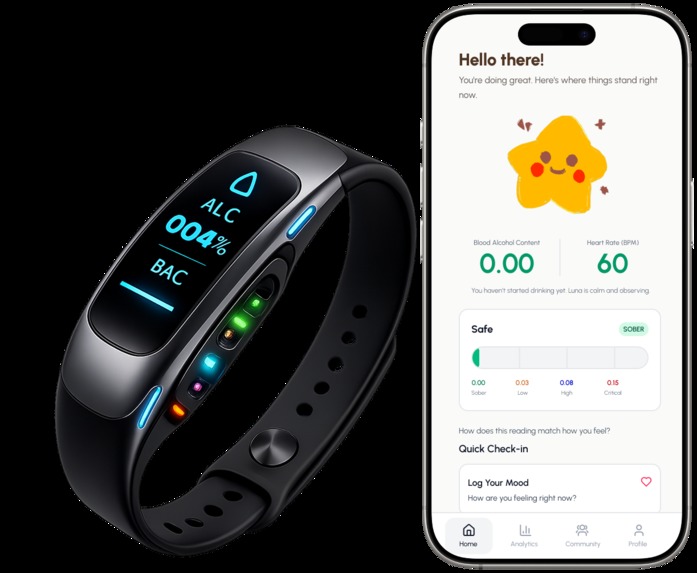
BrightPath: Your AI-powered journey to mindful drinking — with Luna.
-

Meet Luna, our AI companion here to help you with your journey to recovery.
-

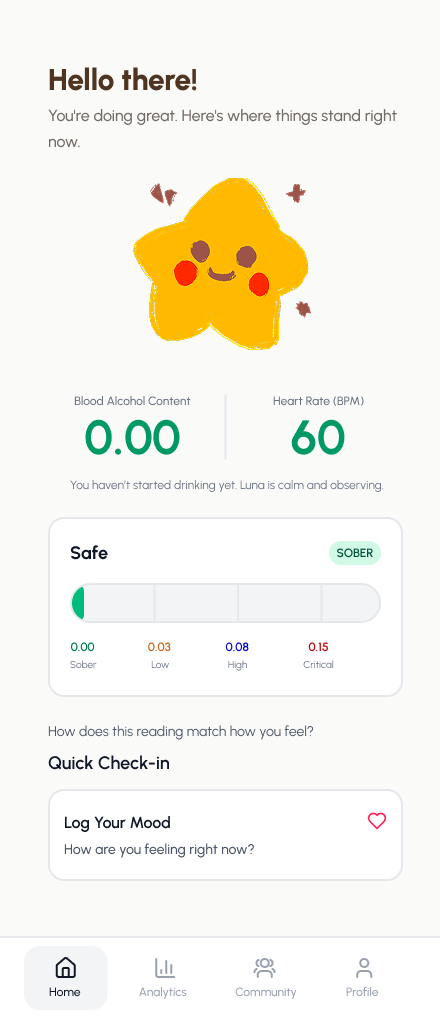
Luna has four emotional states: • Yellow: Happy (safe) • Orange: Alert (BAC rising) • Blue: Concerned (slow down) • Red: Critical (high BAC)
-
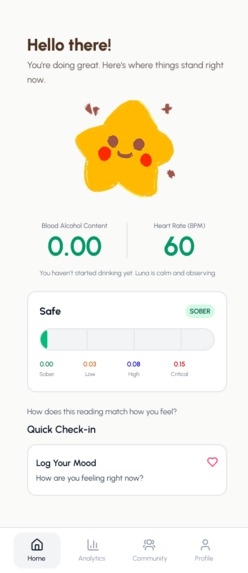
The home screen shows the user’s current state. Luna reflects alcohol levels while the bracelet provides real time health data.
-
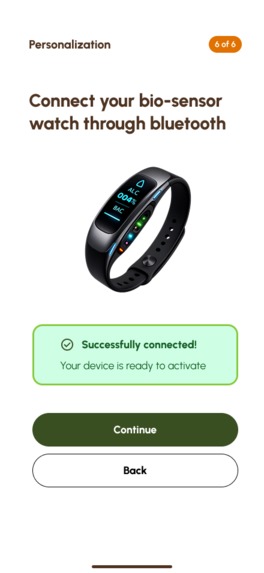
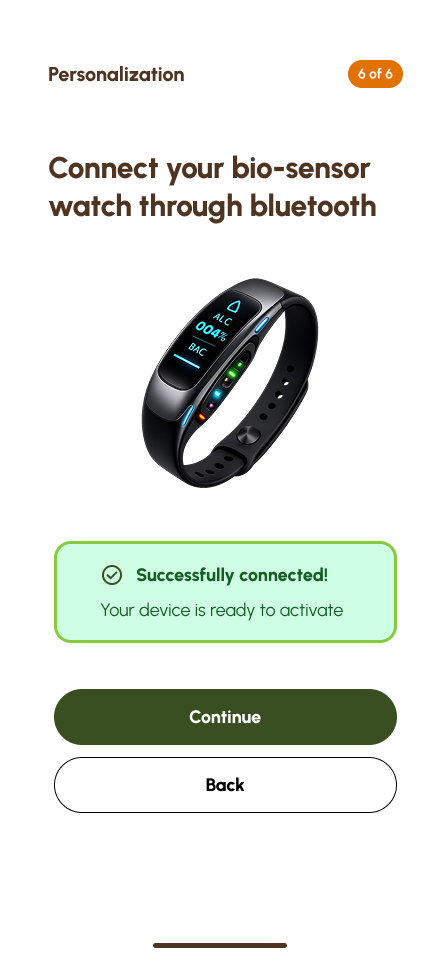
Allows users to connect the biosensor watch via Bluetooth to start monitoring blood alcohol content levels (BAC) and health data.


Inspiration
Many people do not realize how much they have had to drink until it is already too late. In the United States, excessive alcohol use contributes to over 140,000 deaths each year, making it one of the leading preventable causes of death (Centers for Disease Control and Prevention, 2023). Despite this, most tools for tracking alcohol rely on manual input or only address harm after it has already occurred.
BrightPath was inspired by the idea that health information often exists in forms that are difficult for people to perceive or interpret. Alcohol levels in the body are normally invisible until they affect behavior or wellbeing. Our goal was to design a tool that translates this hidden information into something people can sense and understand in the moment.
By combining a biosensor bracelet with an AI companion named Luna, BrightPath helps make the invisible signals of the body visible, emotional, and actionable.
Who is it for?
BrightPath is designed for working professionals who want a more mindful relationship with alcohol. It supports adults ages 21–45 who frequently attend social events, networking gatherings, or after-work outings where alcohol is present. Work-related stress and long workdays often influence drinking habits, and many professionals lack real-time awareness of how alcohol is affecting their bodies. BrightPath helps users recognize these patterns while supporting safer, more intentional choices through wearable and mobile health tracking.
What users can perceive now that they could not before
BrightPath focuses on a sensory experience connected to interoception, the body’s ability to sense what is happening internally. Interoception is one of the many human senses beyond the traditional five, and it helps people understand signals coming from their own body.
Alcohol levels in the bloodstream are normally invisible and difficult to estimate accurately. Most people rely on guesswork or delayed physical cues to understand how alcohol is affecting them. BrightPath makes those internal signals easier to notice.
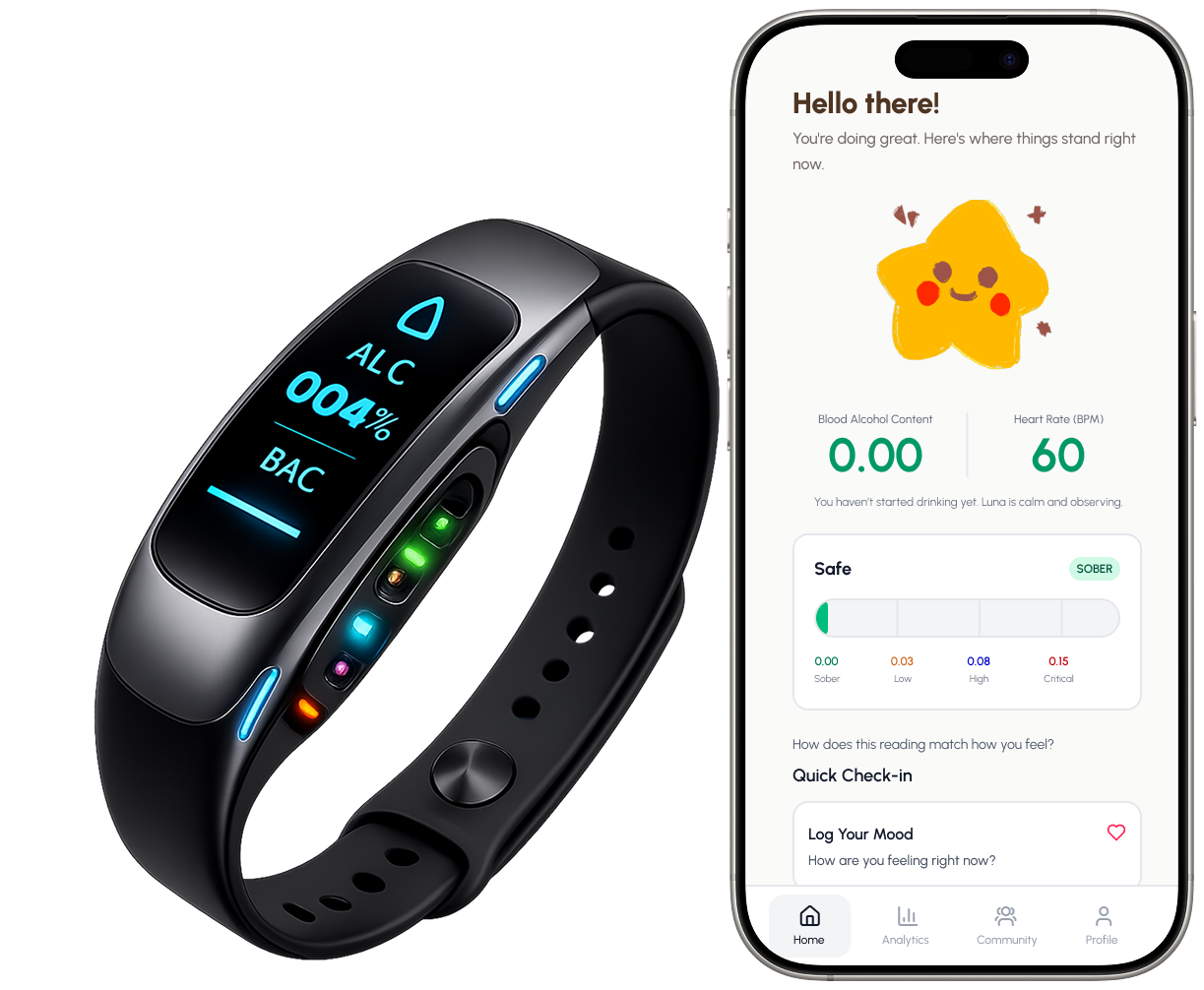
The non-invasive biosensor device measures alcohol levels through the skin and sends that information to the app, where Luna reflects the user’s current state. At the same time, the bracelet provides subtle vibrations that gently notify the user when their alcohol level begins to rise. If levels continue increasing, the vibrations become slightly stronger or more frequent. This allows users to become aware of changes in their body even if they are not looking at their phone.
Together, Luna’s expressions and the bracelet’s vibrations turn hidden body signals into something users can see and feel in real time, helping them better understand their limits and make more mindful decisions.
Target wellness goal
The primary goal of BrightPath is to encourage mindful drinking and safer decision making. The tool helps users become aware of how alcohol affects their body before reaching harmful levels.
BrightPath addresses several dimensions of wellness. It supports physical wellbeing by helping users avoid dangerous alcohol levels. It supports emotional wellbeing by encouraging reflection and awareness. It also supports social wellbeing by connecting users with trusted contacts or community support when needed. The overall behavioral goal is to help users pause, reflect, and make informed decisions about their alcohol consumption.
What it does
BrightPath is a mobile app connected to a biosensor device that detects alcohol levels through the skin. The device continuously sends data to the mobile app.
Inside the app, Luna acts as an AI companion that visualizes the user’s current state. Luna’s mood changes depending on the detected alcohol level. When levels are low, Luna appears calm and encouraging. As levels rise, Luna becomes more concerned and suggests slowing down or drinking water. When levels reach a critical threshold, Luna encourages the user to reach out to trusted contacts or community support.
This system transforms physiological data into a simple and intuitive experience that users can understand at a glance.
How it works in everyday life
Use Case 1: Social gathering A user is out with friends at a bar. Instead of manually tracking drinks, the biosensor bracelet measures alcohol levels continuously. The user glances at the BrightPath app and sees Luna’s mood shift from calm to slightly concerned. Luna suggests drinking water or taking a break, helping the user stay within a safe range.
Use Case 2: Personal reflection A user reviewing their evening opens the BrightPath app and sees how Luna’s mood changed throughout the night. This helps them reflect on their drinking patterns, look at resources, and better understand their limits.
Use Case 3: Critical moment after a fall After a social event or game, a user drinks too much and returns home. Their alcohol level reaches a critical threshold and the bracelet detects a fall and lack of movement. If the user does not respond, Luna enters an emergency state and BrightPath activates safety protocols, notifying trusted contacts, sharing location, and alerting nearby BrightPath users who can help while authorities are contacted if needed.
How users manage the information
BrightPath was designed to prevent information overload. Instead of presenting complex graphs or numbers, the system prioritizes emotional and visual cues. The device collects alcohol data passively so users do not need to input information manually. The mobile interface presents only the most relevant insight at any moment through Luna’s mood and short messages.
Users can explore deeper insights if they want, but the default experience focuses on clarity and simplicity. Luna’s changing expressions act as a quick visual signal that communicates the user’s current state without requiring constant attention.
Safeguards and responsibility
Providing new forms of perception requires thoughtful safeguards. BrightPath includes several design considerations to protect users. The system prioritizes user privacy and allows users to control how their data is stored or shared. Emergency contact features require explicit user consent during setup. Location sharing and notifications only occur when the user enables them.
The app also avoids shaming or judgmental messaging. Luna’s responses are designed to feel supportive rather than punitive. In critical situations, the system focuses on connecting users with trusted contacts or community support rather than forcing automatic interventions.These safeguards help ensure the technology remains supportive, respectful, and safe.
How we built it
We used Figma and Figma Make to design and prototype the BrightPath app, focusing on a simple and supportive experience centered around Luna. We also used ChatGPT and Google Gemini to conceptualize and generate the non-invasive biosensor device. Together, these tools helped us design how the device, AI companion, Luna, and the mobile app work together through real time data, vibrations, and safety alerts.
Challenges we ran into
One challenge was translating complex alcohol data into something that feels supportive and easy to understand rather than overwhelming or judgmental. We wanted users to feel guided by Luna instead of monitored.
Accomplishments that we are proud of
We are proud that BrightPath turns something complex like alcohol monitoring into an experience that feels human and supportive. By translating biosensor data into Luna’s emotional states, the system makes internal body signals easier to perceive and understand.
The combination of wearable sensing, AI companionship, and thoughtful interface design creates a tool that feels approachable rather than clinical.
What we learned
This project showed us that health technology works best when it communicates information in ways that people can intuitively understand. Data alone rarely changes behavior. Clear feedback, emotional signals, and supportive guidance can help people reflect on their habits and make better choices. We also learned how wearable technology, AI, and interface design can work together to create new forms of sensory awareness.
What's next for BrightPath
In the future we would like to explore deeper integration with wearable biosensors so alcohol levels can be measured more continuously and accurately. We would also expand Luna’s AI capabilities so the system can provide personalized insights about drinking patterns over time.
We are also interested in partnering with health experts and wellness professionals to ensure BrightPath offers evidence based guidance and resources.
BrightPath could evolve into a broader wellness platform that helps people better understand their internal body signals, stay connected to supportive communities, and develop healthier relationships with alcoho
Built With
- chatgpt
- figma
- figmamake
- gemini


Log in or sign up for Devpost to join the conversation.