BriefMe: Your AI Chief of Staff for Meeting Prep
Elevator Pitch BriefMe is your autonomous AI research agent. It scrapes the web, synthesizes deep insights, and generates strategic briefings to help you master every meeting.
 Inspiration
We've all been there—scrambling five minutes before a crucial meeting, trying to look up the person's LinkedIn, scan their company's latest news, and figure out a decent icebreaker. Thorough research takes hours, but in a fast-paced world, we often only have minutes. We asked ourselves: What if you had an AI Chief of Staff who could do the deep dive for you?
We wanted to build a tool that doesn't just "summarize" data but actually researches like a human analyst—browsing profiles, connecting dots between disparate sources, and even helping you practice the conversation beforehand.
 What it does
BriefMe is an autonomous research and briefing agent that automates the entire pre-meeting workflow.
- Deep Research: Autonomous agents browse LinkedIn, Twitter, and company websites to gather comprehensive intelligence on people and organizations.
- Adaptive Synthesis: It doesn't just dump data; it synthesizes raw information into structured insights, identifying key themes, shared interests, and strategic talking points.
- Scenario Fabrication: It helps you practice. BriefMe generates mock conversations, likely objections, and simulates the meeting so you can rehearse your pitch.
- Compliance Guardrails: It analyzes past call transcripts (via ElevenLabs and Claude) to ensure your interactions remain compliant with regulations.
- Professional Deliverables: Generates a beautiful, downloadable PDF briefing and presents a rich interactive dashboard for immediate consumption.
 How we built it
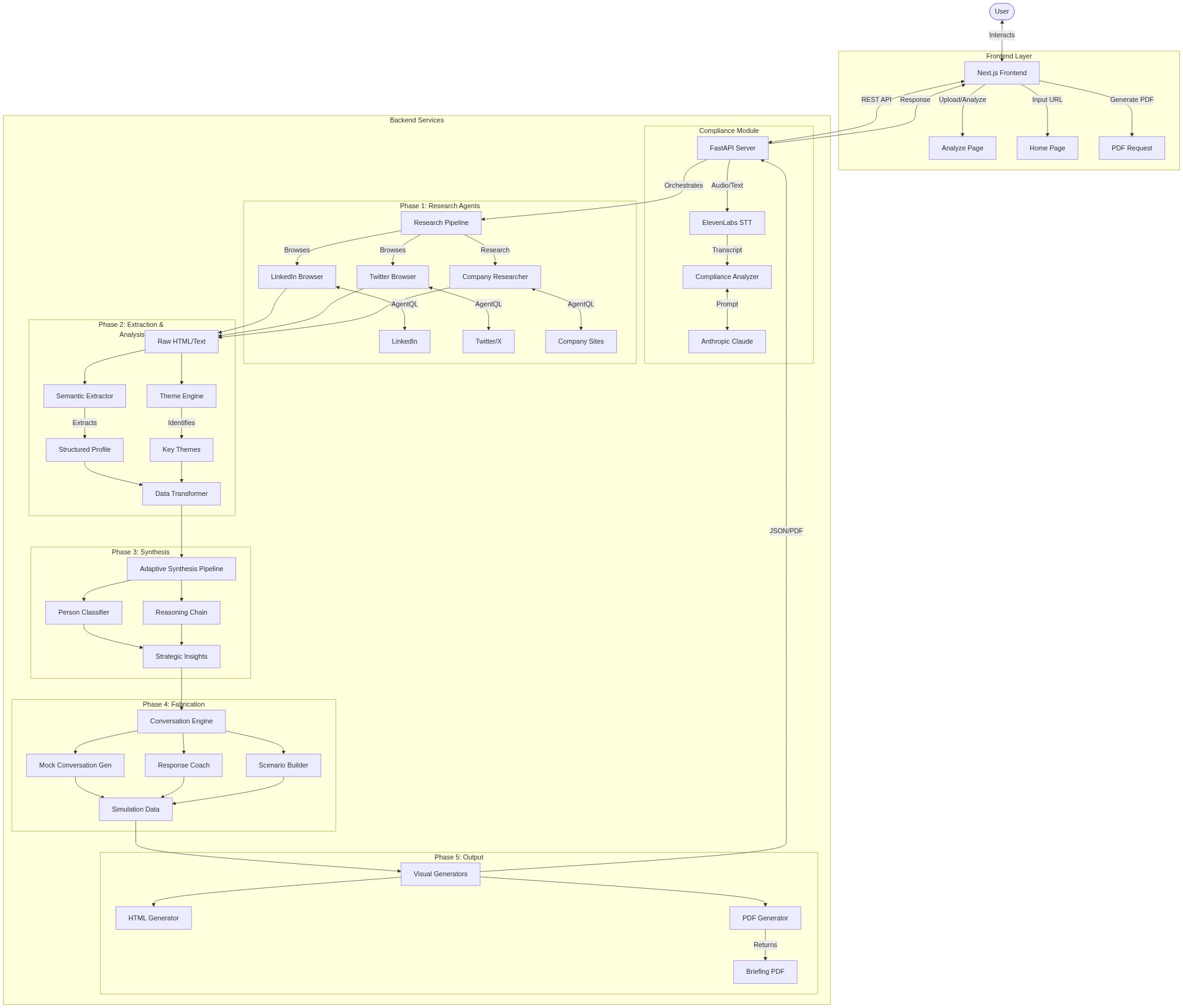
We built BriefMe using a modern, agentic architecture orchestrated by a Python FastAPI backend. Here is how we leveraged our key technologies:
 Intelligent Browsing with Yutori Navigator
We used Yutori Navigator to power our browsing agents, but we went beyond simple scraping. Instead of just visiting a URL, our agents use Yutori's decision-making capabilities to prioritize information.
- Novel Use Case: The agent doesn't just grab the last 5 posts. It analyzes engagement and content to decide which posts reveal the person's true professional identity, ignoring generic company reposts.
 Semantic Extraction with TinyFish AgentQL
Traditional selectors break whenever a website updates. We used TinyFish AgentQL to query data semantically.
- Novel Use Case: We used AgentQL's self-healing selectors to build a "Theme Engine." By querying for intent rather than just DOM elements, we could extract abstract concepts like "Passion Topics" and "Communication Style" directly from raw profile data.
 Visual Intelligence with Retool
We built our entire frontend dashboard in Retool to create a professional, interactive experience in record time.
- Novel Use Case: We implemented a "Why Panel" (Reasoning Transparency). When the AI suggests a talking point, users can click to see the exact reasoning chain and evidence source, building trust in the agent's output.
 Role-Play Simulation with Tonic Fabricate
Most people use Tonic Fabricate for test data. We used it to generate preparation scenarios.
- Novel Use Case: We feed the synthesized profile intelligence into Fabricate to generate a "Mock Conversation." The AI simulates the person you're about to meet—mimicking their tone and interests—allowing you to role-play your pitch before the actual meeting.
 Professional Output with Freepik
To make the briefing shareable, we use Freepik's API to generate a polished one-pager.
- Novel Use Case: We use Freepik to enhance profile photos and generate custom thematic icons for the PDF, turning raw text data into a visually stunning document you can take offline.
 Architecture
 Challenges we ran into
- Data Noise: The internet is noisy. Early versions of our agents grabbed too much irrelevant text. We had to refine our
extraction_outputschemas and use our custom "Theme Engines" to filter for signal over noise. - Agent Reliability: Dynamic websites change often. Traditional scraping broke constantly. Switching to an AI-powered query language (AgentQL) was a game-changer but required us to rethink how we structure our data queries.
- Pipeline Latency: Chaining multiple AI calls (Research -> Extract -> Synthesize -> Fabricate) can be slow. We had to optimize the async flows in our FastAPI backend to ensure the user wasn't waiting forever for their briefing.
 Accomplishments that we're proud of
- The "Scenario Builder": We're particularly proud of the fabrication module. Seeing the AI generate a realistic role-play script based on a person's actual tweets and LinkedIn history feels like magic.
- Seamless PDF Generation: Generating a professional-grade PDF dynamically from the analyzed data was a tricky engineering hurdle that adds immense real-world value.
- End-to-End Automation: Going from a single name or URL to a comprehensive dossier without human intervention is a massive productivity unlock.
 What we learned
- Structured Data is King: LLMs are great at text, but software needs structure. Forcing our agents to adhere to strict Pydantic models (Schemas) was crucial for building a reliable application.
- Context Windows Matter: We learned how to efficiently manage context when passing data between the researcher agents and the synthesis engine to avoid "forgetting" key details or hallucinating.
 What's next for BriefMe
- Calendar Integration: Automatically triggering research 24 hours before every meeting on your Google Calendar.
- Real-time Coaching: A live "copilot" mode that listens during the meeting and nudges you with facts or compliance warnings in real-time.
- CRM Sync: Pushing the synthesized insights directly into Salesforce or HubSpot to keep client records updated automatically.
 Try it out
Check out the source code and contribute: GitHub Repository
Built With
- agentql
- anthropic-claude
- elevenlabs
- fastapi
- fpdf2
- framer-motion
- jinja
- next.js
- playwright
- pydantic
- python
- react
- recharts
- tailwind-css
- tonic-fabricate
- typescript
- yutori

Log in or sign up for Devpost to join the conversation.