BriefGuard — Check the Brief. Prove the Result.
Inspiration
AI can generate an answer that looks impressive but still misses an important instruction. It might ignore a budget, overlook a requirement, or contradict something the user explicitly requested. Finding these mistakes manually takes time, especially when the response is long.
I wanted to explore a simple question: what if we could check an AI-generated result against the original request before trusting it?
That idea became BriefGuard, an evidence-first tool designed to make missing requirements visible and help people correct them without starting over.
What it does
BriefGuard checks whether an AI-generated response appears to satisfy the user's original brief.
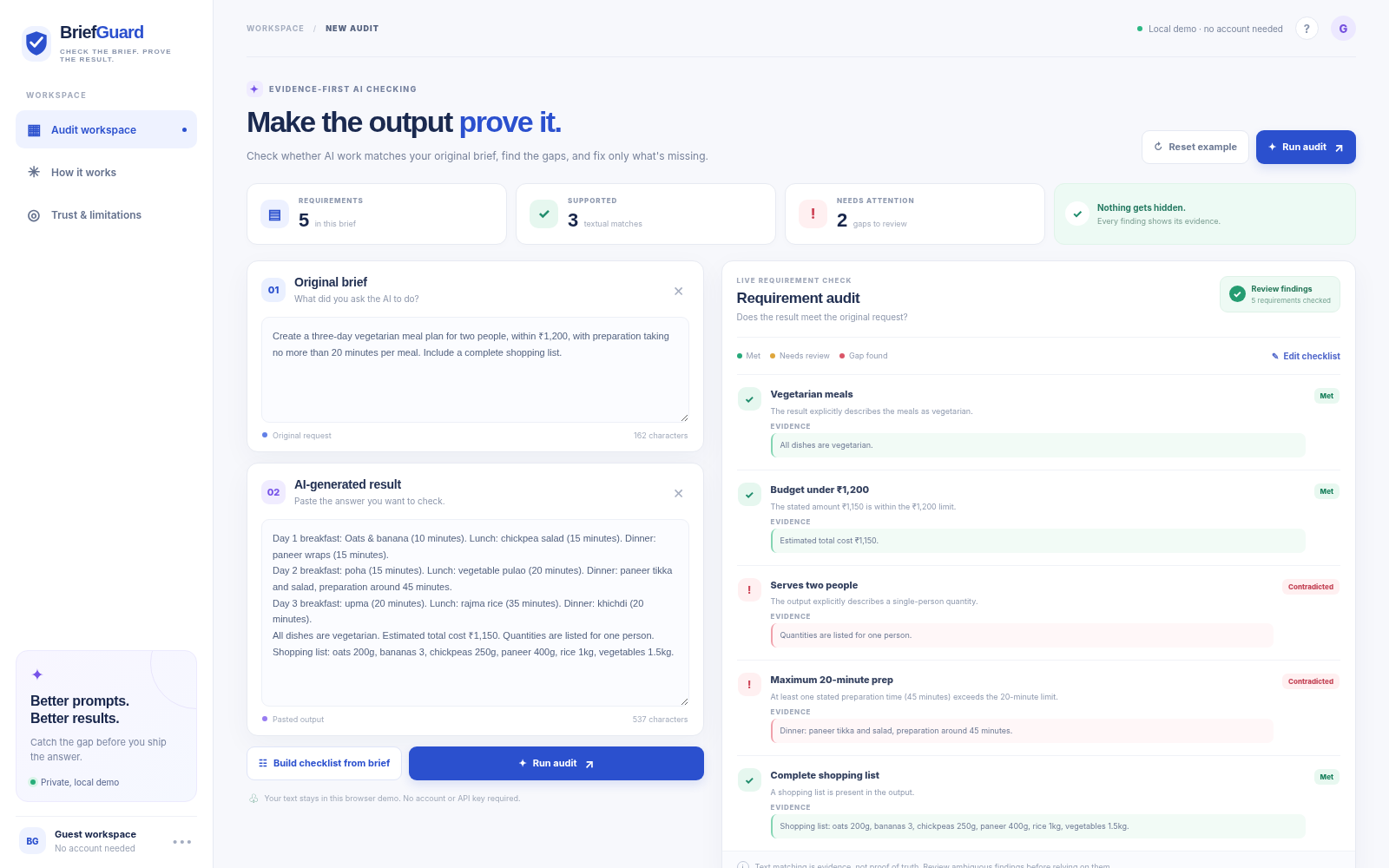
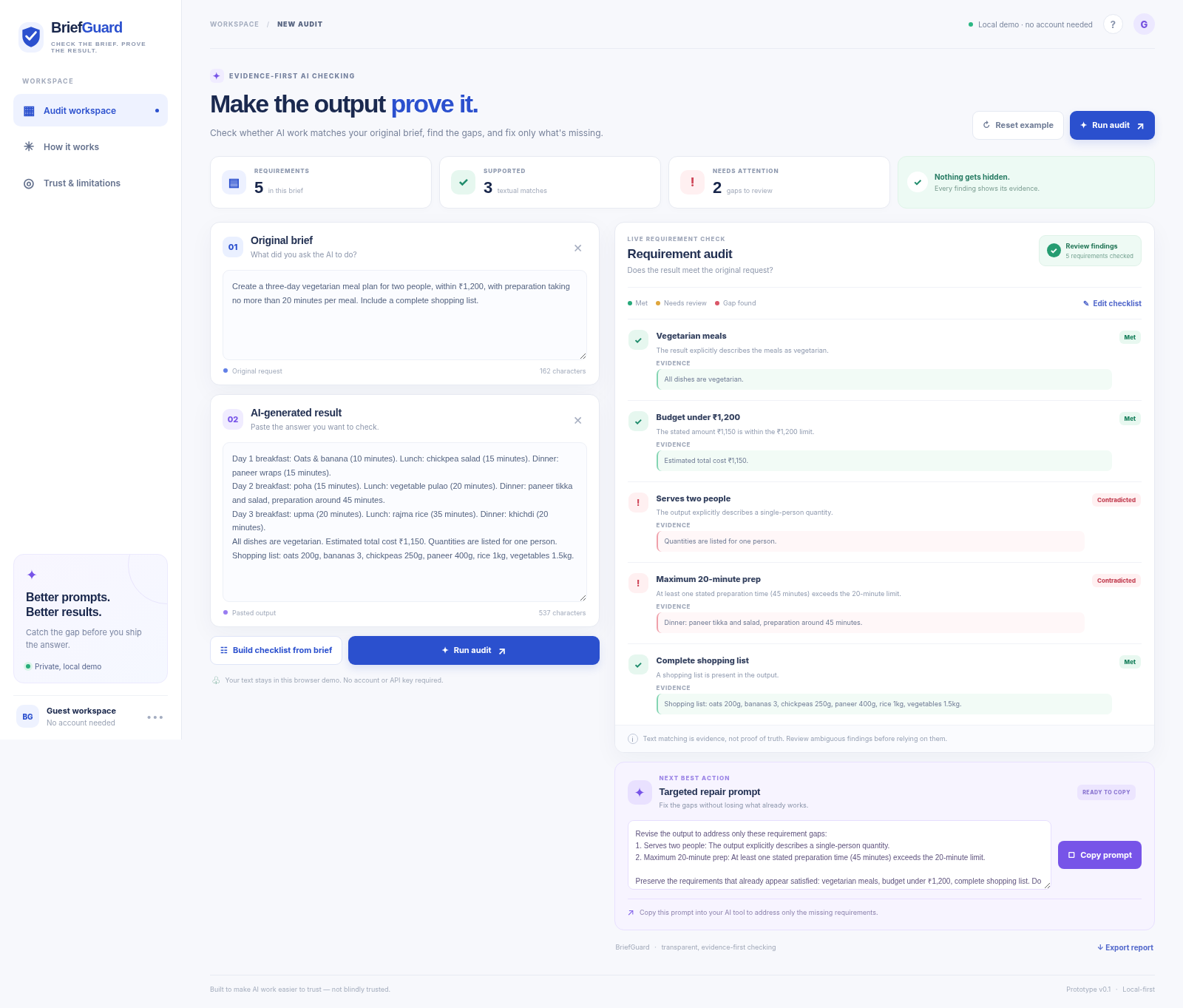
Users can paste their instructions and the AI-generated result into the app. BriefGuard turns recognizable constraints into an editable checklist and evaluates the result against those requirements.
Its key features include:
- Requirement checklist: Organizes the original instructions into individual items.
- Evidence-based audit: Shows supporting text for each finding instead of relying on a single overall score.
- Clear status labels: Identifies requirements as met, missing, contradicted, or needing review.
- Targeted repair prompts: Creates a follow-up prompt that focuses on unresolved requirements while preserving constraints that were already satisfied.
- Report export: Lets users export their audit results in Markdown format.
BriefGuard is designed for students, job seekers, freelancers, professionals, and everyday AI users who want to review generated work more systematically.
How we built it
BriefGuard is a browser-first web application built with semantic HTML, CSS, vanilla JavaScript, and a lightweight Node.js server.
The prototype runs without an account, API key, or external AI service. Users can test the complete demonstration locally, edit the brief and response, run checks, inspect evidence, generate a repair prompt, and export a report.
We chose transparent, rule-based checks for this proof of concept so that the results are repeatable and the reasoning behind each finding is visible. The interface also communicates an important limitation: detecting matching text does not prove that a statement is factually correct.
Challenges we addressed
One of the main design challenges was distinguishing a genuinely missing requirement from a contradiction or an inconclusive result.
For example, if a brief requires meals to take no more than 20 minutes to prepare, a response explicitly stating that a meal takes 45 minutes provides evidence of a contradiction. If the response never mentions preparation time, the requirement may simply be unverified.
BriefGuard uses conservative status labels and evidence excerpts to make these differences easier to inspect. Its current rule-based approach is intentionally limited and can require human review, especially for complex instructions or nuanced language.
What we learned
This prototype reinforced three important lessons about building useful AI tools:
- Make requirements explicit. Breaking a broad request into smaller checks makes omissions easier to identify.
- Show evidence, not just scores. Users should be able to inspect why a requirement received a particular status.
- Be honest about uncertainty. A text match is evidence of a match, not proof that the answer is complete or true.
The project also highlights the value of keeping an initial build focused on one complete workflow rather than adding features before the core experience works reliably.
What's next
Future improvements could include stronger semantic evaluation, more domain-specific checks, a wider set of automated tests, and optional AI-powered analysis with clear evidence and uncertainty reporting.
The long-term goal is to help people use AI more confidently without asking them to trust every generated answer blindly.
Project status
BriefGuard is a working proof of concept. Its current checks use transparent text-based rules; it does not independently fact-check claims or guarantee that every requirement has been satisfied.
Built With
- ai-assisted-development
- artificial-intelligence
- css3
- devlopment
- html5
- javascript
- node.js
- web

Log in or sign up for Devpost to join the conversation.