-
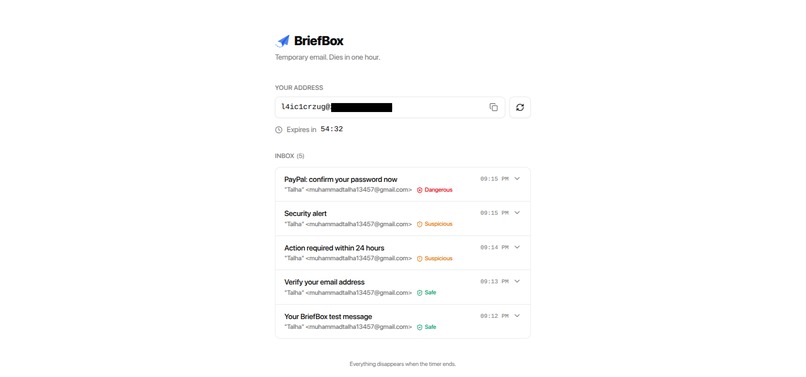
Home Page
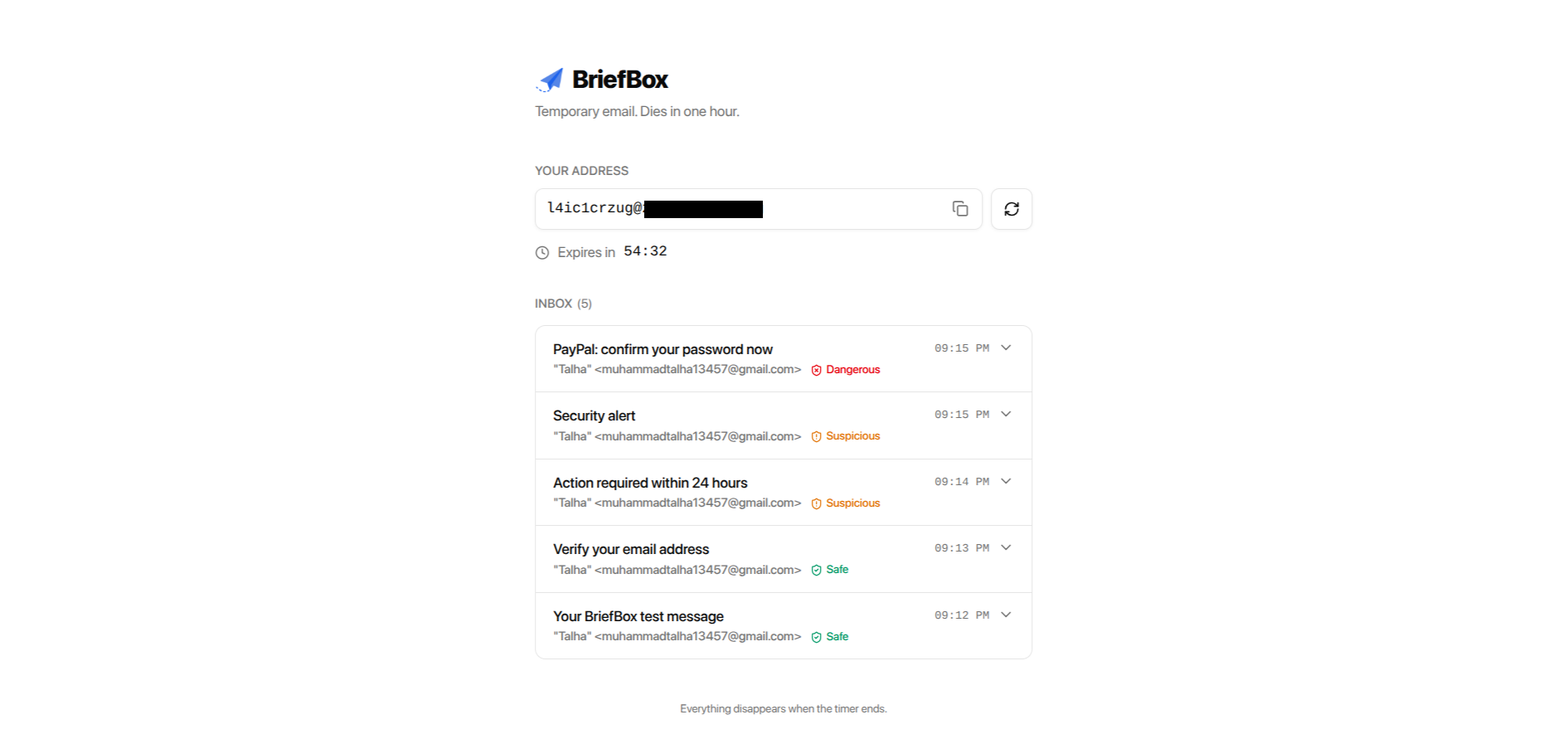
Inspiration
Signing up for random tools, newsletters, and one-off verifications shouldn’t mean handing over a permanent inbox. Most “temp mail” products feel either unreliable, ad-heavy, or blind to obvious phishing. We wanted something quieter and more intentional: one disposable address, one hour, then gone — with basic safety signals so you’re not clicking blind.
BriefBox came from a simple idea: temporary email should feel like a private workbench, not a public dumpster.
What it does
BriefBox is an anonymous temporary email service.
- Opens instantly — no signup, no login
- Issues a real address on your domain (e.g.
[email protected]) - Session lasts exactly one hour, then self-destructs
- Receives real inbound mail via Cloudflare Email Routing
- Parses text + HTML and shows messages in a clean inbox
- Scores mail locally as Safe / Warning / Dangerous
- Stores everything in Redis only (no user database)
- Auto-cleans sessions and messages with TTL
You visit the site, copy an address, receive mail, read it with a risk badge, and when the timer hits zero — the address and inbox disappear.
How we built it
Monorepo with pnpm workspaces + Turborepo:
- Frontend: React Router (framework mode), cookie-aware API client for loaders + browser
- Backend: Fastify, HttpOnly session cookies, rate limiting, helmet, CORS
- Storage: Redis only — sessions, reverse email lookup, and messages with matching TTLs
- Inbound mail: Cloudflare Email Routing (catch-all) → Email Worker →
POST /api/webhook/email - Parsing:
mailparserfor MIME (subject, text, html, links) - Safety: local rule-based scorer (phrases, shady links, brand mismatch, structure) — no LLM for speed/privacy
- UI: countdown, copy address, risk badges, sanitized HTML rendering
Key design choice: no accounts. A session is just a session_id cookie backed by Redis. Emails are stored as email:{sessionId}:{emailId} and wiped with the session.
Challenges we ran into
- SSR + cookies in Docker: loaders run inside the container, so
localhostis not the host backend. We split browser vs server API base URLs. - Path aliases in production: TypeScript
~/...imports survivedtscand broke Node ESM. Fixed withtsc-alias+.jsextension rewriting. - Cloudflare Email Routing: nameservers, catch-all, Worker secrets, and webhook wiring had to line up before a single real message appeared.
- False-positive safety scoring: early rules flagged normal “verify your email” product mail. We reworked brand-mismatch and weak-auth phrase logic so legitimate transactional mail stays mostly green.
- Keeping the product honest: tempting to add attachments, Gemini, and websockets — we cut scope so the core loop stayed solid.
Accomplishments that we're proud of
- A full real-mail loop on a custom domain, not a fake demo inbox
- Zero-account architecture that still feels like a product
- Fast local phishing heuristics with meaningful badges and fewer false positives
- Clean separation of session service, email service, webhook, and UI
- Dockerized web + backend builds for a pnpm monorepo
- A usable MVP: open → receive → scan → expire
What we learned
- Temp mail is as much infra + DNS + routing as it is UI
- Redis TTL is a powerful product feature when the whole model is ephemeral
- Safety scoring needs restraint: strong scam signals ≠ every “verify email” subject
- Production Node ESM is unforgiving about aliases and file extensions
- The best MVP constraint was time itself - one hour forced simplicity
What's next for BriefBox
- Server sent events (SSE) for true push updates instead of short polling/revalidate
- Hardened production deploy (Compose/K8s, monitoring, stricter rate limits)
- Attachment metadata display (still no malware file hosting)
Built With
- cloudflare-email-worker
- fastify
- mailparser
- pnpm
- react-router-framework
- redis
- tailwindcss
- turborepo
- typescript


Log in or sign up for Devpost to join the conversation.