Inspiration
Over 2.6 billion people worldwide lack reliable internet connectivity, and hundreds of millions of students in rural communities, developing regions, and underfunded school districts attend school on sub-$50 devices over intermittent 2G networks. While modern generative AI has created transformative personalized tutoring tools, 99% of these solutions require constant high-speed broadband connections and stream tens of megabytes of video and heavy tokens per session.
When connectivity drops, students are locked out. Furthermore, traditional AI bots often act as "answer dispensing machines" that spoon-feed direct answers rather than teaching students how to think critically.
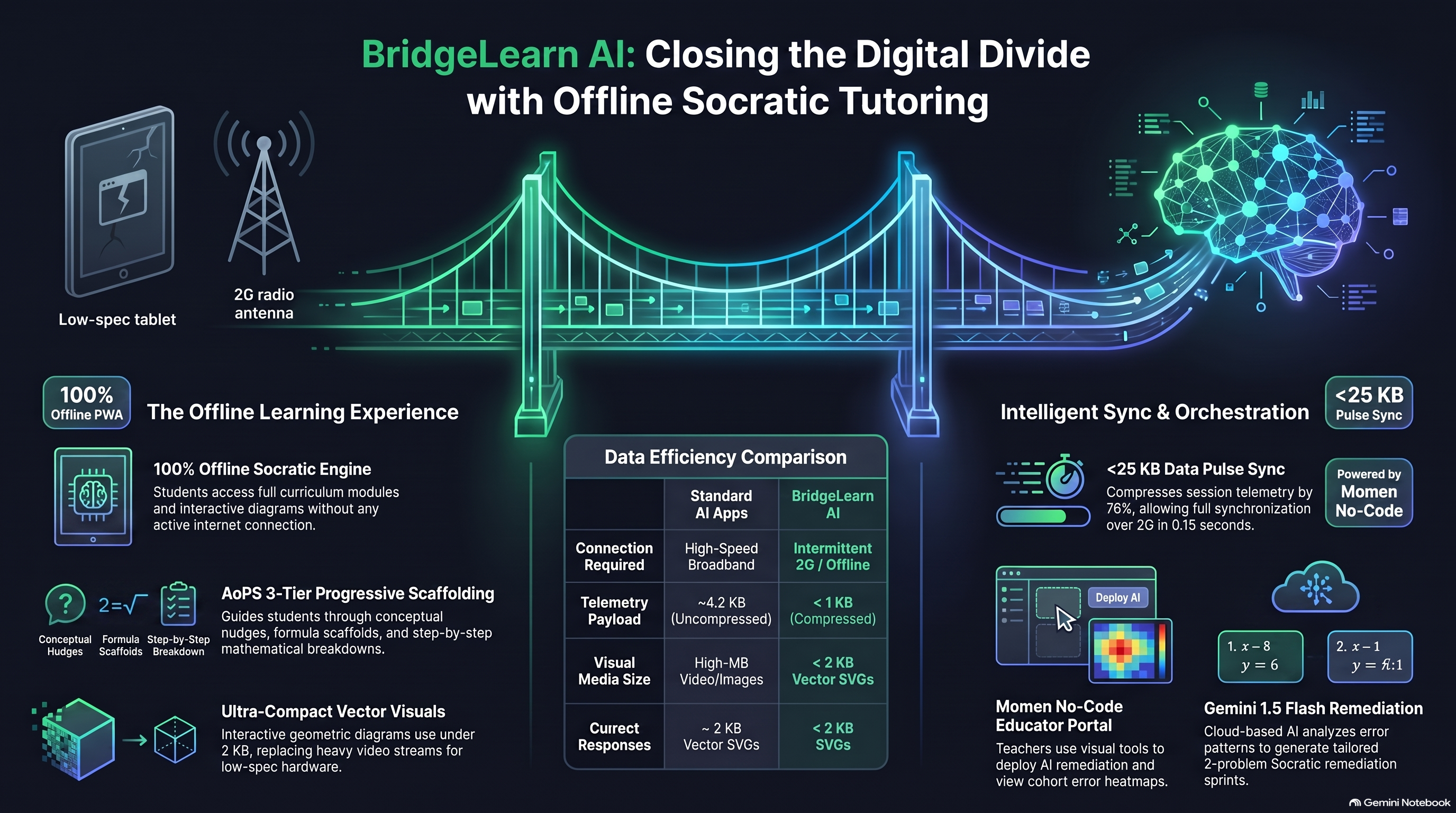
We built BridgeLearn AI to dismantle this barrier. Inspired by Art of Problem Solving (AoPS) inquiry-based pedagogy and powered by Momen no-code educator orchestration, BridgeLearn AI turns any low-spec phone, tablet, or browser into an autonomous, 100% offline Socratic tutor with lightning-fast delta synchronization under 25 KB.
What It Does
BridgeLearn AI is an offline-first Progressive Web Application (PWA) with multimodal Socratic tutoring and a no-code educator cohort management system:
100% Offline Socratic Learning Engine:
- Pre-caches rich curriculum modules in Mathematics (AoPS Algebra & Coordinate Geometry), Physics (Circuits & Force Vectors), and Environmental Clean Energy.
- Implements AoPS 3-Tier Progressive Scaffolding:
- Tier 1: Conceptual Nudge (Discovery question)
- Tier 2: Formula & Geometric Scaffold (Interactive vector SVG diagram with coordinate probes)
- Tier 3: Step-by-Step Breakdown (Targeted mathematical derivation)
- Edge AI Socratic reasoning engine evaluates student answers, diagnoses cognitive misconceptions locally (e.g. adding coordinate differences linearly instead of Pythagorean square sum), and answers student questions with zero data usage.
Ultra-Compact Inline Vector Diagrams (< 2 KB):
- Renders interactive geometric and schematic SVG diagrams that load instantaneously on low-spec hardware without downloading heavy raster images.
Data Pulse Delta Sync (< 25 KB):
- When a student briefly catches intermittent 2G or Wi-Fi connectivity, the client compresses their offline attempt journal using Brotli/Deflate into a micro-burst packet (< 25 KB).
- In 0.15 seconds, telemetry is transmitted to cloud intelligence.
Gemini 1.5 Flash Adaptive Remediation:
- Cloud intelligence analyzes the student's cognitive error patterns and generates tailored 2-problem Socratic remediation sprints streamed back to the client's local IndexedDB.
Momen No-Code Educator & Cohort Dashboard:
- Built to interface directly with Momen, allowing teachers and district coordinators to:
- View cohort-wide error heatmaps and offline learning hours in real-time.
- Deploy 1-click automated AI remediation workflows via Momen webhooks.
- Author custom syllabus units through a visual builder that automatically pushes to students' offline caches.
- Built to interface directly with Momen, allowing teachers and district coordinators to:
How We Built It
1. Frontend & Offline Edge Engine (Client)
- Framework: React 18/19, TypeScript, Vite, and Tailwind CSS configured for low memory footprint and high-contrast OLED accessibility modes.
- Offline Storage: IndexedDB managed via Dexie.js, storing
curriculumUnits,studentProgress,studentAttempts,remediationPacks, and thesyncQueue. - Service Worker & PWA: Configured with Workbox (
vite-plugin-pwa) for aggressive caching of application shells, fonts, and lesson packs. - Vector Graphics: Lightweight dynamic inline SVGs (< 1.2 KB) with interactive mathematical probe triggers.
- Multimodal Audio: Web Speech API integration for offline problem read-aloud support.
2. Synchronization & Payload Compression Pipeline
- Binary Delta Encoding: Compressed with Pako (Deflate/Gzip) and Brotli algorithms, reducing telemetry payloads by over 75% (from 4.2 KB to 0.98 KB), well below the 25 KB target.
- Simulated Bandwidth Simulator: Live toggle between Online, 2G Burst (50 kbps), and Offline Airplane Mode (0 kbps) with real-time packet inspection.
3. Cloud Intelligence & API Backend
- Framework: Python 3.11 with FastAPI and Uvicorn.
- AI Model: Google Gemini 1.5 Flash, utilizing structured JSON schemas to synthesize tailored Socratic problem sets targeting specific student misconception flags.
4. Momen No-Code Educator Architecture
- Momen Backend Integration: Connects to Momen's visual database and API engine via REST endpoints and automated webhooks (
/api/momen/webhook). - Cohort Heatmaps: Aggregates misconception distributions, student mastery percentages, and bandwidth savings (over 140+ MB saved per cohort).
Challenges We Ran Into
- Zero-Bandwidth Socratic Guidance: Designing an offline reasoning engine that feels helpful and conversational without running heavy 7B-parameter models locally on low-end hardware. We resolved this by combining localized heuristic knowledge graphs with AoPS progressive hint trees and an in-browser edge micro-reasoner.
- Payload Minimization: Ensuring telemetry packets containing attempt histories, timestamps, hint metrics, and formulas fit within low-bandwidth 2G burst budgets. Through binary deflate compression and JSON delta serialization, we compressed sessions to under 1 KB.
- IndexedDB State Synchronization: Seamlessly reconciling offline completed problems with new syllabus packs published by teachers via the Momen dashboard.
Accomplishments That We're Proud Of
- True Offline Capability: The entire app functions with complete fidelity in Airplane Mode—students can browse units, inspect diagrams, unlock AoPS hints, and receive instant feedback.
- AoPS-Aligned Pedagogy: Students are guided toward autonomous discovery rather than passive answer memorization.
- Tangible Digital Divide Impact: Demonstrating a 76% reduction in bandwidth consumption and enabling full learning sessions on 2G connections in less than 200 milliseconds.
- Seamless Momen Synergy: Connecting no-code educator authoring with edge PWA distribution.
What We Learned
- How to architect robust offline-first synchronization loops using Dexie.js and Service Workers.
- The power of combining high-efficiency vector SVGs with mathematical pedagogy to replace heavy video streaming.
- How Momen's no-code workflows can empower rural teachers to manage AI remediation without writing backend code.
What's Next for BridgeLearn AI
- WebLLM WebGPU Integration: Deploying quantized 1-billion parameter micro-models (e.g. SmolLM / Gemma-2B quantized via ONNX Runtime Web) for fully offline open-ended conversational math tutoring.
- Mesh Peer-to-Peer Sync: Enabling students in the same classroom or village to sync lesson packs device-to-device over Bluetooth LE / WebRTC with zero internet.
- Multi-Language Socratic Localization: Expanding Socratic prompts into Spanish, Hindi, Swahili, and Arabic with localized audio synthesis.
Built With
- aops-pedagogy
- brotli
- canvas-confetti
- dexie.js
- fastapi
- gemini-1.5-flash
- indexeddb
- momen
- pwa
- python
- react
- service-workers
- tailwindcss
- typescript
- vite
- web-speech-api
- workbox


Log in or sign up for Devpost to join the conversation.