Inspiration
It all started when a close friend of mine was preparing for IGCSE. He wanted proper guidance to choose the right subjects for his career path, so he paid $20 to a professional career counselor. Unfortunately, the advice he received turned out to be completely wrong. The counselor gave him a subject combination that didn’t match his career interests or the requirements of the universities he was aiming for. Not only did he lose money, but he also lost valuable time and confidence. Watching his struggle made me realize how often students around the world face the same problem. Many rely on expensive counselors, online guides, or random advice from others, but still end up confused or misled. That experience inspired me to create BridgeGuide — a free, personalized, and reliable subject selection tool. I wanted to build something that could give every student the kind of accurate and supportive guidance that my friend never received.
What it does
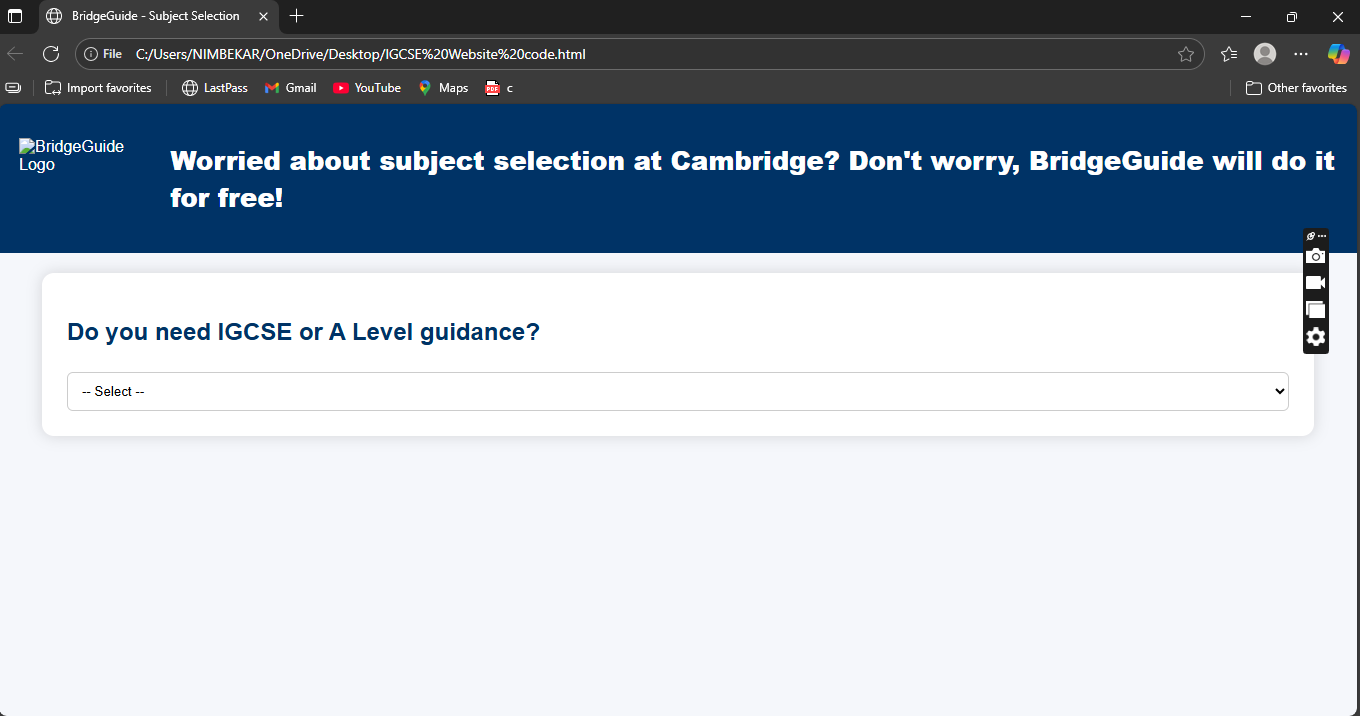
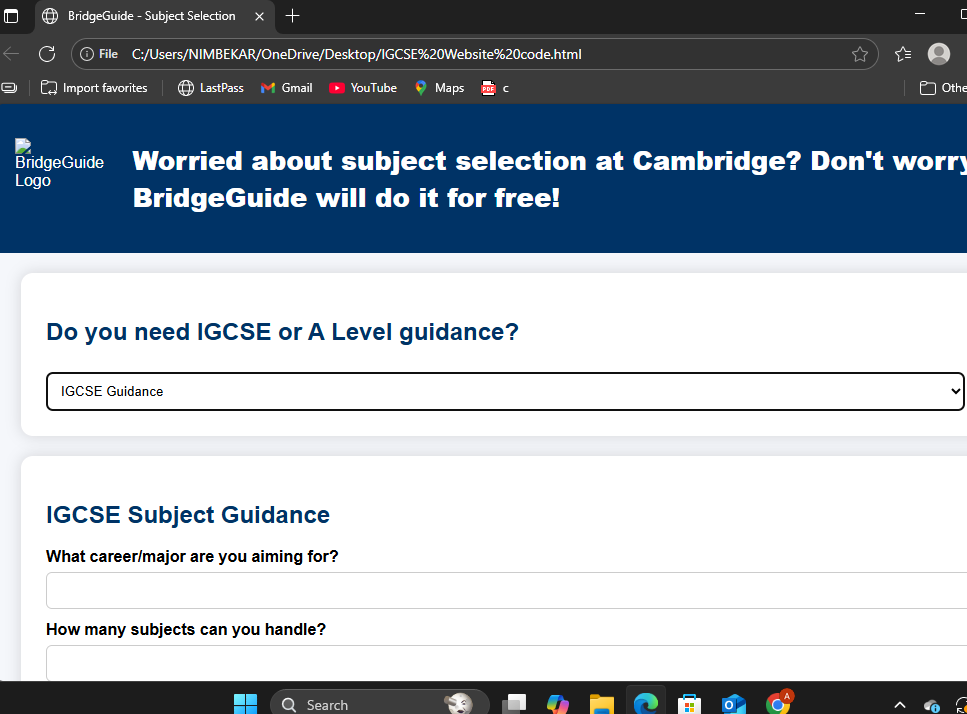
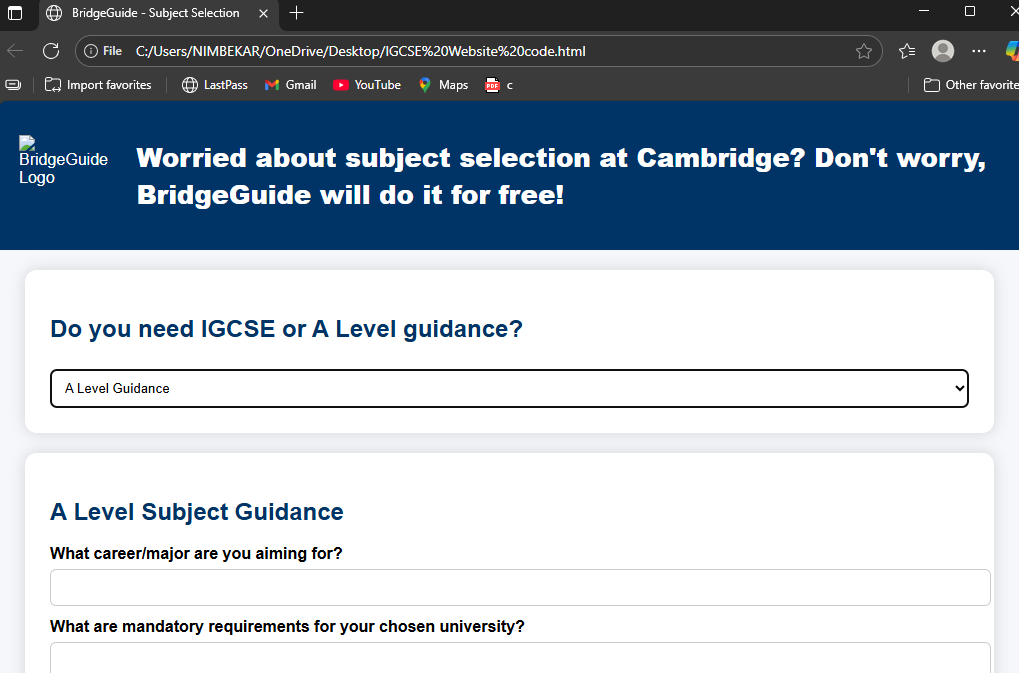
BridgeGuide is designed to act like a personal subject counselor, but in a way that is free and accessible to everyone. It helps students select the right IGCSE or A-Level subjects by asking about their career goals, preferred universities, personal interests, and academic strengths. The system then recommends the most suitable subjects by carefully mapping their choices to Cambridge subject offerings. It also considers important rules such as making English compulsory at IGCSE, offering subject-specific guidance like English as a Second Language for STEM students who are comfortable with British accents, or English Literature for those aiming at humanities careers. The tool even allows schools and students to add subjects that aren’t already listed, ensuring flexibility. In the end, the recommendations feel tailored, practical, and aligned with the student’s future.
How we built it
The project was built using simple yet powerful tools: HTML for structure, CSS for styling and layout, and JavaScript for logic and interactivity. The front-end design is clean, responsive, and user-friendly, making the experience smooth for students. The core strength lies in the JavaScript algorithms, which analyze the student’s responses and generate subject recommendations. For vague answers such as “Engineering” or “Data Science,” the system asks the student to specify a more detailed path, ensuring accuracy. The English subject selection logic was carefully designed to account for student comfort with British accents and career alignment. We deliberately kept the build lightweight with no heavy frameworks or cloud dependencies, making it easy to use and accessible anywhere.
Challenges we ran into
The journey wasn’t without its difficulties. One of the main challenges was making recommendations truly career-specific rather than generic. Another hurdle was handling vague or broad inputs like “Engineering” — since that could mean Mechanical, Civil, Software, or many other fields — and finding a way to ask students for clarification. Designing the English subject guidance also proved tricky, because it required balancing compulsory rules with career alignment and student comfort. We also had to work hard to make the interface not only functional but also engaging, so students felt like they were interacting with a real guide rather than just a static form.
Accomplishments that we're proud of
The biggest accomplishment is that BridgeGuide actually works as intended. It gives students tailored subject plans instead of generic lists, which makes it feel more personal and reliable. We’re proud of the fact that it includes flexibility for schools to add their own subjects, ensuring it can adapt to different environments. Another key achievement is that the design feels approachable and human-like, almost as if a counselor is speaking directly to the student. For us, turning an idea born from one bad experience into a real, functioning platform is something we take pride in.
What we learned
Throughout the process, we learned that effective career guidance has to be contextual and personalized. A one-size-fits-all approach doesn’t work, especially for something as critical as subject selection. We also discovered how even the smallest details — like whether a student is comfortable with British accents or the specific requirements of a university — can make a huge difference in the recommendations. Another big takeaway is that students respond better to systems that feel human and flexible rather than rigid and machine-like. Building BridgeGuide reinforced the importance of empathy and precision in solving educational problems.
What's next for BridgeGuide (A subject selection guide for CAIE)
BridgeGuide is just the beginning of what we envision. The next step is to make it even smarter by integrating specific university requirements for CAIE students, so the recommendations can be more fine-tuned for each target. We also plan to add a proper backend and database so students and schools can save, review, and update their subject plans over time. Eventually, we want to integrate AI so that the system learns from patterns and provides even better recommendations as more students use it. Most importantly, we aim to publish BridgeGuide as a full website with its own domain, making it available to students around the world for free. With this, we hope to prevent thousands of students from making the same mistake my friend once did and ensure that their academic journey starts on the right path.
Built With
- conditions
- css
- expertsystem
- html5
- javascript


Log in or sign up for Devpost to join the conversation.