-
-
plan
-
landing
The problem nobody talks about
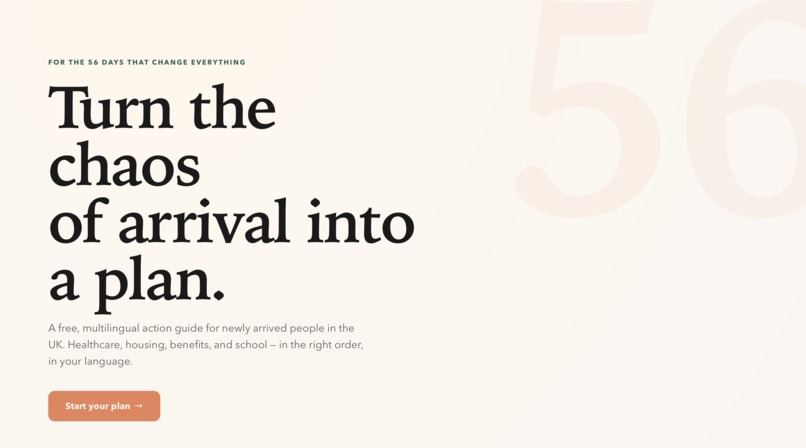
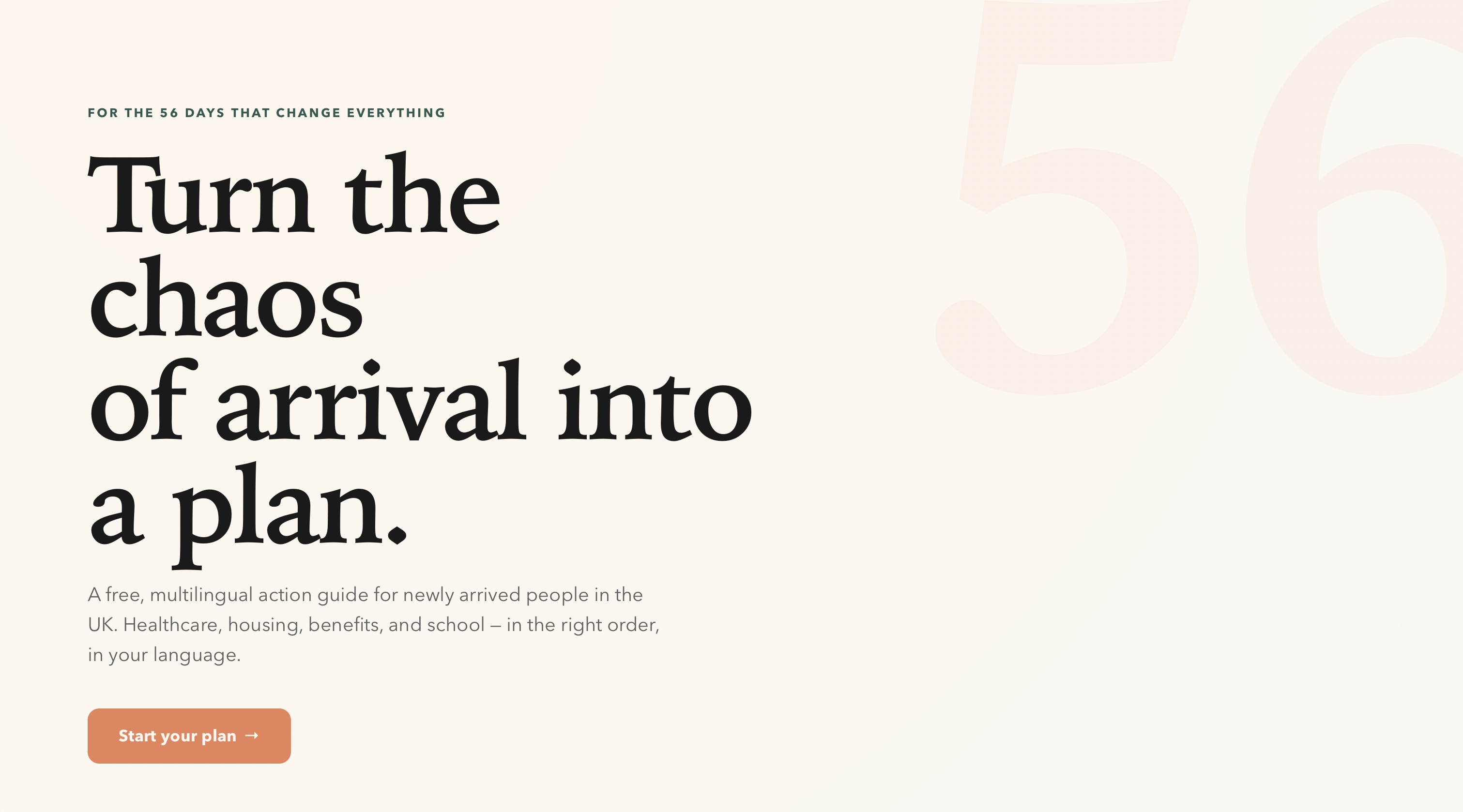
When the UK government grants someone refugee status, it starts a 56-day clock. After that, support stops. Housing. Food vouchers. Everything. It's called the move-on period, and the assumption is that in those 56 days, a person will have sorted a bank account, benefits claim, GP registration, school places for their children, and somewhere to live.
Most people don't know the clock is running.
And the ones who do know still face something that nobody has really solved: the order matters. You cannot apply for Universal Credit without a bank account. You cannot get many bank accounts without ID. You cannot get some forms of ID without a fixed address. The 28-day window to apply for benefits after status recognition is a hard deadline, and if you miss it, you fall into a gap. The information exists. It is on government websites, in charity leaflets, in PDFs nobody reads. But it exists in English, in no particular order, spread across fifty different domains, with no indication of which step makes the next one possible.
That is not an information problem. It is a sequencing problem.
What Bridge56 actually does
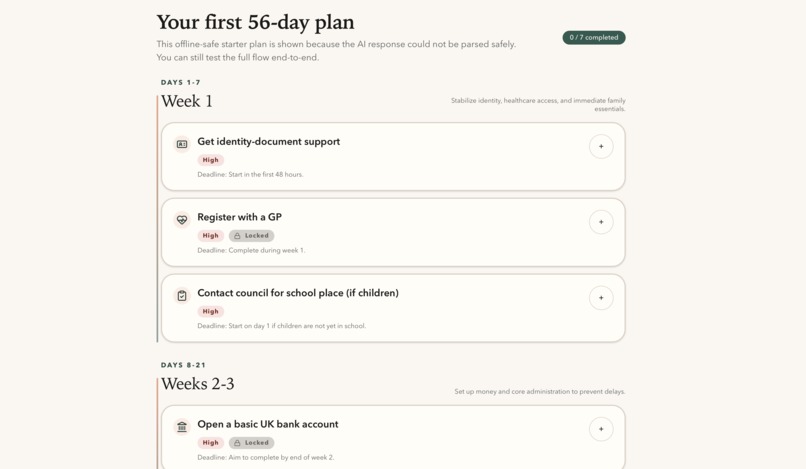
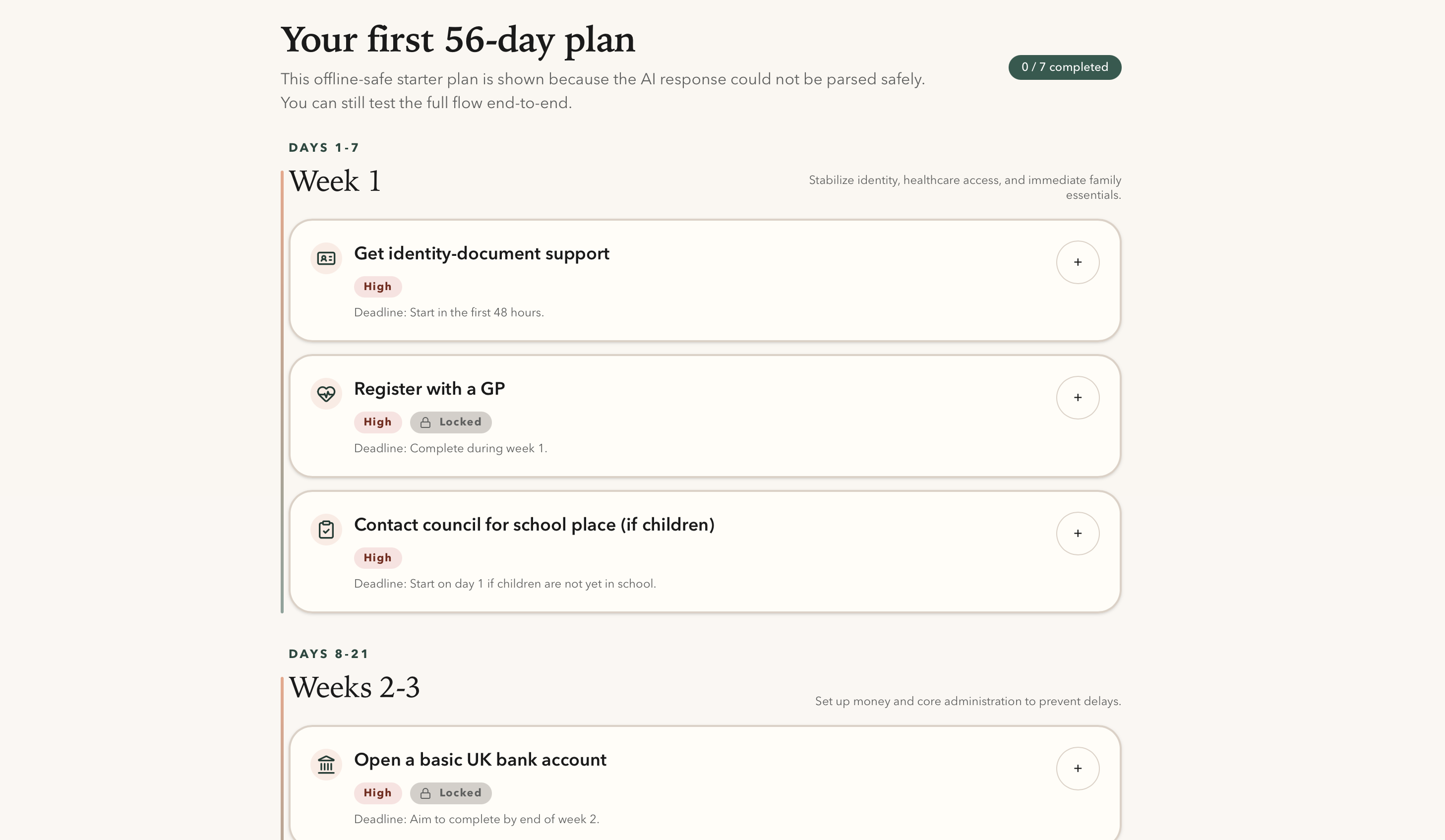
Bridge56 takes five inputs: how long you have been in the UK, your housing situation, which documents you carry, whether you have children, and what you have already sorted. From those five answers, Gemini 2.5 Flash generates a dependency-resolved, phased action plan across three time horizons: this week, the next two weeks, and this month.
Each step is a card. The card tells you what the step is, why it is urgent right now, exactly what to bring, a script for what to say when you arrive, and which other steps this one unlocks. Steps that cannot yet be attempted are shown as locked, with a clear explanation of what needs to happen first.
The whole thing is available in eleven languages: English, Ukrainian, Arabic, Somali, Dari, Spanish, Polish, French, Tigrinya, Russian, and Bengali. Right-to-left layout for Arabic and Dari. The plan is generated in the user's selected language, not translated after the fact.
Two more things that matter: a location service that finds the nearest GP, foodbank, Citizens Advice bureau, and council office based on postcode. And a calendar export that turns every step and deadline into a real calendar event, because an action plan you forget is the same as no plan at all.
Who we built it for
Not "immigrants" as a category. Liubov, 54, from Kharkiv. She does not know what a GP is. She does not know she is entitled to free healthcare. She does not know her grandchildren can start school this week, regardless of what documents she has. She is sitting in a friend's spare room with a folder of papers she does not fully understand.
There are hundreds of thousands of Liubovs. The Refugee Council has caseworkers. Citizens Advice has advisors. Both are overwhelmed, underfunded, and operate primarily in English. The gap between arriving and being settled is where people lose housing, miss benefit windows, and watch the 56 days run out.
Bridge56 does not replace those services. It gets people to the front door.
How we built it
Stack: Next.js 16, Gemini 2.5 Flash via the Google AI API, Tailwind CSS 4, shadcn/ui, Vercel.
The AI layer was the hardest part to get right. Generating a list is trivial. Generating a list where the model reliably encodes dependency relationships, labels steps with urgency, locks steps that cannot yet be started, and does all of this in Somali at the same fidelity as English, took serious prompt engineering.
The system prompt is built around UK-specific procedural knowledge baked directly into the context: NHS registration rules (including the legal fact that a GP cannot refuse registration due to lack of ID or fixed address), the 28-day and 56-day benefit windows, BRP collection deadlines, which banks will open accounts for customers with limited documentation, and which charities operate in which postcodes.
The output is strict JSON, validated with Zod on both ends. Each step in the plan carries: a phase label, an urgency score, a blocked_by array of step IDs, an unlocks array, what-to-bring and what-to-say fields, and official source links. The frontend renders this into a visual timeline with locked/unlocked state derived from which steps the user has marked complete.
The intake form is five questions. We cut it from twelve. Every question we removed was a deliberate decision, because the people using this are not filling in a survey for fun.
What we learned
Two things surprised us.
First, the dependency graph insight turned out to be the entire product. We started thinking Bridge56 was about multilingual access to information. It is actually about the order. That reframe changed everything: the UI, the prompt, the output schema, the step cards.
Second, tone is a technical problem. Government information is written to protect institutions. Guidance that protects people uses a different register: direct, warm, never condescending, specific about what to bring and what to say rather than vague about "contacting the relevant authority." Getting that register consistent across eleven languages, generated by an AI, required as much iteration as the dependency logic.
The hard questions
What if the AI is wrong?
Every step links to a primary official source. Every plan ends with a clear note that this is guidance, not legal advice, and that for a specific situation the user should verify with Citizens Advice or the Refugee Council. We are a compass, not a GPS. We point in the right direction and explicitly tell users to confirm with a human before they commit.
Why not just use ChatGPT?
You could. If you know what questions to ask. Liubov does not know to search "GP registration refugee UK" because she has never heard of a GP. The intake form is doing the work of knowing what questions to ask. The dependency-ordered output is something a raw LLM prompt does not give you. The locked/unlocked step state is a UI layer that a chat interface cannot replicate.
Who does this exclude?
Anyone without a smartphone or reliable wifi. We know this. The offline version, the SMS version, the version that works on a low-end Android, those are next. The web app is proof of concept. It is not the final form.
What is next
Partnership. The technology is the easy part. Accuracy, trust, and reach come from working with organisations that already have them: Refugee Council, Migrant Help, Citizens Advice, local councils with high refugee populations.
The vision is white-labelled and embedded in the onboarding pack given to every person who receives refugee status in the UK. The link alongside the letter. The QR code on the first page.
The 56 days do not get easier. But they could be less confusing.
Built With
- claude
- gemini-2.5-flash-via-the-google-ai-api
- next.js-16
- shadcn/ui
- tailwind-css-4

Log in or sign up for Devpost to join the conversation.