BRIDGE — Turning Communication Into Connection
1. Inspiration
Have you ever received an important email, understood every word, but still had no idea what you were supposed to do?
BRIDGE was inspired by the language barriers international students face in their daily academic and personal lives. University announcements, immigration updates, and workplace emails often contain complex English, multiple tasks, unclear deadlines, and important follow-up instructions. For students whose first language is not English, understanding these messages and taking the right actions can be challenging.
We realized that traditional translation tools can translate words, but they do not fully address the challenges of understanding information, learning English, and completing tasks.
That's why we created BRIDGE, an AI-powered platform designed for international students, travelers, and older adults. It helps users overcome language barriers by transforming complex messages into simple English and clear, actionable steps.
This idea connects directly to the hackathon's theme, Connections. True connection is not just about delivering information; it is about ensuring that people/entities from different linguistics and cultural backgrounds can understand one another and take action.
2. What it does
BRIDGE is more than a translation tool. It is an AI-powered platform that combines multilingual understanding, English-learning support, intelligent task extraction, and task management.
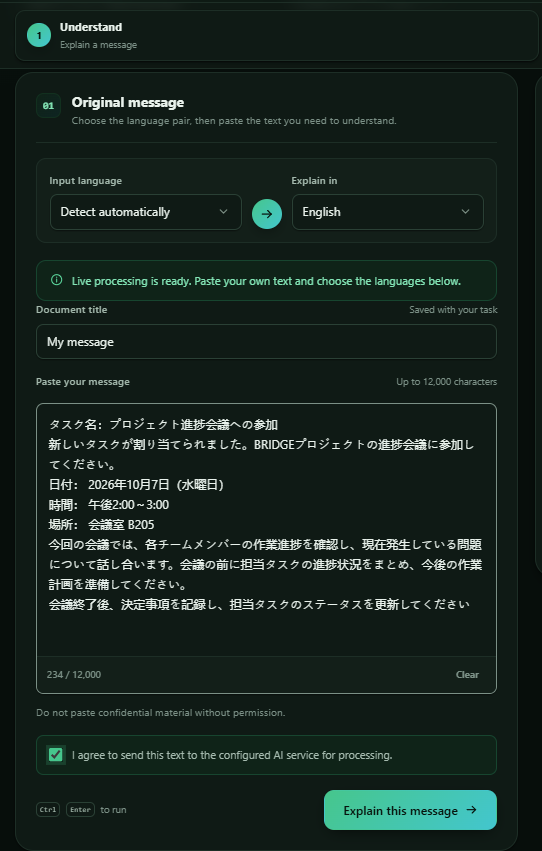
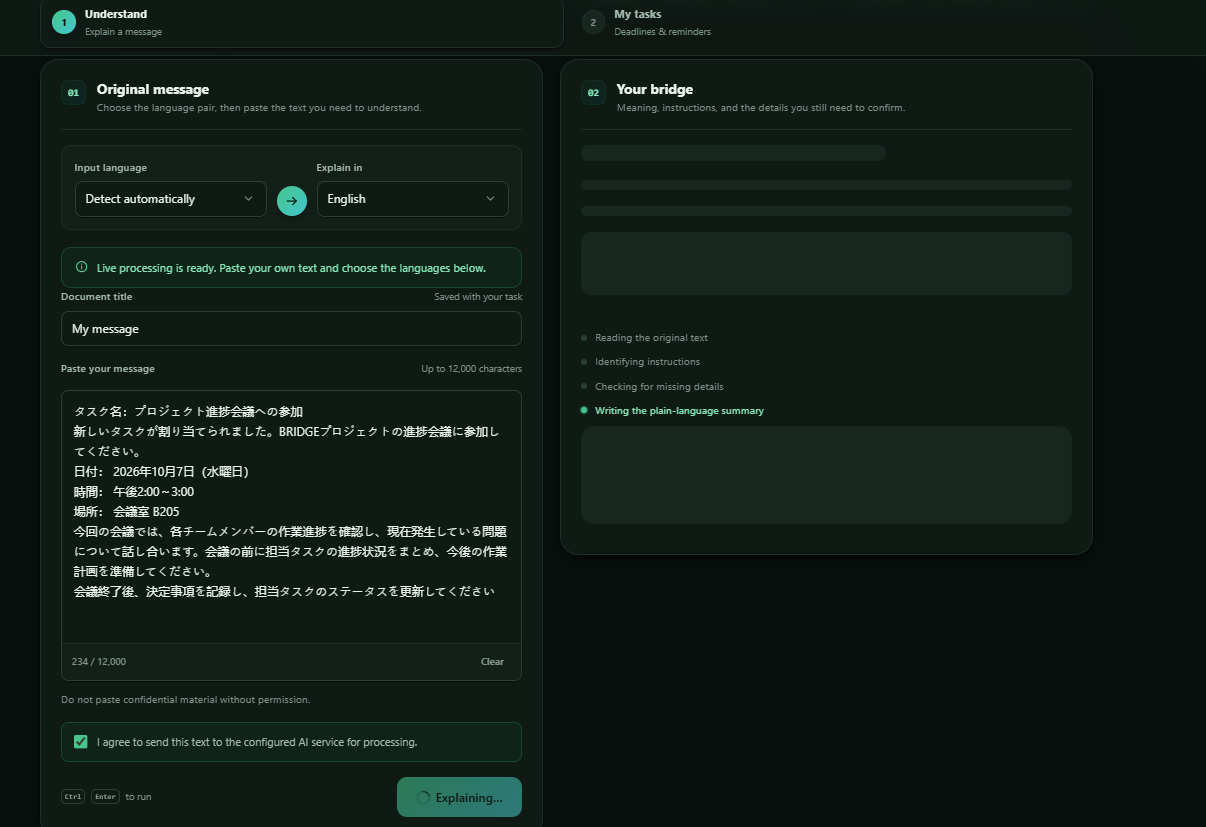
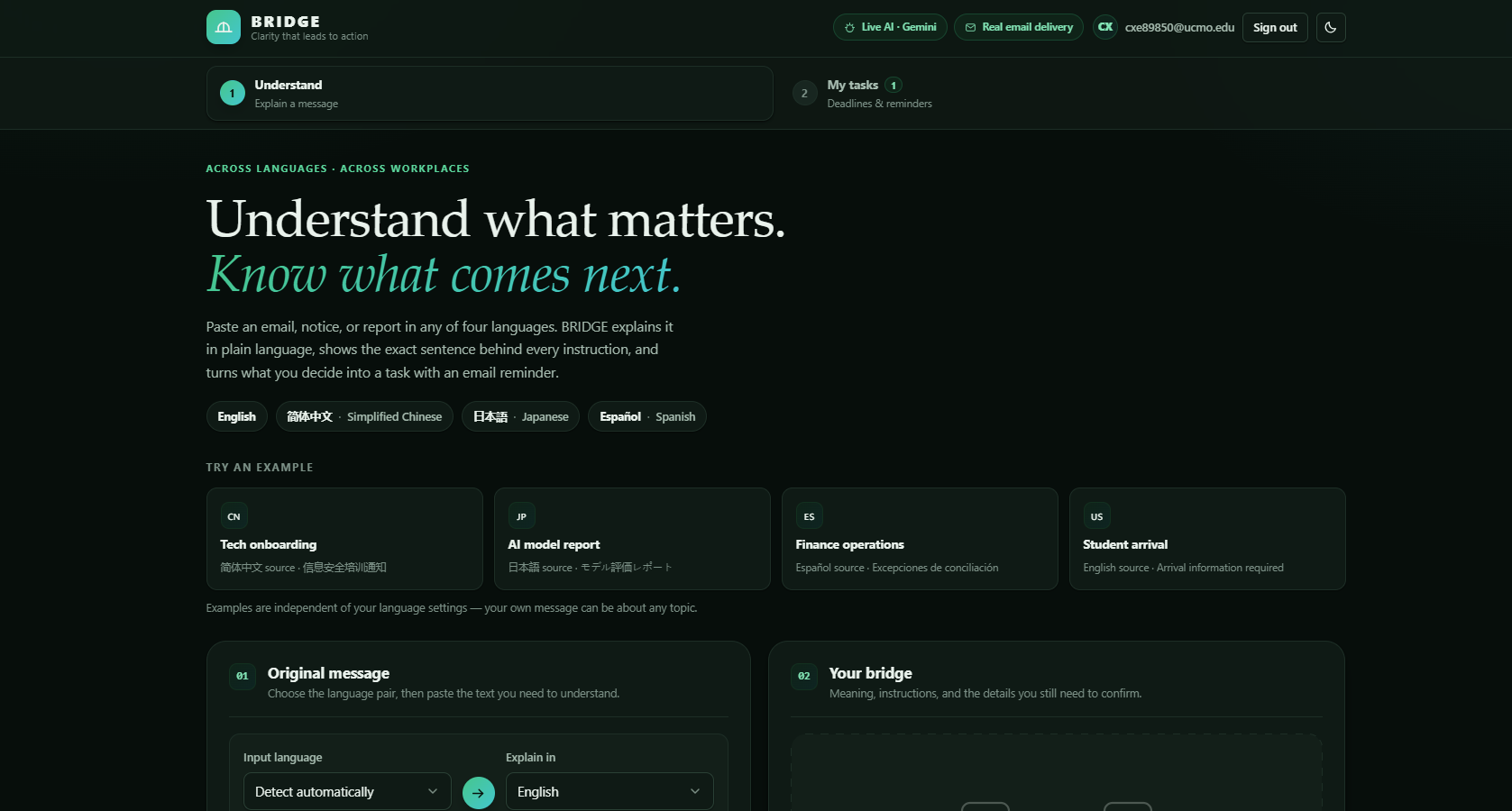
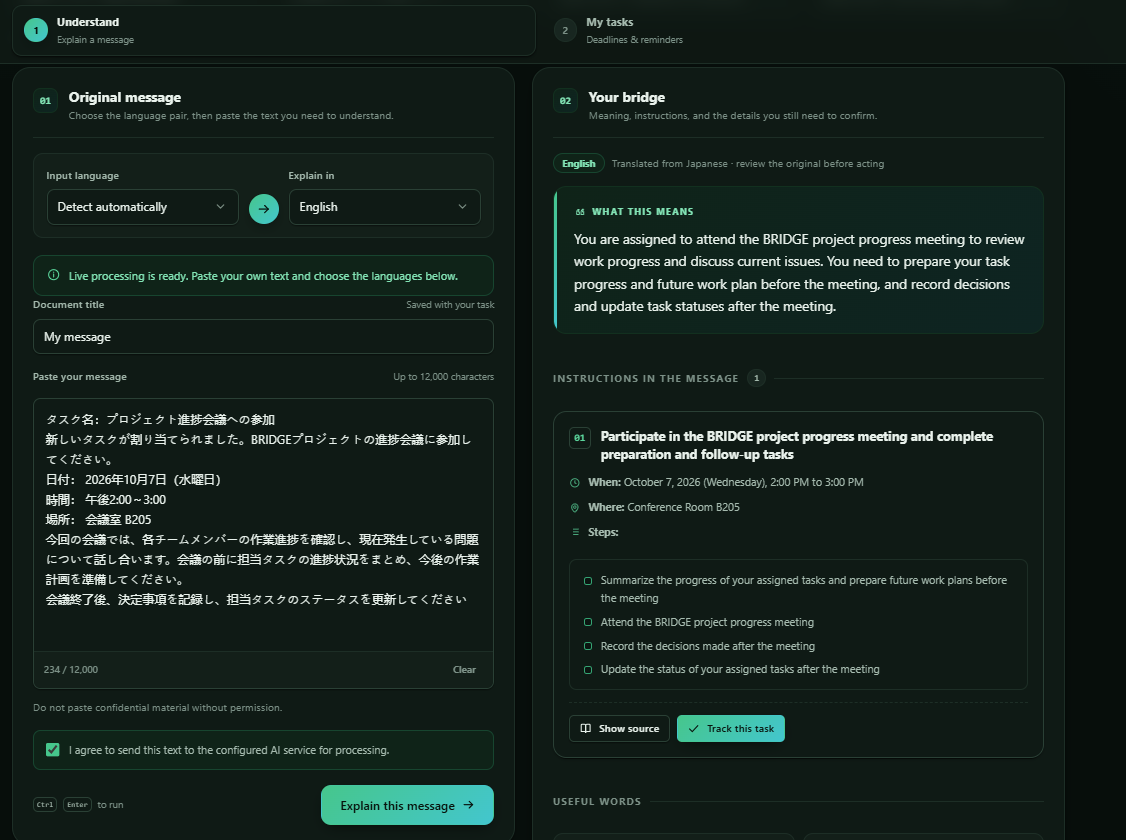
BRIDGE transforms messages written in Chinese, Japanese, Spanish, and English into clear, simple English, helping people of different language backgrounds understand important information while improving their English skills through real-world communication.
BRIDGE's six core features:
- Multilingual to Simple English: Converts messages in four languages into clear, easy-to-understand English, making university announcements, emails, and everyday instructions more accessible.
- English-Learning Support: Helps students develop their English skills through simplified explanations, important vocabulary, and comparisons with the original text.
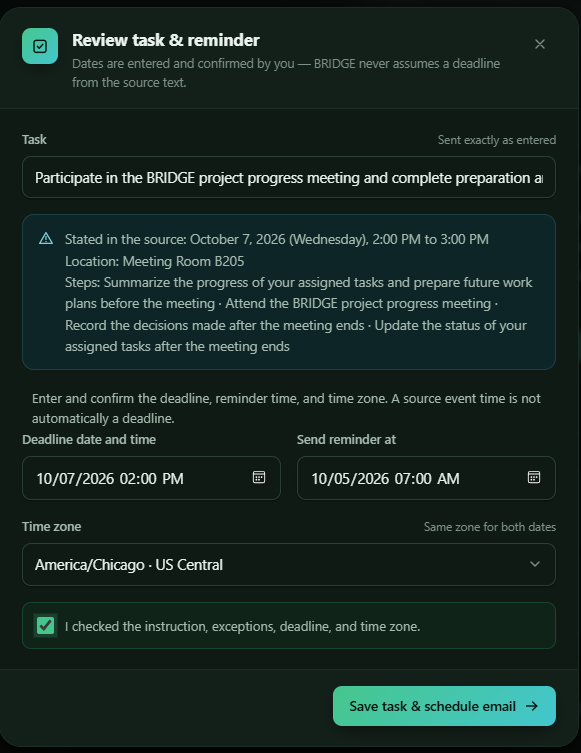
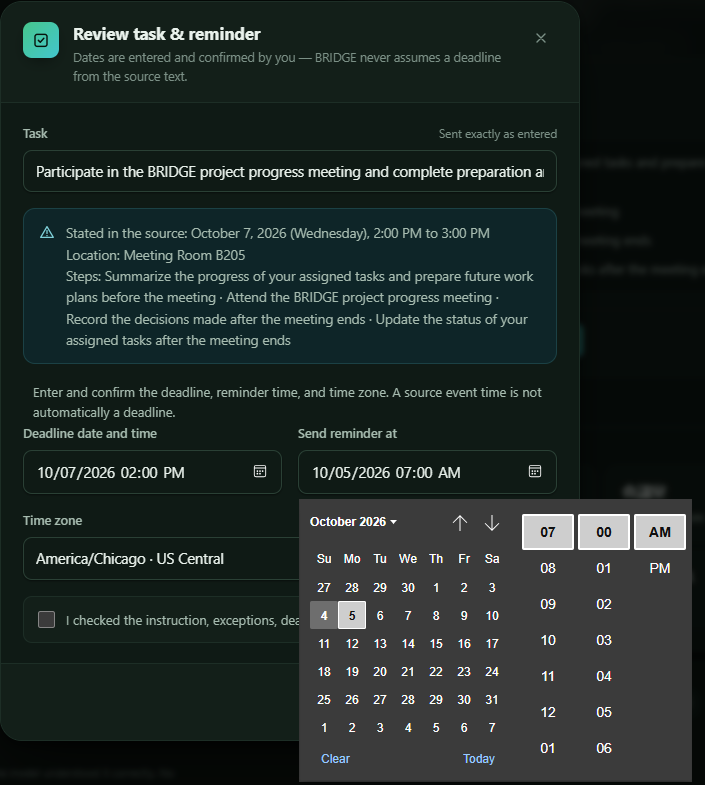
- Intelligent Task Extraction: Automatically identifies required actions and organizes complex instructions into clear, step-by-step tasks.
- Key Information Extraction: Identifies dates, times, locations, deadlines, and important conditions.
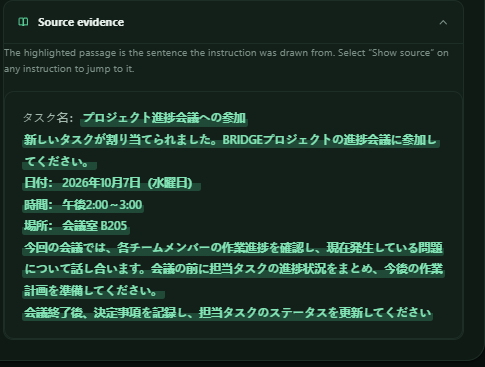
- Source Verification: Preserves supporting passages from the original message so users can verify the AI-generated explanations and extracted tasks.
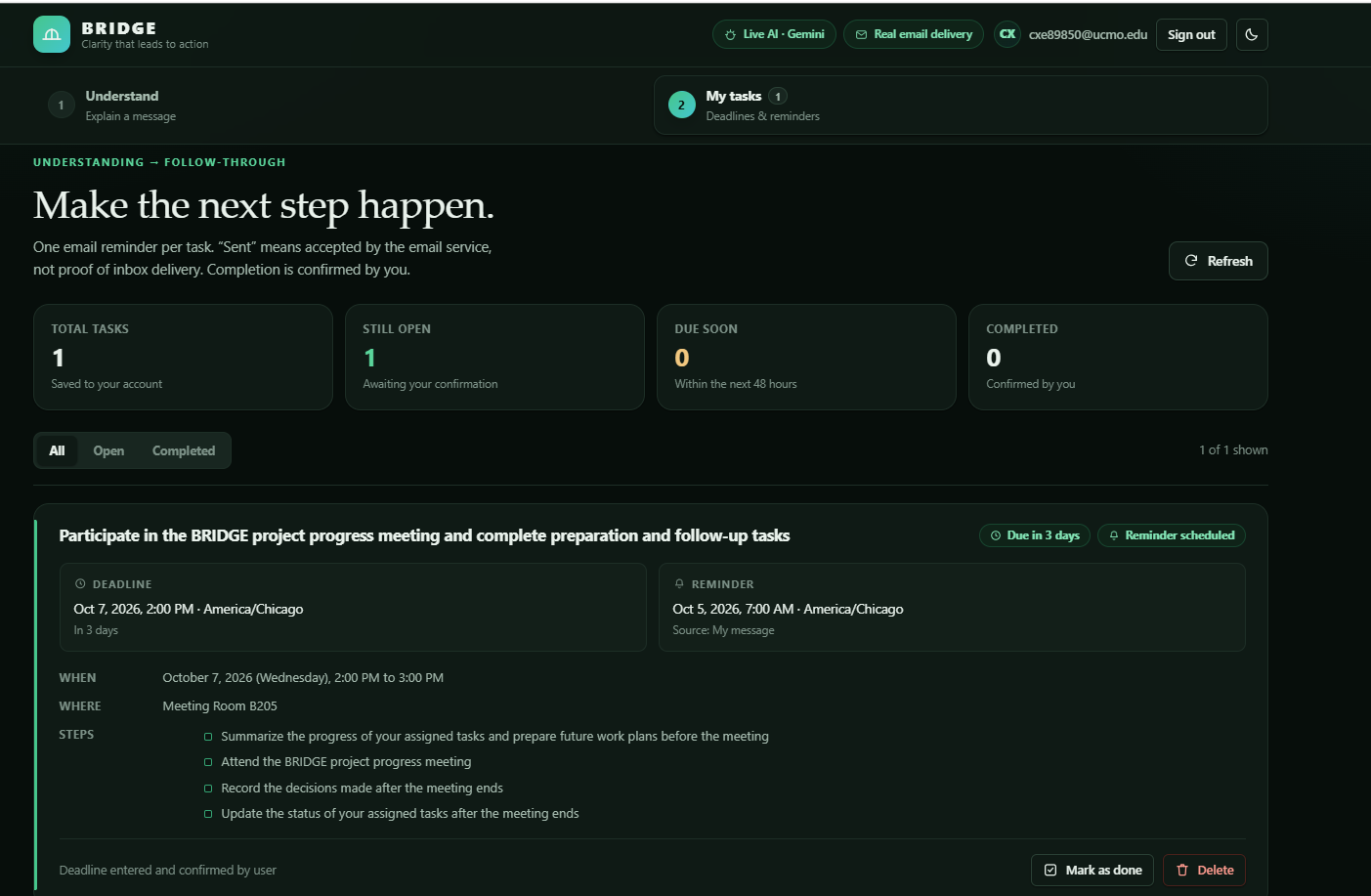
- Task Management and Reminders: Allows users to save tasks, track their progress, mark them as completed, and schedule email reminders.
For example, an individual who receives a complicated university announcement can use BRIDGE to convert it into simple English, identify the required tasks, and understand important deadlines. By comparing the simplified explanation with the original message, the student can also improve their English reading comprehension.
Our core concept: Message → Meaning → Action → Connection
From receiving information to understanding its meaning, taking action, and ultimately building meaningful connections.
3. How we built it
We developed BRIDGE as a full-stack web application that combines generative AI, natural language processing, English-learning support, and task management.
We used Python and Flask for the backend, HTML, CSS, and JavaScript to build a responsive user interface, and SQLite to store user accounts, tasks, and reminders.
For AI functionality, we integrated the Google Gemini API and designed the architecture to support OpenAI. These models power multilingual text understanding, simple English generation, and structured task extraction.
To improve reliability, we implemented JSON Schema and custom Python validation rules to check AI-generated responses, verify supporting source text, and reduce errors in extracted information.
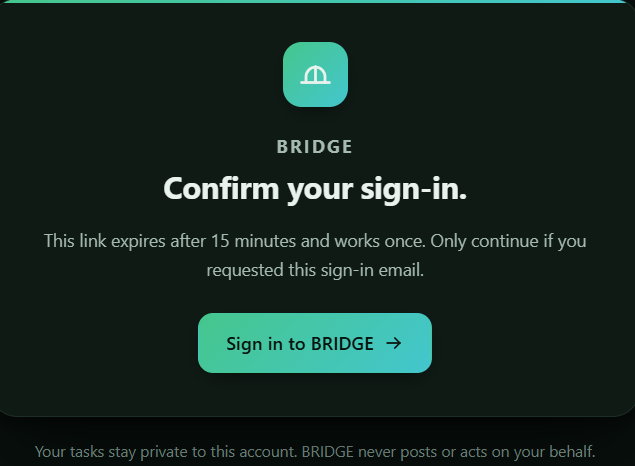
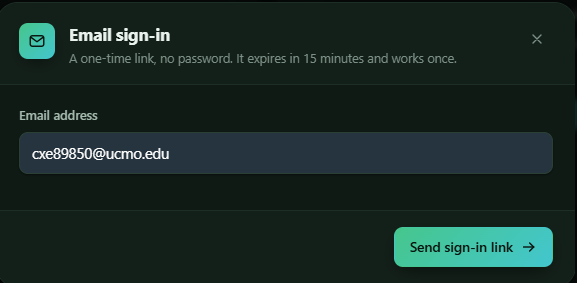
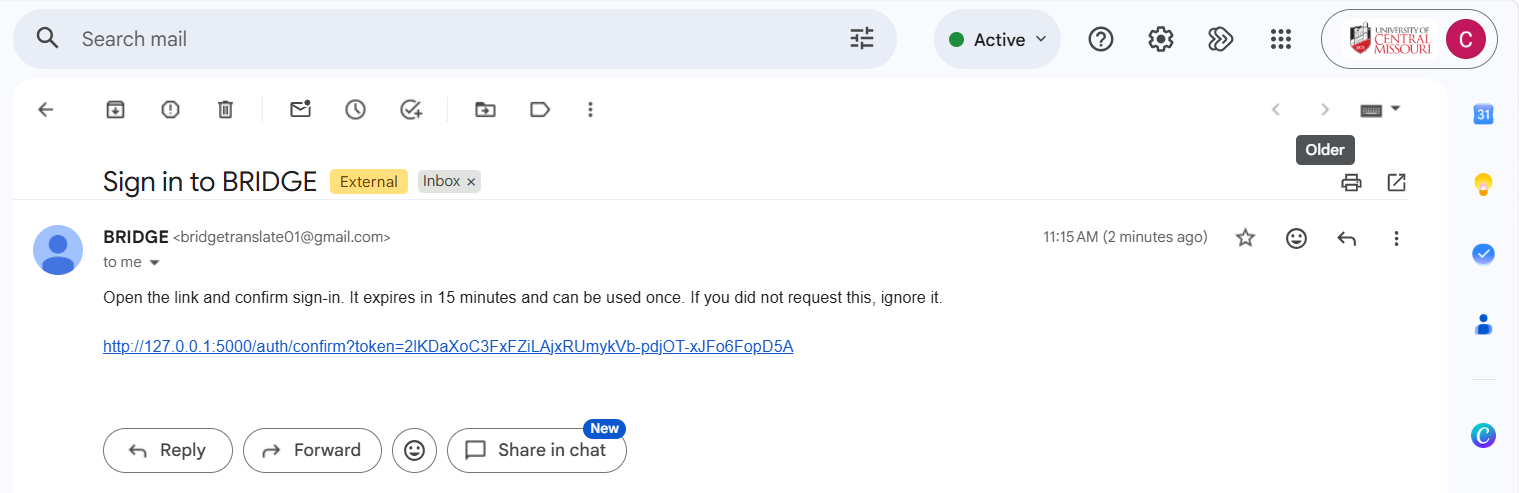
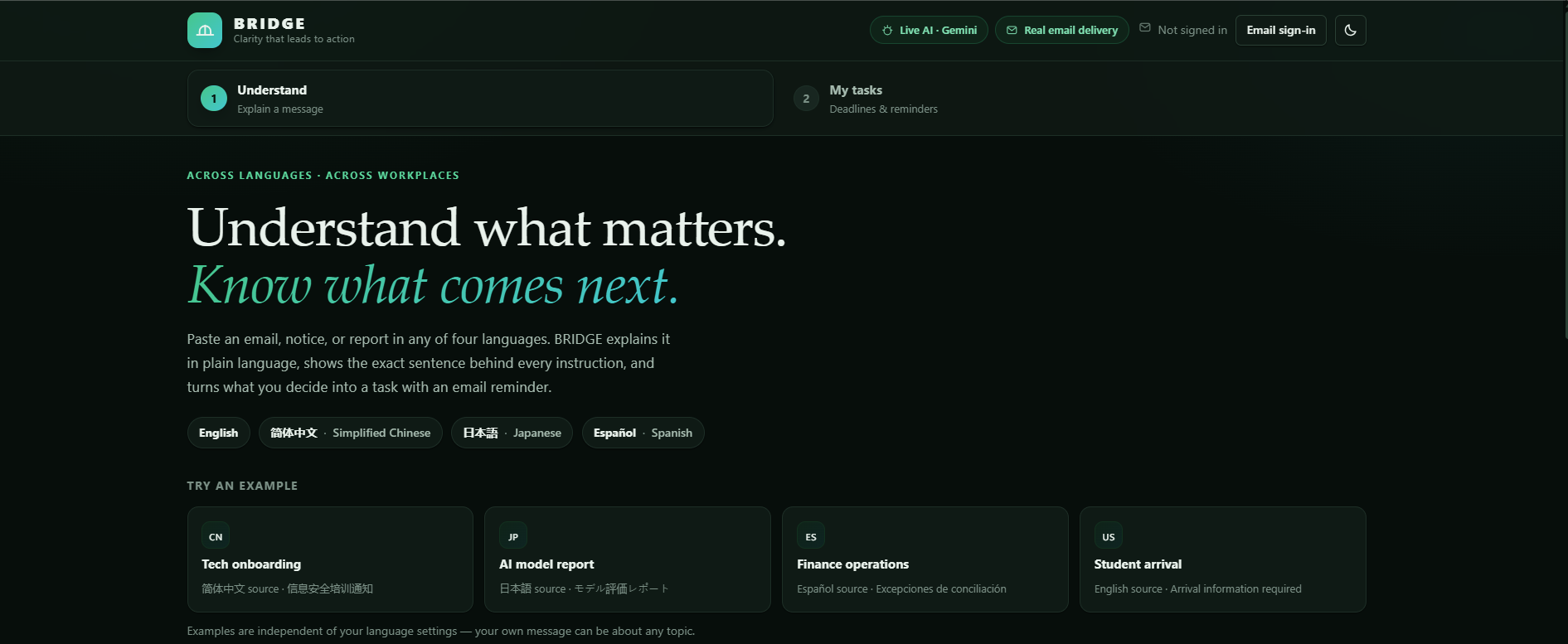
For authentication, we implemented passwordless email authentication. Users simply enter their email address and receive a verification email containing a unique sign-in link. By clicking the link, they can securely access BRIDGE without creating or remembering a password.
We also integrated Gmail SMTP and a separate Python background worker to handle email delivery and scheduled task reminders, connecting information processing, authentication, and task management within one platform.
4. Challenges we ran into
During development, we faced several challenges involving multilingual processing, AI API integration, real email delivery, and passwordless authentication.
Challenge 1: Multilingual Processing and Simple English Generation
One of our biggest challenges was converting Chinese, Japanese, Spanish, and complex English into simple English while preserving the original meaning.
We refined our AI prompts, improved the output structure, and tested messages in different languages to produce clearer explanations without losing important instructions or key information.
Challenge 2: AI API Integration and Reliability
Connecting the Google Gemini API to our Flask backend required us to handle user input, API requests, AI-generated responses, and structured data validation.
We encountered challenges with API key configuration, model requests, response formatting, and error handling. We addressed these by refining our API integration, validating responses with JSON Schema, and storing sensitive credentials securely in environment variables.
Challenge 3: Real Email Delivery and Passwordless Authentication
We wanted BRIDGE to provide a simple and secure login experience without requiring users to create or remember passwords.
However, sending real verification emails and ensuring that users could successfully access BRIDGE through their email links was a significant technical challenge.
To solve this, we integrated Gmail SMTP, configured the email server and Google App Password authentication, and implemented a passwordless login system using secure, single-use verification links.
When users enter their email addresses, BRIDGE generates a time-limited sign-in link and sends it to their inbox. Clicking the link verifies their identity and allows them to access the platform.
We also had to address differences between local email testing and real email delivery, SMTP configuration errors, and verification-link expiration.
Challenge 4: Connecting the Complete User Workflow
BRIDGE needed to do more than explain messages. It also needed to allow users to save tasks, manage their progress, and receive reminders.
We integrated Flask, SQLite, email authentication, and a background reminder system into a complete workflow, connecting user authentication, AI-powered message analysis, and task management in one application.
5. Accomplishments that we're proud of
Our greatest accomplishment is transforming an idea inspired by international students' communication challenges into a functional prototype that combines multilingual understanding, English-learning support, and intelligent task management.
BRIDGE can process messages in four languages, transform them into simple English, and automatically extract actionable steps, dates, times, and locations.
Unlike traditional translation tools, BRIDGE also provides source verification, clear step-by-step instructions, task tracking, and email reminders, connecting language comprehension with practical action.
We are also proud of implementing a passwordless email authentication system, allowing users to access BRIDGE securely through verification links without managing passwords.
Most importantly, BRIDGE helps international students address immediate communication challenges while providing opportunities to improve their English through everyday interactions.
6. What we learned
Building BRIDGE taught us that translation is not the same as understanding, and understanding does not automatically lead to action. A valuable AI application should help users turn information into practical solutions.
Technically, we learned how to integrate large language models into a full-stack web application, gaining hands-on experience with multilingual processing, prompt engineering, API integration, structured data validation, and database design.
Developing our authentication system also taught us about SMTP email services, single-use sign-in links, user authentication, and background task processing. We gained a deeper understanding of how independent technologies work together to create a complete web application.
We also learned that simplifying language involves more than shortening sentences. It requires reducing language complexity while preserving the accuracy and meaning of the original information.
Above all, we learned how to design a user-centered AI application that balances accessibility, reliability, and educational value.
7. What's next for BRIDGE — Turning Communication Into Connection
Our vision is to develop BRIDGE into a comprehensive platform for multilingual communication, language learning, and intelligent task management.
We plan to enhance its language-learning features with richer vocabulary explanations, language practice, and personalized learning support, helping international students improve their communication skills while understanding important information.
We also plan to support PDFs, images, scanned documents, and voice input, as well as integrations with Gmail, Outlook, Google Calendar, and Microsoft Teams to make communication, scheduling, and task management even easier.
In addition, we aim to improve AI accuracy and introduce voice interaction, accessibility features, and stronger privacy protections.
Our long-term goal is to expand BRIDGE beyond university communications into education, healthcare, workplaces, and public services, helping people from different linguistic backgrounds overcome communication barriers.
Our mission: Message → Meaning → Action → Connection — breaking language barriers, making information understandable, turning understanding into action, and building meaningful connections.


Log in or sign up for Devpost to join the conversation.