-
-
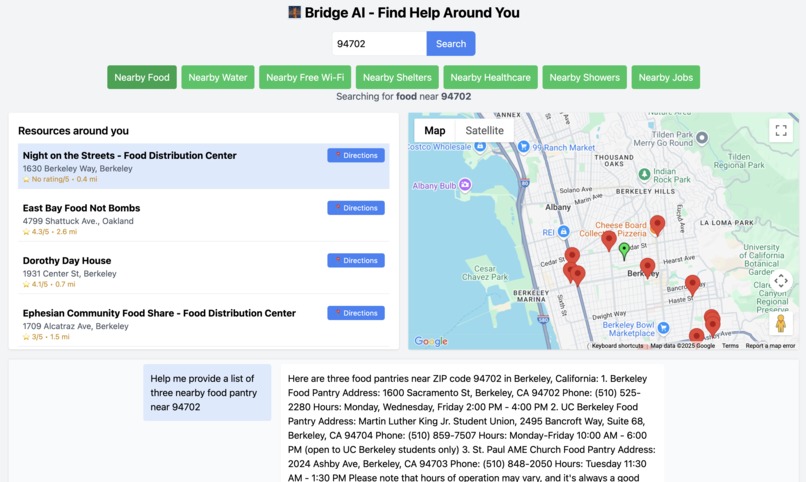
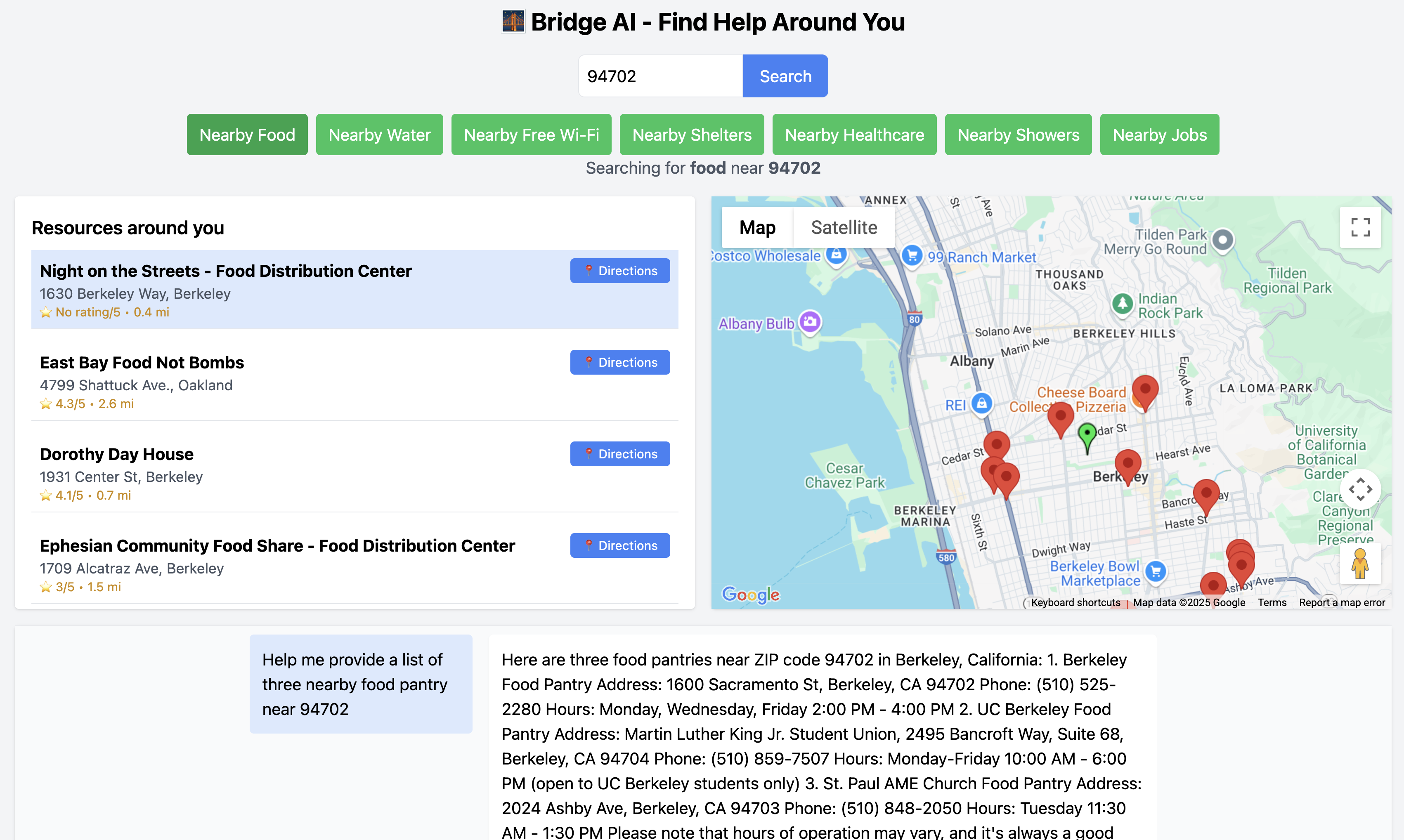
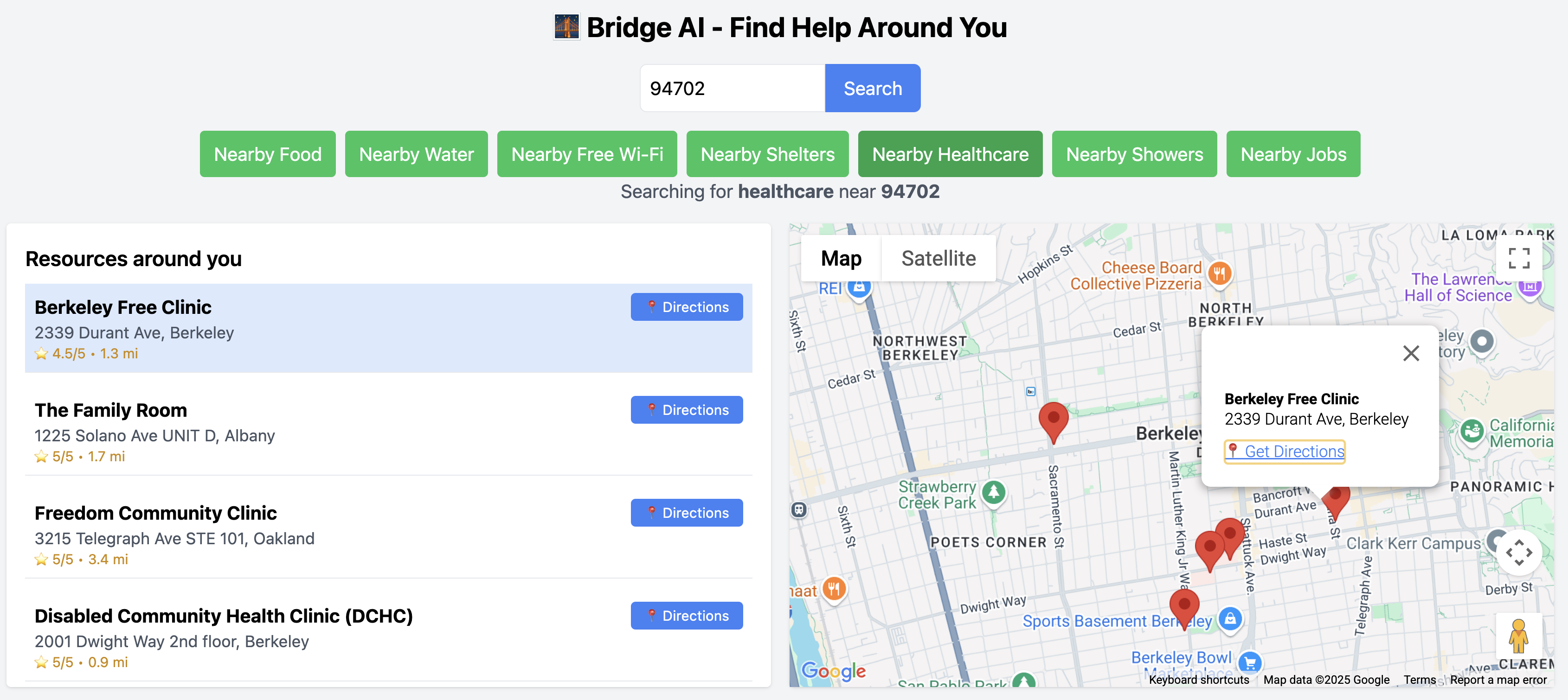
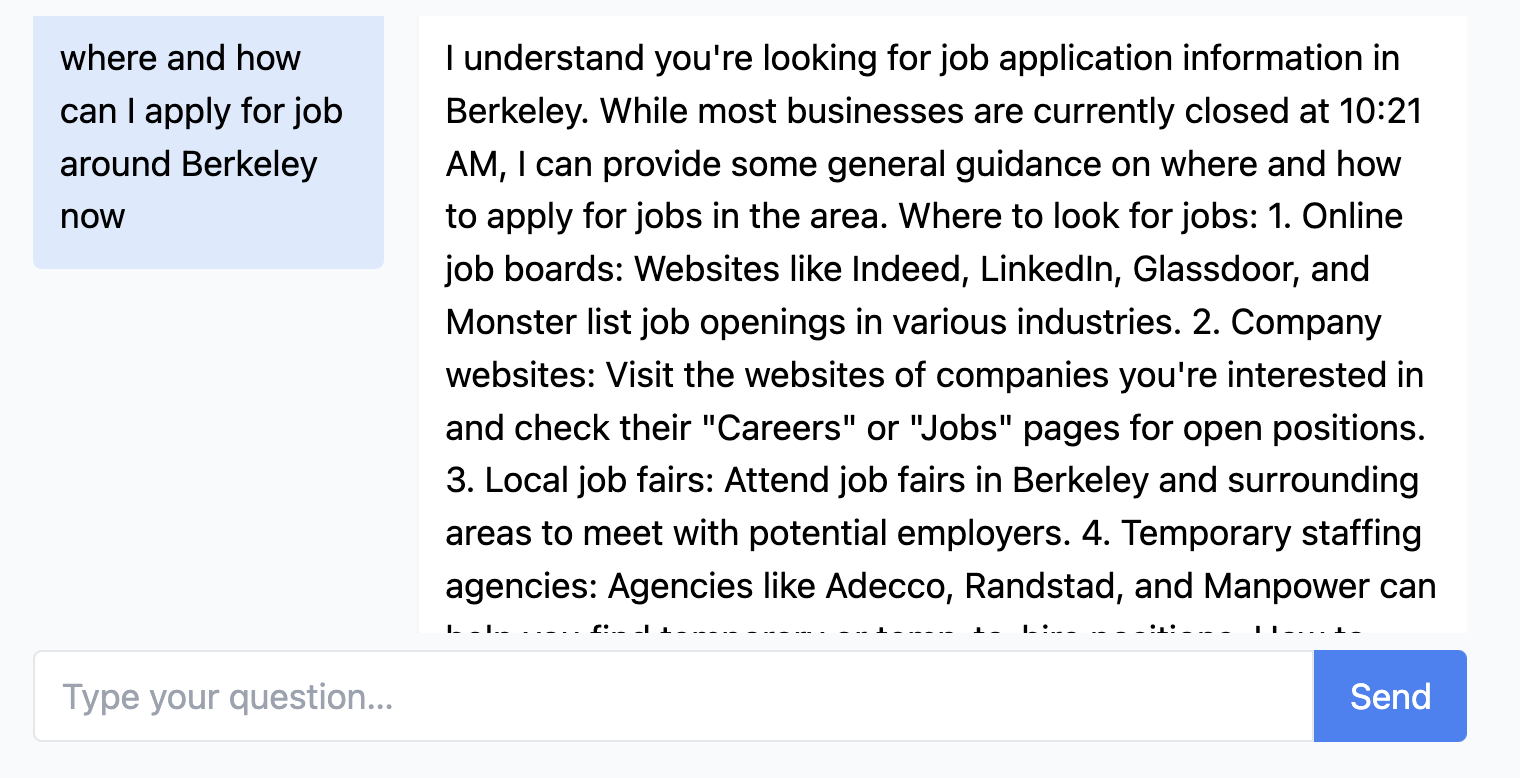
Bridge AI in action: pinpointing nearby food pantries and dishing out real-time guidance and personalized response through our chatbot.
-
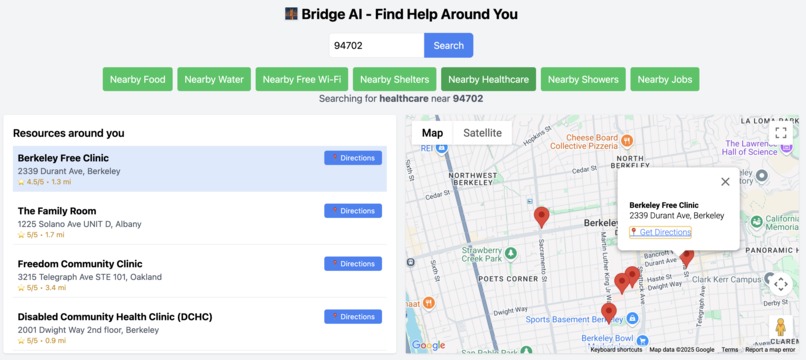
Bridge AI displays clear map pins for each service and lets you open Google Maps directions instantly (double-click a pin to launch).
-
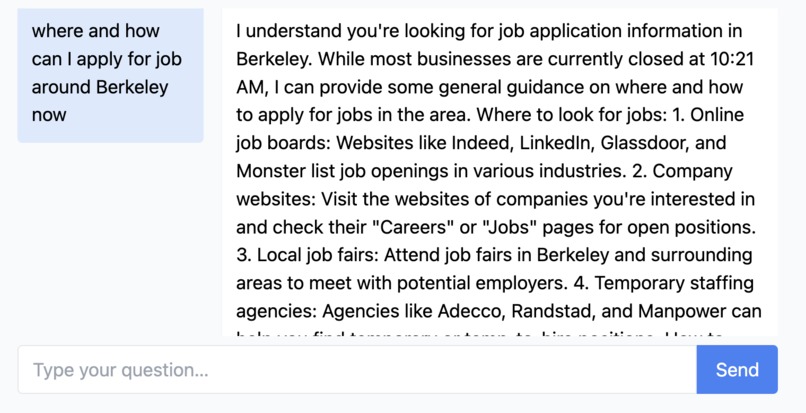
Bridge AI chatbot follows up on your unique needs—leveraging live information and data—to deliver personalized guidance in real time.
Inspiration
Over the last half-century, financialization and globalization have fueled unprecedented GDP growth in the U.S. In 2024, U.S. GDP exceeded $28.3 trillion. However, because of financialization, the growth of high-tech industries, and globalization, wealth and income inequality have also widened significantly in the U.S. For instance, according to a UC Berkeley professor, wealth inequality in the U.S. has reached an all-time high (UC Berkeley). At the same time, Pew Research reports that income inequality is now at its highest level since 1928 (Pew Research). According to the Department of Housing and Urban Development’s annual report published in 2024, around 23 out of every 10,000 Americans—771,480 people—experienced homelessness in January 2024, and the total homeless population in the U.S. rose 32.5% from 2022 to 2024 (USAFacts). Currently, the U.S. has recorded 7.2 million unemployed people in May 2025 (U.S. Bureau of Labor Statistics), but only about 2 million claim unemployment insurance (United States Department of Labor).
To alleviate poverty and reduce economic inequality, we have designed Bridge to help homeless and unemployed individuals find shelters, food banks, and employment services—assisting them in reengaging with the U.S. labor force, promoting social productivity, and enhancing societal security.
What It Does
By simply entering their ZIP code, users get easy access to rated resources with distances. There’s also a live AI ChatBot to interact and help consult on personal needs:
ZIP Code Resource Search
Instantly find nearby shelters, food banks, clinics, clothing closets, and more—complete with user ratings and distance from you.Resource Map
Interactive map plotting all free/low-cost services in your neighborhood—select an item in the list to highlight its pin on the map, and click a pin to spotlight its entry. Double-click a pin to open its location in Google Maps.Live AI ChatBot
Chat in real time for personalized guidance and follow-ups, with seamless integration of ZIP-based weather and temperature data to tailor all recommendations.
How We Built It
Anthropic-Powered LLM ChatBot Integration
Fine-tuned large language models (via Claude API) drive our live chatbot for real-time, context-aware resource suggestions and user consultations.React Frontend + Node API
Snappy React + Tailwind UI talks to an Express server that aggregates Google Places and community-sourced data.Google Maps APIs
Geocoding API for converting ZIP code into lat/lng coords. Places API for finding nearby food banks, shelters, clinics, job centers, etc. Maps JavaScript API for rendering a visual map with interactive pins for each resource.Weather-Aware Advice
We hit the OpenWeatherMap API for current weather and temperature by ZIP code—so Claude can tailor its recommendations (“Bring a raincoat!”) to local conditions.Modular AI Agents
Separate brains for resource discovery, recommendation orchestration, and future profile modules—keeps things neat and scalable.
Challenges We Faced
- Keeping LLM outputs consistent meant endless prompt tuning and automated validation pipelines.
- Real-time queries across multiple agents pushed us to optimize caching, batching, and auto-scaling.
- Guarding against bias and protecting vulnerable users required strict safety nets and audit logs.
- Building trust meant partnering with local orgs and iterating the UX based on real feedback.
Accomplishments We’re Proud Of
- Spun up three (Resource Discovery Agent, Recommendation Orchestrator, Profile & Follow-up Agent) specialized and interactive AI agents in just 24 hours.
- Rolled out a slick React UI with a super-simple workflow—“Enter ZIP → Pick need → Search”—so anyone can tap a few buttons to find help instantly.
What We Learned
- AI can dramatically lower the barrier to vital services. By wrapping basic LLM and Google Maps API calls into a seamless AI agent, we make life-saving resources instantly accessible to those who need them most .
- For people with limited internet exposure and experience, we streamlined the flow to “Enter ZIP → Pick need → Go,” paired icons with clear labels, and enlarged tap targets—making the interface more accessible and intuitive.
What’s Next for Bridge AI
- Collaborate with local and federal governments, as well as NGOs and social-welfare organizations, to expand free or low-cost shelters, food, clothing, technical-skills training, and other resources that meet our users’ needs.
- Launch native iOS and Android apps for broader accessibility and offline support.
- Create login features and a database to store user information, chat history, and query history.
- Analyzing our user data to help policymakers design better public and social welfare policies, including Universal Basic Income policies for local governments and the country.
- Expanding services to cover mental health counseling, community colleges, legal-aid referrals, and so on.
Citations:
Coy, Peter. “Wealth Inequality Is the Highest since World War II.” Wealth Inequality Is the Highest Since World War II | Letters & Science, 3 Feb. 2022, ls.berkeley.edu/news/wealth-inequality-highest-world-war-ii.
DeSilver, Drew. “U.S. Income Inequality, on Rise for Decades, Is Now Highest since 1928.” Pew Research Center, Pew Research Center, 5 Dec. 2013, www.pewresearch.org/short-reads/2013/12/05/u-s-income-inequality-on-rise-for-decades-is-now-highest-since-1928/#:~:text=Emmanuel%20Saez%2C%20an%20economics%20professor,levels%20not%20seen%20since%201928.
Kollar, Jessica Semega and Melissa. “Increase in Income Inequality Driven by Real Declines in Income at the Bottom.” Census.Gov, 13 Sept. 2022, www.census.gov/library/stories/2022/09/income-inequality-increased.html.
“Labor Underutilization Measures Ranged from 1.5 Percent to 7.8 Percent in May 2025.” U.S. Bureau of Labor Statistics, U.S. Bureau of Labor Statistics, 17 June 2025, www.bls.gov/opub/ted/2025/labor-underutilization-measures-ranged-from-1-5-percent-to-7-8-percent-in-may-2025.htm.
“UNEMPLOYMENT INSURANCE WEEKLY CLAIMS .” Office of Workforce Security, Employment & Training Administration (ETA) - U.S. Department of Labor, 18 June 2025, oui.doleta.gov/unemploy/archive.asp.
USAFacts Team. “How Many Homeless People Are in the US? What Does the Data Miss?” USAFacts, USAFacts, 28 Feb. 2025, usafacts.org/articles/how-many-homeless-people-are-in-the-us-what-does-the-data-miss/.
Built With
- antropic
- claude-api
- geolocation-api
- github
- google-maps
- javascript
- openai
- react
- weatherapi

Log in or sign up for Devpost to join the conversation.