Inspiration
The motivation for Bridge comes from a simple but stark reality: over a billion people live with a disability, and millions more work in their second or third language. In a fast-paced digital environment like Slack, every screenshot without a description, every jargon-filled announcement, and every rapidly moving thread can quietly exclude a teammate. We wanted to build an agent that ensures "every message is for everyone," making accessibility a native part of the conversation rather than a feature added later.
What it does
Bridge is an AI-powered accessibility agent that automates inclusion through several key features:
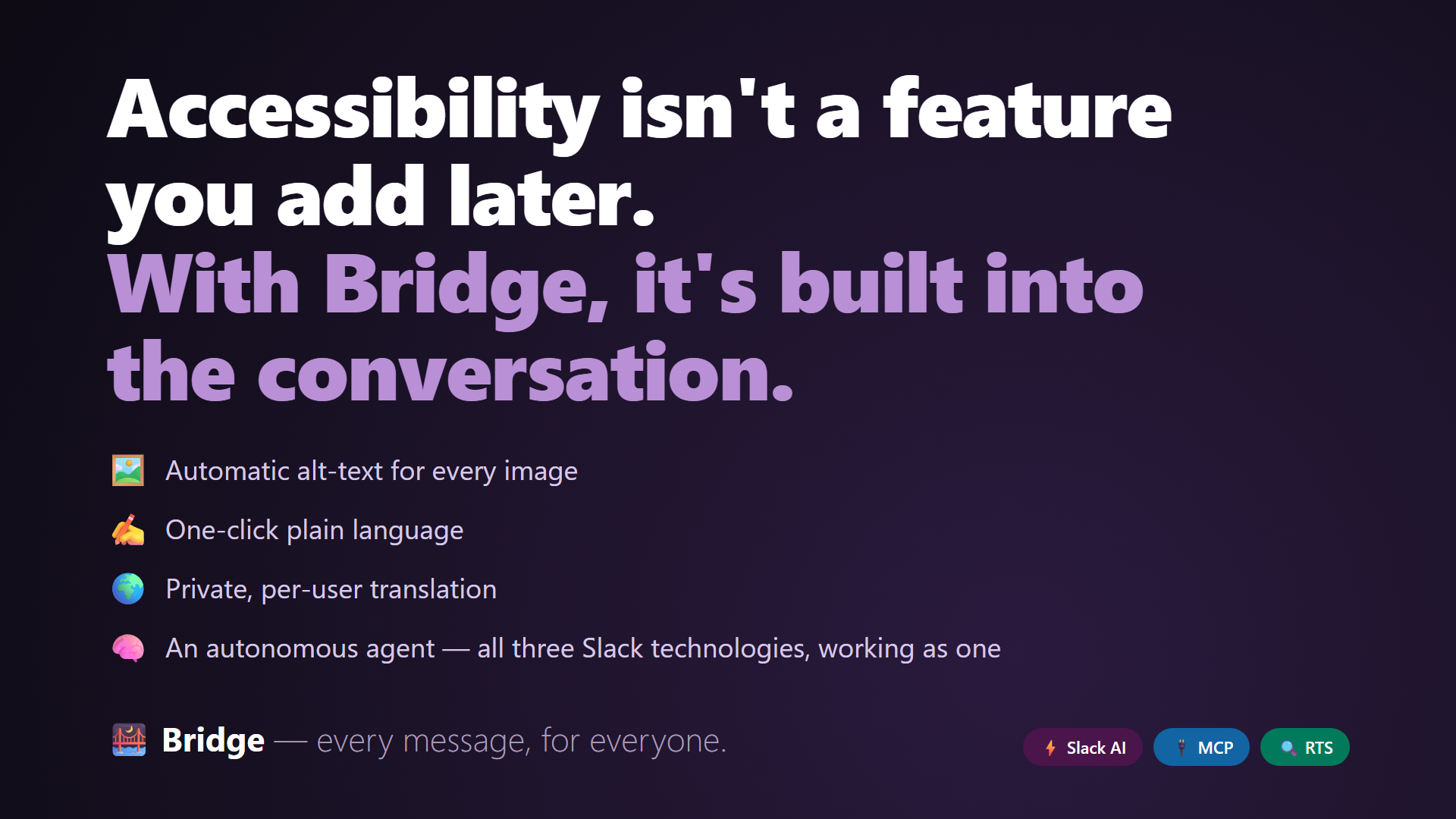
- Automatic Alt-Text: Bridge automatically provides threaded descriptions for images, transcribing error messages, charts, and visual data so blind or low-vision teammates using screen readers aren't left behind.
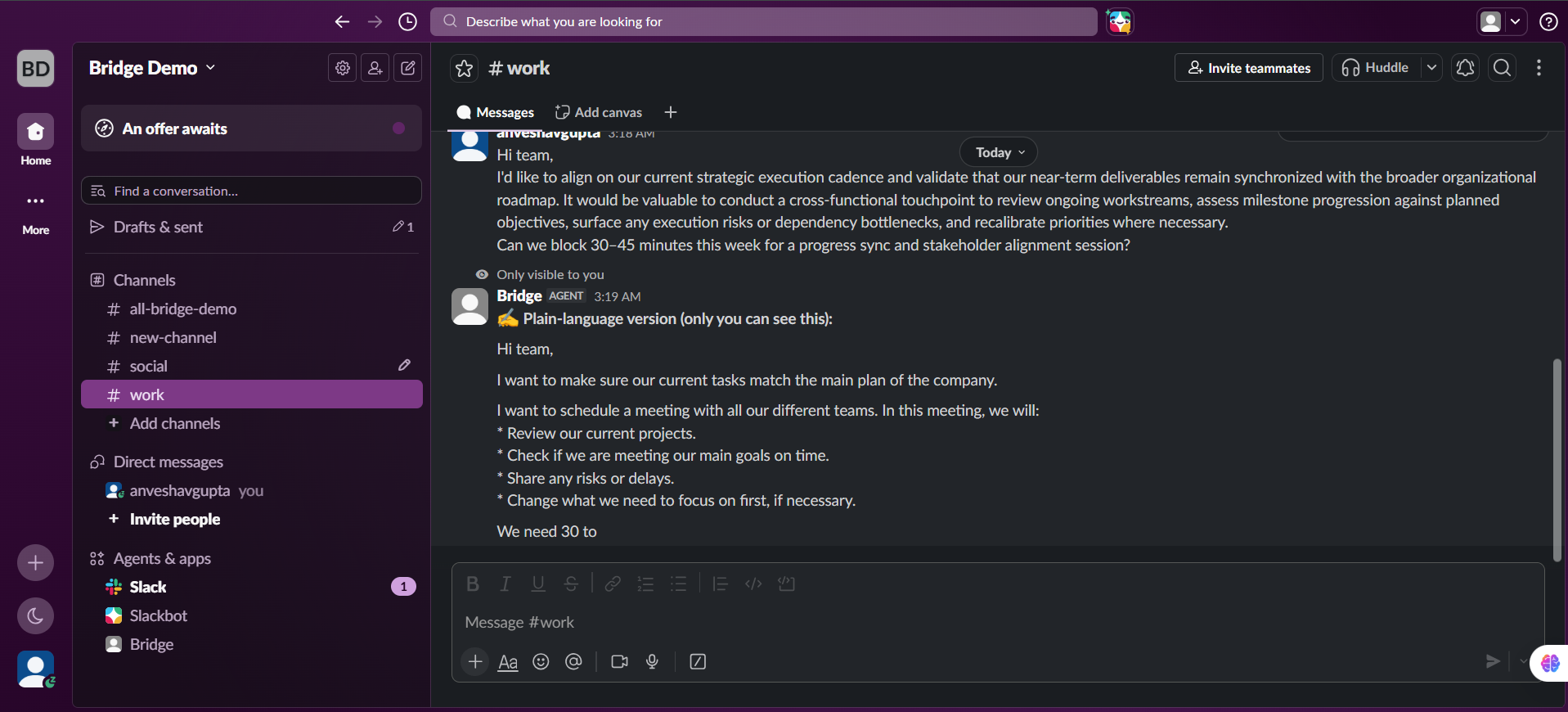
- One-Click Plain Language: For neurodivergent teammates or those working in a second language, Bridge rewrites dense, jargon-heavy messages into clear, actionable plain language.
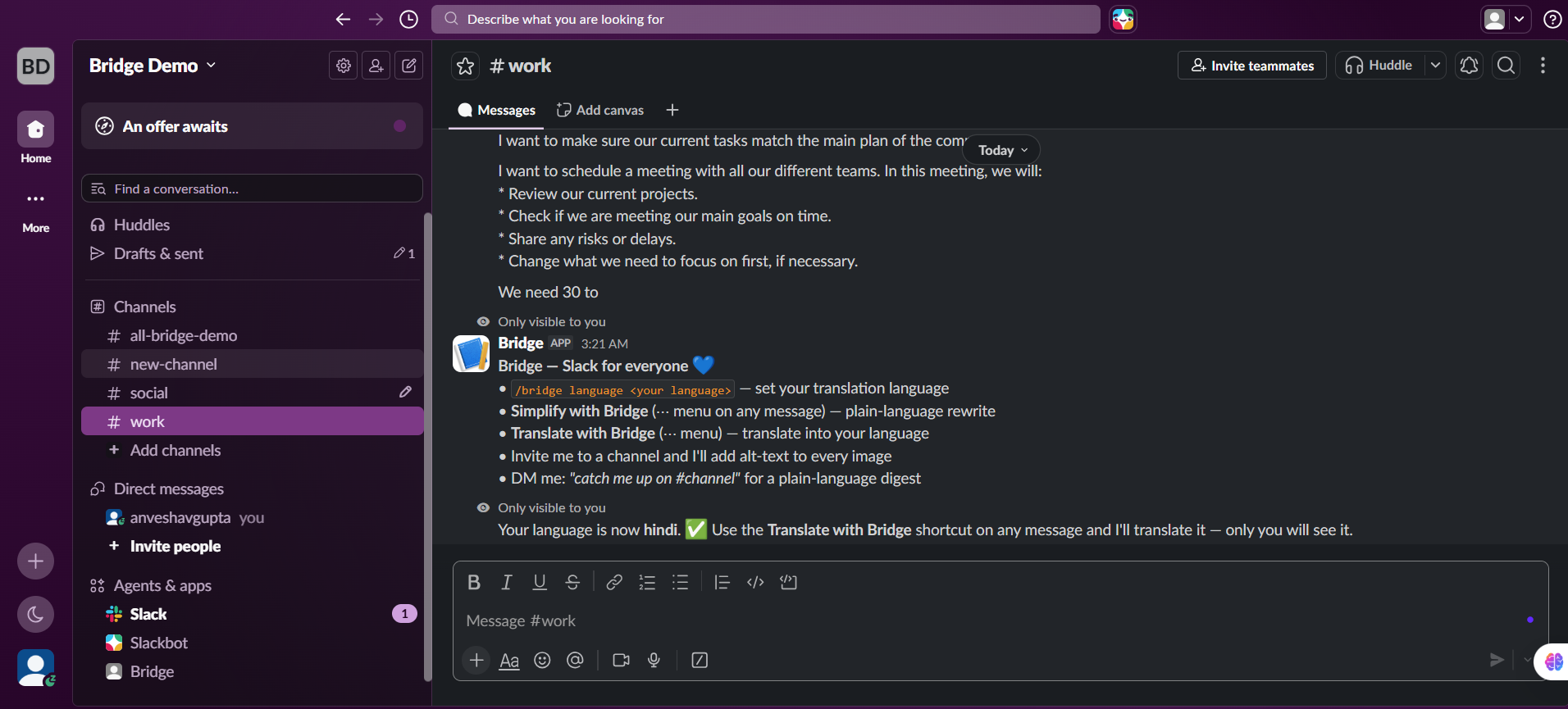
- Translation with Memory: Users can set their preferred language once, and Bridge provides one-click translations while preserving formatting, mentions, and tone.
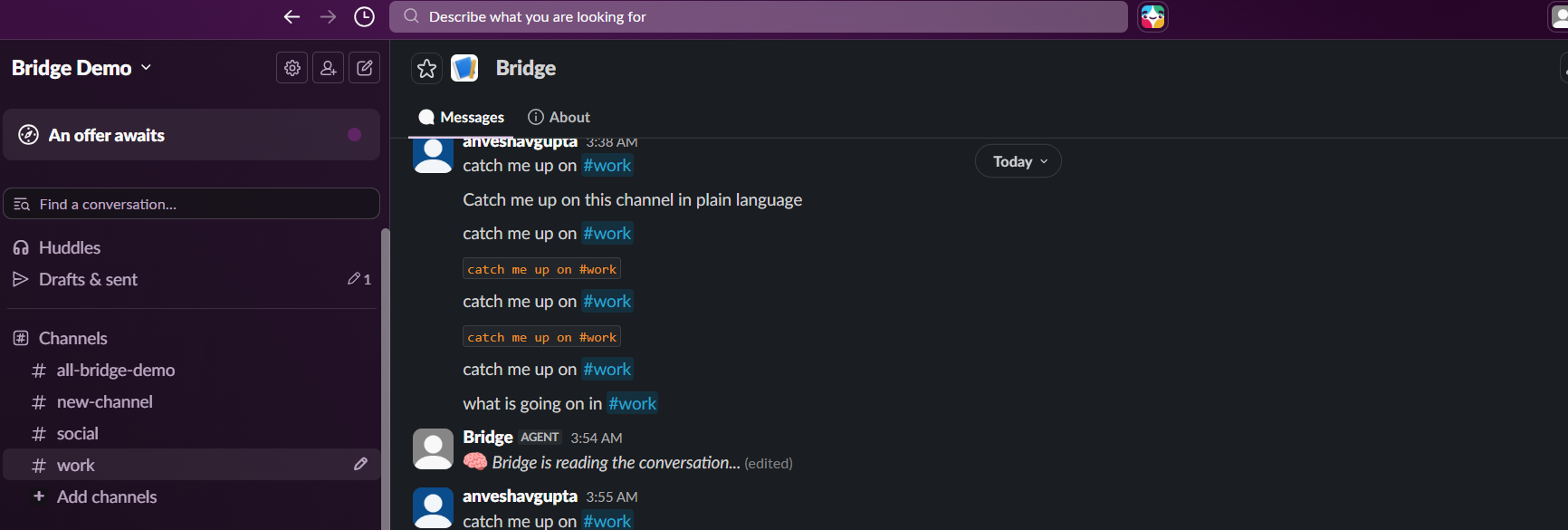
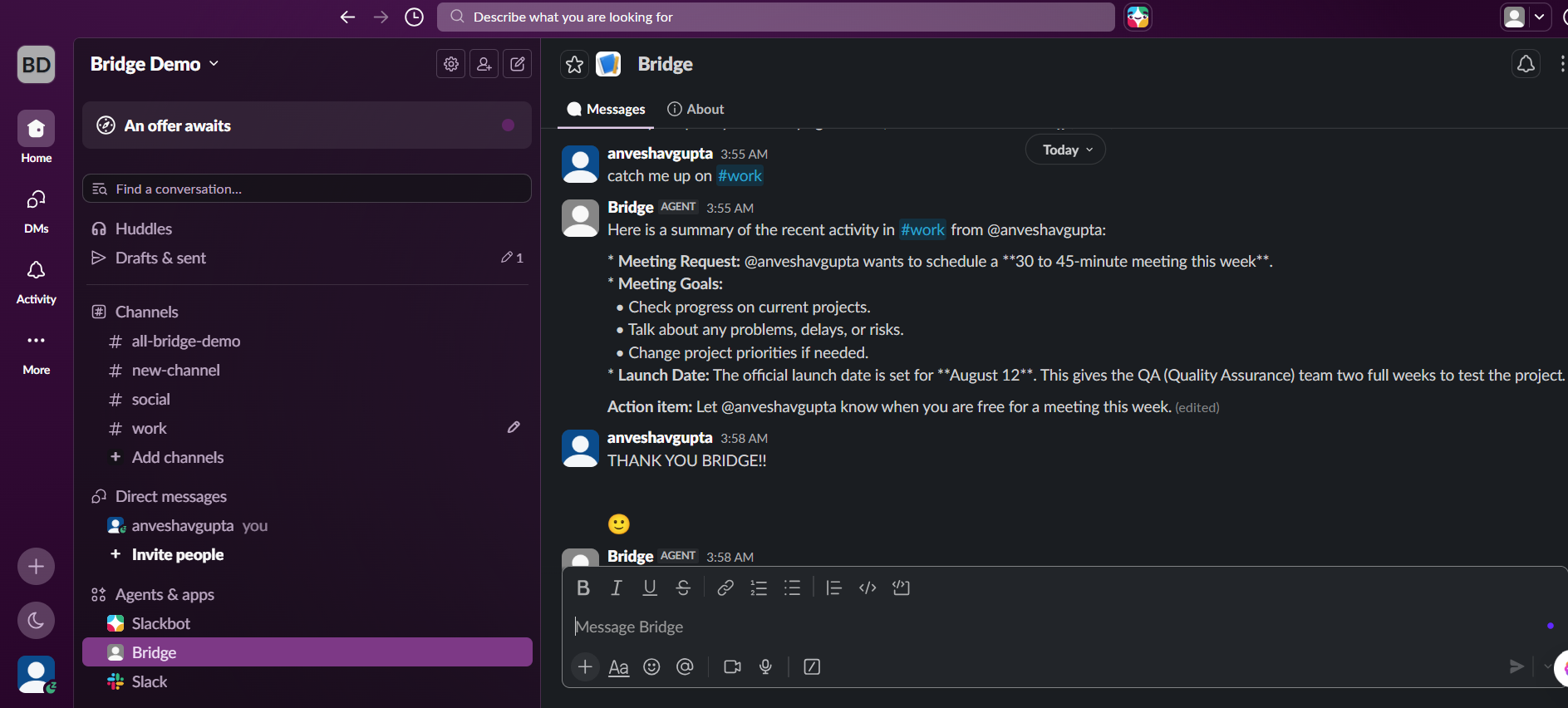
- Autonomous Agent Capability: Users can ask complex questions like "Find where we discussed the launch date and explain it to me simply in Hindi". Bridge then autonomously chains tools—searching the workspace, reading conversations, simplifying content, and translating—to provide a cited answer.
- Privacy by Design: Accommodations like simplifications and translations are ephemeral, meaning only the person who requested them can see them.
How we built it
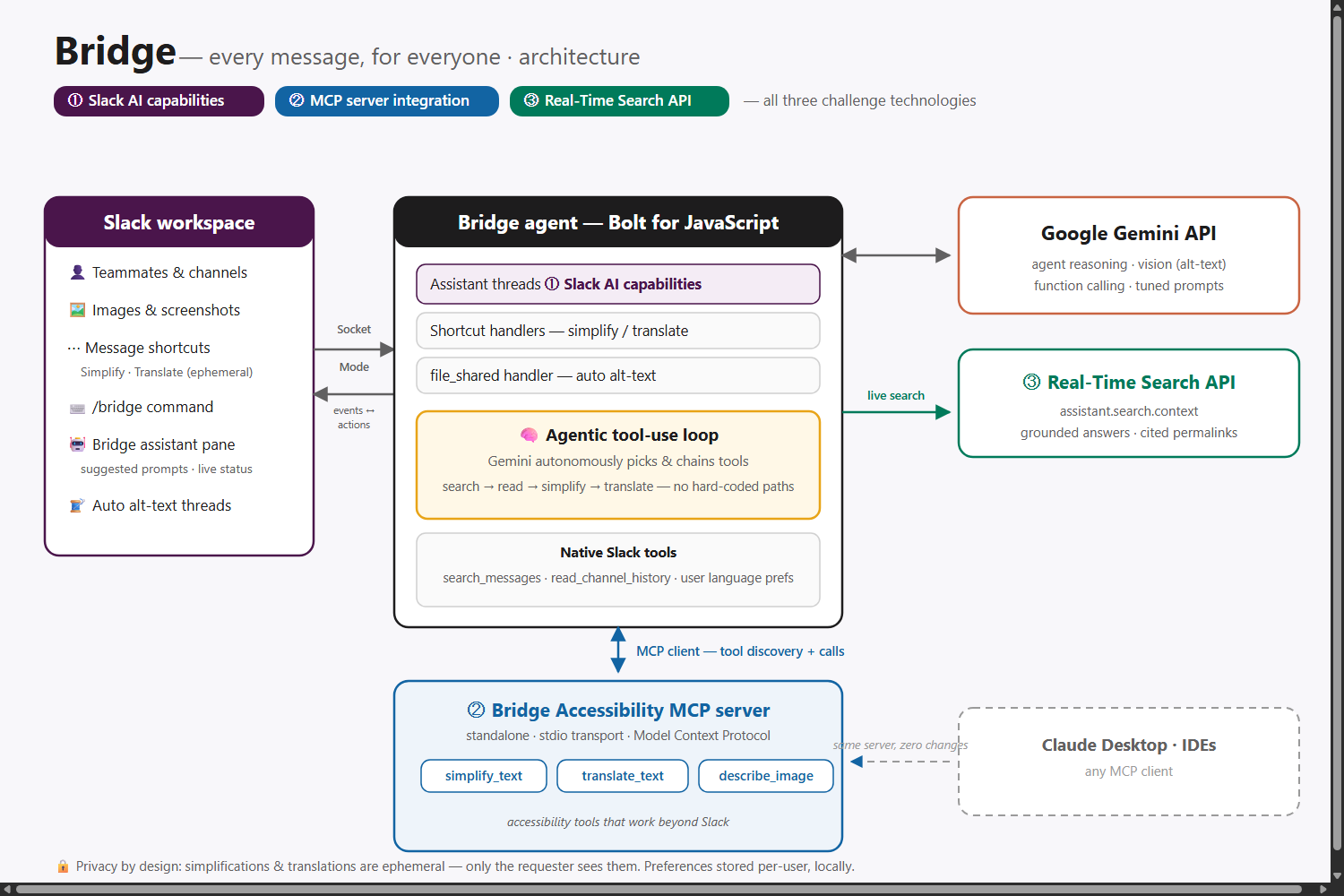
The project was developed using a modern agentic architecture centered around Bolt for JavaScript. The technical stack includes:
- Google Gemini API: Powering the agent's reasoning, vision for alt-text, and function calling.
- Model Context Protocol (MCP): We built a standalone Bridge Accessibility MCP server featuring tools for
simplify_text,translate_text, anddescribe_image. This server is platform-agnostic and can plug into other clients like Claude Desktop unchanged. - Slack AI & Real-Time Search API: Bridge utilizes Slack’s Real-Time Search API to find grounded information across the workspace and integrates with Slack AI capabilities for assistant threads.
- Agentic Tool-Use Loop: Rather than using hard-coded logic, Bridge employs an autonomous loop where it picks and chains tools (e.g., $search \rightarrow read \rightarrow simplify \rightarrow translate$) based on the user's specific request.
Challenges we ran into
Orchestrating the autonomous tool-use loop to handle multi-step requests without losing context or providing ungrounded answers was a significant hurdle. We also had to manage the latency of the agent during complex tasks, which can take 15–30 seconds live. To address this, we implemented real-time status updates (e.g., "is searching the workspace...") to maintain a good user experience. Finally, ensuring privacy by design required careful architecture to keep translations and simplifications visible only to the requester.
Accomplishments that we're proud of
We are proud of successfully integrating three distinct Slack technologies—Slack AI, the Real-Time Search API, and MCP—into a single, cohesive agent. Another major achievement was creating a standalone MCP server; this allows our accessibility tools to function beyond Slack, providing value to users in any MCP-compatible environment.
What we learned
The development process reinforced that accessibility is most effective when it is built into the conversation itself. We also gained deep insights into the power of standardized protocols like MCP, which allow for "tool discovery" where an AI can autonomously determine which accessibility utility to use without being explicitly told each step by the developer.
What's next for Bridge
The next steps involve expanding the Bridge Accessibility MCP server with more specialized tools, such as audio-to-text for voice clips and more advanced visual analysis for complex diagrams. Because the core accessibility tools are standalone, we also aim to bring Bridge's capabilities to other enterprise platforms, continuing our mission to make every message accessible to everyone.
Built With
- api
- gemini
- javascript
- mcp
- vision

Log in or sign up for Devpost to join the conversation.