-
-
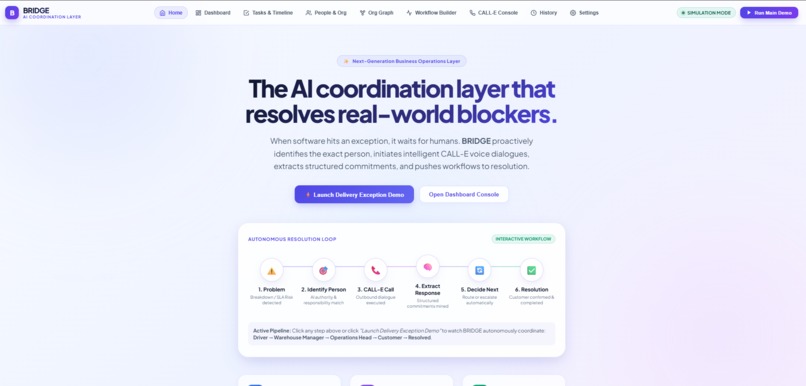
the dashboard
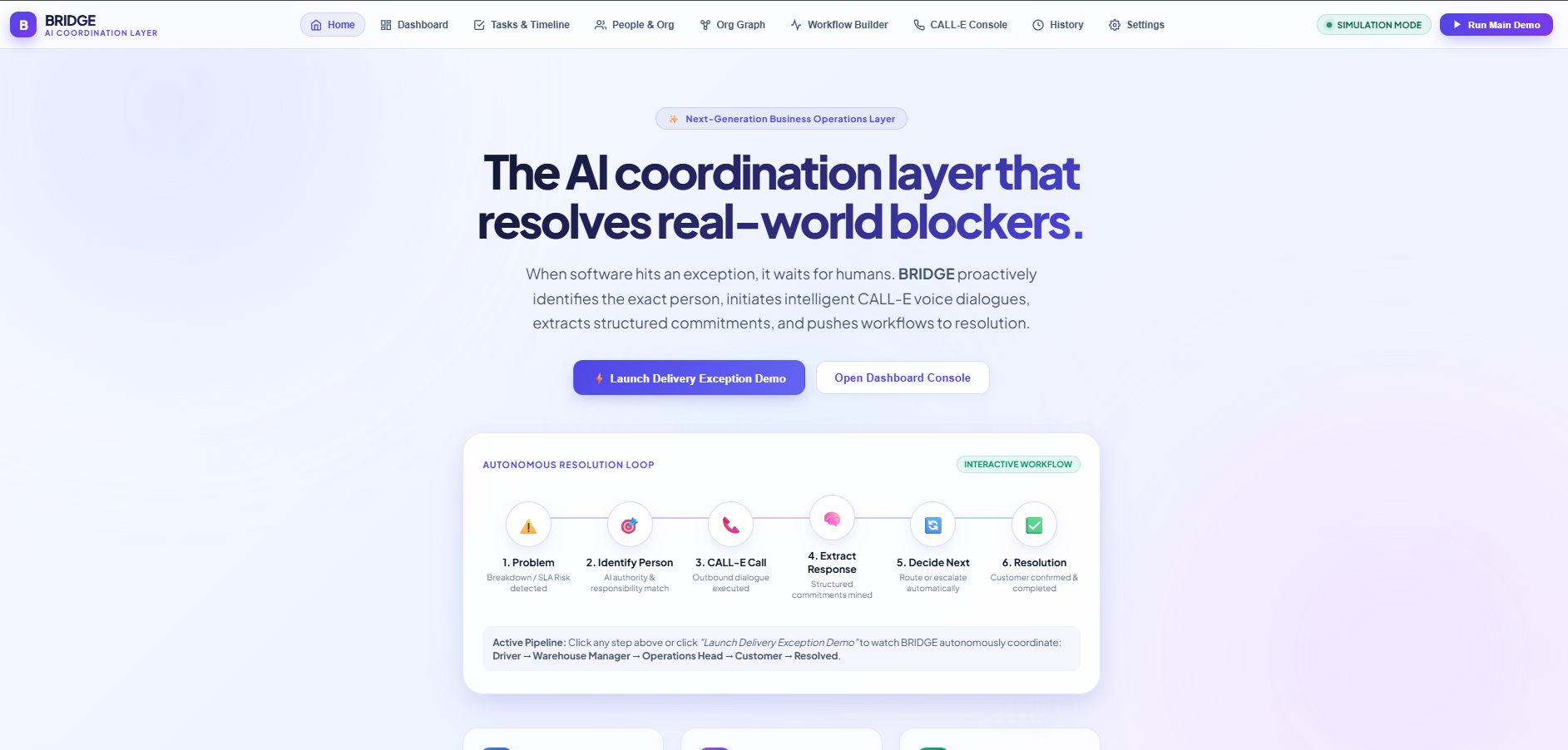
About the Project
The Problem
In many businesses, solving an operational problem does not require more software—it requires the right person to be contacted at the right time.
A delayed delivery, unavailable vehicle, supplier issue, field-service failure, or approval request can trigger a chain of phone calls between drivers, managers, operations teams, customers, and other stakeholders. Humans spend significant time figuring out who to call, what to ask, and who needs to be contacted next.
We wanted to solve that coordination gap.
Our Inspiration
We were inspired by a simple observation:
AI can answer questions, but businesses often need AI to coordinate people.
Instead of building another AI voice agent that simply calls a person and reports the conversation, we wanted to build a system that understands the business context around the call.
That led to BRIDGE — the AI coordination layer for business.
What is BRIDGE?
BRIDGE takes a business problem and turns it into a dynamic coordination workflow:
Problem → Right Person → CALL-E Conversation → Structured Result → Next Decision → Next Person → Resolution
For example, consider a delayed delivery:
Driver → Warehouse Manager → Operations Head → Customer → Resolved
BRIDGE understands the responsibility and decision authority of each person, determines who should be contacted next, uses CALL-E to handle the voice conversation, extracts the useful information, and uses that information to determine the next step.
The key idea is that every conversation changes the state of the business workflow.
How We Built It
We built BRIDGE as a modular web application consisting of:
- Organization Graph — represents people, roles, responsibilities, relationships, and authority.
- Task Engine — converts business problems into trackable workflows.
- Decision Engine — determines who should be contacted based on the current information need.
- Orchestrator — controls the sequence of actions and determines the next step.
- CALL-E Integration — provides the voice communication layer.
- Result Processing — converts call outcomes into structured information that the workflow can use.
- Simulation Mode — allows the complete workflow to be demonstrated without making real phone calls.
- Human Escalation — allows BRIDGE to hand situations back to a human instead of blindly continuing.
We also designed the system so that the coordination logic is separated from the phone-call provider. This makes the core workflow reusable across different business scenarios.
What We Learned
The biggest lesson was that making an AI phone call is not the hard part.
The harder problem is deciding:
- Who actually has the answer?
- Why should this person be contacted?
- What information should we ask for?
- Does their response change the workflow?
- Who has the authority to make the next decision?
- When should the system stop calling?
This shifted our thinking from building an AI caller to building an AI coordinator.
We also learned how important structured state is for multi-step agentic workflows. A conversation should not simply produce a transcript—it should produce an actionable result that can drive the next decision.
Challenges We Faced
One of our biggest challenges was designing a workflow that could make multiple decisions without becoming unpredictable.
We had to carefully separate:
Context → Decision → Action → Result → Next Decision
We also had to handle situations such as unavailable people, failed calls, approval limits, incomplete information, and escalation.
Another challenge was making the system safe to demonstrate. Real phone calls have real-world consequences, so we implemented Simulation Mode and designed Live Mode to require explicit confirmation before executing calls.
Why BRIDGE Is Different
Most voice-agent systems focus on:
“What should the AI say?”
BRIDGE focuses on:
“Who should we talk to, why, what did we learn, and what should happen next?”
CALL-E gives BRIDGE the voice.
BRIDGE provides the context, coordination, and decision-making layer around that voice.
Our goal is to turn fragmented business phone calls into a single intelligent resolution workflow.
Built With
- agentic
- agents
- ai
- api
- automation
- call-e
- express.js
- github
- javascript
- llm
- mode
- node.js
- react
- rest
- simulation
- typescript
- voice
- workflow

Log in or sign up for Devpost to join the conversation.