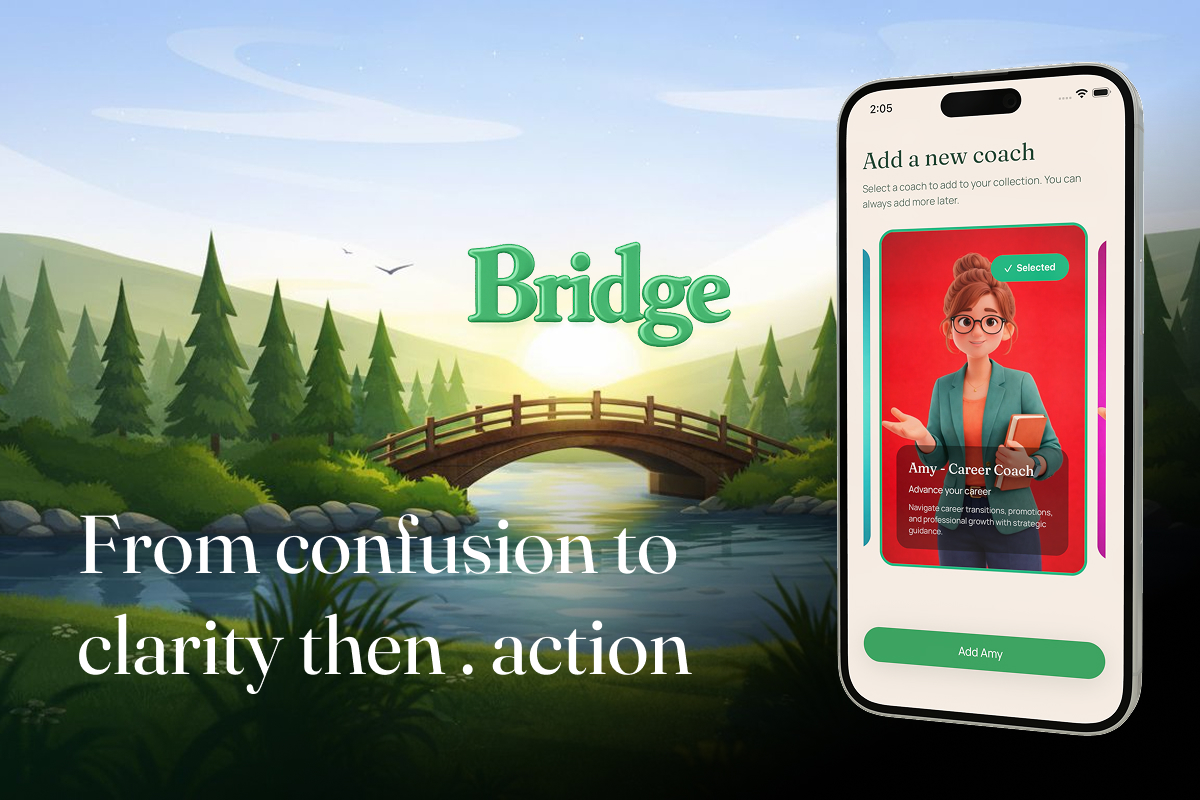
Inspiration
Bridge was inspired by a personal struggle with procrastination and feeling stuck despite having access to powerful AI tools like ChatGPT, Grok, Claude. While tools like ChatGPT were helpful for quick answers, they failed at long-term support, they lack personality, no long term memory continuity, no accountability, and conversations that eventually lost context. I wanted something closer to a real coach—someone who remembers past conversations, understands patterns, checks in regularly, and helps translate intent into action. This led to the idea of using LLMs not as a single all-knowing assistant, but as multiple specialized AI coaches, each focused on a specific area of life such as business, fitness, career, decisions, or relationships.
What it does
Bridge is a one-stop AI coaching app designed to help users be more productive and grow in life.
Users can:
- Choose from default coaches (business, fitness, career, decision-making, relationship)
- Create fully custom coaches with unique personalities (coming in next version curently WIP)
- Receive clear summaries and actionable next steps via action cards
- Get scheduled check-ins at user-defined times
- Receive push notifications tied to committed actions
- Build long-term progress through coaches that remember past interactions
Each coach feels human, takes accountability seriously, and adapts over time using smart memory engine built as backend for Bridge, helping users move from now to next.
How we built it
Bridge is built using an agentic AI framework where each coach is an independent AI agent with:
- Its own personality (system prompts)
- Long-term, structured memory
- Tooling to query and reason over past user data
- A lightweight accountability loop (check-ins, reminders, follow-ups)
Initially, the system started with basic AI API calls. Over time, I evolved it into a more structured agent-based design. The current implementation uses the Anthropic SDK, with plans to migrate to Mastra for more robust agent orchestration.
A key architectural decision was to avoid prompt bloat. Instead of injecting all historical data into every prompt, Bridge selectively retrieves only the most relevant memory needed for each response.
I researched and experimented with multiple frameworks, including LangGraph, LangChain, CrewAI, and OpenClaw, before settling on a simpler, more controllable approach.
Challenges we ran into
Memory management: Designing a system that remembers enough to be useful without overwhelming the model with unnecessary context. Agentic loops: Falling into a research rabbit hole while experimenting with complex agent frameworks before realizing simplicity worked better. UI complexity: Early versions had too many buttons and toggles. Removing features, not adding them was necessary to create a calm, personal experience.
Accomplishments that we're proud of
- Building AI coaches that genuinely feel personal and human
- Creating a memory system that improves response quality over time
- Designing an accountability-driven experience instead of a chat-only interface
- Using Bridge personally and seeing real behavioral improvement
What we learned
- Memory matters more than models, A well-designed memory system often beats switching to a “better” LLM.
- Accountability beats advice, Users don’t need more answers, they need follow-through.
- Less UI is more clarity: Removing clutter dramatically improves usability.
What's next for Bridge: AI coaches that helps you cross from now to next
Next, Bridge will focus on:
- More advanced memory retrieval and personalization
- Smarter accountability loops and progress tracking
- A marketplace for shareable, user-created coaches
- Deeper integrations for fitness, work, and planning workflows
- Continued refinement of coach personalities and behavior
The goal remains the same: help people close the gap between intention and action, one coach, one step at a time.
Built With
- firebase
- reactnative
- revenuecat
- tailwind
- typescript

Log in or sign up for Devpost to join the conversation.